The Age of Decoupling Has Arrived: Bitcoin is No Longer the Sole Compass of Crypto

marsbitPublished on 2026-06-01Last updated on 2026-06-01

Abstract

The era of the cryptocurrency market moving in lockstep with Bitcoin is ending, as the industry splits into two distinct asset categories: endogenous and exogenous. Endogenous assets, like Bitcoin, derive value purely from the crypto market's cycles. Their narratives swing between being "interstellar money" in bull markets and "digital collectibles" in bear markets. Exogenous assets, however, are nominally crypto but operate with independent value drivers. Examples include: * **Venice:** An AI inference service using tokens for payments; its consumer-AI business model is decoupled from crypto price swings. * **Figure:** A fintech lender using blockchain to speed up loan approvals; its core value is in credit, not crypto. * **Stablecoin firms like BVNK:** Acquired by traditional finance giants (Mastercard, Stripe), their growth is tied to payment infrastructure, not market cycles. Hybrid projects like **Hyperliquid** (a decentralized exchange) show a shift, with a growing share of non-crypto trading (e.g., prediction markets). This divergence is fundamental. Endogenous assets remain highly correlated to Bitcoin, similar to gold miners to gold. Exogenous assets are evolving to have their own fundamentals, like the weak correlation between gold and the S&P 500. This changes investment analysis. Evaluating exogenous assets requires traditional fundamental research—assessing user bases, unit economics, and moats—more akin to fintech investing than charting Bitcoin. Pro...

Original Author: Charlie

Original Compilation: Luffy, Foresight News

For a long time, the entire cryptocurrency market's movements revolved around Bitcoin. Now, that era is coming to an end.

The crypto economy is now diverging into two major camps: endogenous assets and exogenous assets.

So-called endogenous assets refer to the familiar traditional crypto categories: the value of these tokens and projects is entirely dependent on the overall rise and fall of the crypto asset market. Exogenous assets, on the other hand, nominally belong to the crypto track, but their value trends are increasingly independent of the crypto market.
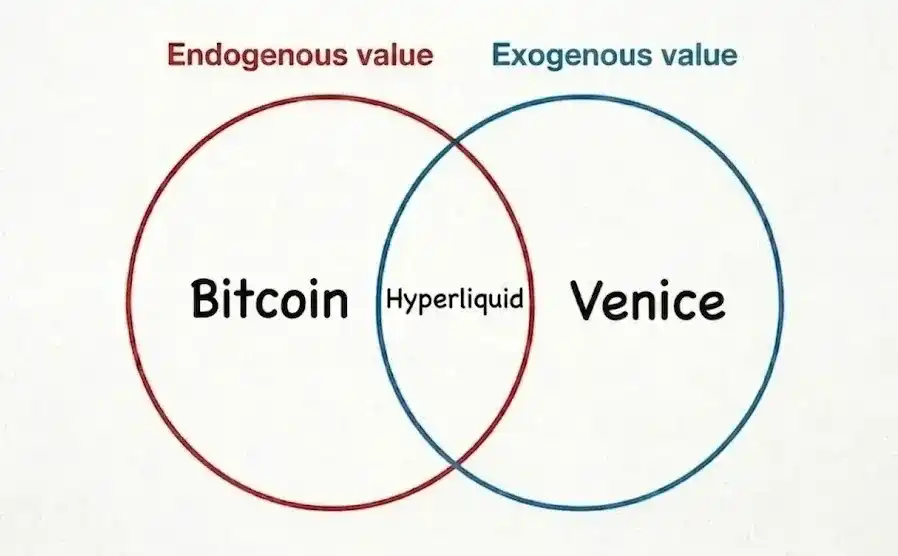
Bitcoin's value stems from its own properties, which in turn are reflected in its price. Price increases further reinforce market perception of its value attributes. At the peak of a bull market, Bitcoin is hailed as "interstellar currency," the scarcest digital circulating asset in human hands; at the trough of a bear market, it is dismissed as a digital collectible with no cash flow support.

Hyperliquid sits between the two camps. Most of its business still relies on crypto market conditions, but both supply and demand sides are continuously expanding. Many on-chain financial infrastructures fall into this category, with underlying assets gradually shifting towards tokenized real-world assets.
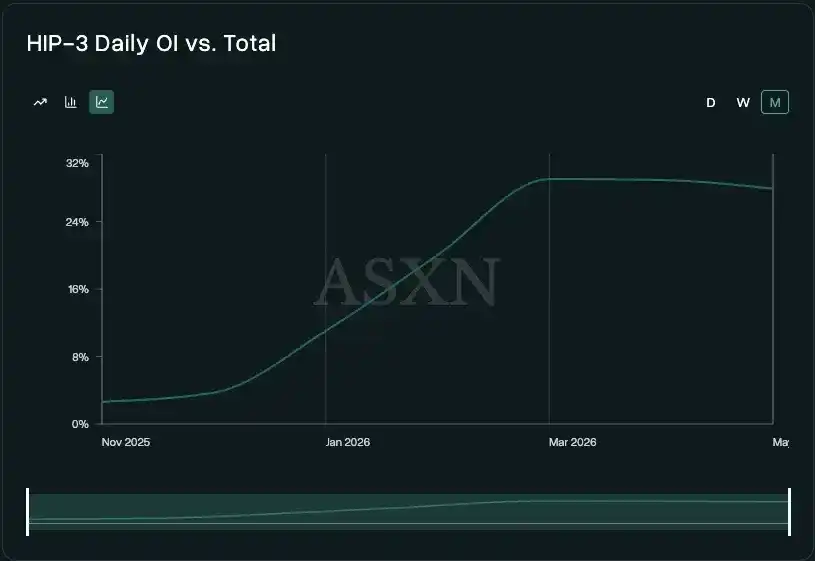
HIP-3 open interest volume can roughly reflect the activity of non-crypto transactions. Currently, HIP-3 contracts account for about 30% of Hyperliquid's total open interest, compared to just 4% in November 2025. The upcoming HIP-4 prediction market will further drive growth, bringing new trading users and trading pairs.

Projects like Venice belong entirely to the exogenous camp, with their development logic completely detached from the crypto market. Although there is some overlap in user bases, its business model leans more towards consumer-grade AI rather than native crypto products like Uniswap. Uniswap's core business remains users trading various endogenous assets, so its performance naturally fluctuates with asset prices; Venice packages private multimodal inference services, adopting a "pay-per-use + subscription" revenue model.

Venice's only connection to the crypto field is its choice of tokens as a value carrier, and some of its compute suppliers have crypto industry backgrounds. Project lead Erik Voorhees, a veteran in the crypto industry, believes that tokens, when used properly, can be an excellent marketing tool.

Figure, among listed companies, is also a typical case. This fintech lending company developed its own blockchain, reducing the approval time for home equity loans to under 5 minutes. For it, blockchain is just a supporting technology; its core value lies in the lending business itself.

The large-scale rise of the exogenous track, whether in the token market or the listed company sector, holds profound significance. In the past, as most business models were deeply tied to crypto asset prices, purely bottom-up fundamental investing was difficult to implement. The crypto industry has seen narratives emphasizing "blockchain over Bitcoin" before, but previous waves ultimately reverted to Bitcoin's performance. The reason was that these tracks never formed stable demand or generated sustainable revenue; even with income, it couldn't be transmitted to token value. Once token prices stopped rising, projects lost their support.

This market cycle is fundamentally different from the past. Now we can clearly see paying user groups and payment logic; the market demand for most tracks is quantifiable, no longer driven solely by sentiment hype. Meanwhile, the mechanism of tokens as value carriers is also continuously improving. Venice's revenue comes from real payments by users purchasing AI inference services; even if the overall crypto market declines, its business won't be significantly impacted because it doesn't rely on coin price movements. This cycle possesses two core advantages that previous waves lacked: sustainable actual usage demand, and investors starting to invest based on fundamentals rather than mere market narratives.

The stablecoin track in the private market is similar. In March 2026, Mastercard announced it would acquire BVNK for up to $1.8 billion. This company's valuation was only $750 million during its Series B round 15 months prior. Another stablecoin-related company, Bridge, was acquired by Stripe for $1.1 billion in February 2025. According to Stripe's annual report, Bridge's current business growth rate is fourfold annually. The development of these companies is entirely decoupled from the crypto industry's bull-bear cycles.

This is not to say endogenous assets are bearish. Just as gold and even small gold mining companies always have a place in an investment portfolio, Bitcoin and a host of endogenous crypto assets also have their raison d'être. However, the performance drivers and market correlations of the two asset classes have fundamentally diverged, and the data confirms this.
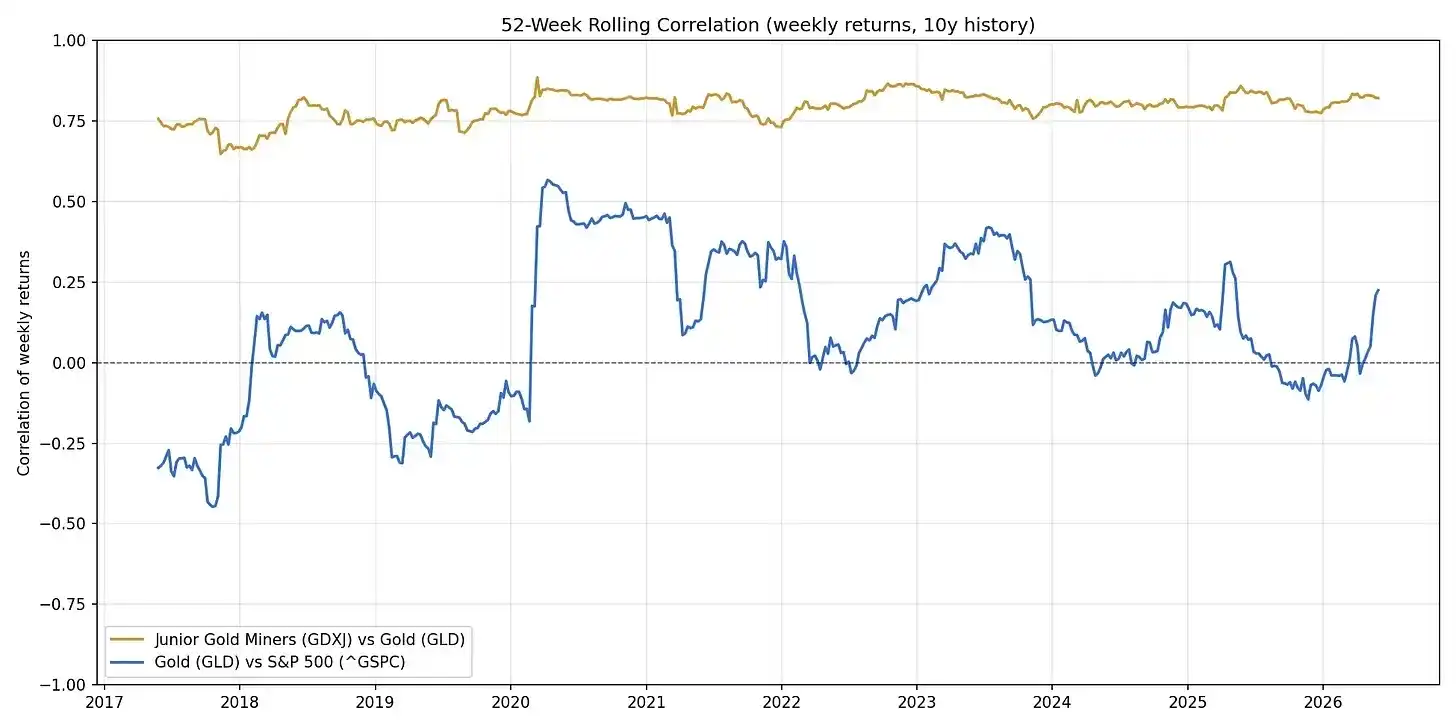
This analogy can be visualized: The correlation coefficient between small gold mining stocks and gold prices has long remained around 0.75. This is precisely the current state of the traditional crypto market — a host of crypto assets act like small gold mines, with Bitcoin corresponding to gold; the entire sector is essentially leveraged investments benchmarked against Bitcoin. The blue curve in the chart represents another relationship: gold and the S&P 500 index may show weak linkage due to macroeconomic influences, but each follows its own independent logic. This is precisely the future direction for exogenous assets. Long-term, these assets will gradually decouple from "following Bitcoin's rise and fall."
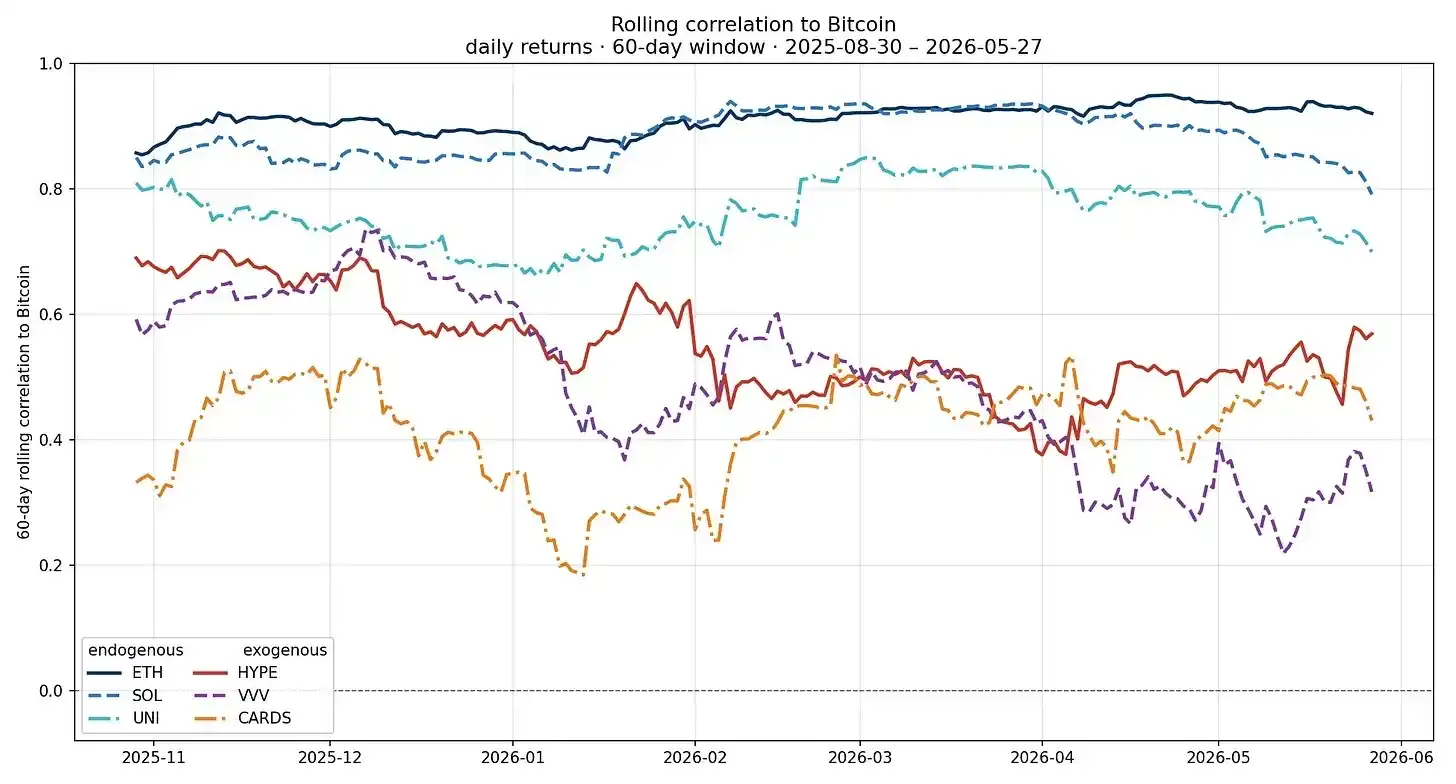
It should be noted that many exogenous projects themselves also issue tokens. This phenomenon both confirms the above trend and represents a special case.

Currently, the vast majority of endogenous assets still move highly in sync with Bitcoin; a few exogenous assets show reduced correlation, but due to their short development cycles, they are not yet strongly indicative. Industry patterns have always been that fundamentals lead, followed by changes in market correlations.

This change has also completely rewritten industry analysis logic. Researching exogenous assets requires fundamental due diligence like analyzing traditional companies: identifying paying user groups, calculating unit economics, and assessing industry moats. Bitcoin price is no longer the primary reference indicator. Analyzing such projects is more akin to fintech investors making judgments, with the added complication of asset custody.

The following are currently promising exogenous tracks:

  • On-chain exchanges and brokerage services
  • Settlement and redemption solutions for long-tail asset tokenization
  • Deep integration of crypto + AI (private inference, distributed open-source model training like Nous Research's Psyche, etc.)
  • Neo-banks (Payy and Raycash, focusing on privacy protection, are worth watching; Aztec and Zama, providing programmable privacy infrastructure for them, also have potential)
  • Lending sector (Morpho has become a mainstream choice for institutional repo markets; smaller projects like Valinor, 3jane specialize in private credit niches)
  • Stablecoin issuers, real-world asset tokenization service providers
  • Payment rails (Stripe and Tempo are benchmarks in general payments; Coinbase currently leads in agent payments)
  • Non-financial crypto consumer products (represented by Venice, Collector Crypt. These projects imbue tokens with real business value, driving product adoption and enabling marketing)
  • Agent economy (The core opportunity lies in the access layer's agents, service providers, and creator ecosystems, which have lower substitutability. Cloudflare is ahead in deployment, but whether it will charge for traffic or merely provide basic services remains unclear)

At this stage, investing in equity of related companies remains the safest way to gain exposure to the above tracks; high-quality token investments are the exception. The role of tokens will only increase as their value-carrying mechanisms are continuously optimized, requiring joint efforts from regulators and the entire industry. Progress is being made: on the regulatory front, the CLARITY Act is advancing steadily; on the industry front, institutions like Blockworks are promoting market transparency. Token mechanisms still have a long way to go.

But none of these details change a core trend: the driving force of the crypto market is shifting from a single factor to multiple factors. The focus of industry research is also shifting from interpreting Bitcoin price charts to delving into company fundamentals. In the next decade, there will be no need to wonder why the "crypto market" no longer rises and falls in unison, because the industry landscape has been completely transformed.


Related Questions

QWhat are the two main categories of assets in the crypto economy according to the article?

AAccording to the article, the crypto economy is now divided into two main categories: endogenous assets and exogenous assets. Endogenous assets are traditional crypto categories whose value is completely dependent on the overall crypto market movements. Exogenous assets are those that only nominally belong to the crypto sector, as their value trajectory is increasingly independent of the crypto market.

QHow is the new cycle of the crypto market fundamentally different from previous ones, based on the author's description?

AThe author states that the current cycle is fundamentally different because it possesses two core advantages that previous cycles lacked: sustainable, real-world usage demand for the services, and investors who are starting to base their decisions on project fundamentals rather than purely on market narratives.

QWhat is the primary driver for the business model of the project Venice, as mentioned in the article?

AVenice's business model is driven by the consumer AI sector rather than being a native crypto product like Uniswap. Its core business involves packaging private multimodal inference services and adopting a 'pay-per-use + subscription' fee model. Its only connection to crypto is using tokens as a value-carrying vehicle.

QHow does the article use the relationship between gold, small gold mining stocks, and the S&P 500 to explain the changing market dynamics?

AThe article uses an analogy: small gold mining stocks have a high correlation (~0.75) with gold prices, similar to how most endogenous crypto assets follow Bitcoin's price movements. In contrast, gold and the S&P 500 index, while weakly linked by macroeconomics, have largely independent operating logics. This illustrates the future path for exogenous assets, which will gradually decouple from simply following Bitcoin's price movements.

QWhat fundamental shift in analysis logic does the emergence of exogenous assets require, according to the conclusion of the article?

AThe emergence of exogenous assets requires a fundamental shift in analysis logic from interpreting Bitcoin price charts to conducting in-depth fundamental research on companies/projects. Analyzing exogenous assets involves due diligence similar to traditional companies: examining paying user bases, calculating unit economics, and evaluating industry moats, with Bitcoin price no longer being the primary reference indicator.

Related Reads

Can DeepSeek Save China One Trillion Dollars?

"DeepSeek and the $1 Trillion Infrastructure Question" The article examines whether DeepSeek's AI optimization breakthroughs could potentially save China $1 trillion in future AI infrastructure costs. The analysis begins with Nvidia's upcoming Vera Rubin AI platform, costing ~$7.8 million, where memory (HBM4/LPDDR5X) constitutes $2 million—a 435% cost increase in one year, highlighting how AI hardware spending is shifting toward expensive memory components. DeepSeek's approach works in the opposite direction. Through three key technical innovations showcased in DeepSeek V4, the company dramatically improves hardware efficiency: 1. **Memory Compression (MLA)**: Re-engineers the attention mechanism to compress long-context memory (KV Cache) by over 90%, drastically reducing expensive HBM usage. 2. **Selective Activation (MoE)**: Employs Mixture-of-Experts architecture where only a small fraction of parameters (e.g., 49B out of 1.6T in V4-Pro) are activated per token, allowing most parameters to reside in cheaper memory/SSD. 3. **Computation Caching**: Reuses previously computed results via cache hits, replacing expensive GPU computations with cheap memory reads. Combined, these optimizations allow the same hardware to produce approximately 4x more tokens, effectively reducing required hardware investment by 75%. DeepSeek's pricing reflects this: a 10-billion token workload costs ~$522 monthly versus ~$9,000-$10,000 for competitors. The $1 trillion savings projection stems from McKinsey's estimate that global AI infrastructure will require ~$5.2 trillion investment by 2030. As China's daily token consumption grows toward quadrillions, even marginal efficiency gains scale massively. With a conservative 4x throughput improvement, China could avoid building tens of thousands of AI data centers equivalent to ~7 trillion RMB ($1 trillion) in saved investment. Critically, this strategy shifts dependency from scarce, expensive GPU/HBM—where China lags—toward more accessible storage, caching, and systems engineering where domestic suppliers like CXMT are gaining strength. Rather than "replacing Nvidia," DeepSeek rebalances AI's value chain away from monolithic hardware dependency. Ultimately, DeepSeek's technical breakthroughs could lower the barrier to AI adoption across Chinese industries by making advanced capabilities affordable at scale—transforming who can access next-generation AI.

marsbit42m ago

Can DeepSeek Save China One Trillion Dollars?

marsbit42m ago

Overturning the Mainstream Approach to Hallucinations: Metacognition is the New Solution for Large Models to Break the Hallucination Barrier

This paper, "Hallucinations Undermine Trust; Metacognition is a Way Forward," proposes a paradigm shift in combating AI hallucination. It argues that the current mainstream approaches—striving for omniscience by scaling data/models or having AI abstain from uncertain answers—are fundamentally flawed. The former has inevitable knowledge gaps, while the latter imposes a crippling "utility tax," requiring the rejection of many correct answers to achieve high accuracy, due to models' poor "discrimination" (the ability to distinguish correct from incorrect answers internally). The core contribution is redefining hallucination not as "being wrong," but as "expressing false information with unwarranted certainty." The proposed solution is **Faithful Uncertainty** or **Metacognition**: enabling AI to accurately perceive its internal uncertainty and honestly express it in its language (e.g., using hedging phrases when unsure). This creates a more reliable assistant that provides useful information while signaling its confidence, minimizing harm from errors. The paper emphasizes that metacognition is critical for the era of AI Agents. Without it, Agents cannot intelligently decide when to use tools like search engines, leading to inefficiency and misuse. Key implementation challenges are highlighted: the "bootstrapping paradox" of training with static uncertainty data, the "alignment distortion signal" where human preference training suppresses internal uncertainty cues, and the difficulty of causally evaluating true metacognition vs. its superficial imitation. The paper concludes that the goal should not be an infallible AI, but one that is honest about the limits of its knowledge, thereby building user trust through transparent communication of its certainty.

marsbit46m ago

Overturning the Mainstream Approach to Hallucinations: Metacognition is the New Solution for Large Models to Break the Hallucination Barrier

marsbit46m ago

Hedge by Buying Gold and Oil, Chase Soaring Returns with AI. ‘Dated’ Bitcoin Enters a Bear Market

Bitcoin has recently declined, hitting a two-month low near $66,123, while Ethereum fell to a three-month low around $1,837. Analysts suggest the drop is not merely due to factors like ETF outflows or MicroStrategy's selling but reflects a deeper issue: Bitcoin is losing a broader asset competition. In a near-zero interest rate environment, Bitcoin previously thrived as an outlet for investor dissatisfaction with inflation and limited options. However, the market landscape has shifted. Bitcoin now occupies an "awkward middle ground," facing competition on three fronts. For inflation hedging, investors prefer gold, energy stocks, and commodity producers—assets with tangible backing and clearer pricing power. For growth exposure, AI-related companies with actual revenues and profits are more attractive. Even within crypto, investors can choose stablecoins, exchanges, or infrastructure firms tied directly to adoption, offering clearer business models and leverage. Thus, Bitcoin is no longer the top choice for hedging, growth, or crypto exposure. This shift is evident in market reactions: despite recent warnings about persistent inflation from a Fed official, Bitcoin did not rally as it might have in the past. Instead, capital flowed to assets with direct commodity or energy exposure. The recent ETF outflows and MicroStrategy sales are symptoms, not causes, of this new reality. Investors are becoming more selective, demanding clearer value propositions beyond mere scarcity. The emerging bear case for Bitcoin is not about it being a bubble or failed technology, but that scarcity alone is no longer sufficient.

华尔街日报49m ago

Hedge by Buying Gold and Oil, Chase Soaring Returns with AI. ‘Dated’ Bitcoin Enters a Bear Market

华尔街日报49m ago

Trading

Spot
Futures

Hot Articles

What is $BITCOIN

DIGITAL GOLD ($BITCOIN): A Comprehensive Analysis Introduction to DIGITAL GOLD ($BITCOIN) DIGITAL GOLD ($BITCOIN) is a blockchain-based project operating on the Solana network, which aims to combine the characteristics of traditional precious metals with the innovation of decentralized technologies. While it shares a name with Bitcoin, often referred to as “digital gold” due to its perception as a store of value, DIGITAL GOLD is a separate token designed to create a unique ecosystem within the Web3 landscape. Its goal is to position itself as a viable alternative digital asset, although specifics regarding its applications and functionalities are still developing. What is DIGITAL GOLD ($BITCOIN)? DIGITAL GOLD ($BITCOIN) is a cryptocurrency token explicitly designed for use on the Solana blockchain. In contrast to Bitcoin, which provides a widely recognized value storage role, this token appears to focus on broader applications and characteristics. Notable aspects include: Blockchain Infrastructure: The token is built on the Solana blockchain, known for its capacity to handle high-speed and low-cost transactions. Supply Dynamics: DIGITAL GOLD has a maximum supply capped at 100 quadrillion tokens (100P $BITCOIN), although details regarding its circulating supply are currently undisclosed. Utility: While precise functionalities are not explicitly outlined, there are indications that the token could be utilized for various applications, potentially involving decentralized applications (dApps) or asset tokenization strategies. Who is the Creator of DIGITAL GOLD ($BITCOIN)? At present, the identity of the creators and development team behind DIGITAL GOLD ($BITCOIN) remains unknown. This situation is typical among many innovative projects within the blockchain space, particularly those aligning with decentralized finance and meme coin phenomena. While such anonymity may foster a community-driven culture, it intensifies concerns about governance and accountability. Who are the Investors of DIGITAL GOLD ($BITCOIN)? The available information indicates that DIGITAL GOLD ($BITCOIN) does not have any known institutional backers or prominent venture capital investments. The project seems to operate on a peer-to-peer model focused on community support and adoption rather than traditional funding routes. Its activity and liquidity are primarily situated on decentralized exchanges (DEXs), such as PumpSwap, rather than established centralized trading platforms, further highlighting its grassroots approach. How DIGITAL GOLD ($BITCOIN) Works The operational mechanics of DIGITAL GOLD ($BITCOIN) can be elaborated on based on its blockchain design and network attributes: Consensus Mechanism: By leveraging Solana’s unique proof-of-history (PoH) combined with a proof-of-stake (PoS) model, the project ensures efficient transaction validation contributing to the network's high performance. Tokenomics: While specific deflationary mechanisms have not been extensively detailed, the vast maximum token supply implies that it may cater to microtransactions or niche use cases that are still to be defined. Interoperability: There exists the potential for integration with Solana’s broader ecosystem, including various decentralized finance (DeFi) platforms. However, the details regarding specific integrations remain unspecified. Timeline of Key Events Here is a timeline that highlights significant milestones concerning DIGITAL GOLD ($BITCOIN): 2023: The initial deployment of the token occurs on the Solana blockchain, marked by its contract address. 2024: DIGITAL GOLD gains visibility as it becomes available for trading on decentralized exchanges like PumpSwap, allowing users to trade it against SOL. 2025: The project witnesses sporadic trading activity and potential interest in community-led engagements, although no noteworthy partnerships or technical advancements have been documented as of yet. Critical Analysis Strengths Scalability: The underlying Solana infrastructure supports high transaction volumes, which could enhance the utility of $BITCOIN in various transaction scenarios. Accessibility: The potential low trading price per token could attract retail investors, facilitating wider participation due to fractional ownership opportunities. Risks Lack of Transparency: The absence of publicly known backers, developers, or an audit process may yield skepticism regarding the project's sustainability and trustworthiness. Market Volatility: The trading activity is heavily reliant on speculative behavior, which can result in significant price volatility and uncertainty for investors. Conclusion DIGITAL GOLD ($BITCOIN) emerges as an intriguing yet ambiguous project within the rapidly evolving Solana ecosystem. While it attempts to leverage the “digital gold” narrative, its departure from Bitcoin's established role as a store of value underscores the need for a clearer differentiation of its intended utility and governance structure. Future acceptance and adoption will likely depend on addressing the current opacity and defining its operational and economic strategies more explicitly. Note: This report encompasses synthesised information available as of October 2023, and developments may have transpired beyond the research period.

363 Total ViewsPublished 2025.05.13Updated 2025.05.13

What is $BITCOIN

Discussions

Welcome to the HTX Community. Here, you can stay informed about the latest platform developments and gain access to professional market insights. Users' opinions on the price of BTC (BTC) are presented below.

活动图片













