Solana's Two Leading Lending Protocols Clash, Foundation Steps In to Mediate

Odaily星球日报Published on 2025-12-08Last updated on 2025-12-08

Abstract

Jupiter Lend and Kamino, the two leading lending protocols on Solana, are embroiled in a public dispute over Jupiter’s “risk isolation” claims. The conflict began when Jupiter promoted its lending product as having isolated risk between pools, but critics—led by Kamino—argue Jupiter’s design actually allows cross-contamination through rehypothecation (reusing collateral across pools). Kamino’s co-founder publicly accused Jupiter of misleading users, prompting community backlash. Jupiter later deleted earlier promotional content and acknowledged the description was inaccurate. The debate centers on differing interpretations of “risk isolation,” with Jupiter defending its model as a balance between safety and capital efficiency. Multicoin Capital, a Kamino investor, escalated the situation by accusing Jupiter of incompetence or intentional deception. In response, the Solana Foundation urged both sides to collaborate rather than compete internally, highlighting the larger opportunity in expanding the DeFi lending market overall. The clash reflects growing tension as Jupiter Lend rapidly gains market share in a shrinking TVL environment, turning former allies into rivals in Solana’s competitive lending landscape.

Original | Odaily Planet Daily (@OdailyChina)

Author | Azuma (@azuma_eth)
This past weekend, the two leading lending protocols on Solana, Jupiter Lend and Kamino, got into a public spat.
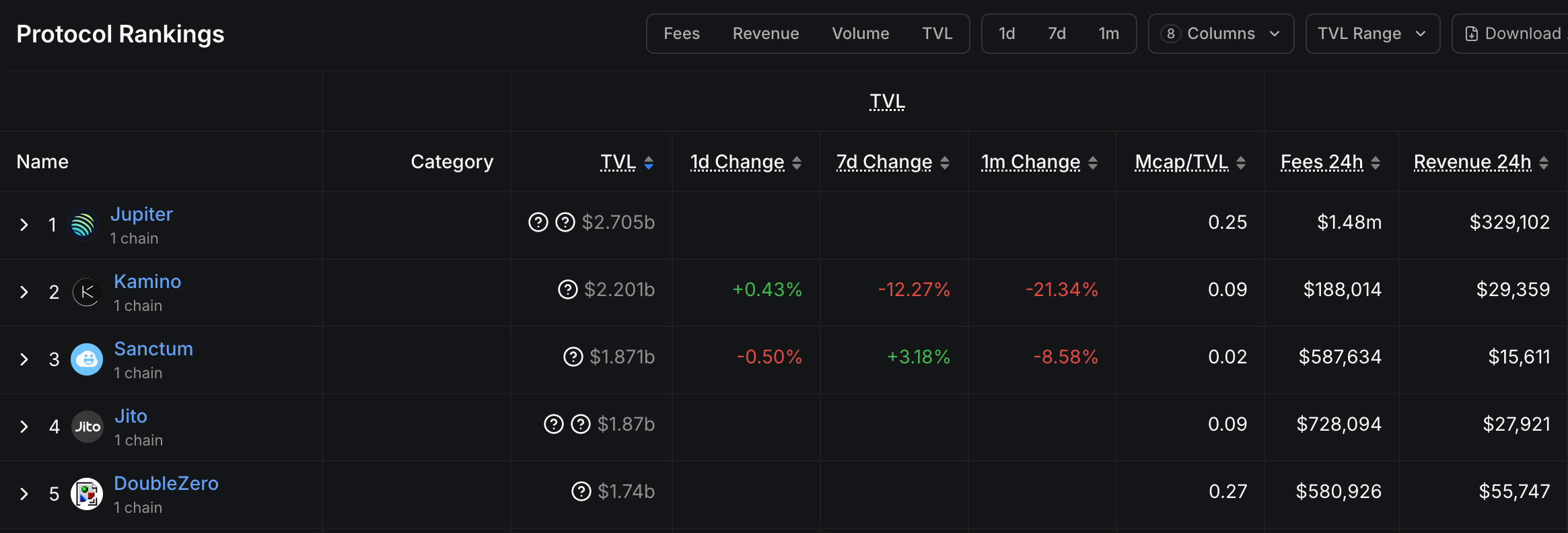
  • Odaily Note: Defillama data shows that Jupiter and Kamino are currently the two protocols with the highest TVL in the Solana ecosystem.

Origin of the Incident: The Tweet Jupiter Quietly Deleted

The origin of the incident can be traced back to August of this year. At that time, during the pre-launch promotion of its lending product Jupiter Lend, Jupiter's official account repeatedly emphasized that the lending product had a "risk isolation" feature (related posts have been deleted), meaning there would be no cross-contamination of risks between different lending pools.
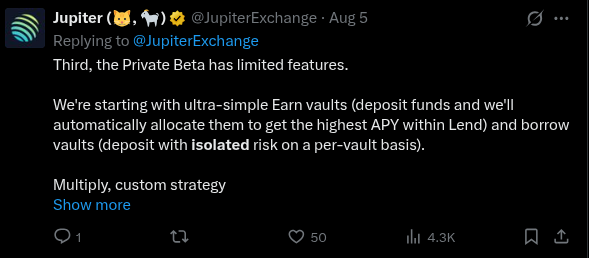
However, the actual design of Jupiter Lend upon launch did not align with the market's common understanding of a risk isolation model. In the general market perception, a DeFi lending pool that can be called risk-isolated is a structure that, through design mechanisms, separates the risks of different assets or markets from each other, preventing a single asset default or a market crash from affecting the entire protocol. The main features of this structure include:

  • Pool Segregation: Different asset types (such as stablecoins, volatile assets, NFT collateral, etc.) are allocated to independent lending pools, each with its own liquidity, debt, and risk parameters.
  • Collateral Isolation: Users can only use assets within the same pool as collateral to borrow other assets, cutting off cross-pool risk transmission.

But in fact, Jupiter Lend's design supports rehypothecation (reusing deposited collateral elsewhere in the protocol) to improve capital efficiency, meaning the collateral deposited into the vaults is not completely isolated from each other. Jupiter co-founder Samyak Jain's explanation for this was that Jupiter Lend's lending pools are isolated "in a sense" because each pool has its own configuration, caps, liquidation thresholds, liquidation penalties, etc., and the rehypothecation mechanism is merely to better optimize capital utilization efficiency.

Although Jupiter's product documentation for Jupiter Lend provides more detailed explanations than the promotional content, objectively speaking, the "risk isolation" mentioned in its early promotions did have a certain deviation from the market's common understanding, creating a suspicion of misleading users.

Escalation: Kamino Launches an Attack

On December 6th, Kamino co-founder Marius Ciubotariu seized this opportunity to publish a post criticizing Jupiter Lend and blocked Kamino migration tools to Jupiter Lend.
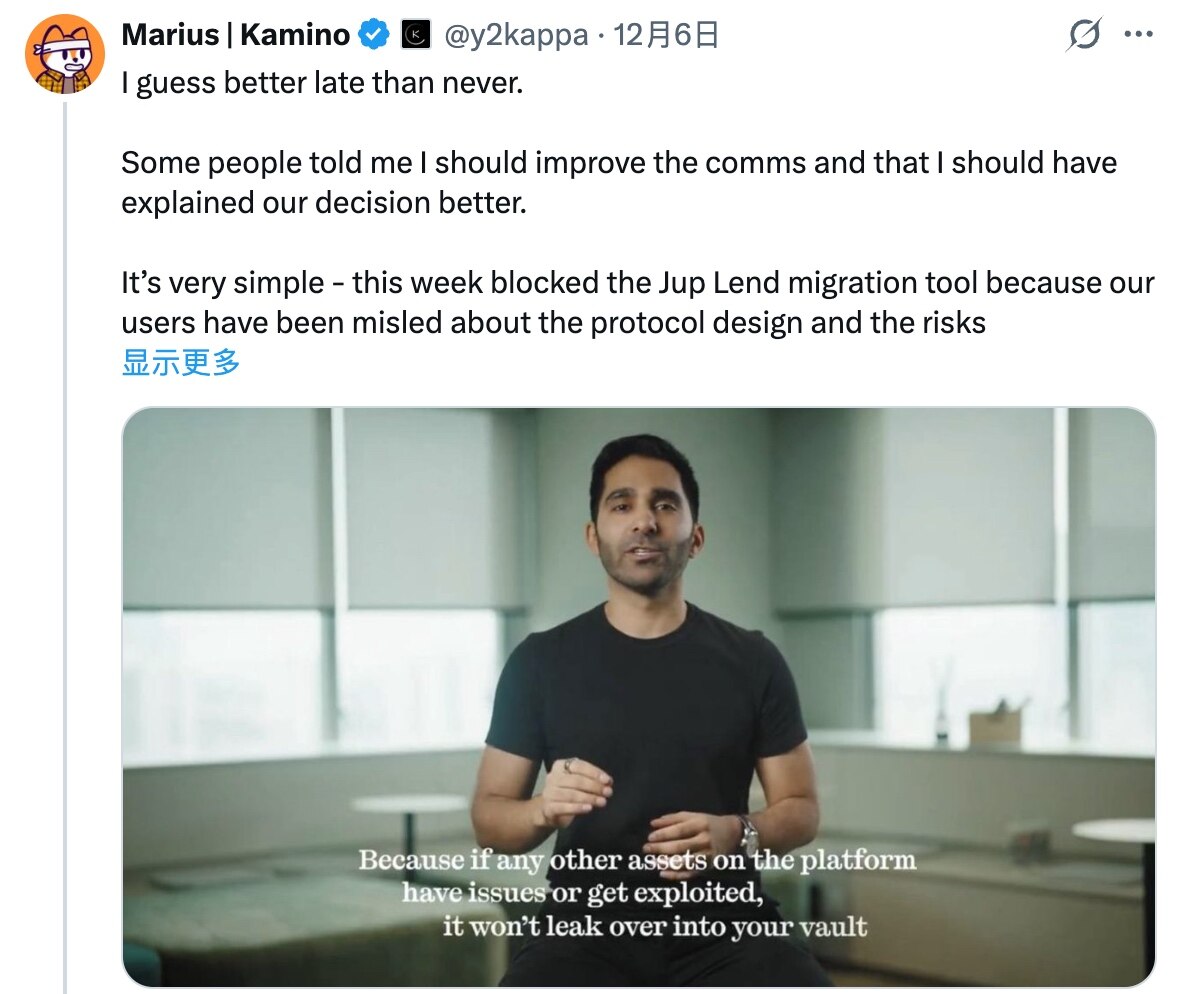
Marius stated: "Jupiter Lend repeatedly claims there is no cross-contamination between assets, which is complete nonsense. In reality, in Jupiter Lend, if you deposit SOL and borrow USDC, your SOL will be lent out to other users engaging in recursive farming using JupSOL, INF, etc. You will bear all the risks of these recursive farms collapsing or the assets crashing. There is no isolation here; there is complete cross-contamination, contrary to what was advertised and what people were told... In both traditional finance (TradFi) and decentralized finance (DeFi), information about whether collateral is rehypothecated and whether there is contagion risk is material information that must be clearly disclosed, and no one should offer vague explanations for it."

After Kamino's offensive, discussions surrounding Jupiter Lend's product design quickly ignited the community. Some agreed that Jupiter was涉嫌虚假宣传 (suspected of false advertising) — for example, Penis Ventures CEO 8bitpenis.sol angrily accused Jupiter of blatantly lying from the start and deceiving users; others believed that Jupiter Lend's design model balanced safety and efficiency, and that Kamino's attack was merely for market competition with impure motives — for example, overseas KOL letsgetonchain stated: "Jupiter Lend's design achieves the capital efficiency of a pooled model while incorporating some risk management capabilities of modular lending protocols... Kamino cannot stop people from migrating to better technology."

Under pressure, the Jupiter team quietly deleted the early posts, but this triggered even larger-scale FUD. Subsequently, Jupiter Chief Operating Officer Kash Dhanda also came forward to admit that the team's previous social media claims of "zero contagion risk" for Jupiter Lend were inaccurate and apologized, stating that a correction should have been issued simultaneously with the deletion of the posts.

Core Contradiction: The Definition of "Risk Isolation"

Summarizing the current opposing attitudes, the fundamental divergence seems to lie in the different definitions different groups have for the term "risk isolation."

From the perspective of Jupiter and its supporters, "risk isolation" is not a completely static concept; there can be some design flexibility within it. Although Jupiter Lend is not the commonly understood risk isolation model, it is also not a completely open pooled model. While it shares a common liquidity layer that allows rehypothecation, each lending pool can be configured independently with its own asset caps, liquidation thresholds, and liquidation penalties.

From the perspective of Kamino and its supporters, any allowance of rehypothecation is a complete negation of "risk isolation," and as a project, one should not use vague disclosures and false advertising to deceive users.

Higher-Level Sentiment: Some Fuel the Fire, Others Mediate

Aside from the dispute between the two parties and the community, another noteworthy point in this风波 (controversy) is the attitude of various higher-level entities within the Solana ecosystem.

First is Multicoin Capital, the venture capital fund with arguably the most influence (perhaps without the 'arguably') in the Solana ecosystem. As an investor in Kamino, Multicoin partner Tushar Jain directly posted questioning whether Jupiter was "incompetent or malicious, but neither possibility is forgivable" — objectively speaking, his remarks significantly exacerbated the controversy.
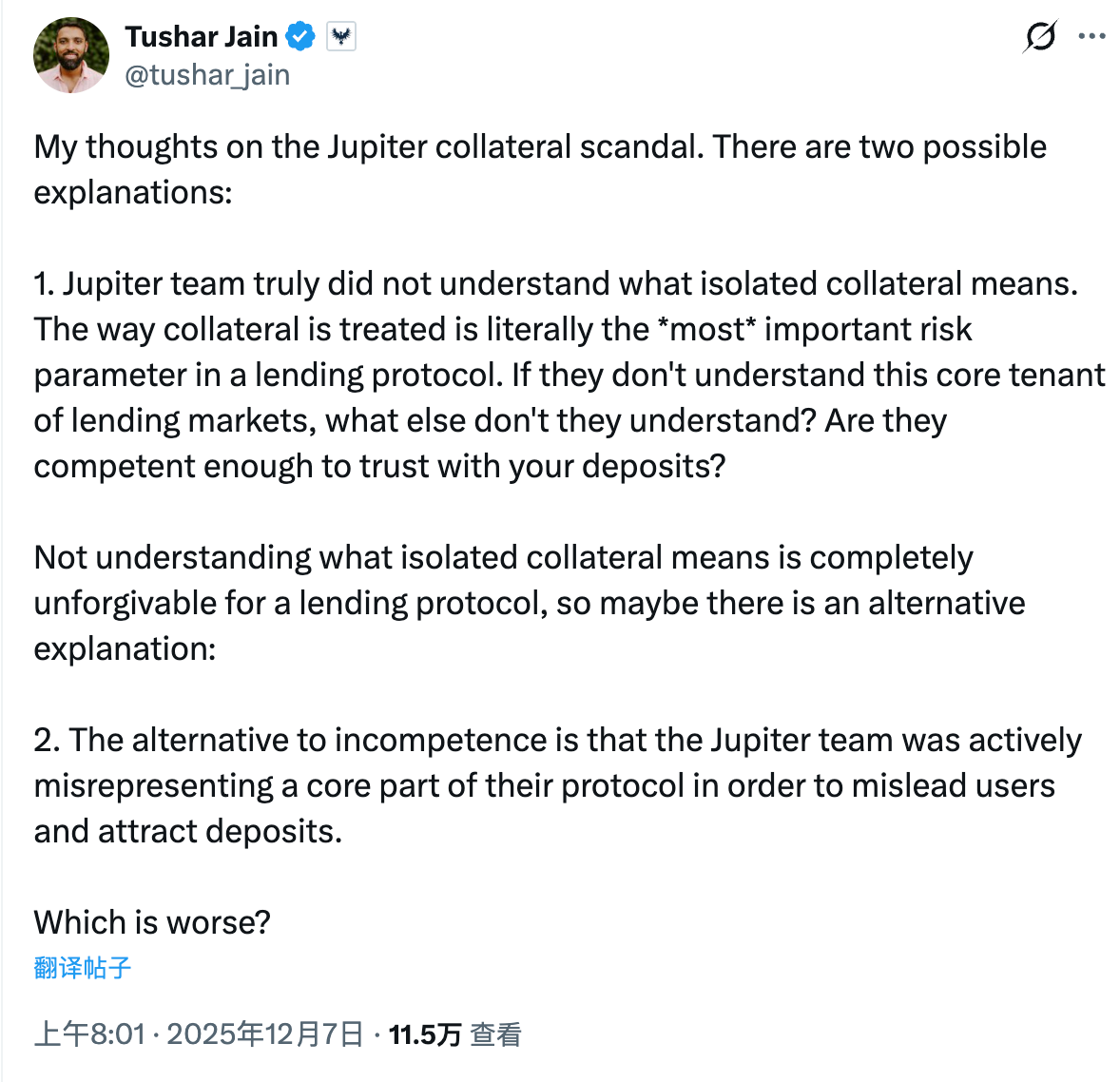
Tushar stated: "There are two possible explanations for the controversy around Jupiter Lend. One is that the Jupiter team genuinely does not understand the meaning of isolated collateral. Collateral treatment is the most important risk parameter in a lending protocol. If they don't understand this core principle of lending markets, what else haven't they figured out? Is their expertise sufficient to reassure people to deposit funds? For a lending protocol, not understanding the meaning of isolated collateral is completely unforgivable. The other possibility is that the Jupiter team is not incompetent but actively misrepresented a core part of their protocol to mislead users and attract deposits."

Clearly, Tushar's motivation was very clear: to seize this opportunity to help Kamino打击竞争对手 (strike a blow against its competitor).

Another important higher-level statement came from the Solana Foundation. As the parent ecosystem, Solana obviously does not want to see its two leading contenders become overly antagonistic, leading to overall ecosystem infighting and inefficiency.
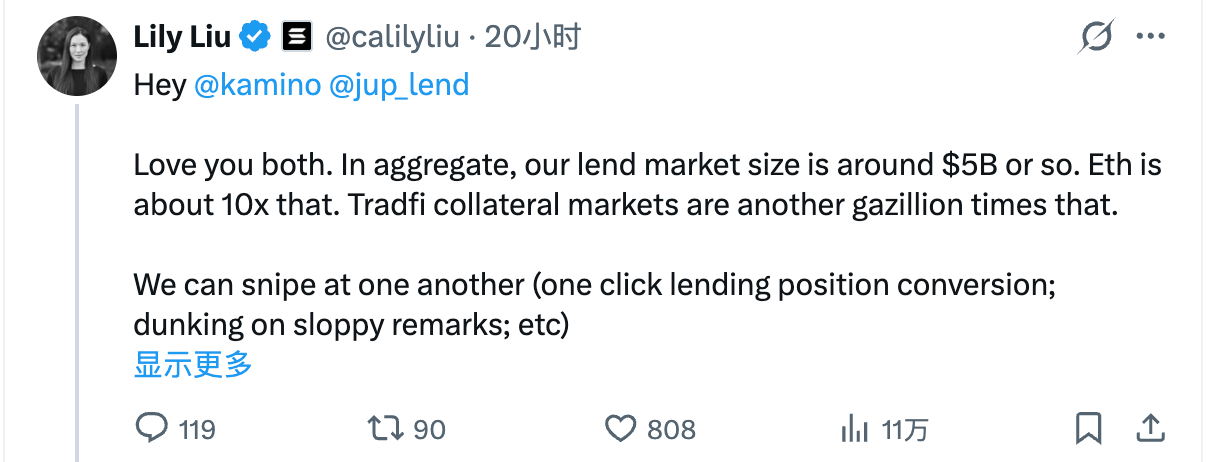
Yesterday afternoon, Solana Foundation President Lily Liu posted on X addressing both projects and mediating: "Love you both. Overall, our lending market size is currently around $5 billion, while the Ethereum ecosystem's size is about 10 times larger. As for the traditional finance collateral market, that's countless times larger than this number. We can choose to attack each other, or we can choose to set our sights further — first work together to capture share from the entire crypto market, and then jointly advance into the vast space of traditional finance.

Simple summary — Stop fighting, or Ethereum will benefit!

Underlying Logic: The Battle for Solana's Lending Leadership

Looking at the data development of Jupiter Lend and Kamino and the market environment, this controversy, though sudden, seems like an inevitable collision that was only a matter of time.

On one hand, Kamino (red in the chart below) long held the top position as the lending leader in the Solana ecosystem, but Jupiter Lend (blue in the chart below) has captured a significant market share since its launch, becoming the only entity currently capable of challenging the former within the Solana ecosystem.
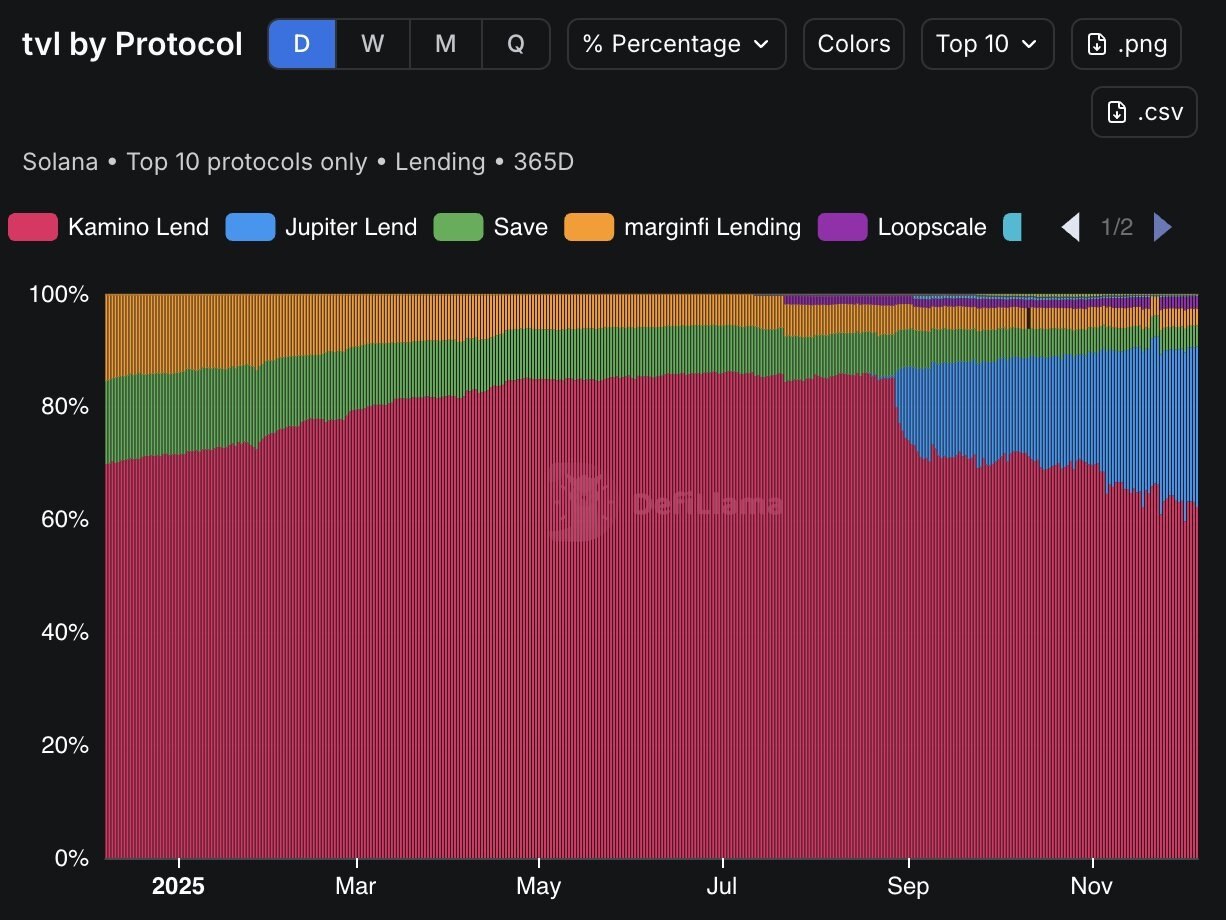
On the other hand, since the major bloodbath on October 11th, market liquidity has tightened significantly, and the overall TVL of the Solana ecosystem has continued to decline; additionally, the subsequent collapse of multiple projects has made the DeFi market extremely sensitive to "security."

When the market environment was better and incremental funds were sufficient, Jupiter Lend and Kamino were relatively harmonious, as both were profitable and seemed poised to become even more so... But when the market shifted to a存量博弈 (stock game/competition for existing market share), the competitive relationship between the two became more tense and confrontational, and security issues正好又是 (happened to be) the most effective point of attack at the moment — even though Jupiter Lend has not had any security incidents historically, mere design suspicions were enough to trigger user alertness.

Perhaps from Kamino's perspective, the present was the perfect opportunity to deal a heavy blow to its opponent.


Related Questions

QWhat was the main reason behind the conflict between Jupiter Lend and Kamino?

AThe conflict stemmed from Jupiter Lend's early marketing claims of 'risk isolation,' which Kamino argued was misleading because Jupiter Lend's design allowed for rehypothecation (reusing deposited collateral elsewhere in the protocol), leading to potential cross-contamination risks between pools.

QHow did Jupiter respond to the accusations regarding its 'risk isolation' claims?

AJupiter's COO, Kash Dhanda, admitted that the team's earlier social media claims of 'zero contagion risk' were inaccurate and apologized for not issuing a correction immediately after deleting the posts.

QWhat role did Multicoin Capital play in the dispute?

AAs an investor in Kamino, Multicoin Capital partner Tushar Jain publicly criticized Jupiter, accusing them of either incompetence or intentional deception regarding their risk isolation claims, which escalated the controversy.

QHow did the Solana Foundation intervene in the situation?

ASolana Foundation President Lily Liu urged both projects to reconcile, emphasizing that the Solana lending market is much smaller than Ethereum's and that internal conflicts could hinder growth, suggesting they focus on expanding the ecosystem together.

QWhat market conditions contributed to the tension between Jupiter Lend and Kamino?

AThe tension was exacerbated by a sharp decline in market liquidity and Solana's TVL after the October 11 market crash, turning the lending market into a competitive存量博弈 (stock game), where Kamino saw an opportunity to attack Jupiter Lend over security concerns.

Related Reads

Can DeepSeek Save China One Trillion Dollars?

"DeepSeek and the $1 Trillion Infrastructure Question" The article examines whether DeepSeek's AI optimization breakthroughs could potentially save China $1 trillion in future AI infrastructure costs. The analysis begins with Nvidia's upcoming Vera Rubin AI platform, costing ~$7.8 million, where memory (HBM4/LPDDR5X) constitutes $2 million—a 435% cost increase in one year, highlighting how AI hardware spending is shifting toward expensive memory components. DeepSeek's approach works in the opposite direction. Through three key technical innovations showcased in DeepSeek V4, the company dramatically improves hardware efficiency: 1. **Memory Compression (MLA)**: Re-engineers the attention mechanism to compress long-context memory (KV Cache) by over 90%, drastically reducing expensive HBM usage. 2. **Selective Activation (MoE)**: Employs Mixture-of-Experts architecture where only a small fraction of parameters (e.g., 49B out of 1.6T in V4-Pro) are activated per token, allowing most parameters to reside in cheaper memory/SSD. 3. **Computation Caching**: Reuses previously computed results via cache hits, replacing expensive GPU computations with cheap memory reads. Combined, these optimizations allow the same hardware to produce approximately 4x more tokens, effectively reducing required hardware investment by 75%. DeepSeek's pricing reflects this: a 10-billion token workload costs ~$522 monthly versus ~$9,000-$10,000 for competitors. The $1 trillion savings projection stems from McKinsey's estimate that global AI infrastructure will require ~$5.2 trillion investment by 2030. As China's daily token consumption grows toward quadrillions, even marginal efficiency gains scale massively. With a conservative 4x throughput improvement, China could avoid building tens of thousands of AI data centers equivalent to ~7 trillion RMB ($1 trillion) in saved investment. Critically, this strategy shifts dependency from scarce, expensive GPU/HBM—where China lags—toward more accessible storage, caching, and systems engineering where domestic suppliers like CXMT are gaining strength. Rather than "replacing Nvidia," DeepSeek rebalances AI's value chain away from monolithic hardware dependency. Ultimately, DeepSeek's technical breakthroughs could lower the barrier to AI adoption across Chinese industries by making advanced capabilities affordable at scale—transforming who can access next-generation AI.

marsbit17m ago

Can DeepSeek Save China One Trillion Dollars?

marsbit17m ago

Overturning the Mainstream Approach to Hallucinations: Metacognition is the New Solution for Large Models to Break the Hallucination Barrier

This paper, "Hallucinations Undermine Trust; Metacognition is a Way Forward," proposes a paradigm shift in combating AI hallucination. It argues that the current mainstream approaches—striving for omniscience by scaling data/models or having AI abstain from uncertain answers—are fundamentally flawed. The former has inevitable knowledge gaps, while the latter imposes a crippling "utility tax," requiring the rejection of many correct answers to achieve high accuracy, due to models' poor "discrimination" (the ability to distinguish correct from incorrect answers internally). The core contribution is redefining hallucination not as "being wrong," but as "expressing false information with unwarranted certainty." The proposed solution is **Faithful Uncertainty** or **Metacognition**: enabling AI to accurately perceive its internal uncertainty and honestly express it in its language (e.g., using hedging phrases when unsure). This creates a more reliable assistant that provides useful information while signaling its confidence, minimizing harm from errors. The paper emphasizes that metacognition is critical for the era of AI Agents. Without it, Agents cannot intelligently decide when to use tools like search engines, leading to inefficiency and misuse. Key implementation challenges are highlighted: the "bootstrapping paradox" of training with static uncertainty data, the "alignment distortion signal" where human preference training suppresses internal uncertainty cues, and the difficulty of causally evaluating true metacognition vs. its superficial imitation. The paper concludes that the goal should not be an infallible AI, but one that is honest about the limits of its knowledge, thereby building user trust through transparent communication of its certainty.

marsbit21m ago

Overturning the Mainstream Approach to Hallucinations: Metacognition is the New Solution for Large Models to Break the Hallucination Barrier

marsbit21m ago

Hedge by Buying Gold and Oil, Chase Soaring Returns with AI. ‘Dated’ Bitcoin Enters a Bear Market

Bitcoin has recently declined, hitting a two-month low near $66,123, while Ethereum fell to a three-month low around $1,837. Analysts suggest the drop is not merely due to factors like ETF outflows or MicroStrategy's selling but reflects a deeper issue: Bitcoin is losing a broader asset competition. In a near-zero interest rate environment, Bitcoin previously thrived as an outlet for investor dissatisfaction with inflation and limited options. However, the market landscape has shifted. Bitcoin now occupies an "awkward middle ground," facing competition on three fronts. For inflation hedging, investors prefer gold, energy stocks, and commodity producers—assets with tangible backing and clearer pricing power. For growth exposure, AI-related companies with actual revenues and profits are more attractive. Even within crypto, investors can choose stablecoins, exchanges, or infrastructure firms tied directly to adoption, offering clearer business models and leverage. Thus, Bitcoin is no longer the top choice for hedging, growth, or crypto exposure. This shift is evident in market reactions: despite recent warnings about persistent inflation from a Fed official, Bitcoin did not rally as it might have in the past. Instead, capital flowed to assets with direct commodity or energy exposure. The recent ETF outflows and MicroStrategy sales are symptoms, not causes, of this new reality. Investors are becoming more selective, demanding clearer value propositions beyond mere scarcity. The emerging bear case for Bitcoin is not about it being a bubble or failed technology, but that scarcity alone is no longer sufficient.

华尔街日报24m ago

Hedge by Buying Gold and Oil, Chase Soaring Returns with AI. ‘Dated’ Bitcoin Enters a Bear Market

华尔街日报24m ago

Trading

Spot
Futures

Hot Articles

Discussions

Welcome to the HTX Community. Here, you can stay informed about the latest platform developments and gain access to professional market insights. Users' opinions on the price of S (S) are presented below.

活动图片