Solana under ‘industrial scale’ DDoS attack: Co-founder says it’s ‘bullish’

cointelegraphPublished on 2025-12-16Last updated on 2025-12-16

Abstract

Solana has been hit by a large-scale distributed denial-of-service (DDoS) attack, with traffic reportedly peaking near six terabits per second (Tbps), as stated by co-founder Anatoly Yakovenko and others in the ecosystem. Yakovenko described the attack as "bullish," suggesting that the attacker spent as much as the chain generates in revenue. Despite the massive scale, the network reportedly showed no significant signs of stress, such as latency or delays. This is not the first time Solana has faced such issues; the network has a history of downtimes, including several in 2022 due to bugs and transaction overloads. However, downtime incidents have decreased in recent years. In comparison, Bitcoin has maintained over 99.99% uptime, with only two major downtime events since 2009. The article highlights Solana’s ongoing challenges with stability despite improvements, contrasting its performance with Bitcoin’s reliability.

Solana co-founder Anatoly Yakovenko and several accounts tied to the network’s ecosystem said this week that Solana has been hit by a large distributed denial-of-service attack, with some posts citing traffic that peaked near six terabits per second (Tbps).

Yakovenko wrote in a Dec. 9 X post that Solana was under a six Tbps distributed denial-of-service (DDoS) attack. Earlier today, Solana Labs co-founder and president Raj Gokal suggested the attack was still ongoing. Cointelegraph was unable to independently verify the attack or its scale.

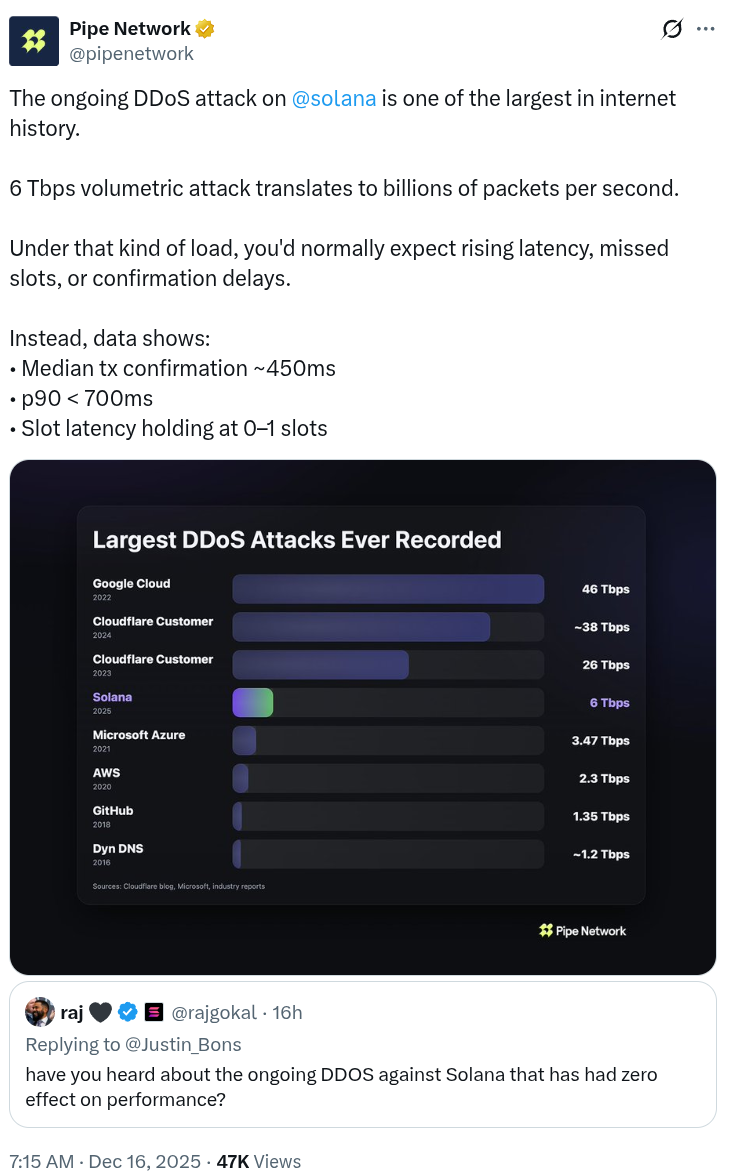
On Monday, the CEO of Solana-based decentralized physical infrastructure network (DePIN) project Pipe Network, David Rhodus, pointed out that the shared metric puts the attack at an “industrial-scale.” In a Monday update, Pipe Petwork also claims that the attack is “one of the largest in internet history” since six Tbps “translates to billions of packets per second.”

A “bullish” attack, co-founder says

A DDoS attack involves many devices flooding a target with traffic to overwhelm it and knock it offline or slow it down. A chart shared by Pipe Network suggests that Solana has faced the fourth-largest DDoS attack ever reported. Still, in 2025 alone, Cloudflare reported a 29.7 Tbps attack, KrebsOnSecurity reported a 6.3 Tbps attack, and Gcore disclosed a six Tbps attack, with none appearing on Pipe Network’s chart.

Yakovenko wrote in a Dec. 9 post that the attack is bullish, also suggesting that “someone is spending as much as the chain makes in revenue to send it.” Similarly, Pipe Network highlights that “under that kind of load, you’d normally expect rising latency, missed slots, or confirmation delays” while the network is not showing any significant signs of stress.
Source: Pipe Network

Solana Labs had not answered Cointelegraph’s request for comment by publication.

Related: Coinbase fixes Solana transaction backlog after 48-hour delay

Solana outage history and fixes

Solana has a history of multiple downtimes, some of which are tied to DDoS-like causes. In December 2020, a block propagation bug halted the network operation. Back in September 2021, Solana’s mainnet saw a 17-hour downtime as Grape Protocol’s launch of its onchain initial DEX offering (IDO) on the crowdfunding platform Raydium AcceleRaytor overwhelmed the network, much like a DDoS would.

In 2022, Solana saw three downtime instances. First, it experienced seven hours of downtime due to transaction spam from bot accounts, then the network saw four and a half hours of downtime due to a bug that caused a consensus failure. Again in 2022, Solana experienced 8.5 hours of downtime due to a bug in the fork choice rules, resulting in consensus failure.

This is where the network stability seemed to pick up slightly. Cointelegraph was able to locate only one instance of downtime in 2023, when, in late February, a fault in Solana’s deduplication logic led to almost 19 hours of downtime. In 2024, the network again saw only one downtime instance when it went down for nearly five hours due to a bug causing an infinite recompile loop.

Related: Solana users hit by delays after Trump memecoins debut

Despite the clear downtrend, this is a lot of downtime for blockchain standards. Bitcoin (BTC), the world’s first blockchain, currently has an uptime of over 99.99%, with the last downtime incident taking place in 2013.

Bitcoin has seen only two downtime incidents since its first block was mined in January 2009. The first one took place in August 2010, when a value-overflow bug was exploited, briefly creating nearly 184.47 billion BTC until a patch reversed the issue. The second one happened in March 2013, when a bug split the network between Bitcoin Core 0.7 and 0.8. The 2013 event did not create new Bitcoin.
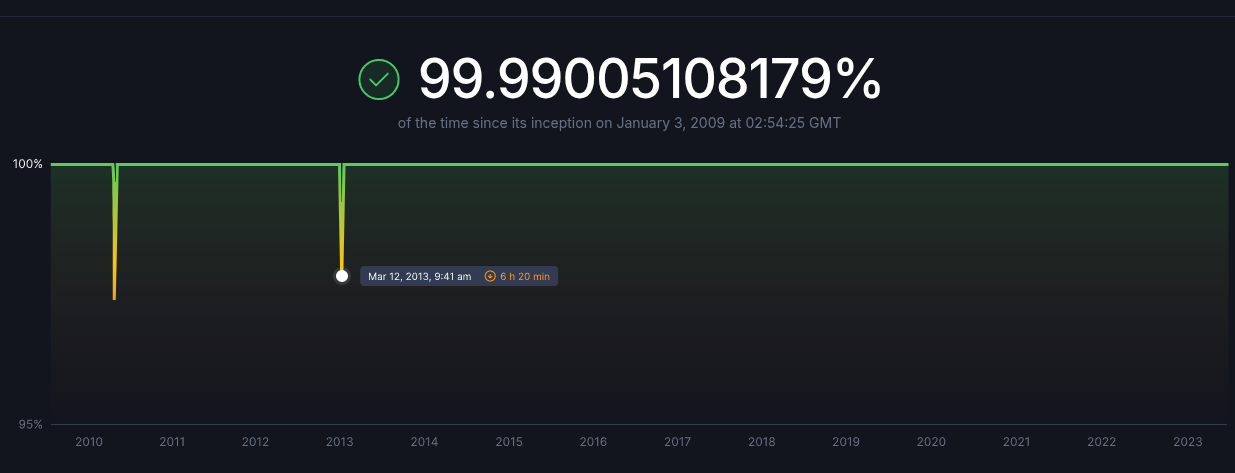
Bitcoin uptime chart. Source: BitBo

Related Reads

70% of the Public Opposes AI, Americans Hope the U.S. Loses the AI War

70% of Americans believe AI development is moving too fast, with growing public resistance evolving from online criticism to real-world protests and violence. This widespread anti-AI sentiment stems from fears of job losses, rising utility costs, environmental damage, threats to democracy, and financial instability. Key incidents illustrate the backlash: Google's former CEO Eric Schmidt was loudly booed at a graduation for promoting AI; AI company ads are vandalized; protests and even violent attacks target AI firms and data centers. Polls show deep public pessimism and strong local opposition to data center construction, often surpassing resistance to nuclear power plants. The core grievances are economic and practical: AI is seen as automating jobs, concentrating wealth, and increasing household electricity and water bills due to massive data center resource demands. Environmentalists also oppose AI's high energy use and carbon emissions. This opposition has turned AI into a major political issue in the US. While the Trump administration prioritizes AI innovation for global competition, bipartisan pushback is growing. Democrats and factions within the MAGA movement are forming temporary alliances to support stricter regulations and local bans on new data centers, pressuring the administration to choose between its tech industry backers and its voter base. The situation highlights a profound national divide over AI's future.

marsbit10m ago

70% of the Public Opposes AI, Americans Hope the U.S. Loses the AI War

marsbit10m ago

Agents Take Over Traffic Distribution Power: What Are Tencent, ByteDance, and Alibaba Competing For?

In the race to dominate the AI era's entry point, China's tech giants—Tencent, ByteDance, and Alibaba—are aggressively deploying AI Agents to control the future of traffic distribution. Alibaba is pursuing a dual-track "closed loop + openness" strategy. Its Qianwen app is evolving into a super-Agent integrated across its ecosystem (Taobao, Alipay, etc.) to handle complex tasks like travel planning. Concurrently, it is opening its platform to external brands (Luckin Coffee, KFC) and has launched a B2B Agent platform, "Wukong," targeting enterprise automation. Its other flagship, Quark, aims to be an "AI super search box" for information and tasks. ByteDance is executing an omnipresent "sprawl strategy." Its Doubao app boasts over 300 million monthly active users and is evolving into a default AI entry point for daily life, with plans for paid versions and e-commerce integration. Its core weapon is the Kouzi platform, a visual "AI assembly factory" for developers to build custom Agents. ByteDance is also pushing hardware integration, collaborating on AI phones and developing smart glasses to embed Doubao everywhere. Tencent is playing its long-held "ultimate card" by quietly embedding an AI Agent directly into WeChat. This Agent, accessible via a swipe, can understand user commands and automatically execute tasks by calling upon WeChat's millions of mini-programs (e.g., finding and ordering coffee). This leverages WeChat's unparalleled 1.4-billion-user ecosystem to position the app as an AI-powered "service operating system," a move that could dramatically reshape the competitive landscape. The core battleground is shifting from competing for "user screen time" to competing to be the "default execution layer" for user intent. The business model is evolving from an "attention economy" to an "intent economy," where the Agent that can most efficiently fulfill a user's need gains control over service access and token flow. This represents a fundamental change in how users connect with digital services, making the fight for the Agent入口 (entry point) a pivotal moment for redefining industry leadership in the AI age.

marsbit2h ago

Agents Take Over Traffic Distribution Power: What Are Tencent, ByteDance, and Alibaba Competing For?

marsbit2h ago

Trading

Spot
Futures

Hot Articles

Discussions

Welcome to the HTX Community. Here, you can stay informed about the latest platform developments and gain access to professional market insights. Users' opinions on the price of S (S) are presented below.

活动图片