Solana Has Dropped To Historically Oversold Levels – It’s Worse Than FTX Levels

bitcoinistPublished on 2026-06-09Last updated on 2026-06-09

Abstract

Solana (SOL) has entered deeply oversold territory, with its monthly Relative Strength Index (RSI) dropping to 38.84—a level analysts note is more extreme than during the FTX collapse in 2022. Despite trading significantly higher than its 2022 low of $8, the current RSI suggests an unusually severe decline in momentum. The cryptocurrency is now at a three-year low near $60, down over 80% from its 2025 high, and has posted eight consecutive red monthly candles. Analyst Ash Crypto highlights that prolonged oversold conditions can signal seller exhaustion and a potential price floor, which historically sets the stage for recovery. However, with no definitive technical confirmation of a bottom, SOL could remain oversold or face further downside. The analysis concludes that while a confirmed bottom doesn't guarantee massive gains, assets at such oversold RSI levels have historically produced significant rallies.

Solana (SOL) has officially entered deep oversold territory, a level analysts say is worse than the one the cryptocurrency reached during the FTX collapse. A decline in this area highlights just how bearish the market has become after months of volatility and steep price declines. Throughout last year, Solana experienced a massive rally that pushed its price firmly above $200. However, now the cryptocurrency has spent most of 2026 trading between lower levels around $60 and $95. Given the poor performance, a crypto analyst is questioning whether SOL may have finally hit a bottom.

Solana RSI Hits Oversold Levels Beyond FTX Crash

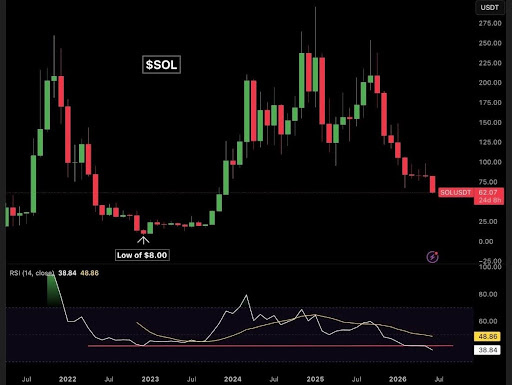
According to a detailed price chart shared by market expert Ash Crypto, Solana’s monthly Relative Strength Index (RSI) has dropped to 38.84, below the signal line sitting near 48.86. The analyst noted that this reading shows the altcoin has reached oversold levels even more extreme than those recorded when FTX collapsed into bankruptcy in 2022, and SOL fell to a low near $8.

The fact that the RSI is now lower despite the price being significantly higher than the 2022 $8 bottom suggests that the momentum decline in this cycle has been unusually severe. From a technical standpoint, prolonged oversold readings on the monthly RSI can signal a potential price reversal, reflecting seller exhaustion. However, oversold conditions can persist for a long time, as a low RSI alone does not confirm that a cryptocurrency has reached its bottom.
Source: X

Given the uncertainty around Solana’s future price direction, Ash Crypto is questioning whether the struggling altcoin has finally found a price floor. If a bottom has been reached, it would imply that most traders who wanted out have likely exited the market, leaving only holders who are committed to Solana long-term. This kind of capitulation often sets the stage for a recovery, as there is very little selling pressure left to disrupt the market.

Notably, after Solana dropped to the $8 bottom in 2022, the cryptocurrency eventually rallied to over $270 in 2025, representing a massive 3,000% recovery. While a confirmed bottom in this cycle does not guarantee the same scale of gains, historically, assets that hit a price floor with RSI readings tend to produce significant rallies.

What It Means If SOL Has Yet To Reach A Bottom

On the flip side, Ash Crypto stated in his analysis that Solana’s price has fallen to a three-year low of $60 after plunging more than 80% from its 2025 all-time high. The analyst noted that cryptocurrency has posted eight consecutive red monthly candles for the first time in its history, highlighting the depth of its bearish trend.

At the moment, there is no signal on SOL’s chart that definitively confirms a bottom or an imminent price reversal. This is because Solana remains firmly in bearish territory, which means its RSI can stay oversold longer than expected. If a price floor has not been reached, it suggests that SOL still has room for further downside, potentially pushing the cryptocurrency below its current level near $60.

SOL price fails to maintain uptrend | Source: SOLUSDT on Tradingview.com

Related Questions

QWhat oversold level has Solana's monthly RSI reached according to analyst Ash Crypto, and how does it compare to the FTX crash period?

AAccording to analyst Ash Crypto, Solana's monthly Relative Strength Index (RSI) has dropped to 38.84, which is below the signal line near 48.86. This reading indicates that Solana has reached oversold levels even more extreme than those recorded during the FTX collapse in 2022.

QWhat was Solana's price performance after its $8 bottom in 2022, and what does it suggest about potential recoveries?

AAfter dropping to a low near $8 in 2022, Solana eventually rallied to over $270 in 2025, representing a massive 3,000% recovery. While not a guarantee for the current cycle, historically, assets hitting a price floor with low RSI readings have tended to produce significant rallies.

QWhat is the significance of Solana posting eight consecutive red monthly candles according to the analysis?

AAsh Crypto notes that Solana has posted eight consecutive red monthly candles for the first time in its history. This highlights the depth and persistence of the current bearish trend for the cryptocurrency.

QIf Solana has indeed hit a price bottom, what market dynamic does the article suggest this creates?

AIf Solana has hit a price bottom, it would imply that most traders who wanted to sell have likely exited the market, leaving primarily long-term holders. This capitulation often sets the stage for a recovery, as there is very little selling pressure left to disrupt the market.

QAccording to the article, what does the lack of a definitive signal on SOL's chart mean for its current price status?

AThe article states that there is currently no signal on SOL's chart that definitively confirms a bottom or an imminent price reversal. This is because Solana remains firmly in bearish territory, which means its RSI can stay oversold longer than expected, and the price could potentially fall further below its current level near $60.

Related Reads

After Tokenization of Assets, How to Exit?

Title: How to Exit After Asset Tokenization? Author: Symbiotic Compiled by: Hu Tao, ChainCatcher Summary: Tokenization addresses how assets go on-chain but largely leaves the redemption question unresolved. While tokenized assets can settle instantly, the underlying redemption for assets like treasuries, private credit, or real estate can take from T+1 to 180 days. This gap hinders DeFi adoption of Real World Assets (RWAs). Three emerging models aim to provide instant exit liquidity, differing primarily in their capital structure and efficiency: 1. **Balance Sheet Model (e.g., Grove Basin):** A single entity (like Sky) provides immediate liquidity from its balance sheet, acting as a bridge during the settlement period. It offers simplicity and deep initial liquidity but is constrained by a single entity's capacity and risk appetite. 2. **Asset-Specific Vault Model (e.g., Upshift Clear):** Independent liquidity providers fund dedicated vaults for each supported asset, earning fees. It decentralizes capital sources but isolates liquidity and capital per asset, leading to potential fragmentation. 3. **Shared Liquidity Layer Model (e.g., Symbiotic Liquid Lane):** A shared capital pool supports multiple RWA types simultaneously. Funds remain productive between redemptions (e.g., earning yield in lending markets). Exits are settled via a competitive RFQ market. This model aims for higher capital efficiency, scalability across assets, and serves longer-duration assets like private credit. Key differentiators are: 1) Source of capital and risk bearer, 2) Redemption pricing mechanism, 3) Capital efficiency, 4) Scalability to new asset types, and 5) Composability. The shared liquidity layer model represents a move from piecemeal solutions toward scalable infrastructure, enabling T+0 exits by pooling capital, maintaining yield, and using competitive pricing, thus enhancing RWA utility in DeFi.

marsbit13m ago

After Tokenization of Assets, How to Exit?

marsbit13m ago

After Tokenizing Assets, How to Exit?

After tokenization, a key unresolved issue is providing holders with a reliable exit mechanism, as underlying asset settlement (taking days to months) lags far behind on-chain token settlement. Three primary models for instant liquidity have emerged, differing in their capital structure and efficiency: 1. **Balance Sheet Model (e.g., Grove Basin):** A single, well-capitalized entity (like Sky) provides immediate liquidity from its own reserves. This offers simplicity and deep initial liquidity but is constrained by that single balance sheet's capacity and risk appetite, limiting scalability. 2. **Dedicated Vault Model (e.g., Upshift Clear):** Independent liquidity providers (LPs) fund separate vaults for each supported asset. This decentralizes capital sources but isolates liquidity and capital, which becomes inefficient as the number of tokenized assets grows. 3. **Shared Liquidity Layer Model (Symbiotic Liquid Lane):** Independent capital providers fund shared vaults that can support multiple tokenized assets simultaneously. Capital remains productive between redemptions (e.g., earning yield in DeFi markets). Exits are settled via a competitive RFQ market where market makers bid. The article argues that the shared layer model offers superior capital efficiency and scalability. It transforms exit liquidity from an asset-specific patch into shared market infrastructure, allowing liquidity capacity to grow with overall market participation rather than being fragmented per asset. This is particularly valuable for longer-duration assets like private credit, where reliable T+0 exits can significantly enhance their utility in DeFi.

链捕手27m ago

After Tokenizing Assets, How to Exit?

链捕手27m ago

Anthropic's Triple Moment: Code Leak, Government Confrontation, and Weaponization

This article analyzes Anthropic's recent conflicts and strategic moves following the U.S. government's emergency halt of its new Fable model, citing national security concerns over potential "jailbreaks." The author argues this incident reveals deeper tensions between AI labs, governments, and the software industry. While critics view Anthropic's safety-focused rhetoric as marketing fear, the author suggests it serves as a commercial moat masking the company's core economic imperative: moving closer to end-users and their valuable data to avoid being commoditized. The piece outlines a coming clash between frontier AI labs like Anthropic and established software companies. Labs need real-world usage data for model improvement via reinforcement learning, creating a cycle where better products attract more users and more data. This threatens software firms who, as Microsoft's Satya Nadella warns, risk having their value captured by a few dominant models. Anthropic's controversial policy changes—initially secretly degrading Fable's performance for LLM development and expanding data retention—are framed as assertions of control, justified by its safety narrative. The company's foundational belief that it alone is sufficiently concerned about superintelligent AI dangers legitimizes its actions, from resisting government demands to shaping usage policies. The author concludes that this alignment of mission, talent, and business strategy is powerful but concerning, as it concentrates immense potential power in the hands of those convinced of their own righteous understanding.

marsbit37m ago

Anthropic's Triple Moment: Code Leak, Government Confrontation, and Weaponization

marsbit37m ago

Trading

Spot
Futures

Hot Articles

Discussions

Welcome to the HTX Community. Here, you can stay informed about the latest platform developments and gain access to professional market insights. Users' opinions on the price of SOL (SOL) are presented below.

活动图片