ShapeShift founder denies $260mln whale accumulation – Here’s what we know!

ambcryptoPublished on 2026-03-23Last updated on 2026-03-23

Recent on-chain data suggests that large investors are quietly building strong positions in Ethereum.

Over the past two weeks, a major whale, reportedly linked to Erik Voorhees, Founder of ShapeShift, has deployed nearly $260 million in USDT to accumulate more than 120,000 ETH.

This buying pattern points to a steady accumulation strategy rather than a one-time trade. For instance, in the latest transaction, the whale spent $4.29 million to purchase ETH at $2,134.
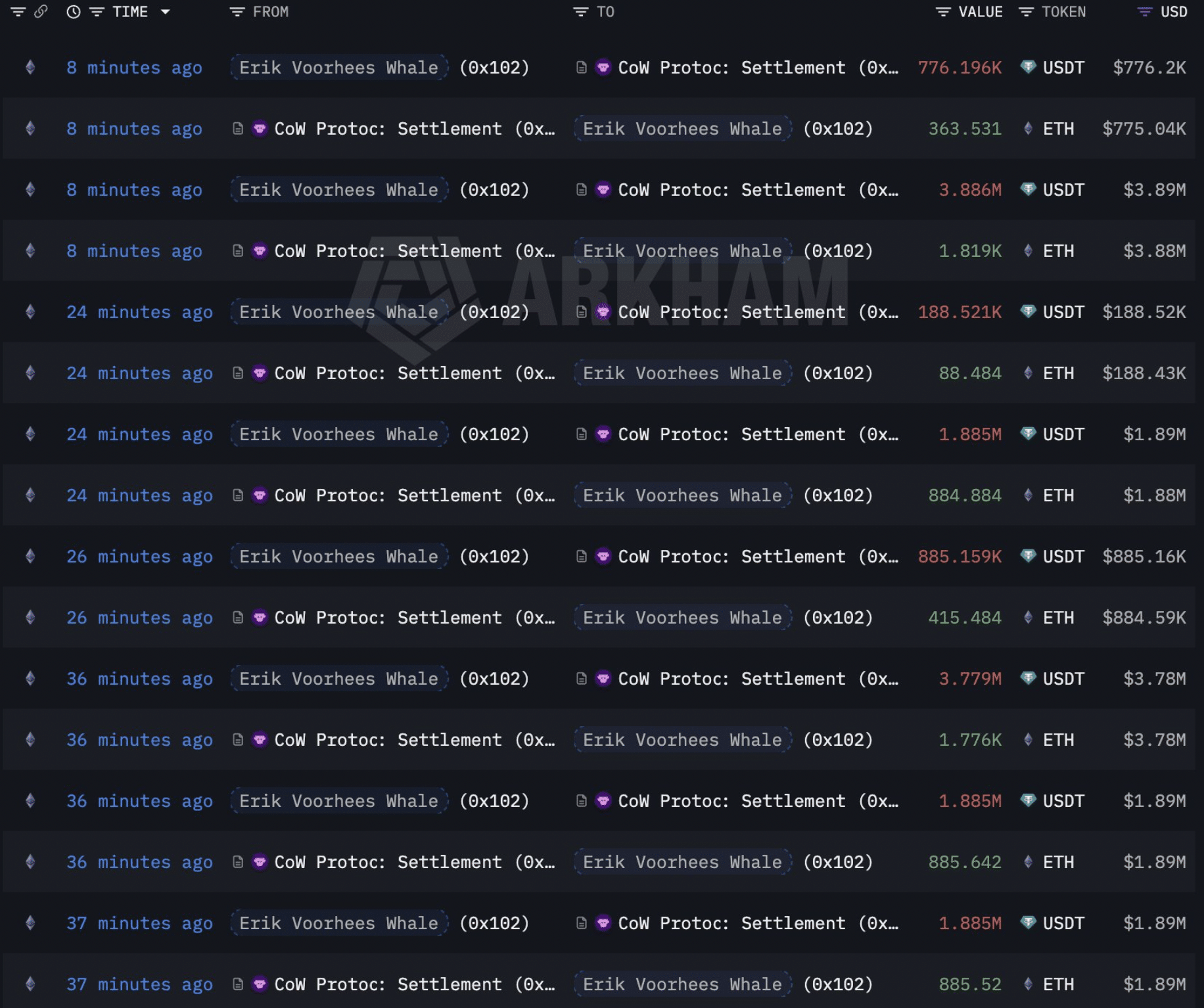
Source: Lookonchain/X

Overall, the average buying price stands at around $2,162, which now acts as a key support level for the market.

Such moves signal strong confidence that Ethereum may be nearing its bottom, with expectations of potential upside in the coming months.

Notably, this accumulation is happening even as ETH trades at $2,071.67, down over 3% in the last 24 hours. This paints a clear divergence between short-term price action and long-term investor sentiment.

Retail vs whale behavior

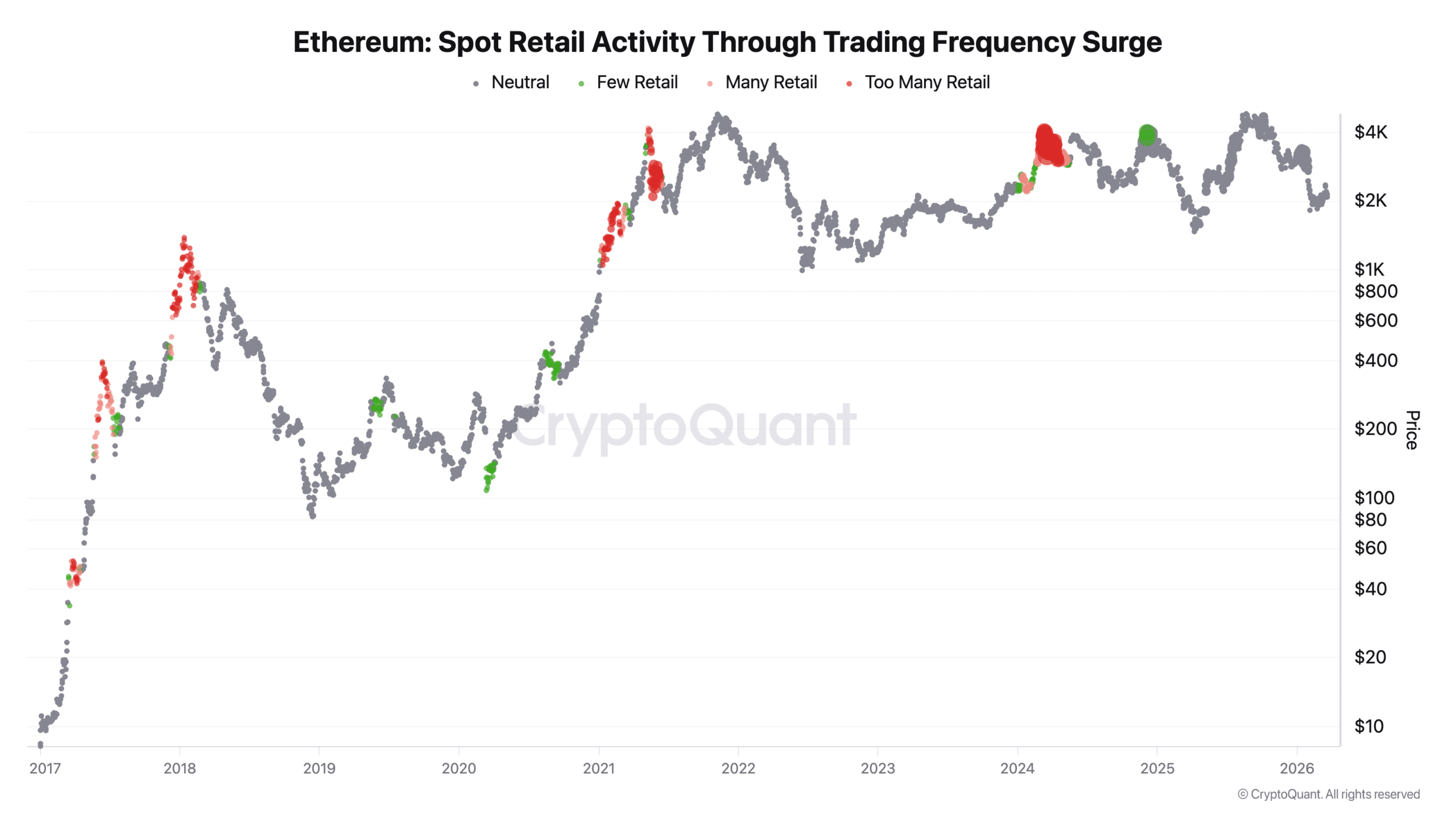
To understand this better, let’s analyse the Spot Retail Activity by CryptoQuant.

Historically, smaller investors tend to buy when prices are already high, driven by FOMO. This happened in past cycles like 2018, 2021, and even 2024.
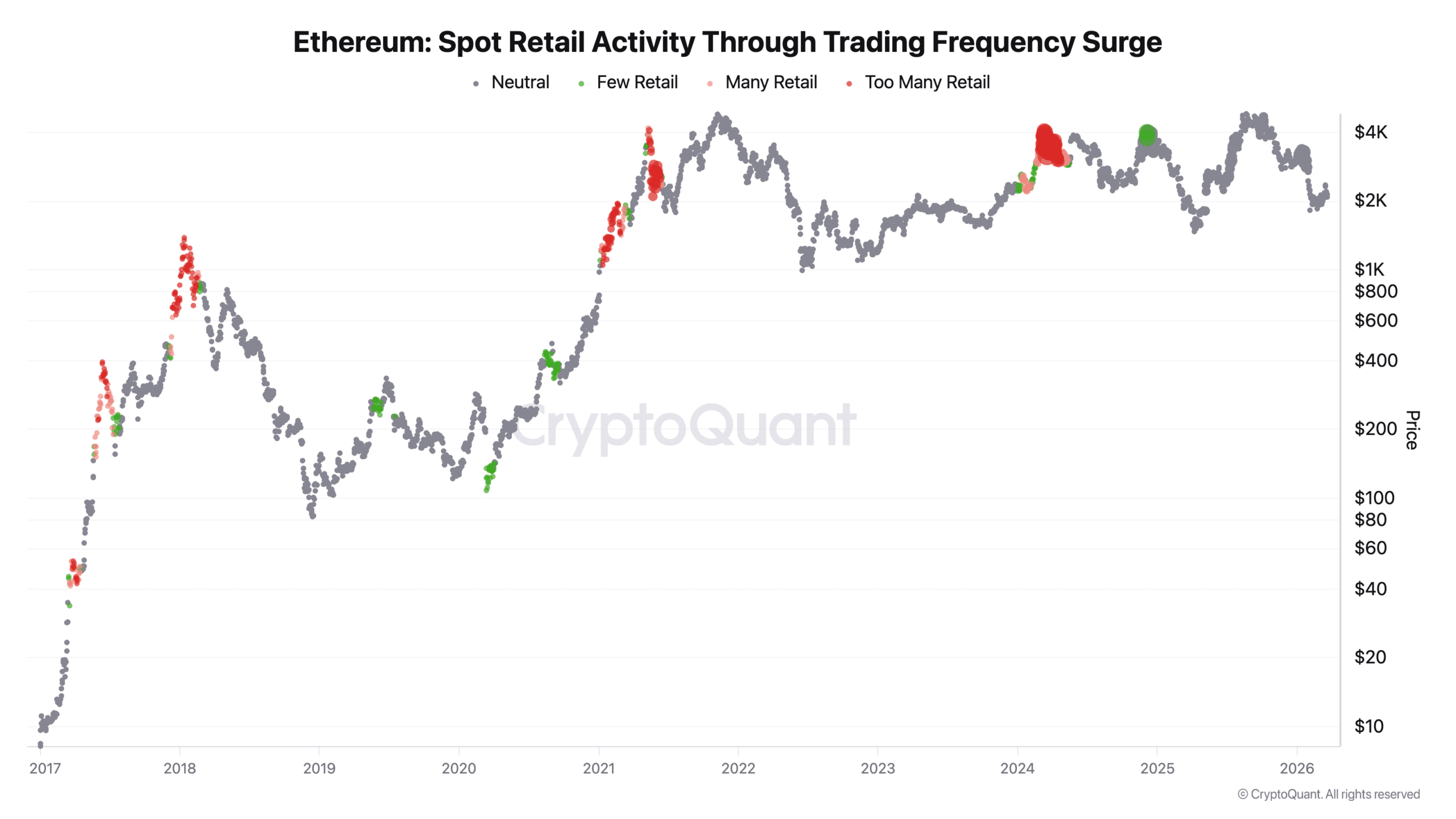
Source: CryptoQuant

Right now, retail activity is relatively low, which is actually a good sign. It means the market is in a quieter phase where large investors are accumulating, while the public is still on the sidelines.

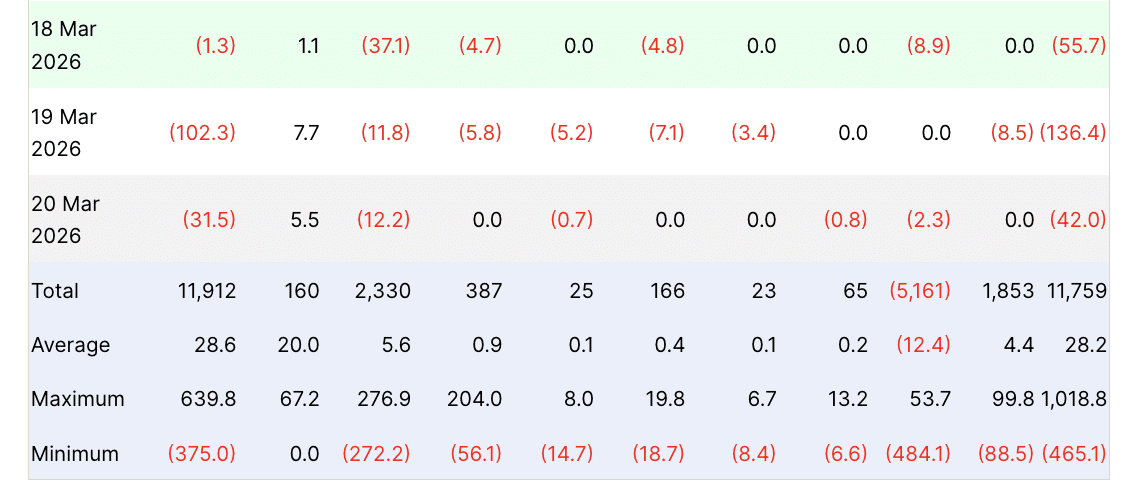
Interestingly, while this whale has been aggressively buying Ethereum [ETH], ETFs have been seeing money flow out, which may seem negative at first.
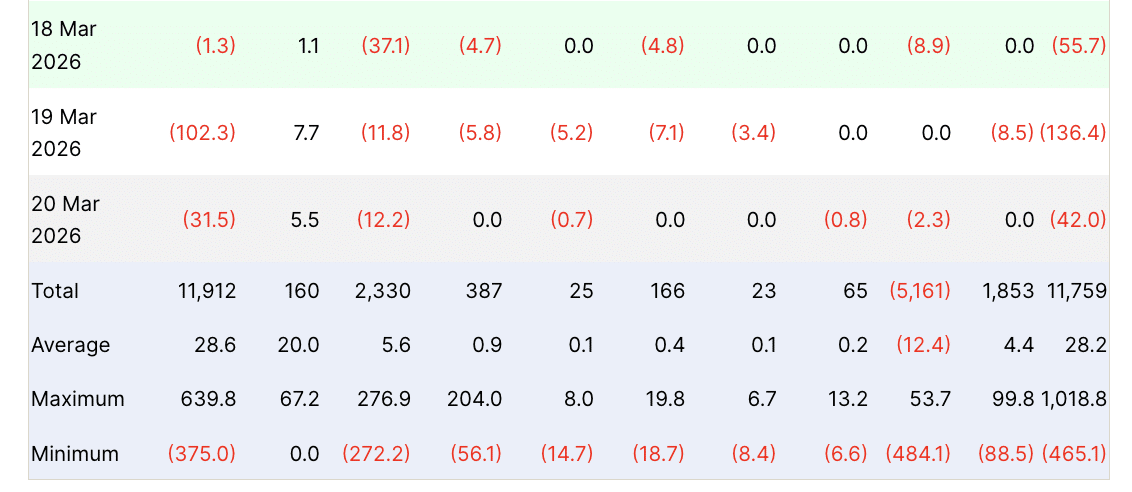
Source: Farside Investors

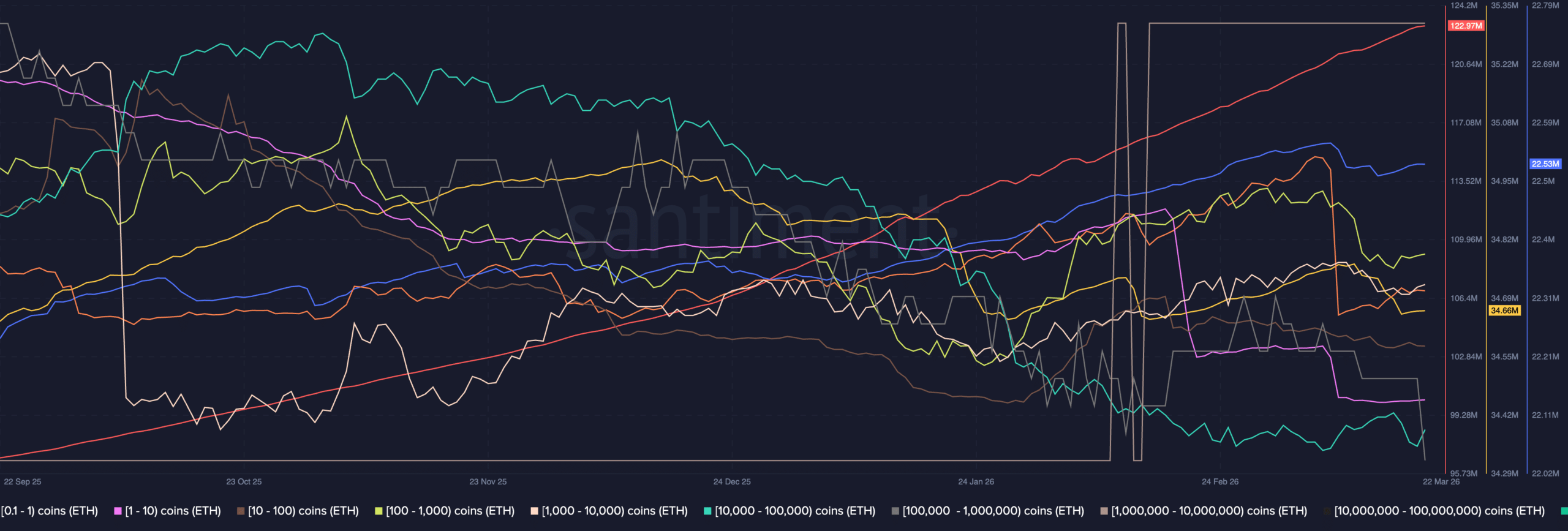
However, a closer look reveals that large whales are steadily increasing their holdings, while mid-sized investors seem to be selling or redistributing.

Meanwhile, retail investors remain inconsistent, often buying at higher levels and selling during dips.
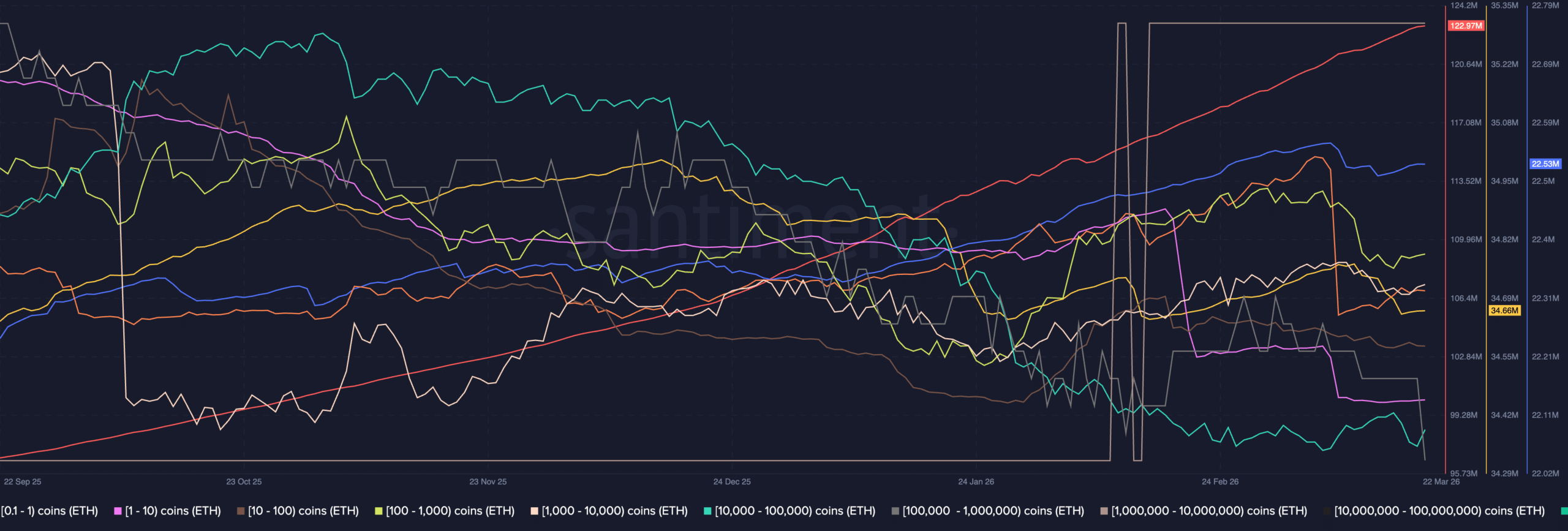
Source: Santiment

Overall, this indicates that Ethereum is gradually moving from weaker hands to stronger, long-term holders, which is typically a bullish sign for the market.

Voorhees’ past whale move and a crazy plot twist

For those unaware, this whale activity began on the 16th of March and intensified on the 20th of March, when the Voorhees-linked whale made another major move.
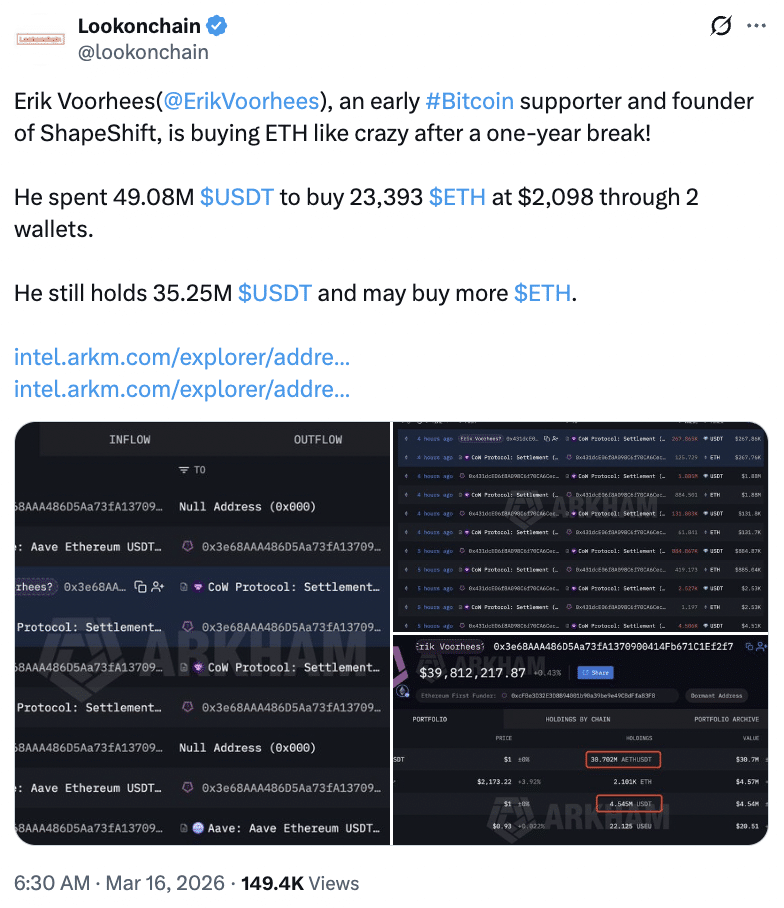
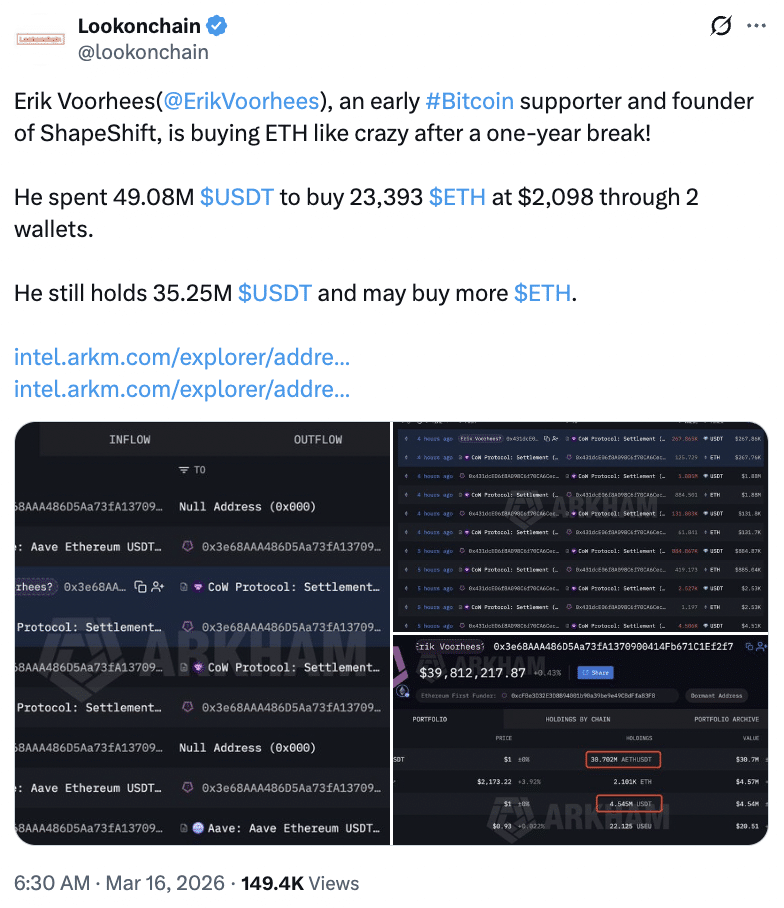
Source: Lookonchain/X

However, the narrative took a sharp turn when Voorhees publicly denied any involvement and said,

I did not buy any eth and those tracking sites are a scam.

Now, this throws darts at two opposite possibilities. In the first case, it could be a different investor with similar wallet activity, or simply a misidentification by tracking platforms.

However, another possibility is stealth accumulation, where large investors buy quietly to avoid moving the market.

Whatever the possibilities may be, such whale movements do impact how investors perceive and feel about the token’s future.


Final Summary

  • Price weakness is being used as an opportunity by large players, not a warning sign.
  • ETF outflows may look bearish, but on-chain data shows whales are steadily increasing holdings.

Related Questions

QWhat recent on-chain activity is linked to a major whale, and how much ETH was accumulated?

ARecent on-chain data suggests a major whale, reportedly linked to Erik Voorhees, deployed nearly $260 million in USDT to accumulate more than 120,000 ETH over the past two weeks.

QWhat is the average buying price for the whale's ETH accumulation, and why is it significant?

AThe average buying price for the whale's accumulation stands at around $2,162, which now acts as a key support level for the market.

QHow does the current retail activity for Ethereum compare to the behavior of large whales, according to the article?

ARetail activity is currently low, which is a sign the market is in a quieter phase where large investors are accumulating, while retail investors tend to buy at higher prices and sell during dips.

QWhat was Erik Voorhees's public response to the reports linking him to the whale activity?

AErik Voorhees publicly denied any involvement, stating, 'I did not buy any eth and those tracking sites are a scam.'

QWhat is one possible explanation given in the article for the whale's activity if it is not Voorhees?

AOne possibility is that it could be a different investor with similar wallet activity, or simply a misidentification by tracking platforms. Another possibility is stealth accumulation, where large investors buy quietly to avoid moving the market.

Related Reads

The Verdict in Choi Tae-won's Divorce Case: Revealing the Inheritance Undercurrent Behind SK Hynix's Trillion-Won Empire

SK Group Chairman Chey Tae-won's high-profile divorce case, involving a record 1.38 trillion won settlement, has drawn attention to the succession plans for Korea's second-largest conglomerate, especially its crown jewel, SK hynix. Unlike traditional chaebol scripts centered on the eldest son, Chey's three children from his marriage to former President Roh Tae-woo's daughter, Roh Soh-yeong, are carving distinct, non-traditional paths. Eldest daughter Chey Yun-jung (b. 1989) is seen as the most evident successor. With a scientific and consulting background, she holds executive roles at SK bioscience and SK Inc.'s growth support department, focusing on future strategy and biopharma. Her marriage is to an AI infrastructure entrepreneur, not a traditional business alliance. Second daughter Chey Min-jung (b. 1991) took a unique route, voluntarily serving as a South Korean naval officer, including an anti-piracy deployment. She later worked on policy and strategy for SK hynix in Washington D.C. before co-founding an AI-driven healthcare startup. She married a former U.S. Marine Corps officer, connecting her to U.S. defense and policy circles—networks crucial for a global semiconductor giant. The only son, Chey In-geun (b. 1995), who studied physics like his father, worked briefly at SK E&S before joining McKinsey. Despite fitting the traditional "heir" profile as the eldest son, he remains silent and holds no public position or shares in SK, suggesting the old succession playbook is obsolete. As SK hynix's valuation soars, becoming a geopolitical asset in the AI era, the heirs' legitimacy is no longer automatic. They must prove themselves in fields like AI biotech, global policy, and strategic consulting. Their marriages also reflect new elite networks in tech and defense, not old political alliances. Their inheritance is the complex challenge of navigating a globalized, tech-driven world, not just a corporate throne.

marsbitYesterday 09:06

The Verdict in Choi Tae-won's Divorce Case: Revealing the Inheritance Undercurrent Behind SK Hynix's Trillion-Won Empire

marsbitYesterday 09:06

From OpenSea to OpenRouter: Is Alex Atallah Repeating His 'Exit at the Peak' Playbook?

From OpenSea to OpenRouter: Is Alex Atallah Repeating His "Exit at the Peak" Playbook? According to the Wall Street Journal, payments giant Stripe is in talks to acquire the AI model aggregation platform OpenRouter in a potential deal valuing the company near $100 billion. This would mark founder Alex Atallah's second creation of a company reaching a $100 billion valuation, following his co-founding of NFT marketplace OpenSea. OpenRouter, founded just over three years ago, has grown rapidly by acting as a unified gateway for developers to access over 400 AI models. It currently has about 10 million users and processes over 200 trillion tokens monthly. While the platform's annualized revenue is around $50 million, its valuation has skyrocketed from $1.3 billion in March 2026. The potential acquisition by Stripe, a company OpenRouter's founder once likened it to, represents a major expansion into AI infrastructure for the payments leader. This move echoes Atallah's previous timing with OpenSea, where he departed before the NFT market's significant downturn. For OpenRouter, selling now may be strategic. Despite its scale, its business model—charging a 5-5.5% fee on AI inference calls—faces pressure from competition, open-source models, and potential price wars among model providers, limiting its profitability narrative for an IPO. A key asset for potential acquirers like Stripe is OpenRouter's vast repository of real-world AI usage data, which offers unique insights into model performance and developer preferences that are difficult to replicate. Whether this potential deal signifies a new valuation benchmark for AI infrastructure or another market peak signal remains to be seen.

链捕手Yesterday 08:42

From OpenSea to OpenRouter: Is Alex Atallah Repeating His 'Exit at the Peak' Playbook?

链捕手Yesterday 08:42

Trading

Spot
活动图片