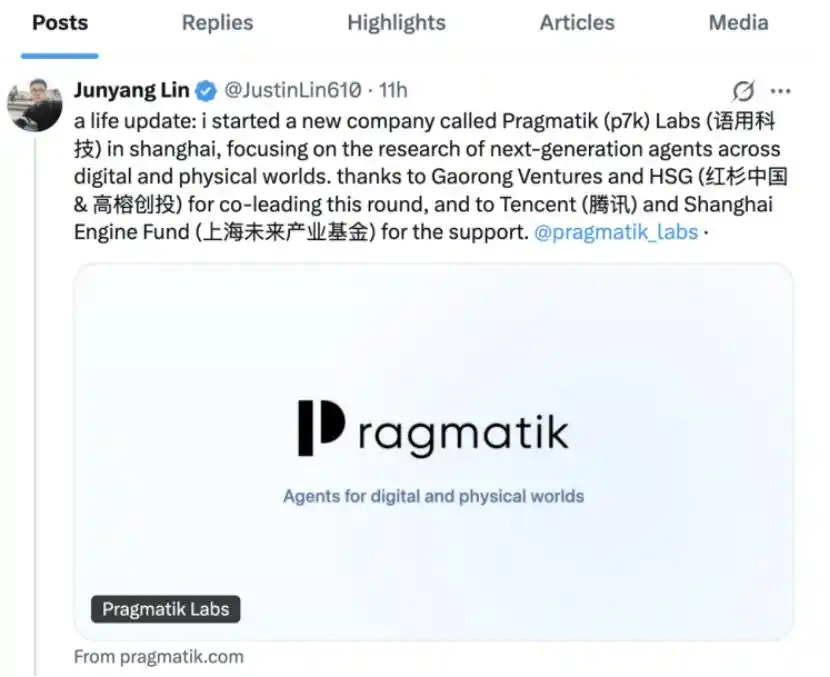
"I have founded a new company in Shanghai called Pragmatik(p7k)Labs, focusing on research into the next generation of agents across the digital and physical worlds."
In the early hours of today, Lin Junyan announced the start of his entrepreneurial venture in Shanghai on social media and revealed the first round of financing—co-led by Gaorong Capital and Sequoia Capital China, with support from Tencent and Shanghai Future Industry Fund. Previous information indicated the company's first-round valuation reached $2 billion (approximately RMB 13.5 billion).
Ultimately, it was Shanghai that secured Lin Junyan—local state-owned capital Shanghai Future Industry Fund appeared in the investor list, and Lin Junyan led Pragmatik Labs to settle in Xuhui's Model Acceleration Space.
Gaorong, Sequoia, and Tencent Join Forces to Back Lin Junyan
Lin Junyan has likely been one of the most sought-after figures in the venture capital circle over the past six months.
Born in 1993, his resume stands out uniquely in the AI community: He completed his undergraduate studies in the English Department of the University of International Relations, while also studying Japanese, Russian, German, and French; for his master's degree, he studied Foreign Linguistics and Applied Linguistics at Peking University, focusing on natural language processing and multimodal representation learning.
After graduating with a master's degree in 2019, Lin Junyan joined Alibaba's DAMO Academy, starting as a senior algorithm engineer. In just six years, he rapidly rose through the ranks to become the youngest P10 in Alibaba's history.
Behind this rocket-like promotion was the rise of Tongyi Qianwen. At the end of 2022, the Tongyi Laboratory was established, with Lin Junyan appointed as the technical lead. In the following three years, he spearheaded the development and open-sourcing of the Qwen series from scratch, making it one of the most influential open-source large models globally.
However, in the early hours of March 4th this year, Lin Junyan suddenly announced his departure: "me stepping down. bye my beloved qwen."
Now, his new company has emerged.
Pragmatik Labs is called "语用科技" (Pragmatics Technology) in Chinese, abbreviated as p7k. Lin Junyan explained the origin of the name on social media: "I studied linguistics because a friend recommended pragmatics to me. Later, I shifted to computational linguistics and natural language processing. The name Pragmatik means returning to where everything began; it also represents pragmatism. We believe artificial general intelligence (AGI) should aim for precisely that."
The Pragmatik Labs website is already live, disclosing information with extreme restraint—no model parameters announced, no specific products released. However, the technical direction is clear: researching the next generation of agents (Agent) spanning the digital and physical worlds, reshaping work and life.
The homepage summarizes the roadmap with four keywords: Digital Agent, Physical Agent, From Research to Product, Long-range Exploration—not making sequels to large models, but working on the next generation of agents.

This direction is not a whim. As early as this March, Lin Junyan published his first long post after leaving, titled "From Reasoning Thinking to Agentic Thinking," proposing that the core proposition of the next stage of AI should shift from 'training models' to 'training agents'. In his view, the real objects that need training in the Agent era are complete systems composed of "model + environment."
During these five months, the venture capital circle has been inquiring about Lin Junyan's whereabouts. This time, the answer is revealed—Gaorong Capital and Sequoia Capital China led the investment, with Tencent and Shanghai Future Industry Fund also participating. As early as June, news had surfaced that the post-investment valuation for the first round of Lin Junyan's AI lab had reached $2 billion.
In other words, even before its official debut, Pragmatik Labs was already a company valued at tens of billions.
Shanghai State Capital Also Joins In
Among this list of investors also emerges the figure of Shanghai state capital—Shanghai Future Industry Fund.
Looking back to 2024, the Shanghai Future Industry Fund was established with an initial scale of RMB 10 billion, later expanded to RMB 15 billion. This is a functionally oriented, government-guided, market-operated government investment fund of funds in Shanghai, positioned to promote disruptive innovation and frontier technology incubation.
"We hope to unite with social capital, give funds full freedom, and help scientific and technological achievements achieve transformation from 0 to 1." At that time, Wei Fanjie, General Manager of Shanghai Future Industry Fund, stated that the fund focuses on supporting young people with an exploratory spirit.
By partnering with Pragmatik Labs, Shanghai Future Industry Fund injects a fresh force into Shanghai's AI industry ecosystem. And the registered address of Pragmatik Labs is precisely Shanghai's Model Acceleration Space.
AI entrepreneurs are no strangers to this place. Unveiled in September 2023 on the West Bund in Xuhui, Model Acceleration Space is the first large model innovation ecosystem community in China. From the initial batch of over 20 companies to now over 300 companies settled in its core area, driving the agglomeration of more than 2,000 AI companies in the surrounding area, with unicorns like WuWen XinQiong and LiblibAI all rooted here, "downstairs and upstairs form the upstream and downstream."
This is precisely a glimpse of Shanghai's AI industry explosion—in 2025, 394 large-scale AI enterprises in Shanghai achieved an industry scale exceeding RMB 637 billion, a year-on-year increase of 39.5%.
Behind this is the irrigation of venture capital activity. Just as the national artificial intelligence fund with a total scale of RMB 60 billion has landed in Shanghai, the municipal-level AI pilot industry fund of RMB 22.5 billion managed by Shanghai State-owned Investment Group is actively investing, and the Shanghai Future Industry Fund under Shanghai State-owned Investment Group, with its 15-year fund life, provides long-term support for early-stage hard-tech projects.
Beyond capital, Shanghai is weaving an even denser network, issuing RMB 1 billion annually in computing power vouchers, model vouchers, and data corpus vouchers, "use first, pay later, exemption from application." From computing power subsidies to data corpus platforms, from opening application scenarios to talent attraction policies, a complete artificial intelligence support system is taking shape.
The latest development: Shanghai is innovating in the market-oriented reform of computing power elements, continuously exploring new investment methods like computing power equity investment and new investment attraction models combining "computing power resources + application scenarios."
And the choices of enterprises are the most genuine vote. From large models to embodied intelligence, from chips to robots, a batch of AI startups have chosen Shanghai as the "first stop" to realize their dreams—here, there is not only patient "long-term money" but also complete industrial chain support, a dense talent pool, and rich application scenarios.
At this moment, the AI industry competition has already unfolded among cities, with Beijing, Shenzhen, and Hangzhou also competing fiercely. Just as Beijing has Zhipu and Kimi, and Hangzhou has DeepSeek, the competition between cities ultimately boils down to competition among enterprises—Changxin and Hefei have proven that one enterprise can change an industry, and one industry can change a city.
This article is from the WeChat public account "投资界" (ID: pedaily2012), author: Zhou Jiali