Securitize announces ‘real’ tokenized stocks, touts DeFi integration

cointelegraphPublished on 2025-12-17Last updated on 2025-12-17

Abstract

Securitize has announced plans to launch what it claims will be the first compliant, on-chain trading experience for tokenized public stocks, representing real share ownership rather than synthetic exposure. The product, expected in Q1 2026, will use tokens issued directly on the issuer’s cap table and recorded onchain. Trading will occur through a DeFi-style swap interface, enabling real-time transactions even outside traditional market hours. The company criticized existing tokenized stock offerings for lacking true ownership, compliance, and proper KYC/AML controls, often relying on offshore structures. In contrast, Securitize emphasizes regulatory compliance, whitelisted wallets, and its role as an SEC-registered transfer agent to ensure tokens represent legally recognized shares. Beyond faster settlement, the firm highlights programmability—enabling integration with DeFi and smart contracts while maintaining investor protections—as a key upgrade to traditional finance.

Securitize, a company focused on tokenizing securities, said Tuesday it plans to launch what it calls the first compliant, onchain trading experience for public stocks that are issued as tokens representing real share ownership.

According to the announcement, Securitize’s stock product is expected to launch in the first quarter of 2026. The company said the offering is designed to avoid structures that mirror stock prices without conveying ownership, and instead, the tokens “are real, regulated shares: issued onchain, recorded directly on the issuer’s cap table.”

It also said trading will be presented in a “swap-style” interface familiar to users of decentralized finance, or decentralized finance (DeFi).

Securitize argued that natively tokenized public stocks, in which tokens represent actual stock ownership, were held onchain but mostly traded through traditional offchain processes. Its pitch is that buyers and sellers will be able to trade “fully on-chain” in real time, including during hours when traditional markets are closed.
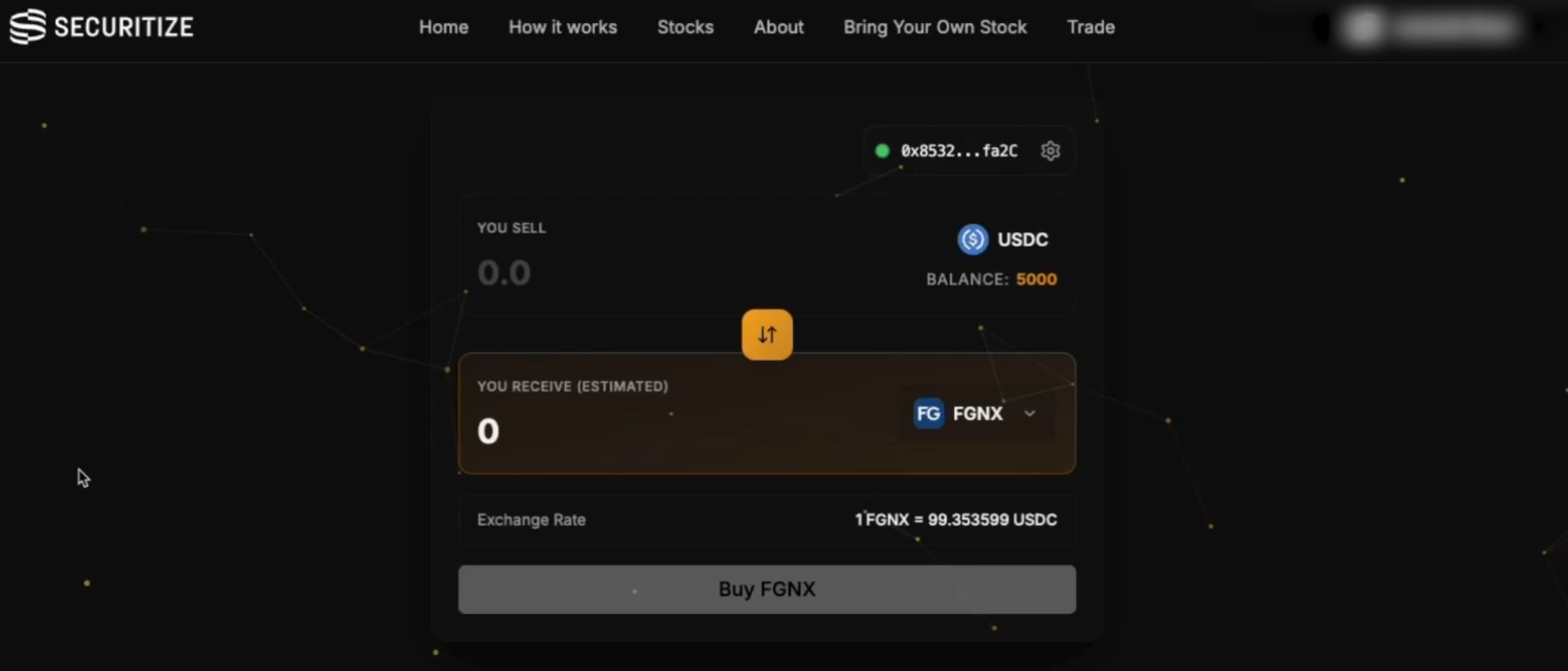
Securitize’s tokenized stock trading user interface. Source: Securitize

Related: Binance hints at stock perps in push to join global tokenized equities race

A compliant tokenized stock ecosystem

Securitize criticized the recent wave of tokenized stock products, claiming they “offer exposure, not ownership.” The company said some products rely on special-purpose vehicles or offshore structures that can add counterparty risk or create pricing mismatches.

It also criticized tokenized stock products, which it said “are not even compliant, since they are issued as permissionless assets without Know Your Customer (KYC) or Anti-Money Laundering (AML) controls.

Still, the company notes that traditional stock infrastructure is antiquated and needs disintermediation and rebuilding, with investors rarely holding “shares in their own name, settlement takes at least a day.”

“If tokenization is going to matter at public-market scale, it must deliver ownership, real securities and maintain investor protections.“

Securitize said its approach is built around regulated securities and compliance requirements, including controls that limit transfers to approved, or whitelisted, wallets.

Related: Ondo wins Liechtenstein approval to offer tokenized stocks in Europe

Regulated shares make their way to DeFi

Securitize said it will act as the transfer agent for the shares, describing itself as registered with the US Securities and Exchange Commission. Transfer agents maintain shareholder records and process changes in ownership. By pairing that role with blockchain-based issuance, the company said the tokens would be legally recognized shares rather than a proxy claim.

Securitize downplayed faster settlement as the main selling point, saying the larger opportunity is programmability, or the ability for tokenized securities to interact with smart contracts and onchain financial applications.

It further argued that this programmability allows tokenized securities to be integrated with DeFi platforms “without compromising compliance or user protections.”

“This is not about replacing traditional finance. It’s about upgrading it,“ Securitize said.

Related Reads

L2 'Recalibration': When L1 Becomes Its Own Rollup, What Is Ethereum's Endgame?

The article discusses the evolving relationship between Ethereum's Layer 1 (L1) and Layer 2 (L2) solutions, moving beyond the initial "L2 for scaling" model. As Ethereum L1 itself scales (increasing Gas Limit, statelessness, zkEVM), the unique value proposition of L2s shifts from merely providing cheap execution to offering differentiated features like application-specific optimization, privacy, and flexible governance. The piece explores three key themes: 1. **L2's New Role:** L2s are transitioning from a pure scaling technology to a spectrum of execution environments with varying degrees of security inheritance from Ethereum L1. 2. **Interoperability as State Trust:** Solving L2 fragmentation is less about cross-chain bridges and more about enabling faster, trust-minimized state verification between environments. This involves initiatives like faster L1 finality, intent-based architectures (Open Intents Framework), and native account abstraction. 3. **Blurring Layers:** With the potential integration of zk-proofs into L1 validation (making L1 akin to its own "Rollup") and the concept of "Native Rollups," the rigid boundary between L1 and L2 may fade. The future could be a unified system with multiple execution domains (for DeFi, gaming, privacy, etc.) sharing a common security, settlement, and state framework. In conclusion, Ethereum's goal is not to abandon L2s or re-centralize everything on L1, but to re-integrate the fragmented user experience—liquidity, accounts, applications—while preserving the scaling benefits of a multi-environment ecosystem. The endgame is a cohesive "one chain" feeling for users, powered by diverse but securely interconnected execution layers.

marsbit29m ago

L2 'Recalibration': When L1 Becomes Its Own Rollup, What Is Ethereum's Endgame?

marsbit29m ago

Trading

Spot
活动图片