Saylor pitches Bitcoin-backed banking system to nation-states

cointelegraphPublished on 2025-12-08Last updated on 2025-12-08

Abstract

Michael Saylor, CEO of MicroStrategy, is advocating for nation-states to establish Bitcoin-backed digital banking systems. He proposes using overcollateralized Bitcoin reserves and tokenized credit instruments to create regulated accounts offering higher yields than traditional deposits, which currently provide minimal returns in regions like Japan and Europe. Saylor suggests a structure with 80% digital credit, 20% fiat, and a 10% reserve buffer to reduce volatility. He claims such a system could attract trillions in capital flows and position a country as a global digital banking leader. This follows MicroStrategy's recent purchase of 10,624 BTC, increasing its holdings to 660,624 BTC. The article also references skepticism around Bitcoin's volatility and the viability of such products, citing MicroStrategy's own STRC offering, which has a $2.9B market cap but faces criticism over potential liquidity risks.

Michael Saylor, CEO of the world’s largest Bitcoin treasury holder, is pushing nation-states to develop Bitcoin-backed digital banking systems that offer high-yield, low-volatility accounts capable of attracting trillions of dollars in deposits.

Speaking at the Bitcoin MENA event in Abu Dhabi, Saylor said countries could use overcollateralized Bitcoin (BTC) reserves and tokenized credit instruments to create regulated digital bank accounts that offer higher yields than traditional deposits.

Saylor noted that bank deposits in Japan, Europe and Switzerland offer little to no yield, while euro money-market funds pay roughly 150 basis points, and US money-market rates are closer to 400 basis points. He said this explains why investors turn to the corporate bond market, which “wouldn’t exist if people weren’t so disgusted with their bank account.”
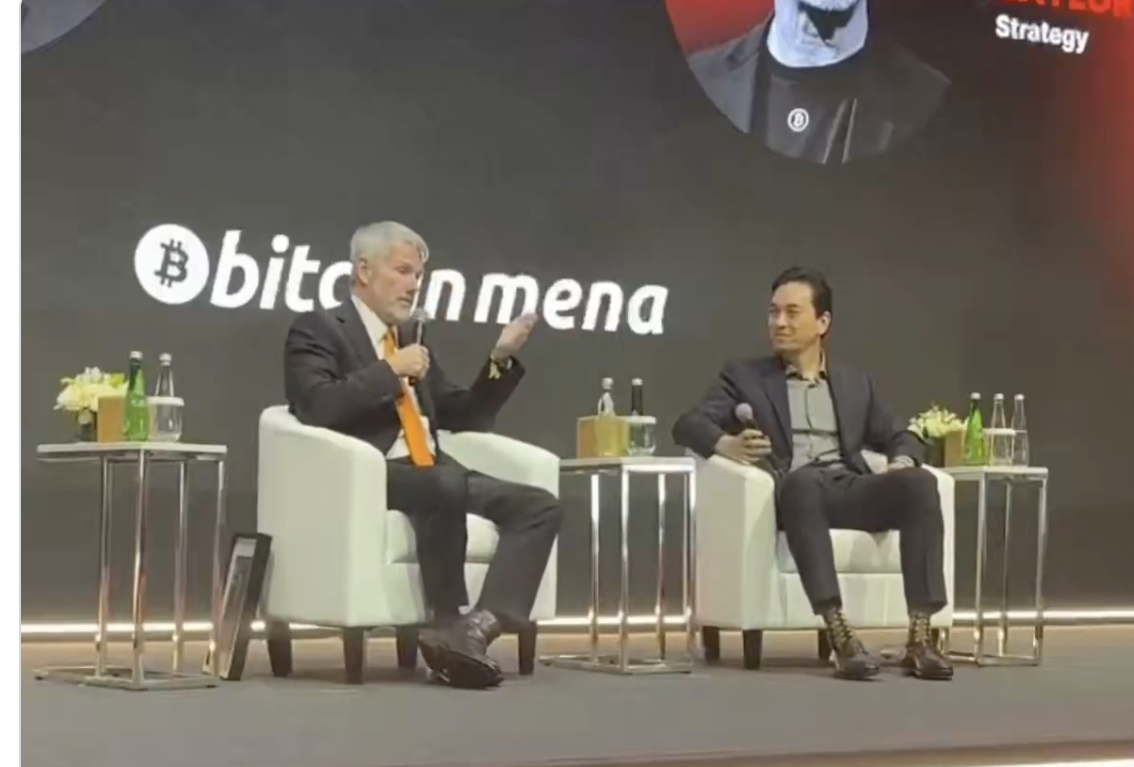
Source: The Bitcoin Therapist

Saylor outlined a structure in which digital credit instruments comprise roughly 80% of a fund, paired with 20% in fiat currency and a 10% reserve buffer on top to reduce volatility. If such a product were offered through a regulated bank, depositors could send billions of dollars to institutions for higher returns on deposits.

The account would be backed by digital credit with 5:1 overcollateralization held by a treasury entity, he said

According to Saylor, a country offering such accounts could attract “$20 trillion or $50 trillion” in capital flows. The CEO argued that a nation adopting this model could become “the digital banking capital of the world.”

The remarks followed Saylor’s revelation on X that the company purchased 10,624 BTC for about $962.7 million last week. The latest buy raises Strategy’s holdings to 660,624 BTC, acquired for roughly $49.35 billion at an average cost of $74,696.
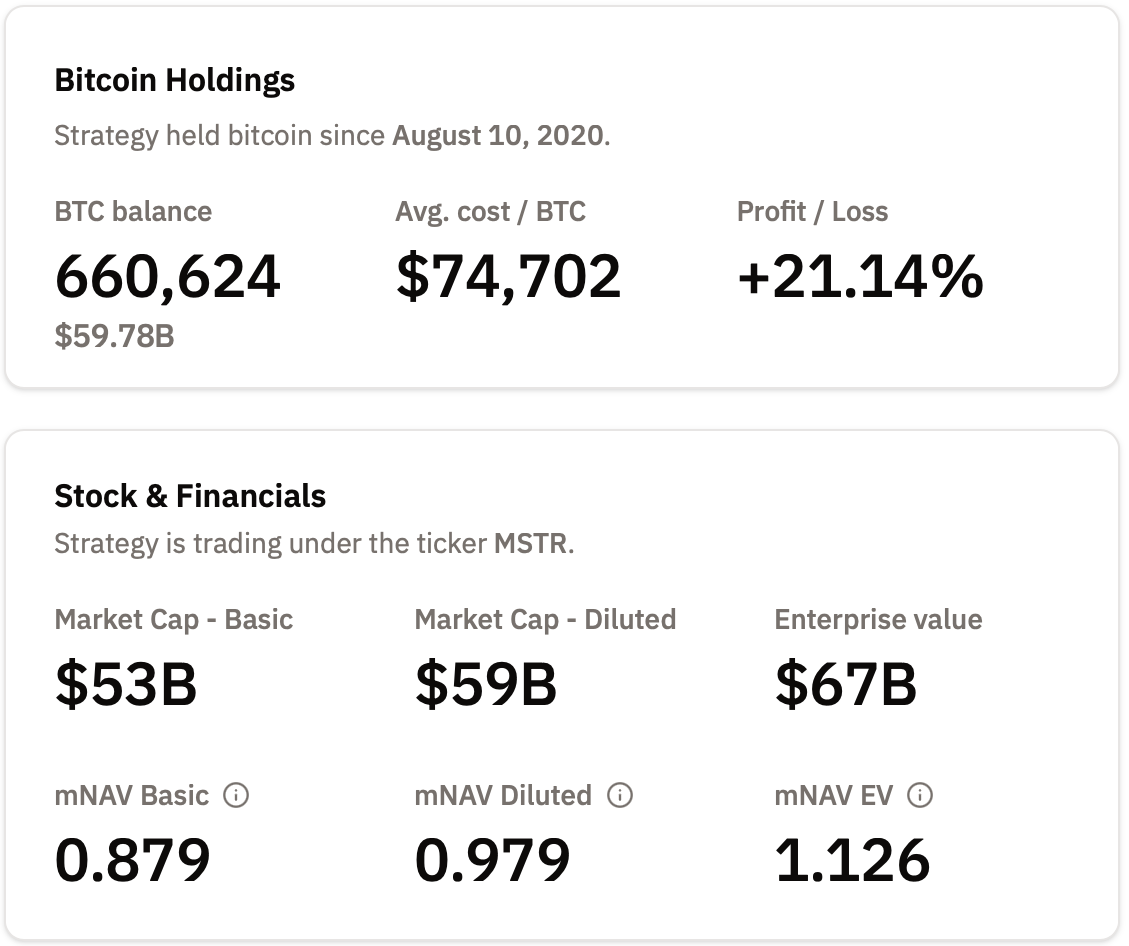
Strategy’s Bitcoin holdings. Source: BitcoinTreasuries.NET

Related: Cantor slashes Strategy target by 60%, tells clients forced-sale fears are overblown

STRK tests the viability of Bitcoin-backed debt products

Saylor’s description of a high-yield, low-volatility digital bank product echoes elements of Strategy’s own offerings. The company introduced in July STRC, a money-market-style preferred share with a variable dividend rate of around 10% and a structure designed to maintain its price near par while being backed by Strategy’s Bitcoin-linked treasury operations.

Although the product has already grown to around $2.9 billion in market cap, it has also been met with some skepticism.
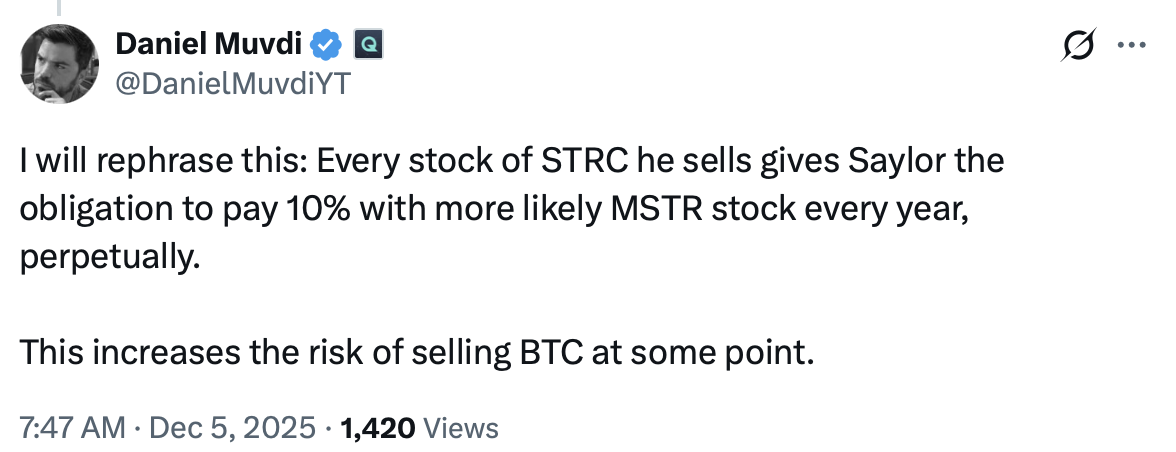
Source: Daniel Muvdi

Bitcoin’s volatility is one reason some observers question Saylor’s push for Bitcoin-backed, high-yield credit instruments. Bitcoin has delivered strong long-term returns, but its short-term performance remains difficult to predict.

At the time of writing, Bitcoin was trading around $90,700, about 28% below its Oct. 6 all-time high of $126,080 and roughly 9% lower over the past 12 months, according to CoinGecko. Over a five-year horizon, however, BTC has climbed 1,155% from $7,193 on Jan. 1, 2020.

In October, Josh Man, a former Salomon Brothers bond and derivatives trader, called Saylor’s moves “folly” and suggested STRC could suffer a liquidity event. He wrote:

“The fiat banking system has been around a long time and has figured out how to build a moat around demand deposits so that they don't break the buck. Hiking rates on STRC to maintain/defend a peg or price level is not going to work when depositors want to get their money back out.”
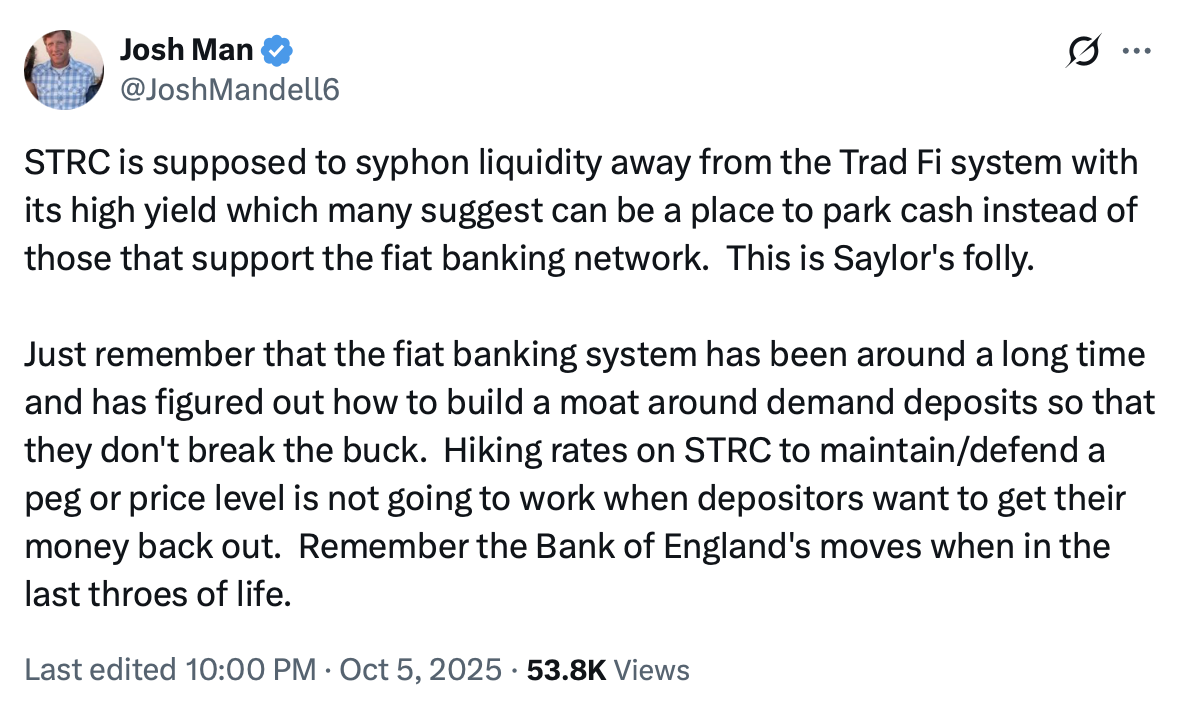
Source: Josh Man

Magazine: 6 reasons Jack Dorsey is definitely Satoshi... and 5 reasons he’s not

Related Reads

Cook's Curtain Call and Ternus Takes the Helm: The Disruption and Reboot of Apple's 4 Trillion Dollar Empire

Tim Cook has officially announced he will step down as CEO of Apple in September, transitioning to executive chairman after a 15-year tenure during which he grew the company’s market value from around $350 billion to nearly $4 trillion. He will be succeeded by John Ternus, a 50-year-old hardware engineering veteran who has been groomed for the role through increasing public visibility and internal responsibility. Ternus’s appointment signals a strategic shift toward hardware and engineering leadership, with Johny Srouji—head of Apple Silicon—taking on an expanded role as Chief Hardware Officer. This consolidation aims to strengthen Apple’s core technological capabilities. However, Cook’s departure highlights a significant unresolved issue: Apple’s delayed and fragmented approach to artificial intelligence. Despite early efforts, such as hiring John Giannandrea from Google in 2018, Apple’s AI initiatives—particularly around Siri—have struggled with internal restructuring and reliance on external partnerships, including with Google. The transition comes at a critical moment as Apple faces paradigm shifts with the rise of artificial general intelligence (ASI). The company’s closed ecosystem of hardware, software, and services—once a major advantage—now presents challenges in adapting to an AI-centric world where intelligence may matter more than the device itself. Ternus must quickly articulate a clear AI strategy, possibly starting at WWDC, to reassure markets and redefine Apple’s role in a new technological era. His task is not only to maintain Apple’s operational excellence but also to reinvigorate its capacity to innovate and lead in the age of AI.

marsbit1h ago

Cook's Curtain Call and Ternus Takes the Helm: The Disruption and Reboot of Apple's 4 Trillion Dollar Empire

marsbit1h ago

Trading

Spot
Futures

Hot Articles

What is $BITCOIN

DIGITAL GOLD ($BITCOIN): A Comprehensive Analysis Introduction to DIGITAL GOLD ($BITCOIN) DIGITAL GOLD ($BITCOIN) is a blockchain-based project operating on the Solana network, which aims to combine the characteristics of traditional precious metals with the innovation of decentralized technologies. While it shares a name with Bitcoin, often referred to as “digital gold” due to its perception as a store of value, DIGITAL GOLD is a separate token designed to create a unique ecosystem within the Web3 landscape. Its goal is to position itself as a viable alternative digital asset, although specifics regarding its applications and functionalities are still developing. What is DIGITAL GOLD ($BITCOIN)? DIGITAL GOLD ($BITCOIN) is a cryptocurrency token explicitly designed for use on the Solana blockchain. In contrast to Bitcoin, which provides a widely recognized value storage role, this token appears to focus on broader applications and characteristics. Notable aspects include: Blockchain Infrastructure: The token is built on the Solana blockchain, known for its capacity to handle high-speed and low-cost transactions. Supply Dynamics: DIGITAL GOLD has a maximum supply capped at 100 quadrillion tokens (100P $BITCOIN), although details regarding its circulating supply are currently undisclosed. Utility: While precise functionalities are not explicitly outlined, there are indications that the token could be utilized for various applications, potentially involving decentralized applications (dApps) or asset tokenization strategies. Who is the Creator of DIGITAL GOLD ($BITCOIN)? At present, the identity of the creators and development team behind DIGITAL GOLD ($BITCOIN) remains unknown. This situation is typical among many innovative projects within the blockchain space, particularly those aligning with decentralized finance and meme coin phenomena. While such anonymity may foster a community-driven culture, it intensifies concerns about governance and accountability. Who are the Investors of DIGITAL GOLD ($BITCOIN)? The available information indicates that DIGITAL GOLD ($BITCOIN) does not have any known institutional backers or prominent venture capital investments. The project seems to operate on a peer-to-peer model focused on community support and adoption rather than traditional funding routes. Its activity and liquidity are primarily situated on decentralized exchanges (DEXs), such as PumpSwap, rather than established centralized trading platforms, further highlighting its grassroots approach. How DIGITAL GOLD ($BITCOIN) Works The operational mechanics of DIGITAL GOLD ($BITCOIN) can be elaborated on based on its blockchain design and network attributes: Consensus Mechanism: By leveraging Solana’s unique proof-of-history (PoH) combined with a proof-of-stake (PoS) model, the project ensures efficient transaction validation contributing to the network's high performance. Tokenomics: While specific deflationary mechanisms have not been extensively detailed, the vast maximum token supply implies that it may cater to microtransactions or niche use cases that are still to be defined. Interoperability: There exists the potential for integration with Solana’s broader ecosystem, including various decentralized finance (DeFi) platforms. However, the details regarding specific integrations remain unspecified. Timeline of Key Events Here is a timeline that highlights significant milestones concerning DIGITAL GOLD ($BITCOIN): 2023: The initial deployment of the token occurs on the Solana blockchain, marked by its contract address. 2024: DIGITAL GOLD gains visibility as it becomes available for trading on decentralized exchanges like PumpSwap, allowing users to trade it against SOL. 2025: The project witnesses sporadic trading activity and potential interest in community-led engagements, although no noteworthy partnerships or technical advancements have been documented as of yet. Critical Analysis Strengths Scalability: The underlying Solana infrastructure supports high transaction volumes, which could enhance the utility of $BITCOIN in various transaction scenarios. Accessibility: The potential low trading price per token could attract retail investors, facilitating wider participation due to fractional ownership opportunities. Risks Lack of Transparency: The absence of publicly known backers, developers, or an audit process may yield skepticism regarding the project's sustainability and trustworthiness. Market Volatility: The trading activity is heavily reliant on speculative behavior, which can result in significant price volatility and uncertainty for investors. Conclusion DIGITAL GOLD ($BITCOIN) emerges as an intriguing yet ambiguous project within the rapidly evolving Solana ecosystem. While it attempts to leverage the “digital gold” narrative, its departure from Bitcoin's established role as a store of value underscores the need for a clearer differentiation of its intended utility and governance structure. Future acceptance and adoption will likely depend on addressing the current opacity and defining its operational and economic strategies more explicitly. Note: This report encompasses synthesised information available as of October 2023, and developments may have transpired beyond the research period.

363 Total ViewsPublished 2025.05.13Updated 2025.05.13

What is $BITCOIN

Discussions

Welcome to the HTX Community. Here, you can stay informed about the latest platform developments and gain access to professional market insights. Users' opinions on the price of BTC (BTC) are presented below.

活动图片