Ripple Ushers In New Year With Sell-Offs: 1,000,000,000 XRP Makes Its Way Out Of Escrow

bitcoinistPublished on 2026-01-03Last updated on 2026-01-03

Abstract

Ripple unlocked 1 billion XRP from escrow on January 1, 2026, in three transactions totaling $1.84 billion, amid concerns of increased sell pressure following XRP's negative December close. However, on-chain data shows Ripple quickly relocked 700 million XRP into new escrow contracts within hours, continuing its practice of mitigating supply shocks. The market impact is expected to hinge on how much of the remaining 300 million XRP is sold on exchanges rather than the unlock itself.

The new year opened with a familiar but closely watched event in the XRP ecosystem as Ripple released 1 billion XRP from escrow on January 1, 2026. The unlock arrived at a sensitive moment for price action, coming just after XRP closed December 2025 in the red.

Large escrow releases often lead to concerns about sell pressure, but early on-chain activity suggests the usual Ripple pattern is already unfolding, with a significant portion of the unlocked supply being prepared for relocking.

How The 1 Billion XRP Escrow Release Unfolded

Blockchain data shows the release occurred in three major transactions, all settled within a narrow time window on January 1. Immediately the year started, 300 million XRP, valued at about $552 million, was unlocked and sent to the address rMhkqz, identified as the Ripple (28) wallet. Shortly after, another 200 million XRP, worth about $368 million, followed into the same wallet, bringing Ripple (28)’s intake to half a billion XRP within seconds.

The final and largest portion arrived into a third wallet during which 500 million XRP, valued at approximately $920 million, was released to the r9NpyV address, designated as the Ripple (9) wallet. Together, these transactions completed the scheduled 1 billion XRP escrow release, immediately increasing the circulating supply on paper.

The timing of the escrow release adds complexity to XRP’s near-term outlook. XRP ended December 2025 with a red monthly close of negative 14.8%. Notably, this was the first time XRP closed December in the red since 2022. An influx of unlocked tokens during such a period can increase bearish sentiment, particularly among short-term traders sensitive to supply changes.

Relocking Activity As Ripple Repeats Its Playbook

History shows Ripple always relocks between 70% and 80% of each monthly escrow release, a practice that has helped soften long-term supply shocks. Interestingly, activity after the unlocks indicates this approach was repeated within 24 hours of the unlocks. Transaction records from XRPScan reveal that funds exiting the Ripple (9) wallet were quickly routed toward new escrow arrangements, and a substantial share of the newly released supply was removed from immediate circulation.
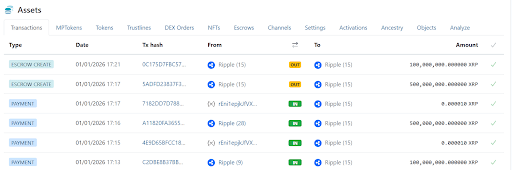
Source: Chart from XRPScan

Millions of tokens were sent out from both Ripple (9) and Ripple (28) simultaneously. At 17:17 UTC, an escrow creation transaction locked 500 million XRP into the Ripple (15) address, followed by another escrow creation at 17:21 UTC that secured an additional 100 million XRP in the same wallet.

Related Reading: Ripple’s XRP Ledger Just Did Something Bitcoin Has Never Done

Parallel activity was also observed from Ripple (14), where a separate escrow creation locked 100 million XRP at 17:19 UTC. Combined, these transactions accounted for 700 million XRP already placed back into escrow.

The appearance of escrow creation transactions changes the narrative of a supply dump. Instead of a full-scale sell-off, the data points to controlled relocking consistent with Ripple’s strategy of escrow management. XRP’s price response will likely depend less on the headline escrow release itself and more on how much of the remaining unlocked supply reaches crypto exchanges.

XRP trading at $1.88 on the 1D chart | Source: XRPUSDT on Tradingview.com

Related Questions

QHow much XRP was released from escrow by Ripple on January 1, 2026, and what was its total value?

ARipple released 1 billion XRP from escrow on January 1, 2026. The total value of the unlocked amount was approximately $1.84 billion.

QWhat was the immediate destination of the 1 billion XRP after it was unlocked from escrow?

AThe 1 billion XRP was sent to two Ripple wallets: 500 million XRP went to the Ripple (28) wallet (rMhkqz) and 500 million XRP went to the Ripple (9) wallet (r9NpyV).

QWhat is Ripple's historical practice regarding the majority of its monthly escrow releases, and what evidence suggests this pattern was repeated?

ARipple historically relocks between 70% and 80% of each monthly escrow release. Evidence from this event shows that within 24 hours, 700 million XRP (70% of the release) was placed back into new escrow contracts, repeating this pattern.

QWhy did the timing of this escrow release add complexity to XRP's near-term price outlook?

AThe timing was complex because it occurred just after XRP closed the month of December 2025 with a negative 14.8% return, its first red December close since 2022. An influx of new supply during a bearish period can increase negative sentiment.

QWhat will XRP's price response likely depend on, according to the article?

AXRP's price response will likely depend less on the headline escrow release itself and more on how much of the remaining unlocked supply (the portion not relocked) is sold on cryptocurrency exchanges.

Related Reads

U.S. Stock Market Trend: Nasdaq Plunges 3.5% Intraday Before a Remarkable Recovery, All Eyes on CPI Tomorrow

"US Stock Market Trends: Nasdaq Plunges 3.5% Before Dramatic Recovery, Eyes on Tomorrow's CPI" On Tuesday, US markets experienced a wild swing. The Nasdaq initially surged nearly 0.7% before plummeting to a 3.5% intraday loss following a post by Donald Trump on Truth Social. He stated that Iran had shot down a US Apache helicopter in the Strait of Hormuz and that the US "must...respond." The index, however, staged a remarkable recovery in the final two hours, closing down only 0.97%, as subsequent remarks from Trump and Vice President Vance suggested a potential Iran deal within days. The S&P 500 fell 0.26%, while the Dow Jones gained 0.17%, supported by its non-tech components. This incident marked the first loss of a US military asset since tensions with Iran escalated in late February. Despite the event, crude oil prices fell sharply (WTI -3.93%) due to expectations of a near-term deal, OPEC+ plans to increase output, and fears that strong jobs data could lead to Fed rate hikes. Market attention is now laser-focused on the May CPI data release Wednesday morning. This report is seen as critical evidence for whether hot job growth is fueling inflation and will heavily influence expectations for the Federal Reserve's upcoming meeting. A hotter-than-expected reading could trigger further sell-offs, particularly in tech, while a cooler print could spark a significant rebound. The article notes a clear sector rotation, with money flowing out of tech (Nasdaq down over 5% in a week) into defensive sectors like healthcare and consumer staples. Other assets like gold and Bitcoin also remain under pressure. The overarching sentiment is one of "war fatigue," with markets desperately awaiting concrete results from the prolonged Iran negotiations rather than reacting to each new headline.

marsbit8m ago

U.S. Stock Market Trend: Nasdaq Plunges 3.5% Intraday Before a Remarkable Recovery, All Eyes on CPI Tomorrow

marsbit8m ago

Second Only to GPUs and Memory: MLCCs Are Becoming the Next Billion-Dollar Windfall for AI Computing Power

After GPU and memory, MLCC (Multi-Layer Ceramic Capacitors) is emerging as the next critical component in AI compute, potentially a multi-billion-dollar market. The article highlights a significant, industry-wide price increase for MLCCs, driven not by inventory cycles but by a fundamental, structural demand surge from AI and automotive sectors. AI servers require exponentially more MLCCs than traditional servers—from 2,000 to over 350,000 units per high-end AI rack—primarily to stabilize power for increasingly powerful, low-voltage GPUs. A key AI server's MLCC cost can reach thousands of dollars, making it the third-largest cost component after GPUs and memory. This demand is compounded by the automotive shift to EVs and advanced ADAS. Supply, however, struggles to keep up. Manufacturing high-end MLCCs involves extreme precision and faces six major barriers: proprietary technology, long customer certification cycles (12-18 months for AI), high capital intensity, patent thickets, specialized talent, and massive scale. Industry capacity grows at only ~10% annually, creating a persistent supply-demand gap projected to last until 2030. Three companies dominate this high-end market. **Murata** (40% global share) is the stable leader. **Samsung Electro-Mechanics** offers the highest growth elasticity with aggressive expansion. **Taiyo Yuden** is the purest MLCC play. While their current P/E ratios appear high, they are expected to compress rapidly as earnings surge, powered by significant pricing power and operational leverage. Key risks include a potential slowdown in AI capex, high valuations, competition from Chinese manufacturers in lower tiers, yen appreciation, and consumer electronics weakness. The article concludes that MLCCs are transforming from a commoditized component into a strategic, capacity-constrained asset essential for the AI-powered future.

marsbit38m ago

Second Only to GPUs and Memory: MLCCs Are Becoming the Next Billion-Dollar Windfall for AI Computing Power

marsbit38m ago

The First to Bring an AI OS to 1.4 Billion People Might Actually Be WeChat?

WeChat has introduced a significant AI update, allowing mini-program developers to integrate their services with WeChat AI. Developers can choose an "automatic mode," where WeChat AI autonomously analyzes and operates mini-programs without additional coding, or a "development mode" for creating customized skills. This move effectively transforms WeChat's vast ecosystem—including millions of mini-programs, WeChat Pay, and official accounts—into an execution layer for AI. The technical documentation reveals that WeChat's approach aligns with industry standards like MCP (Model Context Protocol) and incorporates practical lessons from AI-agent development. Key design principles include a clear "attention weight" system for API calls and a "fact + action" response structure to ensure reliable operations. Unlike Apple's Siri, which struggles with third-party app integration, WeChat's centralized control over mini-program code provides a "God's-eye view," enabling seamless AI orchestration across services. This development revives the concept of "WeChat OS," where the app could function as a natural-language-operated platform for daily tasks—from booking flights to ordering food—all within a chat interface. While challenges remain in areas like payment security and user trust, WeChat's existing service network and massive user base position it uniquely to advance AI agents from conversation to actionable assistance, potentially making complex tasks feel effortless for its 1.432 billion monthly active users.

marsbit1h ago

The First to Bring an AI OS to 1.4 Billion People Might Actually Be WeChat?

marsbit1h ago

Trading

Spot
Futures

Hot Articles

What is XRP 2.0

XRP 2.0: A New Frontier in the Cryptocurrency Landscape Introduction to XRP 2.0 In the ever-evolving realm of cryptocurrency, new projects continuously emerge, vying for attention and adoption. One such promising initiative is XRP 2.0, a novel cryptocurrency project designed to leverage advanced blockchain technology and robust encryption methodologies. While the name draws parallels with Ripple’s XRP, it’s crucial to note that XRP 2.0 operates independently, focusing on enhancing transaction security, privacy, and scalability. As the digital financial landscape increasingly embraces decentralized solutions, XRP 2.0 aims to contribute meaningfully to web3 and the overall expansion of crypto projects. What is XRP 2.0? At its core, XRP 2.0 is a cryptocurrency project that aims to create a secure and decentralized digital currency ecosystem. Its foundational technology integrates sophisticated blockchain principles with cutting-edge encryption techniques. The overarching goal of XRP 2.0 is to establish itself as a reliable and efficient platform enabling swift transaction execution while prioritizing enhanced privacy protections for its users. The project is promoted as a solution to many limitations faced by existing cryptocurrencies, proposing a system that can handle a higher volume of transactions with improved speed and privacy. This versatility positions XRP 2.0 as a significant contender in a marketplace riddled with various digital currencies. Who is the Creator of XRP 2.0? The identity of the creator behind XRP 2.0 has been flagged as ‘Wilbur.’ However, comprehensive details regarding Wilbur or their associated entity remain elusive. The anonymity of many cryptocurrency creators is not an uncommon phenomenon in the industry, often designed to maintain a degree of privacy and security. Who are the Investors of XRP 2.0? As of now, specific information related to the investment foundations or organizations supporting XRP 2.0 is not publicly available. In the cryptocurrency sector, the backing by reputed investors can significantly influence a project's credibility and success, yet the transparency regarding the financial supporters of XRP 2.0 has not been established. How Does XRP 2.0 Work? XRP 2.0 stands out by employing a combination of blockchain technology and advanced encryption algorithms that ensures secure and decentralized transactions. Its innovative structure includes unique features designed to foster user engagement and broaden functionalities beyond conventional cryptocurrency transactions. Among these features, XRP 2.0 incorporates AI-powered capabilities, such as text-to-image and text-to-speech functionalities. These additions are designed to enhance the interactive experience for users, promoting broader applicability across various sectors. By bridging technological advancements with user-centered design, XRP 2.0 aims to capture the attention of a diverse range of individuals and enterprises looking to integrate cryptocurrency solutions into their operational frameworks. Timeline of XRP 2.0 Understanding XRP 2.0 requires examining the milestones that have defined its journey thus far: July 23, 2023: XRP 2.0 is introduced as a novel cryptocurrency project, aiming to revolutionize secure and decentralized transaction capabilities in the blockchain domain. September 8, 2023: The launching of another project, XRP20, occurs, marking the emergence of an ERC-20 token on the Ethereum blockchain that remains unrelated to XRP 2.0. November 13, 2023: The XRP Ledger undergoes a significant update with the release of rippled server software version 2.0.0. It is essential to note that this development is disconnected from the XRP 2.0 cryptocurrency project. Key Points About XRP 2.0 To distill the essence of XRP 2.0, several critical factors emerge: Unique Features: The inclusion of features like AI-powered text-to-image and text-to-speech further diversifies the potential applications of XRP 2.0. Blockchain Technology: The framework utilizes advanced blockchain mechanisms and encryption protocols, ensuring a secure and decentralized environment for transactions. Scalability and Privacy: XRP 2.0 prioritizes enhanced privacy protections in transaction processes and the scalability necessary to accommodate a growing user base. No Affiliation with Ripple: Importantly, despite its name, XRP 2.0 does not have any allegiance or collaboration with Ripple’s XRP, distinguishing its operational framework and objectives within the cryptocurrency ecosystem. Conclusion XRP 2.0 represents an ambitious venture into the cryptocurrency sphere, aiming to offer a combination of security, privacy, and efficiency in digital transactions. By integrating sophisticated technologies and user-friendly features, the project sets out to broaden the horizons of what cryptocurrency can achieve in today's digital economy. While the anonymity of its creator and lack of disclosed investors might raise questions for some, XRP 2.0's focus on advanced functionalities and decentralisation enhances its appeal amidst an increasingly crowded crypto market. As the cryptocurrency landscape continues to evolve, XRP 2.0 may yet emerge as a pivotal player in the expansion of secure and scalable blockchain solutions.

942 Total ViewsPublished 2024.04.01Updated 2024.12.03

What is XRP 2.0

Discussions

Welcome to the HTX Community. Here, you can stay informed about the latest platform developments and gain access to professional market insights. Users' opinions on the price of XRP (XRP) are presented below.

活动图片