Ray Dalio: The Return of a China-led 'Tribute System', and the AI Industry Will Develop Like the Electric Vehicle Industry

marsbitPublished on 2026-06-08Last updated on 2026-06-08

Abstract

Ray Dalio, founder of Bridgewater Associates, discusses shifting global power dynamics and AI competition between China and the US. Following recent visits to China by world leaders, Dalio observes a decline in the perceived reliability of the US as a global power and a rise in China's influence. He suggests a modern "tribute system" is emerging, where nations acknowledge China's strength, impacting global trade and security. This geopolitical shift creates market uncertainty, leading Dalio to advise investors to diversify assets, including holding gold. Regarding AI, Dalio contrasts the approaches of the two nations. He states China views AI as a public utility, akin to electricity, aiming for broad workforce accessibility over immediate profitability. Chinese companies focus on widespread adoption and productivity gains, following a strategy similar to their success in the electric vehicle industry. In contrast, US AI firms are more focused on commercialization and subscription models. A Morgan Stanley executive noted the Chinese perspective lacks fear of AI displacing jobs, instead emphasizing its use to drive development and dominate future industries like robotics.

Original Source:"Wall Street Week" Program: Dalio's Warning&Ray Dalio on U.S.-China AI Development

Compiled by | Odaily Planet Daily (@OdailyChina)

Translated by | Wenser (@wenser2010)
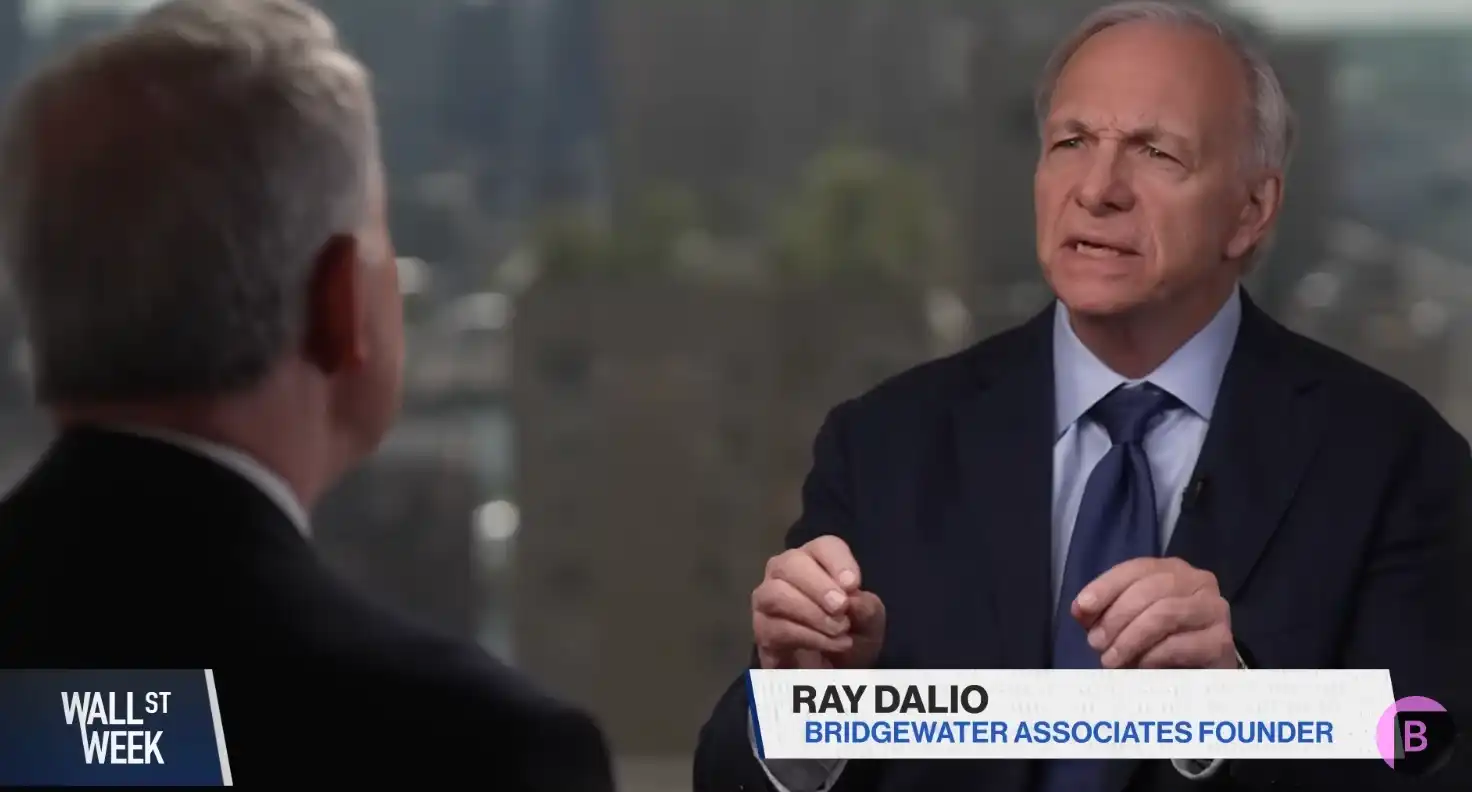
Editor's Note: As the founder of Bridgewater Associates, the world's largest hedge fund, Ray Dalio's remarks have always garnered significant attention from all sectors of society. His insights into the global macroeconomic landscape and various industries are particularly popular topics of discussion. Following the consecutive visits to China last month by world leaders including U.S. President Trump and Russian President Putin, Ray Dalio offered a new perspective on the matter—"The world order is changing, and a China-led tribute system is being established." Recently, he also shared his targeted views on the "competition between AI giants in China and the United States." The following content is compiled and translated by Odaily Planet Daily, with some details edited for clarity.

Ray Dalio on a 'China-led World': The Return of the Tribute System

Last month, following the visits to China by U.S. President Trump and Russian President Putin, Ray Dalio was interviewed by David Westin on Bloomberg's "Wall Street Week" program.

During the interview, Ray Dalio stated bluntly, "The credibility of the United States as a global power willing to fight to defend its interests is declining, while China is steadily accumulating its own global wealth and influence. This situation is fundamentally changing how other countries view these two nations."

"Currently, the United States has approximately 750 military bases in over 80 countries worldwide, so it has long been seen as a trustworthy ally in the face of (wartime) attacks." However, after concluding a roughly month-long trip to Asia (which included about 10 days of meetings with various leaders in China), Ray Dalio sensed a significant shift: an increasing number of countries are gradually coming to believe that "the United States cannot be relied upon to win wars."

Ray Dalio's comments further elaborate on his long-held view: "American power is gradually waning, while China's power is correspondingly increasing." Thanks to Bridgewater's extensive engagement with China, this perspective has gained considerable acceptance. However, on the other hand, due to his relatively close relationship with Chinese leaders, these views have also faced criticism.

Dalio went on to say that international recognition is very important for China. Currently, China's economy is about 60% to 70% the size of the United States', a ratio that has more than tripled over the past 20 years. He stated that while China does not seek to conquer or occupy other countries, it places great importance on the recognition from political leaders of various nations. "You can see many national leaders visiting China one after another, which is akin to the 'tribute system' in Chinese history—countries coming to acknowledge and respect China's formidable strength, but this system is not oppressive or controlling." (Odaily Planet Daily Note: The original phrase was 'tribute system')

"So, this tribute system is actually a hierarchical structure. When dealing with other countries, what matters is how this system affects trade and national security between them. I believe, from a political perspective, we are now entering a period where arrangements similar to the tribute system will form between (China and) various countries, and the relative power of nations will become the decisive factor (in the world's political landscape)." During the discussion, Ray Dalio also mentioned that concepts like the nation-state and national borders only gradually emerged in Western societies around the mid-17th century. Before that, power structures in Western societies were composed of different royal families, which is fundamentally different from the concept of frontiers consistently present throughout Chinese history.

He believes this change will directly impact (global) markets, including capital and finance. Because investors must navigate the current turbulent situation: there are risks to currency values, and global uncertainty requires investors to maintain liquidity and diversify their asset allocations, including investing in gold.

Ray Dalio on the 'U.S.-China AI Competition Landscape': China's AI Industry Will Develop Like the Electric Vehicle Industry

In June, Business Insider reported Ray Dalio's views on the competition in the AI sector between China and the United States, also highlighting the significant differences and potential impacts.

Ray Dalio stated that China views artificial intelligence as an important tool that should be accessible to all workers. "It's like electricity and running water—something everyone should have access to," he said.

As a prominent entrepreneur who first visited China as early as 1984, Ray Dalio has long been optimistic about China's development. He previously told attendees at a Forbes magazine conference in New York: "China has earned huge profits through exports, and these funds are being extensively used for research and development in the field of artificial intelligence, thereby driving economic growth by enhancing production efficiency."

It is worth noting that Ray Dalio emphasized that while American companies like OpenAI and Anthropic are adjusting (AI model) subscription package structures, striving to increase revenue in preparation for going public, Chinese companies are focused on enabling as many ordinary employees as possible to use their models. "It doesn't necessarily have to be expensive, nor does it even have to be profitable (right now)."

"In a way," Dalio believes, "it mimics the successful path the country has taken in industries like electric vehicles—where domestic Chinese companies like BYD have achieved rapid growth in markets such as Europe."

During a guest discussion following Dalio's speech, JPMorgan executive Mary Callahan Erdoes pointed out that unlike the social atmosphere in the United States where "job issues are treated as political topics," executives of Chinese AI companies and politicians "do not express fear about AI impacting employment" when mentioning AI. Instead, the country focuses more on "leveraging AI to drive various developments" and is committed to finding the next industrial field where it can achieve dominance. "The robotics sector can basically be seen as China's 'next-generation electric vehicle industry,'" she said.


Trending Cryptos

Related Questions

QWhat is Ray Dalio's main argument about the changing world order, according to the article?

ARay Dalio argues that the world order is shifting, with a China-led 'tribute system' re-emerging. He states that U.S. credibility as a global power is declining while China is accumulating global wealth and influence, leading more countries to acknowledge and respect China's strength through visits and engagements, reminiscent of a historical tributary relationship.

QHow does Ray Dalio characterize the difference in approach between U.S. and Chinese AI companies?

ADalio characterizes U.S. AI companies like OpenAI and Anthropic as focusing on adjusting subscription models and increasing revenue, often with an eye towards going public. In contrast, Chinese AI companies are focused on making their AI models widely accessible and affordable for ordinary workers, prioritizing broad adoption and integration into productivity, even if it is not immediately profitable.

QWhat historical analogy does Ray Dalio use to describe the current geopolitical dynamic centered on China?

ARay Dalio uses the historical analogy of China's 'tribute system' to describe the current dynamic. He suggests that the visits of numerous world leaders to China represent a modern form of this system, where countries acknowledge and respect China's power, forming a hierarchical structure in international relations based on relative strength.

QAccording to the article, what investment strategy does Ray Dalio suggest due to the current global uncertainties?

ADue to the current global uncertainties and risks to currency values, Ray Dalio suggests that investors should maintain liquidity and diversify their asset allocations. This diversification includes investments in assets like gold as a hedge against the turbulent geopolitical and economic landscape.

QWhat comparison is made regarding the development path of China's AI industry?

AThe article compares the development path of China's AI industry to that of its electric vehicle (EV) industry. It suggests that China aims to replicate the success of companies like比亚迪 (BYD) in the EV market by focusing on making AI a ubiquitous tool for enhancing productivity and seeking dominance in future strategic industries, such as robotics, in a similar manner.

Related Reads

Why Zhang Yiming Spends 50% of His Time on Seed?

Why does Zhang Yiming devote 50% of his time to Seed, ByteDance's core AI research team, while the company’s high-profile AI products like Doubao appear less dominant in the current market? An analysis reveals that ByteDance, historically a leader in defining trends (e.g., TikTok, Toutiao), has not set major AI industry agendas in the first half of the year, instead following competitors in areas like Agent and productivity tools. ByteDance’s strategy diverges from peers like Tencent and Alibaba, who are integrating AI into holistic productivity systems. While Doubao is highly successful—with 382 million MAU and leading revenue—its very success may create inertia, focusing iterations on improving the AI assistant rather than pioneering disruptive new entry points like Agent-native desktops. Zhang Yiming’s deep investment in Seed, a team of 300+ top researchers from firms like Google DeepMind, signals a long-term bet on foundational model capabilities as the ultimate competitive moat, reminiscent of ByteDance's past wins through superior underlying tech (e.g., recommendation algorithms). However, in the fast-evolving AI era, superior foundational models risk being outpaced by rapid shifts in product-level interaction paradigms and user habits. Zhang is essentially applying his principle of "delayed gratification" to corporate strategy, gambling that Seed’s breakthroughs will eventually make it the indispensable infrastructure for all AI applications, regardless of which product leads the user interface. The core question remains: is the AI era a race for the best product or the most powerful underlying infrastructure? The answer will define ByteDance’s future position.

marsbit3m ago

Why Zhang Yiming Spends 50% of His Time on Seed?

marsbit3m ago

From 'Speculative Asset' to 'The Next Generation Financial Infrastructure', Crypto is Growing a New TradFi World

From "Speculative Asset" to "Next-Generation Financial Infrastructure": Crypto Is Evolving into a New TradFi World Looking back, the crypto industry has long focused on identifying the "next asset to pump." However, starting around 2026, several developments across different sectors began converging. Stablecoin market cap approached $300 billion, entering a global payments adoption phase. DTCC initiated its first live tokenized asset conversions, while prediction markets expanded into regulated exchanges and brokerages. Simultaneously, AI Agents began using stablecoins autonomously for payments. These seemingly disparate trends share a common thread: the issuance, custody, trading, payment, and settlement capabilities built by the crypto industry over the past decade are now opening to broader financial activities and machine-driven economies. This suggests crypto is maturing beyond a purely speculative market, building a foundational infrastructure layer beneath it. This simultaneous progress occurs because the core components of a new financial system—stablecoins as programmable money APIs, RWA tokenization for traditional assets, prediction markets for price discovery on future events, and AI Agents as new economic actors—have developed independently and are now beginning to interconnect. These elements form the building blocks of a next-generation financial infrastructure. This emerging infrastructure features multi-layered capabilities: 1) Asset issuance and tokenization for a wider range of assets. 2) 24/7 programmable payments and settlement, simplifying global transfers. 3) Continuous trading and price discovery, providing real-time market signals for both humans and software. 4) Advanced identity, permissions, and authorization systems suitable for institutions and AI. 5) Growing connections to real-world legal and regulatory frameworks, providing greater clarity for traditional participants. This shift is reflected in changing funding sources, with more revenue now coming from real-world business flows, an expanding set of participants (including corporate systems and autonomous agents), and more nuanced regulatory discussions focused on rules and boundaries rather than outright prohibition. However, significant challenges remain. Technical confirmation is not legal finality; liability and governance for AI-driven payments are unclear; fragmentation across networks persists; privacy solutions for institutions are needed; and the system currently lacks mature frameworks for credit, insurance, and complex risk management found in traditional finance. In conclusion, 2026 marks a pivotal point where several previously independent pieces of the crypto puzzle started to connect. While far from complete, it signifies crypto's crucial step towards becoming a low-friction, global execution layer for real assets, traditional institutions, and intelligent software, built beneath its vibrant speculative markets.

marsbit53m ago

From 'Speculative Asset' to 'The Next Generation Financial Infrastructure', Crypto is Growing a New TradFi World

marsbit53m ago

Supporters of Bitcoin BIP-110 Update Have Prepared a 'Last Resort' Plan If the Proposal Is Not Adopted: It Could Radically Change BTC's Value

Supporters of the BIP-110 update for Bitcoin have prepared a contingency plan in case the proposal is not adopted, a move that could radically alter BTC's value. Developer Chris Guida has adapted a proof-of-work code originally created by Luke Dashjr in 2017 for the current version of Bitcoin Knots. This adaptation is described as a last-resort measure to be activated if miners do not signal readiness for BIP-110. The proposal itself is a soft fork aimed at temporarily limiting the storage of arbitrary data in Bitcoin transactions. It introduces stricter limits on new transaction outputs, OP_RETURN fields, and witness data, with rules designed to expire after approximately one year. Guida stated this option needs to remain open if miners were to "conspire to betray Bitcoin." Should the contingency code be used, it could change Bitcoin's current mining algorithm. This change would likely prevent existing ASIC miners from generating blocks on the new chain, leading to a large-scale reorganization of the Bitcoin mining network. Luke Dashjr, another Bitcoin Knots developer, contributed to the code and expressed hope it would not be needed, but sees its existence as useful for a potential crisis. A supporter known as Mechanic argued that the mere possibility of a proof-of-work change could act as a deterrent, emphasizing that Bitcoin's rules should be set by participants and node operators, not miners. While miner signals are tracked for BIP-110 activation, data from the proposal's official tracking page indicates support remains limited.

cryptonews.ru4h ago

Supporters of Bitcoin BIP-110 Update Have Prepared a 'Last Resort' Plan If the Proposal Is Not Adopted: It Could Radically Change BTC's Value

cryptonews.ru4h ago

Why Did Bitcoin's Price Remain Stable and Not Fall Despite the Recent Major Hack? Here's the Secret

The article discusses why Bitcoin's price remained stable despite a recent $100 million hack targeting individual cold wallets, citing insights from experts on "The Wolf of All Streets" channel. Analysts attribute this resilience to significant institutional shifts in the crypto market. Key points include: 1. **Market Maturation:** The crypto market has transitioned from being dominated by individual retail holders to institutional investors. Most new capital now enters via regulated channels like spot ETFs and custodial services (e.g., Coinbase, Anchorage), making vulnerabilities in individual cold wallets less impactful. 2. **Institutional Dominance:** Control over price dynamics has shifted from miners and crypto exchanges to Wall Street and institutional capital. These large players operate with long-term strategies, viewing price corrections as buying opportunities rather than reasons for panic. 3. **Increased Resilience:** Institutional involvement has reduced market sensitivity to negative news. Sellers are largely exhausted, and remaining holders are steadfast. Major financial institutions (e.g., Morgan Stanley, Wells Fargo) are incorporating crypto assets into portfolios, with research teams recommending allocations of 1–6% to Bitcoin. 4. **Risk Perception:** Bitcoin's integration into traditional financial indices has lowered perceived risk among professionals and institutions, further stabilizing its price against isolated security breaches.

cryptonews.ru5h ago

Why Did Bitcoin's Price Remain Stable and Not Fall Despite the Recent Major Hack? Here's the Secret

cryptonews.ru5h ago

Trading

Spot

Hot Articles

Discussions

Welcome to the HTX Community. Here, you can stay informed about the latest platform developments and gain access to professional market insights. Users' opinions on the price of AI (AI) are presented below.

活动图片