In April 2026, China's embodied AI industry witnessed its largest single-round funding ever: $455 million. The company securing this investment is Tashi Zhihang, founded less than two years ago. Its founder, Chen Yilun, previously worked at Huawei for four years, serving as CTO and Chief Scientist of the autonomous driving system.
According to incomplete statistics from IT Juzi, entrepreneurs with Huawei backgrounds have founded/co-founded 26 embodied AI companies, ranking first among all major corporate backgrounds with total funding of 38.85 billion yuan; Huawei-born entrepreneurs are becoming one of the most competitive groups in China's embodied AI industry in terms of fundraising. For more on entrepreneurs from other major company ecosystems, please refer to the latest report "China Embodied AI Entrepreneur Ecosystem Portrait Report".
Today's article focuses on the 12 Huawei-backed companies that received funding in 2026, exploring which companies the hot money is flowing into.
I. 12 Huawei-Background Embodied AI Companies Funded in 2026
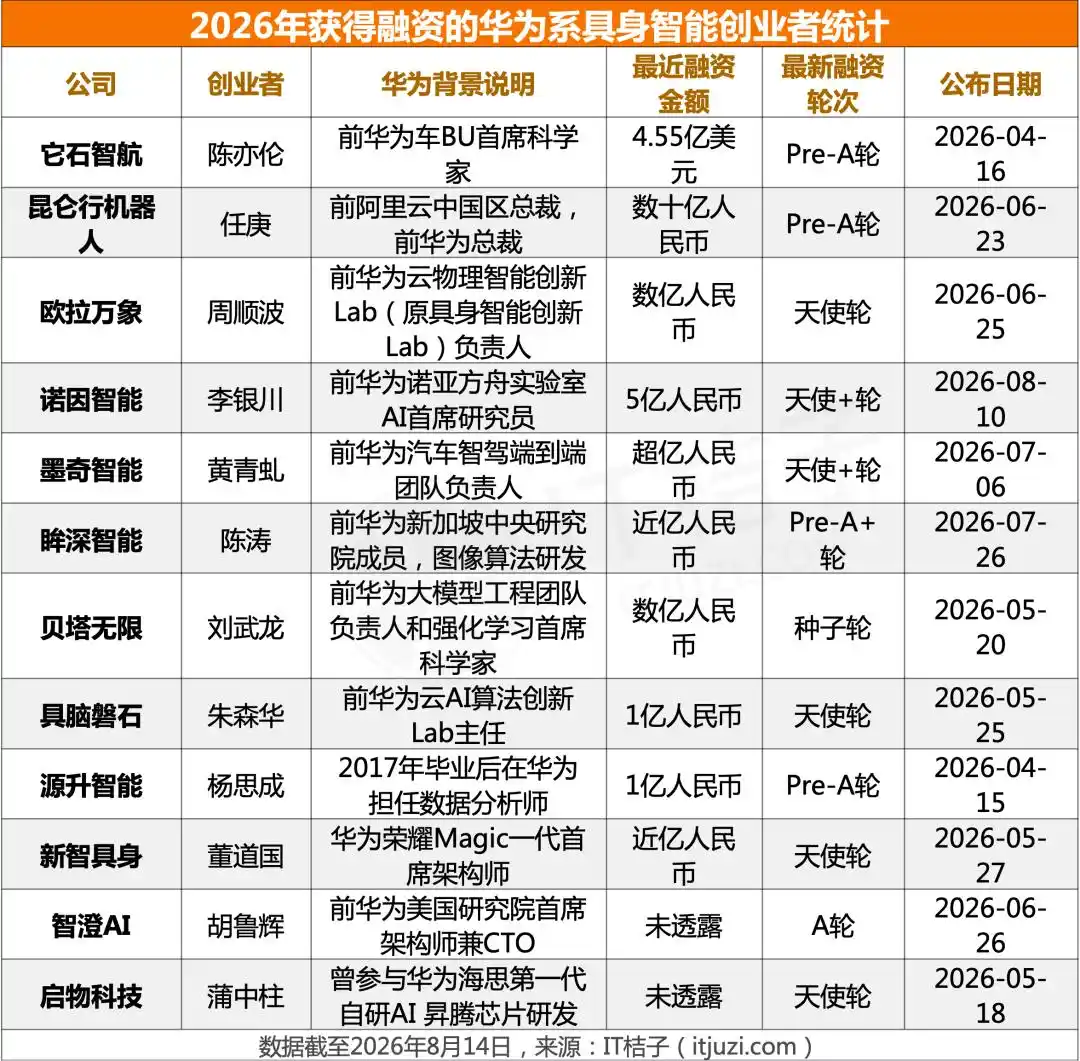
According to IT Juzi data, from January to August 14, 2026, 12 embodied AI companies with Huawei backgrounds completed a total of 24 funding rounds, with estimated total funding reaching approximately 8.635 billion yuan; this represents a growth of over 3 times compared to the full-year figure of the previous year.
Funding events were highly concentrated in the early stages: 9 angel rounds, 5 seed rounds, 5 Pre-A rounds, with early-stage funding (angel/seed/Pre-A) accounting for over 80%. This indicates that most of the companies receiving funding in 2026 are new forces established less than two years ago, with capital bets placed more on trust in the entrepreneurs' backgrounds and technical capabilities.
In terms of funding scale, 2026 shows a strong concentration effect at the top. Tashi Zhihang secured $455 million, and Kunlunxing Robotics raised tens of billions of yuan. These two companies together account for 70% of the total funding for Huawei-backed companies in 2026; the funding amounts for other small and medium-sized projects are relatively limited.
Furthermore, some startups' funding pace has accelerated significantly. Companies like Euler Wanxiang, Kunlunxing Robotics, and MouShen Intelligent completed over 3 funding rounds within six months. This kind of intensive, consecutive funding rhythm is not common, but with the funding surge in the embodied AI sector this year, some star entrepreneurs have received continuous additional investment, with the Huawei faction being an important force among them.
The table below lists each company in descending order of total 2026 funding, showing the details of their latest funding round:
II. These 5 Companies Are the Main Recipients of Major Funding This Year
Tashi Zhihang: $455 Million Pre-A Round Sets China Embodied AI Record
Tashi Zhihang was co-founded in July 2024 by Chen Yilun and Li Zhenyu.
Chen Yilun earned his bachelor's and master's degrees from the Department of Electronic Engineering at Tsinghua University and his Ph.D. from the University of Michigan. He joined DJI in 2017 as Chief Engineer, entered Huawei in 2018, serving as CTO and Chief Scientist of the Autonomous Driving System in the Intelligent Automotive Solutions Business Unit, leading the full-stack R&D of Huawei's first-generation autonomous driving system. In mid-2022, he left Huawei's Vehicle BU to become Chief Expert in Intelligent Robotics at Tsinghua University's Institute for Intelligent Industry.
Co-founder Li Zhenyu previously served as General Manager of Baidu's Intelligent Driving Business and is a senior veteran in the autonomous driving field. The company's core team also includes Huawei "Genius Youth" Ding Wenchao and others. The team possesses composite experience in autonomous driving, AI, and robotics, forming a unique "automotive-grade" engineering mindset.
In April 2026, Tashi Zhihang completed a $455 million (approximately 3.2 billion yuan) Pre-A round of funding, setting the record for the highest single-round funding in China's embodied AI industry. The investor lineup included top VCs such as Hillhouse Capital, Sequoia Capital China, Meituan, Qiming Venture Partners, and Lanchi Ventures, as well as state-owned capital like the Beijing Robotics Industry Development Investment Fund and Shanghai Guotou Xiandao.
Tashi Zhihang's core technology architecture revolves around its self-developed AWE (All-Scenario World Embodiment) general-purpose embodied large model. At the NVIDIA GTC conference in March 2026, Chen Yilun first publicly disclosed the AWE 3.0 technical architecture, achieving three key technological innovations: Omni-View Sensing and Decision (OSD), High-Density Tactile Sensing (HTS), and Latent-space Agile Actions (LAS).
Based on AWE 3.0, Tashi Zhihang set a Guinness World Record for "the most times a robot assembles sub-millimeter wire harnesses within one hour" with 105 successful assemblies—the first Guinness World Record for a Chinese embodied AI enterprise in the field of industrial precision manipulation. The company has also reached a cooperation agreement with the Abu Dhabi Technology Innovation Institute to jointly build the next-generation embodied AI large model for the global market.
Kunlunxing Robotics: Completing a "Triple Jump" from Angel to Pre-A in 4 Months
Kunlunxing Robotics was founded by Ren Geng, who serves as CEO. Ren Geng's career spans Alibaba, Alibaba Cloud, and Huawei, with hands-on experience in cloud computing infrastructure, large model training, and hardware engineering.
Kunlunxing Robotics had a very intensive funding pace in 2026: announcing angel round funding on March 4th, receiving additional angel round funding on May 25th, and completing a Pre-A round of tens of billions of yuan on June 23rd. It completed the "triple jump" from angel to Pre-A in just four months.
The rapid funding of Kunlunxing Robotics reflects a trend in the 2026 embodied AI sector: the "body + brain" dual-drive general embodied intelligence direction is favored by capital, and star entrepreneurs with composite industry backgrounds will be the biggest beneficiaries of this funding boom.
Euler Wanxiang: The Gradual Evolution Path of Huawei's Embodied AI "Employee No.1"
Zhou Shunbo holds a Ph.D. in Robotics from The Chinese University of Hong Kong. In 2021, he joined Huawei's "Genius Youth" program, focusing on intelligent robotics, and later became the "Employee No.1" in Huawei's embodied AI field, building Huawei's largest embodied AI team from scratch.
Euler Wanxiang was established in March 2026 and completed three consecutive funding rounds in just two months: a seed round of tens of millions of yuan in April, jointly invested by Hillhouse Ventures and 5Y Capital; an angel round of hundreds of millions of yuan in May, led by China Merchants Capital, with participation from SAIF Partners, 9F Capital, and Baidu Ventures; and an additional angel round of hundreds of millions of yuan in June, setting a record for funding efficiency in the extremely early stage of the embodied AI track.
Euler Wanxiang's product strategy follows a "gradual evolution" path. Its first product adopts a "mobile chassis + dual robotic arms" form, targeting the Maker and developer communities, allowing early users to help robots learn new skills and complete deployment through data collection, interaction, and demonstration.
Knowin Intelligence: A Generative Embodied Large Model Emerging from Noah's Ark Lab
Knowin Intelligence founder Li Yinchuan, born after 1995, is currently the youngest among the Huawei-background embodied AI founding teams.
Li Yinchuan joined Huawei's Noah's Ark Lab in 2020. Over five years, he served as Head of Generative Large Models, the lab's youngest project manager, and Chief Researcher in the AIGA direction, leaving to start his business in 2025. Co-founder Wang Yunjie is from DJI, and partner Zhou Kaiwen also came from Noah's Ark Lab, a former Huawei "Genius Youth" and former head of Huawei's Agent direction.
On August 10, 2026, Knowin Intelligence completed a 500 million yuan Angel++ round of funding, led by Matrix Partners China, with participation from Redpoint China Ventures, SenseTime Guoxiang Capital, Walden Technology, and L2F Light Source Entrepreneur Fund. The post-investment valuation exceeded 2 billion yuan.
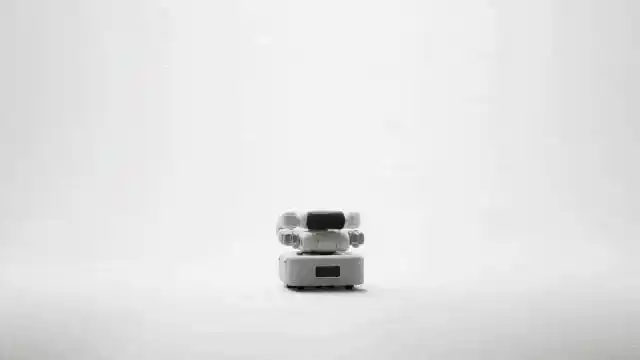
Knowin-X1 robot from Knowin Intelligence Source: Internet
Knowin Intelligence has self-developed the GLOW generative embodied large model system. At this year's WAIC exhibition, the company showcased its first consumer-grade home robot product, Knowin-X1, featuring a folding dual-arm + wheeled chassis design. It can also be fully compressed and folded, and when deployed, can perform tasks such as desktop tidying, clothing retrieval/folding, and operating washing machines. It is reported that Knowin-X1 is expected to be released in 2027.
Embodied Brain Rock: The Minority's Brain-Inspired Intelligence Path
Compared to other Huawei-background entrepreneurial groups, Embodied Brain Rock founder Zhu Senhua has a more profound academic background. He engaged in computer and AI research at Sun Yat-sen University, earned his Ph.D. in Cognitive Neuroscience from the University of Pennsylvania, and completed postdoctoral research at the State Key Laboratory of Brain and Cognitive Science, Chinese Academy of Sciences. At Huawei, he served as Director of the Huawei Cloud AI Algorithm Innovation Lab, was an interviewer for Huawei's "Genius Youth" program, and is known in the industry as "Huawei's No.1 Embodied Brain."
In January 2026, Embodied Brain Rock completed a seed round of tens of millions of yuan, and in May, it completed a 100 million yuan angel round of funding.
In the current market where almost everyone is chasing the VLA (Vision-Language-Action) path, Embodied Brain Rock has adopted brain-inspired intelligence as its underlying paradigm from the outset, aligning with the JEPA architecture proposed by Turing Award winner Yann LeCun to build a Cognitive World Model. In April, their humanoid robot, developed in cooperation with Leju Robot, completed PoC verification in Japanese industrial scenarios.
III. These Companies Also Have Strong Credentials
Beta Infinite was founded by Liu Wulong, who serves as Founder and CEO and has work experience at Huawei. The company focuses on intelligent robotics technology R&D. In March 2026, it completed a seed round of nearly 100 million yuan (investors including Hongtai Fund, Zhengjing Capital, Yinxinggu Capital, etc.), and in May, it received an additional seed round of hundreds of millions of yuan.
It is worth noting that Beta Infinite secured funding at the hundred-million-yuan level during the seed round stage, which is rare both among Huawei-backed companies and in the entire embodied AI track—reflecting the high trust premium capital gives to entrepreneurs with Huawei backgrounds even at the very early stages.
In July this year, Moqi Intelligence announced it had completed cumulative angel round funding of over 1 billion yuan (including the 900 million yuan announced at the end of last year). Founder Huang Qingqiu joined Huawei's Intelligent Automotive Solutions Business Unit through the "Genius Youth" program in 2020, previously serving as Head of the End-to-End Autonomous Driving Team. The company focuses on multimodal, end-to-end general-purpose embodied intelligent robot R&D.
In January 2026, MouShen Intelligent completed an angel round of tens of millions of yuan, received additional angel funding in March, completed a 300 million yuan Pre-A round in May (invested by Leo Group and Gengxin Capital), and received an additional nearly 100 million yuan Pre-A round in July.
Co-founder Chen Tao previously worked at Huawei Singapore Central Research Institute, leading the development of Huawei HiSilicon's first-generation AI image algorithm engine "Wukong." He later served as a professor at Fudan University's Future Information Innovation College and Director of the Deep Learning Lab, with long-term research in AI image algorithms, large model compression, and chip adaptation.
Yuansheng Intelligence was founded by Yang Sicheng, who serves as CEO and possesses dual technical backgrounds from Huawei and Tencent. In April 2026, it completed a 100 million yuan Pre-A round of funding, with investors including Fortune Capital, Chunhua Capital, INCE Capital, etc. The company focuses on the embodied intelligent complete machine direction.
The COO of New Zhi Embodied, Dong Daoguo, was the Chief Architect of Huawei Honor Magic's first generation. The company specializes in visual-tactile sensor R&D and completed a nearly 100 million yuan angel round in May 2026.
Zhicheng AI was founded by Hu Luhui, who served as Chief Architect and CTO of Huawei's US Research Institute and previously worked at global top tech companies like Facebook, Microsoft, Amazon, and JD.com. In March 2026, Zhicheng AI completed a Pre-A round, and in June, it completed an A round. The company focuses on AI large model and general artificial intelligence robot research.
QiWu Technology was founded by Pu Zhongzhu, a former Huawei employee. In January 2026, the company completed a seed round, and in May, it received angel investment from MiraclePlus. The amounts for both rounds were not disclosed. The company is in an extremely early stage, and its current funding scale is still very small.
IV. Analysis of Huawei Career Backgrounds and Entrepreneurial Directions
The dozen or so Huawei-background entrepreneurs who received funding in 2026 show different echelon characteristics in their Huawei tenure backgrounds:
The first echelon consists of core technical executives: Tashi Zhihang CEO Chen Yilun (former Huawei Vehicle BU Chief Scientist), Zhicheng AI founder Hu Luhui (former Chief Architect and CTO of Huawei US Research Institute), and Kunlunxing Robotics founder Ren Geng (former Huawei President). This group held chief-level technical management positions at Huawei, with solid backgrounds, strong technical premium, and capital appeal.
The second echelon comprises "Genius Youths" and Lab heads: Euler Wanxiang founder Zhou Shunbo (former Head of Huawei Cloud Physical Intelligence Innovation Lab), Moqi Intelligence founder Huang Qingqiu (former Head of Huawei's End-to-End Autonomous Driving Team), Knowin Intelligence founder Li Yinchuan (former AI Chief Researcher at Huawei Noah's Ark Lab), Embodied Brain Rock founder Zhu Senhua (former Director of Huawei Cloud AI Algorithm Innovation Lab). They represent the conversion of Huawei's most cutting-edge internal embodied AI research forces to entrepreneurship.
The third echelon consists of former Huawei technical backbones: such as MouShen Intelligent co-founder Chen Tao, Beta Infinite founder Liu Wulong, Yuansheng Intelligence CEO Yang Sicheng, and QiWu Technology CEO Pu Zhongzhu. They accumulated solid systems engineering and product engineering capabilities at Huawei.
Overall, their entrepreneurial directions can be summarized into two major categories: First, embodied large model/embodied brain and complete machine integration, including Tashi Zhihang, Kunlunxing Robotics, Knowin Intelligence, Embodied Brain Rock, Zhicheng AI, QiWu Technology, with some still in the product definition stage. Second, robot visual perception and complete machines, such as MouShen Intelligent, Beta Infinite, Euler Wanxiang, Yuansheng Intelligence, and New Zhi Embodied, focusing either on specific technology layers or scenarios, or emphasizing complete machines.
Regardless, in the embodied AI track, a Huawei background is undoubtedly a good door-opener, allowing these companies to knock on the door of capital even before they have a product demo. The subsequent development of these enterprises is worth watching.
This article is from the WeChat public account "IT Juzi" (ID: itjuzi521), author: Wu Meimei