Pump.fun announces $3mln fund for startups – A move away from memecoins?

ambcryptoPublished on 2026-01-21Last updated on 2026-01-21

Abstract

Following a brief revenue rebound, Pump.fun has announced the launch of the Pump Fund, a $3 million investment arm designed to back early-stage teams based on public traction rather than traditional venture processes. The initiative began with a "build in public" hackathon, using community engagement as the primary funding criterion. Selected teams receive funding based on how well their projects resonate publicly, requiring them to launch a token, retain a portion of the supply, and demonstrate visible progress. This move aims to let users decide which projects deserve capital and is part of Pump.fun's broader effort to reduce rug risks and support longer project lifecycles. The announcement comes as Pump.fun's core business shows signs of recovery. After weeks of low activity, a short memecoin rebound lifted the platform's weekly fee revenues to an estimated $7.6 million, returning to levels last seen in September 2025. This represents an increase from the prior $4-$6 million range, highlighting the platform's sensitivity to speculative activity. The 30-day rolling revenue total also rose from $21.6 million to $24.8 million. However, the improved fundamentals have not yet translated into sustained price gains for the PUMP token. After steady gains in early January, PUMP has struggled to maintain recent highs and is now consolidating sideways. Key indicators like RSI and MACD show weakened momentum, and the token's performance remains closely tied to memecoin sentiment and...

Following a brief rebound that pushed revenues back up, Pump.fun [PUMP] has announced the Pump Fund, an investment arm that backs teams based on public traction.

What’s it about?
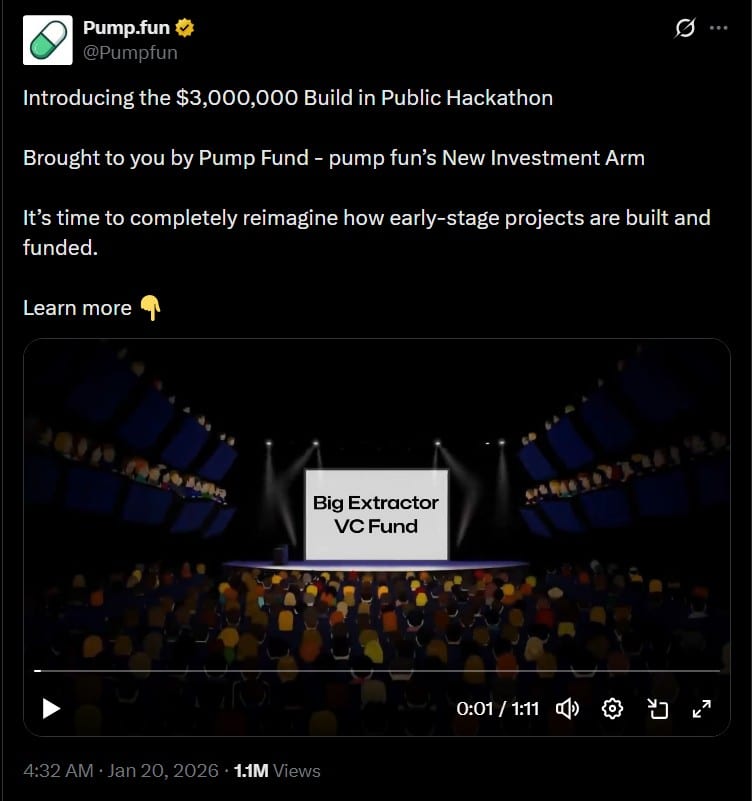
The Pump Fund is a new investment arm designed to back early-stage teams through participation, rather than traditional venture processes. The initiative opened with a $3 million “build in public” hackathon, making community traction the main funding filter.

Source: X

Instead of pitching to judges, selected teams receive funding based on how well their projects resonate publicly. Participants are required to launch a token, retain a portion of the supply, and show visible progress.

The idea is to let real users decide what deserves capital.

The move is the latest in Pump.fun’s recent efforts to reduce rug risks and support longer project lifecycles.

Revenues bounce back

These developments come as Pump.fun’s core business revives. After weeks of weak activity, a very brief memecoin rebound was enough to lift the platform’s fee revenues.

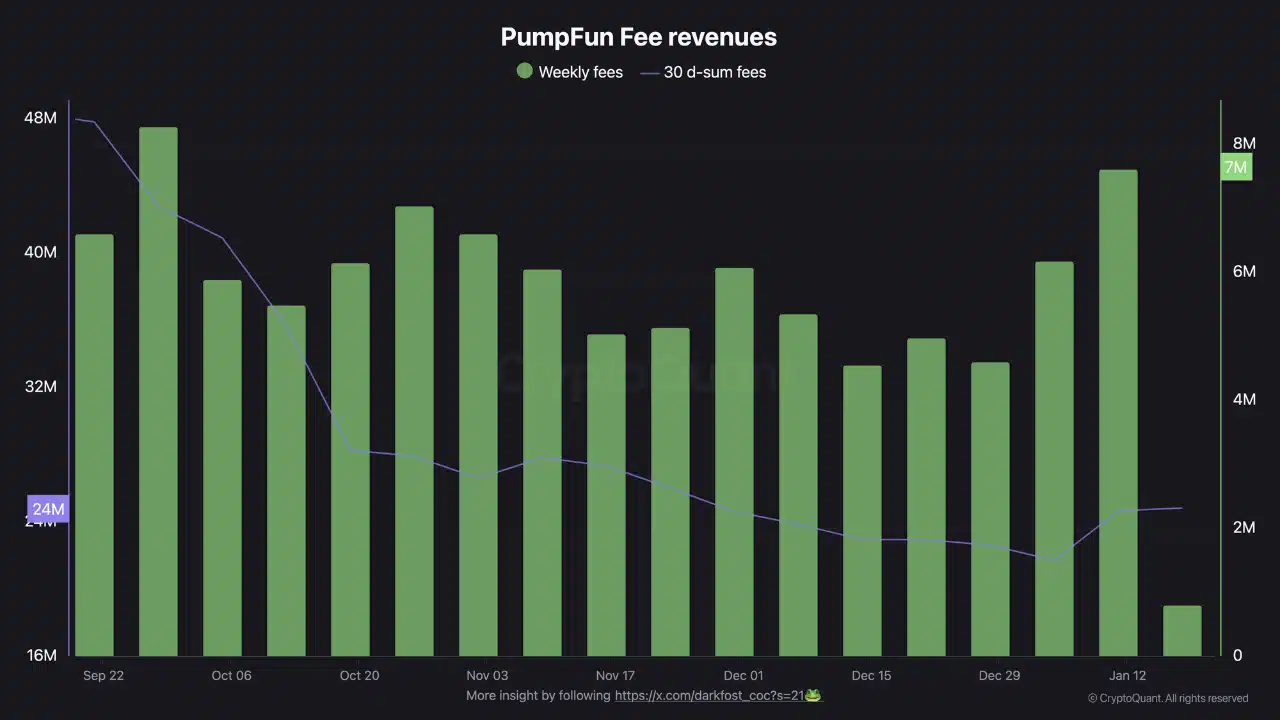
Over the past week, Pump.fun generated an estimated $7.6 million, back to levels last seen in September 2025.

Source: CryptoQuant

For much of the prior period, weekly fees had settled in a $4-$6 million range, so the platform is sensitive to even modest bursts of speculation. The improvement also showed up on a longer view, with the 30-day rolling total rising from $21.6 million to $24.8 million.

PUMP price slows

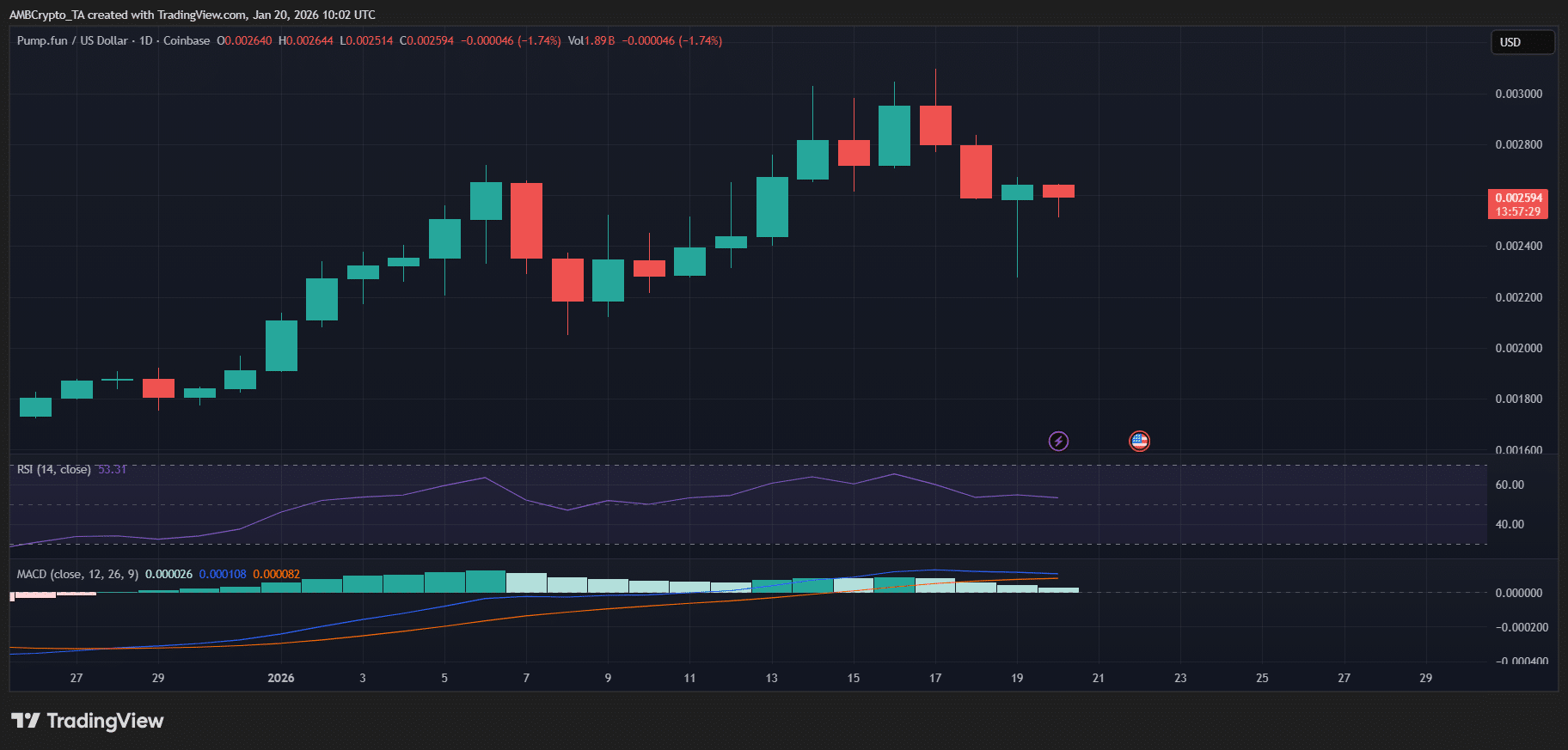
After going up steadily in early January, PUMP struggled to hold recent highs and is now moving sideways. RSI slipped toward neutral territory, while MACD had flattened.

Upside strength is lesser, and the pullback is indicative of consolidation.

Source: TradingView

PUMP remains closely tied to sentiment around memecoins and platform activity. It remains to be seen whether the latest developments result in prolonged demand.


Final Thoughts

  • Pump.fun’s $3M Pump Fund will fund projects that the public deem worthy.
  • With weekly fee surges and token consolidation, the platform’s long-term turn hasn’t yet reflected in price.
Next: Bitcoin price nears 60-day consolidation mark – Is $107K jump imminent?
Share
  • Share
  • Tweet

Related Questions

QWhat is the purpose of the newly announced Pump Fund by Pump.fun?

AThe Pump Fund is a $3 million investment arm designed to back early-stage teams based on public traction through a 'build in public' hackathon, rather than traditional venture processes.

QHow does the Pump Fund's selection process differ from traditional venture capital?

AInstead of teams pitching to judges, funding is awarded based on how well projects resonate publicly, with participants required to launch a token, retain a portion of the supply, and show visible progress.

QWhat recent financial performance did Pump.fun experience prior to this announcement?

APump.fun's weekly fee revenues rebounded to an estimated $7.6 million, returning to levels last seen in September 2025, after weeks of weaker activity in the $4-$6 million range.

QHow is PUMP's token price performing according to technical indicators?

APUMP's price is moving sideways with RSI slipping toward neutral territory and MACD flattening, indicating consolidation after struggling to hold recent highs from early January.

QWhat broader shift does this fund represent for Pump.fun's business strategy?

AThe move represents Pump.fun's effort to reduce rug risks and support longer project lifecycles, potentially signaling a shift away from its memecoin-focused origins toward more sustainable project development.

Related Reads

Huang Renxun Dramatically 'Saves' South Korean Stock Market

In early June, South Korea's stock market experienced a sharp decline, with the KOSPI index dropping over 5% and triggering a trading halt. Amid this volatility, NVIDIA CEO Jensen Huang's visit to Seoul provided a dramatic boost to market sentiment. During his trip, Huang held a dinner meeting with SK Group Chairman Chey Tae-won and SK Hynix CEO Kwak Noh-Jung. He announced that NVIDIA's new Vera CPU would utilize SK Hynix DRAM and confirmed a multi-year technical collaboration between the two companies. This partnership aims to co-develop next-generation memory for NVIDIA's AI infrastructure roadmap, covering products from data center supercomputers to personal AI devices. Huang also publicly commented that AI company stocks were attractively priced. A key announcement was that NVIDIA's upcoming Vera Rubin AI supercomputer systems will use HBM4 memory, with supply qualifications granted to all three major suppliers: SK Hynix, Samsung Electronics, and Micron Technology. Despite this multi-sourcing strategy, Huang warned that the industry-wide chip shortage, affecting everything from wafers to packaging, is expected to persist for several years due to relentless demand from global AI factory construction. The collaboration extends beyond memory supply. SK Hynix will employ NVIDIA's AI platforms and Omniverse digital twin technology to enhance its own semiconductor design, simulation, and manufacturing processes, aiming for more autonomous factory operations. This visit builds upon a prior October 2025 agreement for SK Group to build a large-scale AI data center using over 50,000 NVIDIA GPUs. Huang's itinerary also included meetings with other Korean giants like Hyundai, LG, and Samsung, indicating NVIDIA's broader strategy to deepen ties with South Korea's tech industry.

链捕手2h ago

Huang Renxun Dramatically 'Saves' South Korean Stock Market

链捕手2h ago

When Inference Becomes a Scarce Resource, Who Captures the Value?

When Inference Becomes the Scarce Resource, Who Captures the Value? The core AI bottleneck has shifted from model training to inference (runtime execution). While concerns persisted about an "AI compute gap"—initially a $200B, now a $600B problem—the market is now recognizing that the solution and value lie in the inference layer. Nvidia's financial restructuring around "serving tokens" and Cerebras's successful IPO highlight this shift. Inference is a recurring, usage-based cost, estimated to be 10-50x larger than the one-time training market, especially with the rise of agentic AI. The inference stack spans six layers: silicon (e.g., Nvidia), bare metal (e.g., CoreWeave), GPU rental/aggregation, deployment/optimization, model APIs, and end applications. Most companies operate in one layer. However, Hyperbolic uniquely spans three layers (GPU rental, deployment, and model APIs) without owning any hardware. It aggregates fragmented GPU supply from multiple cloud providers into a standardized pool, offering developers the cheapest available compute through intelligent routing. Its multi-cloud aggregation creates a data moat and a flywheel: more supply leads to better pricing data and liquidity, attracting more developers and providers. In contrast, applications like Venice operate at the top of the stack, reselling privacy-wrapped inference but remaining dependent on and constrained by the underlying compute costs they purchase. As inference demand explodes, value accrues not just to consumer applications but increasingly to the aggregation and routing layer that captures their cost of revenue. The coming potential GPU oversupply reinforces this dynamic. While hardware owners may suffer from depreciation, asset-light aggregators like Hyperbolic benefit from price arbitrage, routing workloads to the cheapest available capacity. The ultimate winner in the inference economy may not be the entity with the most GPUs, but the one that can most efficiently discover, aggregate, and route the world's fragmented compute.

链捕手2h ago

When Inference Becomes a Scarce Resource, Who Captures the Value?

链捕手2h ago

Trading

Spot
Futures

Hot Articles

How to Buy MOVE

Welcome to HTX.com! We've made purchasing Movement (MOVE) simple and convenient. Follow our step-by-step guide to embark on your crypto journey.Step 1: Create Your HTX AccountUse your email or phone number to sign up for a free account on HTX. Experience a hassle-free registration journey and unlock all features.Get My AccountStep 2: Go to Buy Crypto and Choose Your Payment MethodCredit/Debit Card: Use your Visa or Mastercard to buy Movement (MOVE) instantly.Balance: Use funds from your HTX account balance to trade seamlessly.Third Parties: We've added popular payment methods such as Google Pay and Apple Pay to enhance convenience.P2P: Trade directly with other users on HTX.Over-the-Counter (OTC): We offer tailor-made services and competitive exchange rates for traders.Step 3: Store Your Movement (MOVE)After purchasing your Movement (MOVE), store it in your HTX account. Alternatively, you can send it elsewhere via blockchain transfer or use it to trade other cryptocurrencies.Step 4: Trade Movement (MOVE)Easily trade Movement (MOVE) on HTX's spot market. Simply access your account, select your trading pair, execute your trades, and monitor in real-time. We offer a user-friendly experience for both beginners and seasoned traders.

4.4k Total ViewsPublished 2024.12.10Updated 2026.06.02

How to Buy MOVE

Discussions

Welcome to the HTX Community. Here, you can stay informed about the latest platform developments and gain access to professional market insights. Users' opinions on the price of MOVE (MOVE) are presented below.

活动图片