Author: BlockWeeks Block Weekly
In the cryptocurrency market, if you only look at Market Cap, you see a thriving, flourishing digital utopia. Valuations in the tens of billions, grand technical whitepapers, the halo of Turing Award winners... everything looks like the dawn of the next generation of the internet.
But if you put on a different pair of glasses—glasses that only see "on-chain real revenue (Fees)"—you see a completely different, even spine-chilling picture: in this so-called trillion-dollar market, the vast majority of "unicorns" are actually zombies that stopped breathing long ago.
Recently, BlockWeeks conducted a detailed analysis of the "Fees" data for public chains on DeFiLlama, and we discovered an unavoidable structural problem: crypto public chains have entered an era of "extremely concentrated profits and a collectively zombified long tail."

The core data of this article are sourced from DeFiLlama's "Fees / Revenue by Chain" panel (capture time: December 16, 2025). The "Fees" defined here refer to the total fees paid by users on-chain (top-line), serving as an approximate indicator of the scale of on-chain economic activity, not the protocol's net retained income (Protocol Revenue). This article aims to use this open, unified standard to examine the on-chain value capture ability of various public chains.
I. The $17 Humiliation: The Demise of the Technological Utopia
According to the public data we captured from DeFiLlama, the most alarming figure did not come from the million-dollar giants at the top, but from the $17 at the bottom.
This is the daily protocol revenue for Algorand—a chain once crowned the "blockchain trilemma solver," founded by Turing Award winner Silvio Micali, and boasting top-tier technical credentials.
You read that right, not $170,000, but $17.
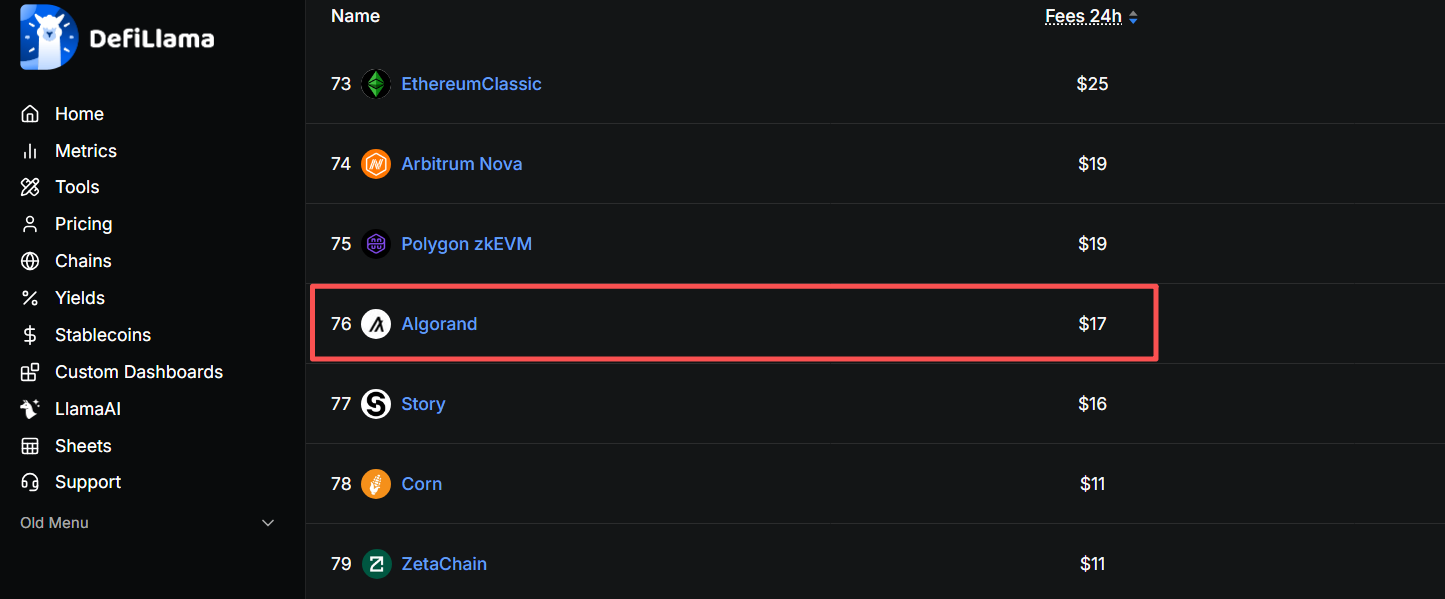
At this very moment, Algorand's market cap remains in the billion-dollar range. A "digital nation" with a billion-dollar market cap generates direct tax revenue from its digital economy that isn't enough to buy four lattes at Starbucks. It shows that despite possessing the most advanced decentralized technology, without real, sustained application demand, its economic value capture ability approaches zero.
This is not just an embarrassment for Algorand; it's the death knell for the entire "classic public chain" camp.
Look at Cardano (ADA), a behemoth consistently in the top 10 by market cap, with millions of token holding addresses. Yet the data tells us its recent average daily on-chain fees hover around $6,000. This means that aside from asset transfers between holders and network maintenance staking, there is a lack of commercial activity on that chain significant enough to generate substantial fees—no large-scale lending, no high-frequency trading, no real, paid value exchange.
These public chains are like luxurious empty cities built at great expense in the middle of a desert. The infrastructure is complete, the roads are wide, the city hall (foundation) is well-funded, but no citizens (active paying users) are seen on the streets. Their method of sustaining operation is often for the city hall to continuously sell off reserves (dumping tokens) to cover operational costs.
II. The Ugly Victory: Who is Actually Capturing Value?
When shifting focus to the top of the list, a fact that makes "technological purists" even more uncomfortable emerges: the ones making the most money are often not the most "elegant" or "decentralized" in terms of technology.
Topping the chart is Tron, with average daily fees as high as $1.24 million. In the eyes of many elitists, Tron might hardly be considered "technical." But the market has given the ultimate answer by voting with its feet: payments are a rigid demand. Tron carries the vast majority of the global on-chain transfer demand for USDT. In this industry full of speculation and bubbles, Tron has inadvertently become the only payment layer application with mass adoption—even if it merely serves as a shadow banking channel for fiat currencies.
One could say: payments, the oldest and most basic internet need, are currently the only mass adoption in the Crypto world. Tron's success is a powerful mockery of all project teams that pursue "perfect technology" while ignoring "real demand."
Close behind is Solana, with nearly $600,000 in average daily fees. Its success logic is even more straightforward: it is the world's most active on-chain casino. Meme coins, high-frequency DEX trading, front-running—these activities contribute the vast majority of the fees. Solana's moat is no longer TPS, but "attention traffic." The rise of Base is even more disruptive (approx. $105k daily): it proves that distribution channels are far more important than the technology itself. Backed by Coinbase's huge user base, Base delivers a dimensional打击 to other L2s.
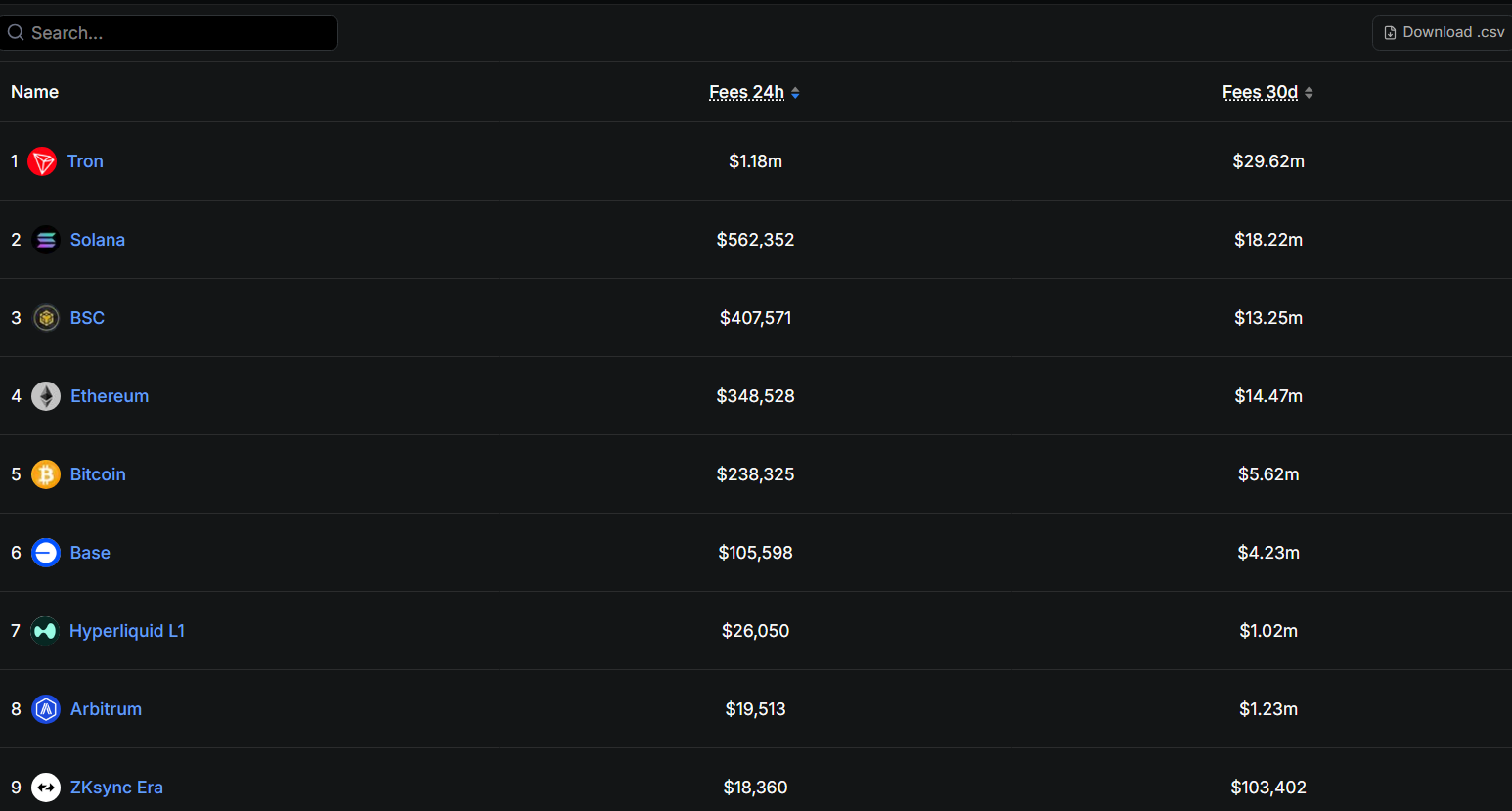
This provides a brutal yet clear revelation: the current Crypto market has only two and a half business models that are verified and can generate large-scale on-chain fees—low-cost payments (Tron), high-frequency speculation (Solana/Base), and the asset settlement layer (Ethereum), which is being constantly eroded by L2s.
Beyond these, those once highly anticipated "enterprise-level applications," "supply chain traceability," and "Web3 social" have, in the face of cold on-chain fee data, at least at this stage, not yet demonstrated规模化付费 demand.
III. The VC Syndicate Dilemma: Why "Peak at Launch"?
This data also reveals another deep crisis: the narrative model for new L1/L2s driven by massive venture capital (VC) financing is facing a brutal reality check regarding monetization.
We see that new public chains like Sui (~$12k daily), Sei (~$320 daily), Starknet (~$10k daily), which launched with great fanfare and raised hundreds of millions or even billions of dollars, have severely inverted链上手续费收入 compared to their fully diluted valuations (FDV) of tens or hundreds of billions.
The standard playbook of the past few years has been: VC investment -> team piles on technical highlights -> attract airdrop farmers to刷取数据 -> token lists on exchanges creating wealth -> retail investors buy into the narrative -> airdrop farmers撤离 -> on-chain activity data plummets.
This is why many new chains have astonishing TPS and hundreds of thousands of daily active users at launch, only to quickly become "ghost towns" months later. Because those users are mercenaries, not residents. When airdrop expectations are realized, when incentive subsidies stop, the real, organic demand is exposed for what it is—daily fee revenues of a few thousand or tens of thousands of dollars simply cannot support billion-dollar valuation dreams.
We are facing severe "block space inflation." The industry has built too many chains, too many L2s, too many data availability (DA) layers, but innovation at the application layer is extremely scarce. This is like狂热ly laying成千上万条光纤 in the early days of broadband internet普及, before Netflix, YouTube, or any killer app that must use this bandwidth has been born.
IV. Investor Awakening: From "Listening to Stories" to "Checking the Books"
For a long time, the valuation logic of the crypto market was built on "dream multiples." The grander the narrative, the richer the imagination, the higher the market cap could fly.
But 2024-2025 is becoming a watershed. As macro liquidity tightens and institutional investors demand more substantial returns, the market is being forced to return to rationality.
For investors, the logic must change:
-
Beware of "Zombie Coins": If a project has a market cap of billions but daily on-chain fees of only a few hundred or thousand dollars, this extreme "unworthiness" is often the starting point for a long-term decline. Its only support—community faith—will eventually run out.
-
Focus on "Positive Cash Flow" Ability: Look for ecosystems where users are willing to持续付费 for services even without token incentives. Tron's stablecoin transfer fees, Base and Solana's transaction fees are direct reflections of real demand.
-
Acknowledge "Channels and Ecosystems are King": Base's success proves that pure technical advantages can hardly be a moat anymore. Giants entering with massive user bases (like Coinbase), or native communities that can breed狂热 cultures, are more valuable assets at the current stage. Purely technical public chains, if they cannot solve the "who will use it and why" problem, will ultimately become Algorand-style academic exhibits.
-
See Through the VC Game: Stop paying for虚假繁荣 driven by subsidies and airdrops.
Faced with the harsh reality of $17 daily revenue, rather than paying for grand narratives and empty "digital ghost cities," it's better to tighten your purse strings and turn to the few ecosystems that can generate real cash flow and have active paying users.
This is not a denial of the long-term value of all technological exploration, but a necessary清算 of the current畸形的 valuation system. Only when the market learns to pay for "value actually generated," rather than透支 for "stories promised in the future," can this industry usher in a truly healthy dawn.
Important Notes and Evaluation Framework
The core of this article is to use "on-chain fees" as a unified, public ruler to measure the "immediate value capture ability" of various public chains. When reading and citing the conclusions of this article, please be sure to understand the following key background and limitations:
1. General Background Notes
-
Development Stage Differences: Some public chains may be technologically advanced but in their early stages, with a user base not yet formed for scale effects. The data in this article reflects the "current state," not the "ultimate potential."
-
Impact of Fee Models: Some public chains are designed to pursue ultra-low transaction fees (Gas Fee), and their native token prices are low. This means that even if the number of on-chain transactions is considerable, the "total fee revenue" denominated in USD appears tiny. This suggests that evaluating such chains should combine metrics like transaction count and active address number for a comprehensive judgment, but the upper limit of their USD-denominated economic throughput remains an objective fact.
2. Evaluation Notes for Specific Types of Chains
For a fairer discussion, we provide the following evaluation ideas for specific types of projects:
| Chain Type | This Article's Evaluation & Suggestion |
|---|---|
| Storage/Service Networks
(e.g., Filecoin, Arweave) |
There is indeed a difference in口径. The core value of these networks lies in storage/retrieval services, and their revenue model differs from单纯 transaction fees. DeFiLlama's "Fees" metric may severely underestimate their actual commercial activity. If you are an investor, you should be on their storage market capacity, active交易订单, and real storage revenue streams. |
| Off-Chain/Consortium Business-Driven Public Chains
(e.g., some enterprise chains) |
Data has limitations. DeFiLlama only statistics public on-chain activity, a point BlockWeeks fully agrees with. But we同样疑惑, if the main value of a public chain is not reflected on-chain, then what supports the market cap of its publicly issued tokens used for on-chain governance and security? |
| Technical Low-Fee/High-TPS Public Chains | The design初衷 is good. However, extremely low per-transaction fees mean the value captured by the chain itself and validators is extremely low. The success of this model must rely on extremely high transaction volume to compensate for the low price disadvantage. If low fees fail to attract massive transactions, its economic model may face challenges. |
| Chains with Ecosystem Traffic Concentrated on CEXs | Hard to evaluate. If a public chain's on-chain economic activity is weak and cannot generate sufficient fees, then its practical value and value capture ability as a "decentralized settlement layer" or "smart contract platform" are low. Its value may be closer to a单纯的 "digital collectible." |
We始终 believe that in a world of highly concentrated profits, projects in the long tail are almost sentenced to fate unless they find unique application scenarios (like gaming or specific AppChains). Only platforms that can generate cash flow through real, sustained user demand have the potential to survive long-term and outperform the market.
Twitter:https://twitter.com/BitpushNewsCN
Bitpush TG Discussion Group:https://t.me/BitPushCommunity
Bitpush TG Subscription: https://t.me/bitpush