Polymarket's "2028 Presidential Election" Traffic King Is... LeBron James???

Odaily星球日报Published on 2026-04-23Last updated on 2026-04-23

Abstract

An article titled "Polymarket's '2028 Presidential Election' Volume Leader is... LeBron James???" discusses a peculiar trend on the prediction market platform Polymarket. Despite having less than a 1% real-time probability of winning, celebrities like NBA star LeBron James (with $48.41 million in trading volume), Kim Kardashian ($33.84 million), and even ineligible candidates such as Elon Musk ($23.14 million) dominate trading activity for the 2028 U.S. presidential election. In contrast, high-probability candidates like Vice President JD Vance and California Governor Gavin Newsom have significantly lower volumes. The high volumes for unlikely candidates are not driven by irrational betting. Instead, they are largely attributed to users seeking risk-free returns from Polymarket’s 4% annualized holding rewards for certain markets, which exceeds the yield on 5-year U.S. Treasuries. Large holders often simultaneously buy both "YES" and "NO" shares on these candidates to capitalize on this incentive. Additionally, some users purchase "NO" shares for liquidity or pricing advantages and later convert them into "YES" shares for their preferred candidates. Thus, the seemingly absurd trading behavior is rational and strategically motivated.

Original | Odaily Planet Daily (@OdailyChina)

Author | Azuma (@azuma_eth)
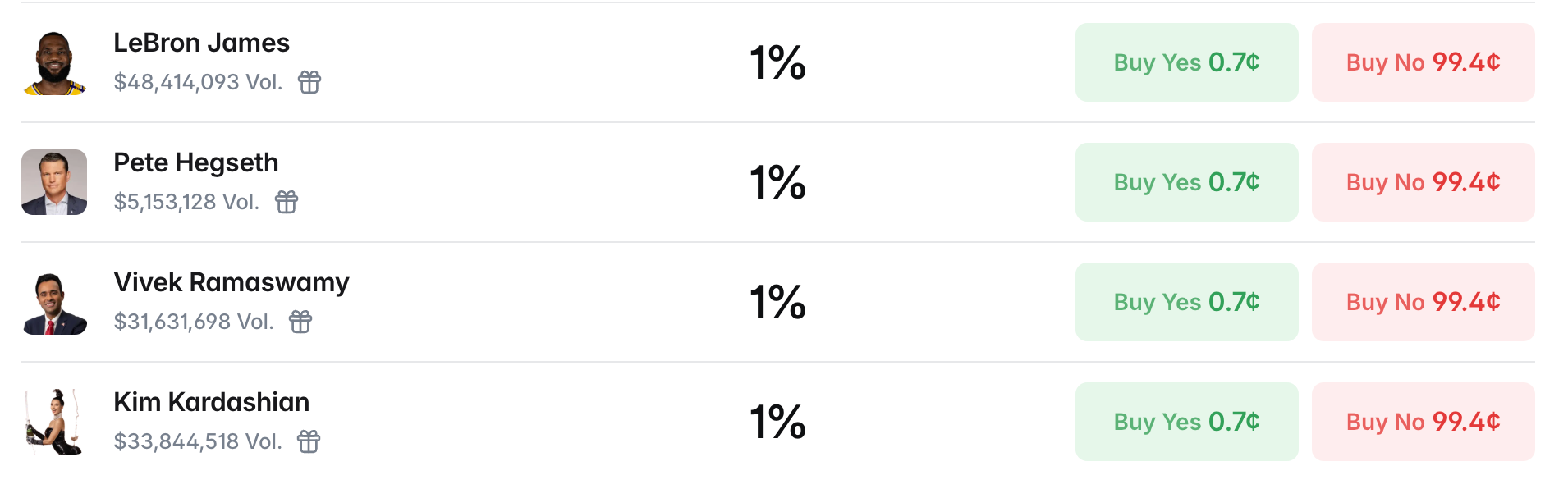
This morning, Barron's reporter Nick Devor posted a very "bizarre" phenomenon on X — on the "2028 Presidential Election" prediction event on Polymarket, about 70% of the trading volume is concentrated on some almost impossible (real-time probability less than 1%) candidates.

For example, the highest trading volume is actually NBA star LeBron James (trading volume $48.41 million), followed closely by entertainment celebrity Kim Kardashian (trading volume $33.84 million), and even some candidates who are not even U.S. citizens (not meeting the candidacy rules), such as the world's richest man Elon Musk (trading volume $23.14 million), New York City Mayor Zohran Mamdani (trading volume $18.39 million)......
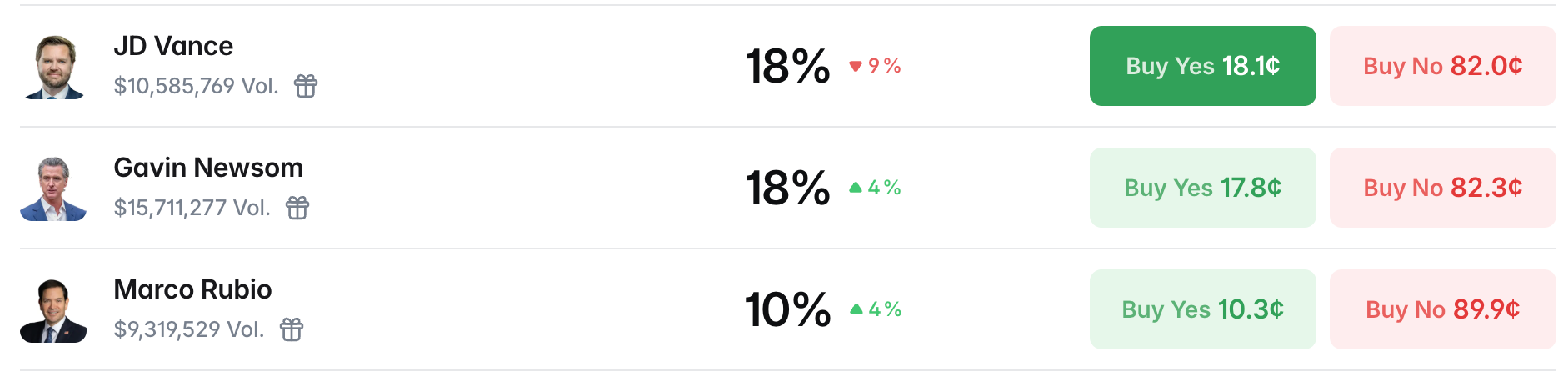
As for those truly high-probability candidates, such as the real-time probability leader Vice President JD Vance (trading volume $10.58 million), California Governor Gavin Newsom (trading volume $15.71 million), Secretary of State Marco Rubio (trading volume $9.32 million), their trading volumes are far lower than the aforementioned "celebrity candidates".
Official data from Polymarket shows that the total trading volume for the "2028 Presidential Election" has reached $549 million, making it the platform's hottest betting event. However, a closer look at the trading volume data for the 36 candidates reveals the counterintuitive situation described above. Why is this? Are people crazy, betting on candidates who are almost or completely impossible?

The answer, of course, is no. Earlier this year, Odaily wrote an article titled "Who is Placing Counterintuitive Bets in Prediction Markets?", which used examples like "The Second Coming of Jesus" and "Flat Earth Theory" to explain that the groups trading or providing liquidity in these absurd event markets can be categorized into three main types: "lottery players, bots, and airdrop hunters".
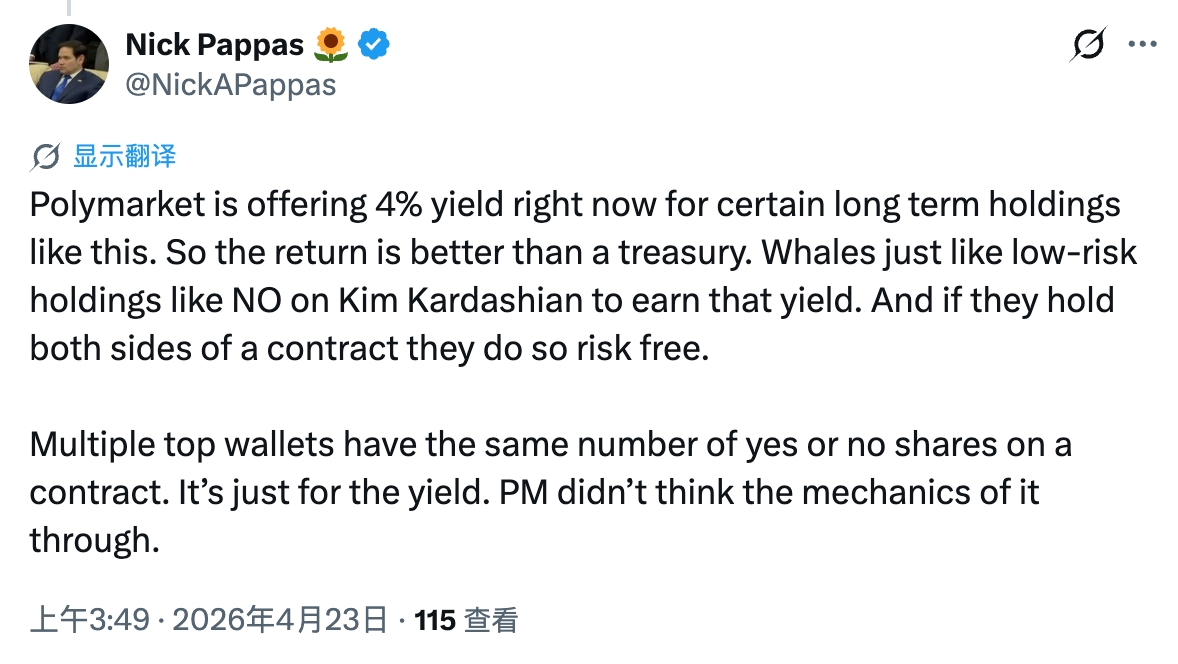
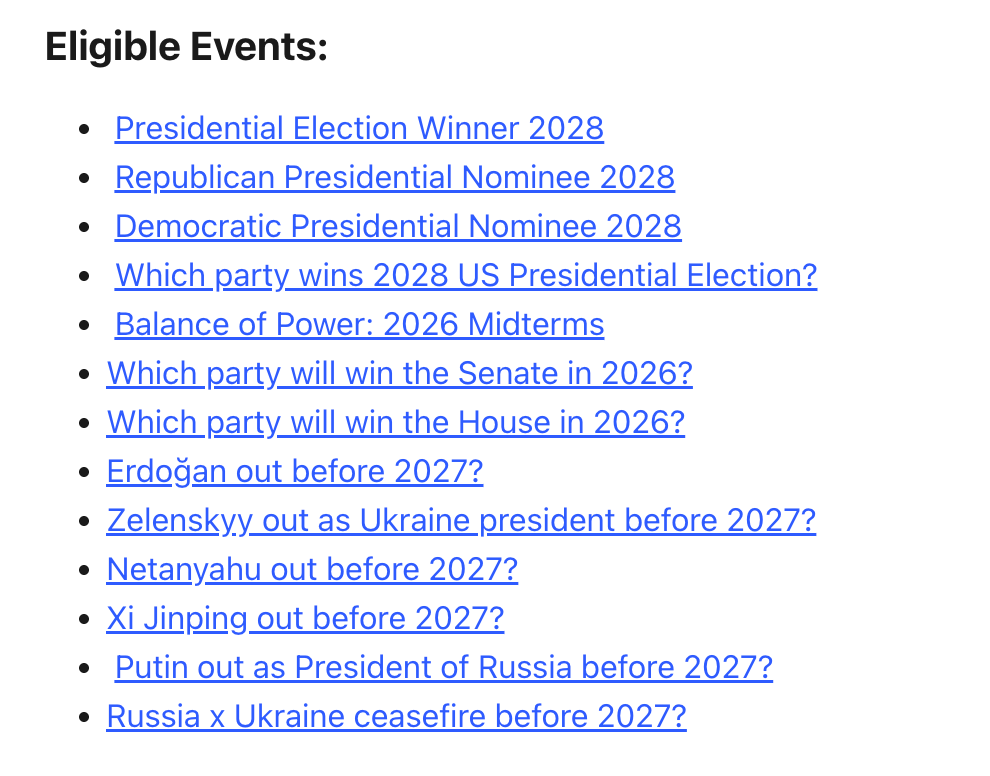
Nick Devor's own explanation also aligns with the third logic we listed. He found that multiple top addresses hold equal quantities of YES and NO shares for the same candidate, essentially aiming to earn risk-free returns subsidized by Polymarket — to maintain long-term pricing accuracy, Polymarket provides a 4% annualized holding reward based on the total position value for holdings in certain markets, and the "2028 Presidential Election" is one of these subsidized events.
Nick Devor stated that a 4% annualized return is higher than the current U.S. Treasury yield (3.98% for 5-year notes), making whales prefer this low-risk holding strategy. For example, they might buy NO shares for James or Kardashian (it's all the same, just buy whoever is popular) to capture this return; by simultaneously holding both YES and NO shares, they can achieve risk-free returns.

As for why some users unilaterally hold small amounts of YES shares for such low-probability candidates, another X user A5 (@probablythenuts) explained that in this type of multi-option market, Polymarket offers a feature that allows users to convert a set of NO shares into a corresponding set of YES shares.

Many users utilize this feature for better liquidity depth or pricing — meaning they don't directly buy YES shares for the candidate they think will win, but first buy NO shares for the candidates they believe will lose, and then convert these NO shares into a corresponding set of YES shares. Additionally, they can buy NO shares for multiple candidates and, after conversion, hold a corresponding set of YES shares for other candidates, including any new candidates added to the event in the future.

Therefore, the users trading James and Kardashian on Polymarket's "2028 Presidential Election" event are neither crazy nor foolish. They are either seeking stable annualized returns or a better execution path. While the operations may seem absurd, they are still driven by rationality.


Related Questions

QWhy is LeBron James the highest volume candidate in Polymarket's 2028 US Presidential Election market, despite having less than a 1% chance of winning?

AThe high trading volume on seemingly improbable candidates like LeBron James is primarily driven by users seeking to earn a risk-free 4% annualized yield on their positions, which is subsidized by Polymarket and is higher than the current 5-year US Treasury yield. Additionally, some users trade these candidates to utilize a platform feature that allows for the conversion of NO shares into YES shares for better execution.

QWhat are the three main groups of participants that trade in outlandish prediction market events, as mentioned in the article?

AThe three main groups are lottery-type bettors, automated trading bots, and airdrop farmers (users seeking to earn platform rewards).

QWhat specific financial incentive does Polymarket offer to encourage liquidity in its '2028 Presidential Election' market?

APolymarket offers a 4% annualized yield on the total position value for holding shares in certain markets, including the '2028 Presidential Election' market, to maintain long-term pricing accuracy.

QHow can a user achieve a risk-free return on Polymarket according to the explanation provided?

AA user can achieve a risk-free return by simultaneously holding both YES and NO shares for the same candidate, thereby qualifying for the platform's 4% annualized yield subsidy on the total position value without any market exposure.

QWhat is the functional reason, unrelated to yield farming, that a user might trade the NO shares of a low-probality candidate like Kim Kardashian?

AA user might trade the NO shares of a low-probability candidate to later use Polymarket's conversion feature, which allows them to swap a set of NO shares for a corresponding set of YES shares, often to get better liquidity or pricing than buying the YES shares directly.

Related Reads

Dialogue with a Macro Analyst: AI Drains All Liquidity from U.S. Stocks, $40K Bitcoin is the True Bottom

In a recent discussion, macro strategist Luke Groman, founder of FFT LC, presented a sobering analysis of current markets. He argues that while the S&P 500 hits new highs, this is largely driven by just seven AI stocks, which are "sucking all the oxygen and liquidity out of the room." Bitcoin, which he calls the "last working smoke alarm for liquidity," is signaling trouble, having entered a difficult period. Groman explains that the AI boom is fueled by accounting practices that front-load revenue, creating an illusion of high profits while cash is being depleted. He warns this cycle could reverse sharply when construction slows. His base case is that stocks will rise in dollar terms but fall significantly when measured in gold or Bitcoin, highlighting that long-term US Treasury futures have already lost 90% of their value against gold over the past decade. He points to major structural risks, including China's dominance in rare earths—a small commodity market underpinning trillions in tech stock value—and the prolonged closure of the Strait of Hormuz, which he calls a "Suez Moment" for the US. This, combined with a shift towards a "no ticky, no washy" proof-of-work system for settling trade (using gold, not trust), signals deeper systemic distrust. Regarding US debt, Groman notes that historically, all 58 countries that reached a 130% debt-to-GDP ratio defaulted, primarily through inflation. The US crossed this threshold in 2020. He also highlights a contradiction in the AI narrative: if it's as transformative as claimed, it must destroy white-collar jobs, threatening half of US tax revenue—a reality at odds with the "no job loss" messaging from tech leaders. On Bitcoin, Groman sold most of his position near the top and hasn't fully re-entered. Citing technical analysis from Northstar Bad Charts, he suggests a potential bottom around $40,000 could materialize in Q3 or Q4. He concludes that while he may be labeled a doomsayer, his view is simply realistic, grounded in historical precedents and current macro pressures.

marsbit1h ago

Dialogue with a Macro Analyst: AI Drains All Liquidity from U.S. Stocks, $40K Bitcoin is the True Bottom

marsbit1h ago

Trading

Spot
Futures

Hot Articles

Discussions

Welcome to the HTX Community. Here, you can stay informed about the latest platform developments and gain access to professional market insights. Users' opinions on the price of S (S) are presented below.

活动图片