Polymarket New Rules Released: How to Build a New Trading Bot

marsbitPublished on 2026-02-25Last updated on 2026-02-25

Abstract

Polymarket has removed the 500ms taker delay and introduced dynamic taker fees, rendering many existing trading bots obsolete. The new meta shifts advantage from taker arbitrage to market making. A profitable bot in 2026 must be a maker bot, leveraging zero fees and USDC rebates. Key requirements include using WebSocket (not REST), fee-aware order signing with the `feeRateBps` field, and a sub-100ms cancel/replace loop to avoid adverse selection. The architecture involves connecting to the CLOB, querying fee rates per market, and placing maker orders on both YES/NO sides. For 5-minute BTC markets, a deterministic strategy involves placing maker orders at $0.90–0.95 with 10 seconds remaining, capitalizing on ~85% directional certainty. Critical mistakes to avoid are using REST, omitting feeRateBps, high-latency infrastructure, and outdated taker strategies. AI can assist in implementation, but must be guided by the new technical constraints.

Editor's Note: Polymarket removed the 500ms delay without prior announcement and introduced dynamic fees, instantly rendering a large number of existing bots obsolete overnight. This article systematically outlines the correct way to build trading bots under these new rules, providing a clear and actionable path—from the fee mechanism and order signing to market-making logic and low-latency architecture.

After publication, the article garnered 1.1M views, sparking widespread discussion. Under Polymarket's new rules, the advantage is shifting from taker arbitrage to long-term structures centered around market making and liquidity provision.

Original text below:

Polymarket Quietly Removed the 500ms Delay

Here’s the clear explanation: How to build a bot that actually runs and makes money under the new rules.

Two days ago, Polymarket removed the 500ms taker quote delay in crypto markets. No announcement, no warning. Overnight, half the bots on the platform stopped working. But at the same time, this created the biggest opportunity window for new bots since Polymarket launched.

Today I will explain in detail: How to build a bot that still works under the new rules.

Because every solution you saw before February 18th is now outdated.

If you ask an AI model to write Polymarket bot code for you right now, it will give you a solution based on the old rules: REST polling, no fee handling, completely unaware the 500ms buffer is gone.

Such a bot will lose money from the very first trade.

Let me explain: What exactly changed, and how to redesign your bot around these changes.

What Changed?

Three key changes happened over the past two months:

1. The 500ms Taker Delay Was Removed (February 18, 2026)

Previously, all taker orders waited 500ms before execution. Market makers relied on this buffer time to cancel "stale" quotes, which was almost like free insurance.

Now it's different. Taker orders execute immediately, with no cancellation window.

2. Dynamic Taker Fees Introduced in Crypto Markets (January 2026)

15-minute and 5-minute crypto markets now charge taker fees. The formula is: Fee = C × 0.25 × (p × (1 - p))²

Peak fee: ~1.56% around 50% probability

Fee approaches 0 in extreme probability ranges (near 0 or 1)

Remember that bot that arbitraged the price delay between Binance and Polymarket, making $515,000 in a month with a 99% win rate?

That strategy is completely dead. Because the fee alone is now higher than the arbitrageable spread.

What is the New Meta?

In one sentence: Be a maker, not a taker.

The reasons are simple:

· Makers pay no fees

· Makers earn daily USDC rebates (subsidized by taker fees)

· With the 500ms delay gone, maker order execution is actually faster

The top bots now profit just from rebates, without even needing the spread. If you're still running a taker bot, you're facing a constantly rising fee curve. Around 50% probability, you need at least a 1.56% edge just to break even.

Good luck.

So, How Should a Truly Viable 2026 Bot Be Built?

Here is a design思路 (design approach) for a bot architecture that remains effective in 2026:
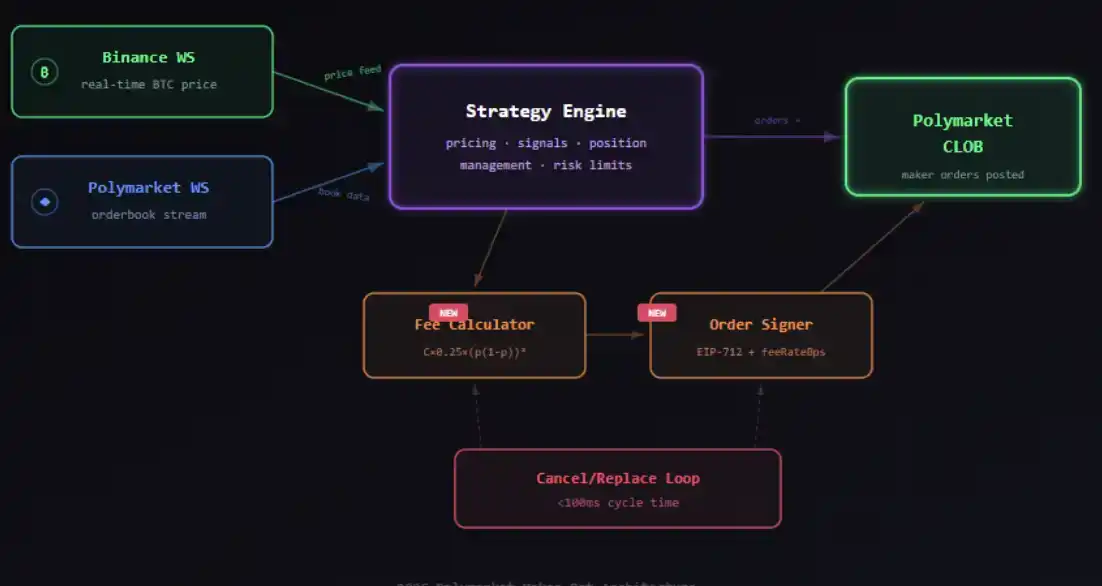
Core Components:

1. Use WebSocket, Not REST

REST polling is completely obsolete. By the time your HTTP request completes a round trip, the opportunity is long gone. You need a real-time order book data stream based on WebSocket, not intermittent pulling.

2. Fee-Aware Order Signing

This is a new requirement that didn't exist before. Now, the feeRateBps field must be included in the payload of the order you sign. If you omit this field, orders will be outright rejected in markets where fees are enabled.

3. Ultra-Fast Cancel/Replace Loop

With the 500ms buffer removed: If your cancel-replace process takes over 200ms, you will suffer from adverse selection. Others will snatch your stale quotes before you can update them.

How to Build It

1. Get Your Private Key

Use the same private key you use to log in to Polymarket (EOA / MetaMask / Hardware Wallet)

export POLYMARKET_PRIVATE_KEY="0xyour_private_key_here"

2. Set Up Approvals (One-Time Operation)

Before Polymarket can execute your trades, you need to approve the following contracts: USDC, Conditional Tokens.

This only needs to be done once per wallet.

3. Connect to the CLOB (Central Limit Order Book)

The official Python client can be used directly: pip install py-clob-client

However, there are now faster options in the Rust ecosystem:

· polyfill-rs (Hot path zero-allocation, SIMD JSON parsing, ~21% performance boost)

· polymarket-client-sdk (Official Polymarket Rust SDK)

· polymarket-hft (Complete HFT framework, integrates CLOB + WebSocket)

Which one you choose isn't critical; the key is to pick the one you can get up and running the fastest.

4. Query the Fee Rate Before Placing Every Order

GET /fee-rate?tokenID={token_id}

Never hardcode fees.
Fees vary by market, and Polymarket can adjust them at any time.

5. Include the Fee Field in Order Signing

When signing the order, the fee field must be written into the payload. Missing this will cause the order to be rejected in fee-enabled markets.

{
"salt": "...",
"maker": "0x...",
"signer": "0x...",
"taker": "0x...",
"tokenId": "...",
"makerAmount": "50000000",
"takerAmount": "100000000",
"feeRateBps": "150"
}

The CLOB will validate your order signature based on feeRateBps. If the fee rate in the signature doesn't match the current actual rate, the order will be rejected outright.

If you use the official SDK (Python or Rust), this logic is handled automatically; but if you implement the signing logic yourself, you must handle this, otherwise the order simply won't go through.

6. Place Maker Orders on Both Sides (Bid and Ask)

Provide liquidity to the market by placing limit orders: On both YES and NO tokens; Place both BUY and SELL orders. This is the core way you earn rebates.

7. Run a Cancel/Replace Loop

You need to monitor simultaneously: External price feeds (e.g., Binance WebSocket); Your current open orders on Polymarket.

Once the price changes: Immediately cancel outdated quotes; Re-place orders at the new price. The goal: Keep the entire cycle under 100ms.

Special Note on 5-Minute Markets

The 5-minute cycle BTC up/down markets are deterministic.

You can directly calculate the specific market just from the timestamp:
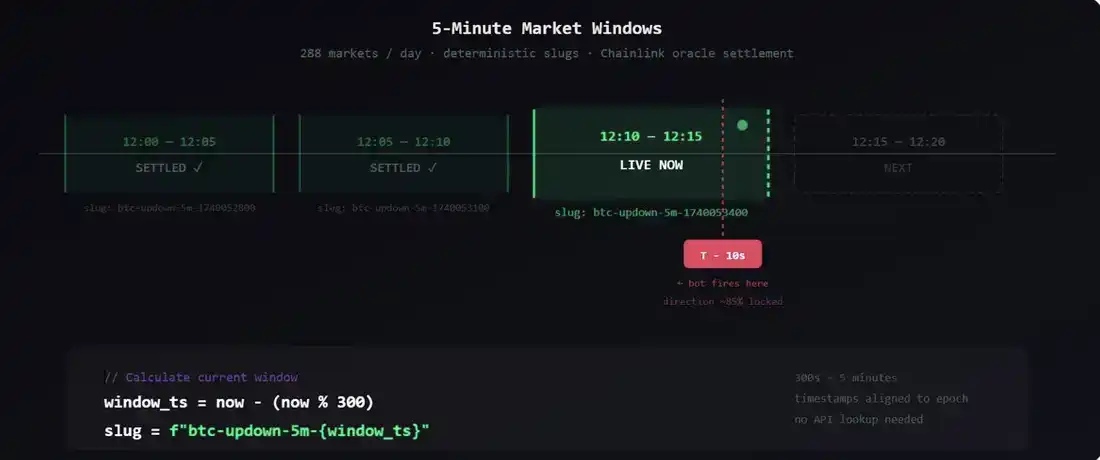
There are 288 markets per day. Each one is a fresh opportunity.

Currently validated effective strategy: By T–10 seconds before the window closes, the direction of BTC's move is about 85% determined, but the odds on Polymarket haven't fully reflected this information yet.

The method is: On the side with the higher probability; Place maker orders at a price of $0.90–0.95.

If filled: Profit $0.05–0.10 per contract at settlement; Zero fees; Plus you get rebates.

The real advantage comes from: Figuring out BTC's direction faster than other market makers, and getting your orders up sooner.

Common Mistakes That Will Get You Wiped Out

· Still using REST instead of WebSocket

· Not including feeRateBps in order signing

· Running the bot on home Wi-Fi (150ms+ latency, vs. <5ms for datacenter VPS)

· Market making near 50% probability without considering adverse selection risk

· Hardcoding fee rates

· Not merging YES/NO positions (locking up capital)

· Still using 2025's taker arbitrage mindset

The Right Way to Use AI

The technical part ends here. Now you understand: The architecture design, fee calculation method, and new market rules.

Next, you can open Claude or any reliable AI model and give it a sufficiently clear and specific task description, for example: "Here is the Polymarket SDK. Please write a maker bot for the 5-minute BTC market that: Listens to Binance WebSocket for prices; Places maker orders on both YES and NO sides; Includes feeRateBps in order signing; Uses WebSocket for order book data; Keeps the cancel/replace cycle under 100ms."

The correct workflow is: You define the tech stack, infrastructure, and constraints, and the AI generates the specific strategy and implementation logic on top of that.

Of course, no matter how perfectly you describe the bot's logic, you must test it before going live. Especially at this stage, where fees are already materially eroding profit margins, backtesting under the real fee curve is a mandatory step before deployment.

The bots that will truly win in 2026 are not the fastest takers, but the best liquidity providers.

Build your system accordingly.

Related Questions

QWhat are the key changes in Polymarket's rules that have made old trading bots obsolete?

AThe key changes are: 1) Removal of the 500ms taker delay on February 18, 2026, which eliminated the free 'insurance' period for market makers to cancel stale quotes. 2) Introduction of a dynamic taker fee schedule in January 2026, calculated as `fee = C × 0.25 × (p × (1 - p))^2`, which peaks at ~1.56% near 50% probability. These changes rendered taker arbitrage strategies, like the one that previously profited from Binance-Polymarket delays, unprofitable.

QWhat is the new 'meta' or recommended approach for building a profitable bot on Polymarket in 2026?

AThe new meta is to be a maker, not a taker. This is because makers pay no fees, earn USDC rebates (subsidized by taker fees), and benefit from faster order execution with the 500ms delay removed. The most successful bots can now profit from rebates alone, even without capturing price spreads.

QWhat are the critical technical components of a viable 2026 Polymarket bot architecture?

AThe critical components are: 1) Using WebSocket for real-time data instead of REST polling. 2) Implementing fee-aware order signing by including the `feeRateBps` field in the signed payload. 3) Establishing an ultra-fast cancel/replace loop (aiming for under 100ms) to avoid adverse selection and update stale quotes before they are taken.

QWhat is a specific, effective strategy mentioned for the 5-minute BTC markets?

AAn effective strategy is to identify the likely direction of BTC price movement (which is ~85% determined in the last 10 seconds of the window) and place maker orders on the higher probability side at prices between $0.90–$0.95. If filled, this yields a profit of $0.05–$0.10 per contract at settlement, plus rebates, with zero fees.

QWhat are some common mistakes that will cause a bot to fail under the new rules?

ACommon fatal mistakes include: using REST instead of WebSocket; omitting the `feeRateBps` field in order signing; running the bot on high-latency home Wi-Fi (>150ms) instead of a low-latency VPS (

Related Reads

AI is Killing 'Poor People's Entertainment'

AI Is Eliminating 'Entertainment for the Poor' This article discusses the rising cost of video gaming, arguing that AI is making digital entertainment increasingly expensive. It follows the example of a frugal gamer who, accustomed to waiting for discounts and buying second-hand games, now faces a new reality. Video game consoles like the PS5 Pro and Switch 2 are increasing in price post-launch, breaking the traditional pattern of降价 over time. Game prices are also rising, with major titles like GTA 6 launching at $80. Furthermore, the industry is moving towards eliminating physical media, exemplified by Sony's plan to stop PS disc production by 2028. This shift blocks the二手 market, a key cost-saving avenue for players. Even Valve's anticipated affordable Steam Machine launched with a high price and disappointing specs. Manufacturers cite inflation, supply chain issues, and rising development costs, but a core driver is the AI boom. AI data centers now consume semiconductor and memory resources once prioritized for consumer electronics like game consoles. This competition from a more profitable sector drives up hardware costs. Additionally, developing modern AAA games with massive teams over many years is astronomically expensive, pushing publishers towards digital-only distribution and subscription models to secure recurring revenue. The article suggests this trend extends beyond gaming. Video streaming, music platforms, cloud storage, and AI tools are increasingly locked behind complex subscription tiers. While AI promises future benefits, it is currently making digital entertainment and services more costly. The era of progressively cheaper, accessible online entertainment is ending, forcing consumers to pay more upfront for future technological promises.

marsbit33m ago

AI is Killing 'Poor People's Entertainment'

marsbit33m ago

The Demise of the Trillion-HKD ETF Myth: SK Hynix Plummets, Hong Kong Switches from 'Double Leverage' to 'Flexible Leverage', South Korea Restricts Leveraged ETF Investments

South Korea's AI-driven bull market has taken a sharp downturn, severely impacting SK Hynix's stock and prompting regulatory tightening in both Hong Kong and South Korea on single-stock leveraged products. The CSOP SK Hynix Daily Leveraged (2x) ETF, once the world's largest single-stock leveraged ETF with over HKD 130 billion in assets, saw its value plummet by over 80% as SK Hynix shares fell nearly 46% from their June peak, erasing more than HKD 100 billion. In response, Hong Kong's Securities and Futures Commission (SFC) revised its regulatory framework. Starting August 3rd, fixed 2x leverage for single-stock leveraged and inverse products will shift to a dynamic "flexible leverage" mechanism, where daily leverage can vary up to a maximum of 2x. This aims to balance market development with investor protection but has sparked debate about changes to the products' core features and potential reduced appeal for risk-seeking investors. Simultaneously, South Korean authorities announced plans to further restrict single-stock leveraged ETFs following two consecutive days of market circuit breakers. Proposed measures include capping individual investors' allocations to such products at 20% of their total financial investment assets, increasing trading costs, and enhancing suitability requirements. The Finance Minister publicly apologized, acknowledging insufficient initial risk assessment. Analysts note that while the long-term fundamentals for South Korean semiconductor firms like SK Hynix remain solid, short-term market volatility is heightened due to concentrated leveraged bets and shifting global risk sentiment. The regulatory moves in both markets signal a clear shift from encouraging innovation towards prioritizing risk control, reminding investors of the amplified risks inherent in leveraged products.

marsbit38m ago

The Demise of the Trillion-HKD ETF Myth: SK Hynix Plummets, Hong Kong Switches from 'Double Leverage' to 'Flexible Leverage', South Korea Restricts Leveraged ETF Investments

marsbit38m ago

After the Privatization of the Internet, Silicon Valley Begins Privatizing Human Civilization

"The Privatization of Human Civilization" The article critiques how AI companies like Anthropic are systematically acquiring and digitizing millions of books—sometimes by destroying physical copies—to build proprietary training datasets for models like Claude. While a lawsuit resulted in a settlement, the author argues the deeper issue transcends copyright: it is about the privatization and centralized control of human knowledge and civilization. This process coincides with a powerful Silicon Valley ideology, exemplified by Marc Andreessen's "Techno-Optimist Manifesto" and movements like e/acc (Effective Accelerationism). This worldview frames technological growth and speed as inherently moral, portraying caution, regulation, and public dissent as obstacles to progress. It often envisions intelligence itself, rather than human well-being, as the ultimate goal, potentially sidelining present human concerns. Figures like Peter Thiel and Curtis Yarvin express skepticism towards democratic processes as too slow, suggesting more centralized, founder-led governance is efficient. This logic extends to AI, where a small team within a company defines the model's "constitution"—its rules, values, and definitions of truth and safety—effectively governing how millions understand the world. Thus, the scanned books symbolize a new form of control. Knowledge isn't erased but is ingested into private, opaque systems. The original, decentralized, and contestable nature of books and public knowledge is replaced by a curated, company-controlled output. The public's access to their own cultural heritage becomes mediated by corporate AI, which remembers civilization only in the form its creators dictate. This is not book-burning but a subtler, potentially more complete privatization of human memory and understanding.

marsbit48m ago

After the Privatization of the Internet, Silicon Valley Begins Privatizing Human Civilization

marsbit48m ago

Trading

Spot
活动图片