Pi Network Temporarily Halts Wallet Payment Requests Amid Rising Scams

TheNewsCryptoPublished on 2025-12-31Last updated on 2025-12-31

Abstract

Pi Network has temporarily disabled its wallet payment request feature due to widespread scams. Scammers were impersonating official accounts and targeting high-balance wallets, tricking users into approving fraudulent requests, resulting in irreversible losses. Over a million PI tokens have been stolen this year, with one wallet receiving more than 838,000 tokens. The Pi Core Team clarified that the issue stems from user approval, not a system vulnerability, and emphasized that this is a common risk across crypto wallets. The token’s value dropped 10% following the incident but has since shown slight recovery. Recent updates include standardized KYC and testnet DEX improvements to enhance security and liquidity.

The Pi network, which is the mobile-first Cryptocurrency and web3 blockchain, recently posted a tweet on DEC 30 that the team has warned that scammers are exploiting the Payment request feature to steal Pi tokens from users’ balances. In the Pi network, the wallet balances are publicly visible, and the attackers are targeting the high-balance wallets and sending the payment request to the wallet as an impersonation of official Pi accounts or community moderators.
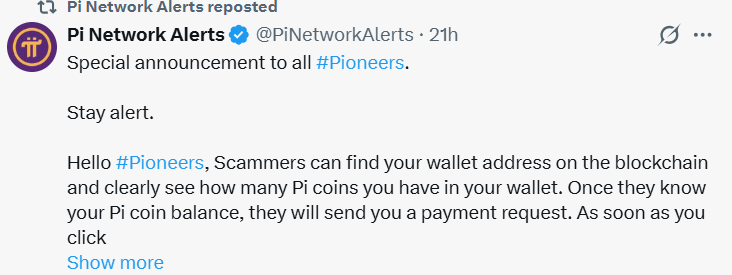
Once the user approves the payment request, the Tokens will be instantly transferred to the scammers’ account and will be gone forever. No reversal or recovery will be done. The Community reports indicate the scams are widespread, and one scammer’s wallet has received more than 838,000 PI tokens. Overall, more than a million PI tokens have been lost throughout the year. This created a panic situation among the users, and even the experienced users were tricked because the request looked legitimate.

Pi Core Team Denies System Vulnerability, Addresses Market and User Impact

After this incident happened, many users called it a wallet flaw, but the Core team clarified that the problem is from the human approval, not the protocol Flaw. They say that the wallet never sends funds on its own, and the transfer only happens after the user’s approval. This behavior exists in all major Crypto wallets. So to stop this scam, the PI network has disabled all payment requests network-wide. This stops the scams instantly and prevents further user losses. This makes the PI token safe, and it was the fastest way to contain the damage.

The token is currently trading at $0.204 with a market cap of 1.7 billion. The Token has dropped to 10% due to this issue. Recently, the token has updated its ecosystem by adding Standardized KYC to cut the verification backlogs by 50% and speed up mainnet migration for millions of users. Another update is from the testnet DEX, which makes the trading safer and easier by using Pi as the main trading Pair and improving the liquidity. This makes the token regain its momentum, and it has increased by 0.7% in 24 hours.

Highlighted Crypto News:

XDC Network Momentum Test: Will It Break Resistance or Slip Back to Lows?

TagsAltcoinCryptocurrencyPi Network

Related Questions

QWhy did the Pi Network temporarily halt wallet payment requests?

AThe Pi Network temporarily halted wallet payment requests to stop scammers who were exploiting the feature to steal Pi tokens by impersonating official accounts, preventing further user losses.

QHow were the scammers able to steal Pi tokens from users?

AScammers targeted high-balance wallets, sent payment requests while impersonating official Pi accounts or community moderators, and stole tokens once users approved these deceptive transactions.

QWhat was the Pi Core Team's response to the incident being called a 'wallet flaw'?

AThe Pi Core Team clarified that the issue was due to human approval of fraudulent requests, not a protocol flaw, emphasizing that transfers only occur after user authorization, similar to other crypto wallets.

QHow much Pi token value was reported lost due to these scams?

ACommunity reports indicated that over a million Pi tokens were lost throughout the year, with one scammer's wallet receiving more than 838,000 Pi tokens.

QWhat recent updates has the Pi Network implemented to improve its ecosystem?

AThe Pi Network recently added Standardized KYC to reduce verification backlogs by 50% and introduced updates to the testnet DEX, using Pi as the main trading pair to enhance safety and liquidity.

Related Reads

Farewell to Traditional Bull and Bear Markets, Deciphering the Logic of Today's Bubble Rotation

"Farewell to Traditional Bulls and Bears: Understanding Today's Market Logic of Bubble Rotation" The article draws a parallel between modern financial markets and a meteorological chain of thunderstorms, contrasting it with the past's slower-moving, more predictable 'layered cloud' systems of long bull/bear cycles and gradual sector rotations. The author argues that today's market has undergone a permanent structural shift, creating an environment where discrete, intense thematic bubbles (e.g., AI, GLP-1 drugs, crypto, robotics, quantum tech) sequentially form, swell, and burst. These 'storm cells' are triggered when capital fleeing a dying bubble acts like a meteorological 'cold air wedge,' forcing the warm, moist capital of latent interest in a new sector to rapidly rise and condense into the next speculative frenzy. This new 'convective' market regime is driven by eight fundamental changes: 1. Democratization of speculation via zero-commission trading, gamified apps, and heavy retail participation in instruments like 0DTE options. 2. Permanent, price-insensitive buying pressure from defined-contribution retirement plans (e.g., 401(k)s). 3. Passive investing creating inelastic market participants that amplify momentum, especially into mega-cap stocks. 4. The dominance of multi-strategy funds and high-frequency trading (HFT), weakening price discovery and creating fragile microstructure prone to synchronized sell-offs. 5. Artificially suppressed volatility that eventually erupts in violent spikes. 6. A transformed market index heavily weighted toward long-duration, narrative-driven tech companies instead of stable, cyclical industrials. 7. The total elimination of information delay, accelerating fear-of-missing-out (FOMO) and herd behavior. 8. A persistently loose fiscal and monetary policy environment. These structural shifts are deemed irreversible. The article outlines the common lifecycle of these thematic bubbles: latency, catalyzing event, narrative formation, peak divergence, and rupture—with outflowing capital seeding the next bubble. In this environment, two investor archetypes can thrive: deep domain experts who understand underlying technologies and business models, and disciplined trend-followers. The author concludes that while emotionally challenging, recognizing this new "climate" is crucial. The key is to elevate one's perspective above the immediate storm to see the cyclical chain of bubbles, avoiding being swept away by the emotions of any single thematic frenzy.

Foresight News21m ago

Farewell to Traditional Bull and Bear Markets, Deciphering the Logic of Today's Bubble Rotation

Foresight News21m ago

Michael Saylor's Latest Article: Bitcoin Must Find Balance Between Uniqueness and Universal Value

Michael Saylor outlines four key Bitcoin ideologies shaping its future: * **Bitcoin Maximalists** see Bitcoin as the dominant digital monetary network and a breakthrough in economic empowerment, emphasizing its superior property rights and role as a sound money solution. * **Bitcoin Capitalists** focus on integration, believing Bitcoin must embed into the global economy—through institutions, capital markets, and financial products—to reach its full potential as digital capital. * **Bitcoin Technologists** advocate for continuous protocol improvements in scalability, privacy, and security to adapt to evolving needs and threats, while acknowledging the high bar for change. * **Bitcoin Fundamentalists** guard Bitcoin's core principles of self-custody, decentralization, and censorship resistance, warning against dilution from institutions or risky modifications. Saylor argues that a healthy Bitcoin ecosystem requires a balance of these perspectives. Bitcoin's path forward involves disciplined expansion: preserving its immutable core (Fundamentalist insight), recognizing its dominant status (Maximalist view), integrating with the global economy (Capitalist drive), and enabling careful innovation, primarily in higher layers (Technologist role). The challenge is to maintain Bitcoin's unique properties while making it useful for the world, ensuring it remains Bitcoin as it grows.

Foresight News53m ago

Michael Saylor's Latest Article: Bitcoin Must Find Balance Between Uniqueness and Universal Value

Foresight News53m ago

Reddit Weekly Hot Stock Watch: RKLB/LUNR/ASTS Plunge Collectively, Is the Space Sector Still Worth Considering?

Reddit's stock communities witnessed a concentrated surge in discussion around space stocks last week, with SPCE, RKLB, LUNR, and ASTS leading the chatter. This often signals an underlying catalyst for investor attention. However, despite being grouped as "space plays," these companies have vastly different fundamentals and recent performances. While SPCE (Virgin Galactic) saw a 22% single-day surge—potentially fueled by short covering and fallout from Blue Origin's rocket test anomaly—the other three stocks declined sharply. RKLB dropped 15%, LUNR fell 13%, and ASTS was down 7%. This divergence highlights they are not a monolithic sector. The downturn for RKLB, LUNR, and ASTS stemmed from multiple headwinds converging: Blue Origin's New Glenn rocket explosion (directly impacting ASTS's launch plans), anticipation of SpaceX's massive IPO drawing funds away from these "alternative" public space stocks, and insider selling at RKLB after significant rallies. A closer look reveals key differences: RKLB stands out with substantial, growing revenue ($113.9M in Q1) and a $2.2B backlog, though its high valuation (~80x Forward P/S) prices in success for its upcoming Neutron rocket. LUNR's reported revenue growth is largely acquisition-driven, with its core moon landing business facing a crucial test with the upcoming IM-3 mission. ASTS has a large potential market in space-based cellular connectivity but faces significant execution risk, especially after the Blue Origin launch setback. SPCE, despite high discussion volume, has minimal revenue and its recent spike appears driven more by sentiment than fundamentals. The analysis suggests it's premature to call a "buying opportunity" for the sector broadly. RKLB is considered the most fundamentally sound but may be more attractive at a lower price point ($96-$102). For the others, investors are advised to wait for specific catalysts: LUNR's IM-3 mission outcome, clarity on ASTS's revised launch timeline, and for SPCE, to avoid the speculative frenzy. The long-term space thesis remains, but short-term valuations have run ahead of fundamentals for most names.

marsbit1h ago

Reddit Weekly Hot Stock Watch: RKLB/LUNR/ASTS Plunge Collectively, Is the Space Sector Still Worth Considering?

marsbit1h ago

Trading

Spot
Futures
活动图片





