Paradigm Bets on Brazil: The New Battleground for Stablecoins Is Not in the US

marsbitPublished on 2025-12-17Last updated on 2025-12-17

Abstract

Paradigm has made its first investment in Brazil by leading a $13.5 million Series A round in Crown, a Brazilian stablecoin issuer, at a $90 million valuation. This follows an $8.1 million seed round just two months prior. Crown issues BRLV, a Brazilian real-backed stablecoin, which currently has a modest market presence. The investment reflects a strategic bet on both Crown’s experienced team and Brazil’s growing fintech ecosystem. Crown’s founders include former executives from major Brazilian fintech firms like Nubank and Xerpa, with strong backgrounds in law, engineering, and finance. Brazil presents a unique opportunity due to its large unbanked population, high digital adoption, and proactive central bank policies like the Pix instant payment system. Despite historical inflation issues, the country has seen improved economic stability, with growing crypto adoption—ranking fifth globally. Stablecoins are widely used for practical purposes like cross-border payments and DeFi, not just as inflation hedges. Crown’s BRLV differentiates itself by offering holders a share of government bond yields, which are around 15% in Brazil. This feature, combined with potential integration with Pix and other financial applications, positions BRLV for growth in a market ripe for digital currency innovation.

Recently, the Brazilian stablecoin company Crown completed a $13.5 million Series A funding round at a $90 million valuation, led by Paradigm. The Block's press release explicitly highlighted that this is Paradigm's first investment in a Brazilian company. This funding round also marks Crown's second round of financing within just two months. In mid-October, Crown had just completed an $8.1 million seed round led by Framework Ventures, with participation from Coinbase Ventures, Paxos, and others.

This might not be front-page headline news, but there are two key points worth noting: Why Crown? And why Brazil?

Why is Crown Worth Investing In?

Analyzing this situation typically requires considering both internal and external factors.

From an external factor perspective, the author believes that investment opportunities in US-based stablecoin issuers are becoming scarce. Tether and Circle already dominate the vast majority of the market, forcing investment firms to look outside the US market to find greater Alpha. Furthermore, there are not many targets that allow foreign capital to invest in companies related to a local fiat currency, while also having a domestic market for stablecoins.

Brazil is a rare "treasure land" in the Americas that meets most of these conditions. We will discuss why later.

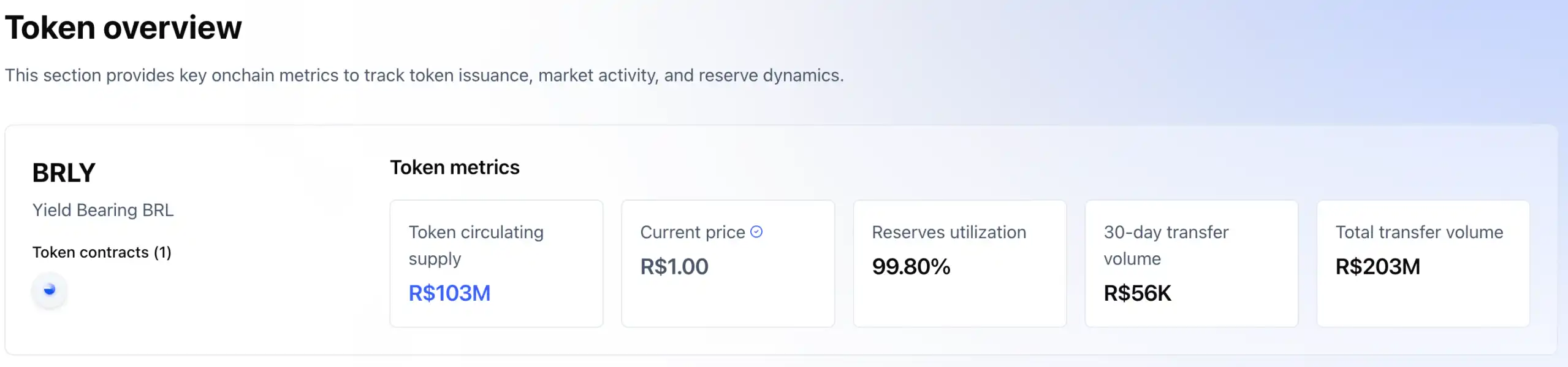
First, back to Crown. According to disclosed data, the total supply of BRLV, the Real (Brazilian fiat currency) stablecoin issued by Crown, is currently just over 100 million tokens, which translates to a value of less than $20 million USD. Its trading volume over the past 30 days is only $56,000. This indicates that the current market for domestic currency stablecoins in Brazil is not large, especially since Crown currently serves institutional clients only.
Clearly, the logic behind investing in Crown is betting that the team behind it can achieve success in this market in the future.

Crown's co-founder and CEO, John Delaney, is a former lawyer in international finance and was the COO of Xerpa, a prominent local Brazilian company that received investment from Founders Fund. In 2019, Xerpa launched an "Earned Wage Access" platform, allowing employees to withdraw their earned wages for days already completed at any time (instead of waiting for the end of the month), helping them avoid high-interest credit. This has been particularly popular in Brazil's high-interest rate and financial stress environment, seen as a tool for employee financial well-being. The company charges a small fixed fee, with no interest involved.

Co-founder and Chief Engineer Vinicius Correa was an early engineer at the Brazilian digital bank Nubank. Nubank's investor list is also impressive. Across multiple funding rounds totaling $2 billion, participating institutions included Sequoia Capital, Tiger Global, Goldman Sachs, Founders Fund, Tencent, and Berkshire Hathaway. Nubank went public on the NYSE in 2021 with an IPO valuation of $41.5 billion and currently has a market cap of nearly $80 billion.

Founding Partner and Ecosystem Lead Alex Gorra previously served as Managing Partner at the family office Brainvest, which manages $5 billion in assets, and had prior management roles at ARX Investments, UBS, Rothschild Bank, and J.P. Morgan. COO Bruno "BL" Passos previously led cross-functional teams at Hashdex.

Crown's founding team can be described as a veritable all-star team. Both co-founders have also been involved in the process of building Brazilian local businesses from 0 to 1. Although the current data for BRLV is not impressive, it hasn't prevented the company from raising over $20 million in total within two months.

Additionally, the Crown team stated in their blog that the essence of launching BRLV was also seeing the contribution made by USDT and USDC through the purchase of government bonds. Issuing stablecoins locally in Brazil can similarly provide purchasing power for government bonds, thereby stabilizing the economy, which in turn further stimulates the use of stablecoins—a win-win situation. If dollar stablecoins are just helping the US "stay afloat," then the Real stablecoin can be said to tangibly help the country.

Why Bet on Brazil?

In terms of the underlying fiat currency for stablecoins, there seem to be many choices better than the Brazilian Real. So why Brazil?

You might not believe it, but this country, which many 80s and 90s kids might last have heard of due to football, has become one of the largest innovation hubs in Latin America and a global leader, with over 1,500 fintech companies and more than 100 million users.

As a capitalist country, Brazil's banking sector has long been dominated by five major banks (Itaú, Banco do Brasil, Bradesco, Caixa, Santander), which hold over 80% of the assets, far higher than the US (around 50%). Traditional banking services were rigid, expensive (credit card APRs often exceeded 300%), and burdened by bureaucracy, excluding tens of millions of low- and middle-income individuals and the unbanked (historically up to 55 million) from the system.

But this also created a huge demand gap. Fintech companies like Nubank, starting with no-fee credit cards and offering simple, low-cost services, quickly filled this market void.

The Brazilian Central Bank, although unable to change the monopoly of traditional banking, surprisingly actively promoted competition and inclusion, even becoming a classic case in global digital financial regulation. Its biggest contribution was launching the instant payment system Pix in 2020. Pix supports free, 24/7 real-time transfers, with transaction volume exceeding one trillion Reais in 2025 and user coverage exceeding 90% of the population. Upon its launch, Pix quickly replaced cash and credit cards, becoming the preferred payment method for 76% of Brazilians, significantly enhancing financial inclusion and providing low-cost infrastructure for Fintech (such as payment and credit innovations integrated with Pix).

I believe everyone often sees integrations of Pix by various exchanges or Crypto payment tools in Web3 industry news. It is indeed not easy for the central bank of a capitalist country to lead the launch of a payment system powerful enough to shake the original banking system. However, this "pro-people" direction has also allowed local fintech companies to have better development prospects because they can reach more users.

It is precisely for this reason that new financial forms like cryptocurrency have high acceptance in Brazil. Brazil's population exceeds 200 million, with a smartphone penetration rate of nearly 90% and over 180 million internet users, averaging more than 5 hours online per day. Young, digital natives, especially Gen Z, have a strong demand for mobile finance. In September last year, Circle began supporting direct exchange of Reais for USDC.

The popularity of dollar stablecoins in Brazil has been analyzed in many articles as being due to the instability of the Brazilian national currency. However, based on the author's research from multiple sources, even if this is part of the reason, it only accounts for a very small portion. It seems now that if this reason held true, investment firms like Paradigm would not place such heavy bets on Brazil's domestic fiat stablecoins and fintech companies.

In fact, Brazil did experience multiple episodes of hyperinflation in the 1980s and 1990s, even reaching an extreme monthly inflation rate of 80%. However, in recent years, although the Real's fluctuations are still not small, for a country like Brazil, it has achieved decent results in stabilizing the currency value and reducing inflation. Brazil's inflation rate hovered between 4.5% and 5% in 2025, still above the central bank's target but sufficiently better than its neighbor Argentina.

While some Brazilian residents holding dollar stablecoins do so to hedge against the depreciation of the Real, especially against the backdrop of the Fed's interest rate hikes in previous years, more do so for practical purposes such as foreign trade, tax avoidance, facilitating capital flow, and trading cryptocurrencies.

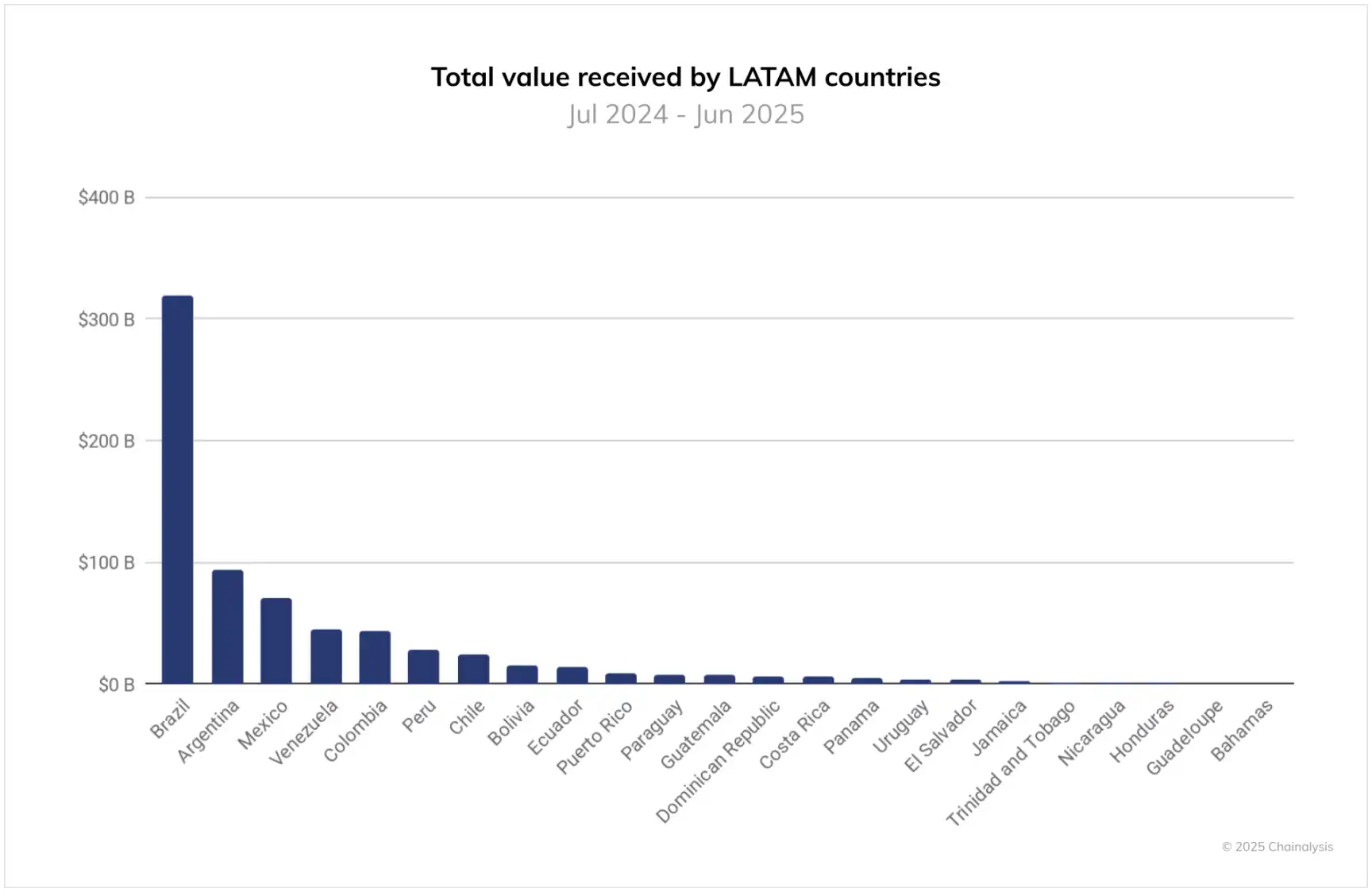
According to Chainalysis data, Brazil's cryptocurrency adoption index ranks fifth globally, behind only India, the US, Pakistan, and Vietnam. Its cryptocurrency inflow from July 2024 to July 2025 reached $318.8 billion, far surpassing other Latin American countries.
Furthermore, according to data provided by crypto market maker Gravity Team, Brazil has adopted stablecoins as a tool for investment and cross-border payments. Stablecoins currently account for about 70% of the indirect capital flow from Brazilian local exchanges to international exchanges.

At this point, some might ask, since they already have a national payment tool like Pix, what is the significance of stablecoins?

BRLV, launched by Crown, has a feature not explicitly stated on its official website but mentioned in the press release: it shares the interest income from government bonds with stablecoin holders. In Brazil, this number is 15%. Although it's impossible to distribute all of it to holders, even half is a very attractive yield.

In the future, BRLV could also be integrated into the Pix system. For ordinary people or even the impoverished, there might be no motivation to exchange for stablecoins. But for those with ample funds, stablecoins not only do not affect payments but even allow them to "earn interest" just by holding them. In the future, they could also be traded seamlessly with dollar stablecoins and even participate in DeFi. In short, all these possibilities ensure that stablecoins will have sufficient demand and use cases in this land.

For most countries with weaker national strength, unable to maintain long-term stability of their currency and with scarce foreign exchange reserves, the US dollar and dollar stablecoins are a lifeline for their people. Brazil is precisely an exception among them.

Related Questions

QWhy did Paradigm invest in Crown, a Brazilian stablecoin company, and what makes Brazil an attractive market for stablecoins?

AParadigm invested in Crown due to the limited investment opportunities in the U.S. stablecoin market, dominated by Tether and Circle. Brazil is attractive because of its large, digitally-savvy population, high cryptocurrency adoption (ranked fifth globally), supportive regulatory environment with innovations like Pix payment system, and a strong fintech ecosystem with over 1,500 companies. Crown's experienced team and the potential for BRLV to integrate with Pix and offer yield from Brazilian government bonds (around 15%) also made it compelling.

QWhat is Crown's BRLV stablecoin, and how does it differ from traditional dollar-based stablecoins like USDT or USDC?

ACrown's BRLV is a Brazilian real-backed stablecoin, pegged 1:1 to Brazil's national currency, the real. Unlike dollar-based stablecoins like USDT or USDC, which are primarily used for hedging against local currency volatility or facilitating crypto trading, BRLV aims to integrate with Brazil's financial infrastructure, such as the Pix payment system, and offer holders a share of the interest from Brazilian government bonds (currently around 15% annually), providing a yield-bearing feature not typically found in traditional stablecoins.

QWhat role does Brazil's Pix instant payment system play in the adoption of stablecoins and fintech innovation?

ABrazil's Pix, launched by the central bank in 2020, is a free, 24/7 real-time payment system that has become the preferred payment method for 76% of Brazilians, significantly enhancing financial inclusion. It provides low-cost infrastructure for fintech companies, enabling innovations in payments and credit. For stablecoins like Crown's BRLV, Pix offers a seamless integration point, allowing users to easily convert between stablecoins and traditional currency, thus boosting adoption and utility in everyday transactions.

QHow does Crown's team background contribute to its potential success in the Brazilian stablecoin market?

ACrown's team includes experienced professionals with strong backgrounds in Brazilian fintech and finance. CEO John Delaney was COO of Xerpa, a company backed by Founders Fund, and co-founder Vinicius Correa was an early engineer at Nubank, a successful digital bank. Their experience in scaling Brazilian fintech companies from scratch, combined with expertise in law, engineering, and finance, positions Crown to navigate the local market effectively and leverage opportunities like Pix integration and yield-bearing stablecoin features.

QWhat are the primary use cases for stablecoins in Brazil, and how do they address local financial challenges?

AIn Brazil, stablecoins are primarily used for practical purposes such as facilitating cross-border payments, tax optimization, capital flow efficiency, and cryptocurrency trading. While some users hold dollar stablecoins to hedge against currency volatility, the adoption of real-backed stablecoins like BRLV is driven by their ability to integrate with local systems like Pix, offer yield from government bonds, and provide access to DeFi. This addresses challenges like high banking fees, limited financial services for underserved populations, and the need for more efficient digital payment solutions.

Related Reads

Near Returns to the AI Stage: Transformation into a Public Chain Due to 'Payroll Difficulties,' Agent and Privacy Emerge as New Growth Narratives

NEAR Returns to AI Origins: From Payroll Struggles to Blockchain, Now Focusing on AI Agents and Privacy NEAR Protocol's journey began not with grand blockchain ambitions, but from a practical hurdle: its AI startup founders, including Transformer paper co-author Illia Polosukhin, couldn't efficiently pay international developers in 2017. This led them to pivot and build a high-performance, scalable blockchain. After years navigating various crypto narratives like sharding and cross-chain interoperability, NEAR is now leveraging its AI roots to re-enter the AI arena. A key driver is its "NEAR Intents" layer, which abstracts complex cross-chain transactions. Users simply state their goal (e.g., swap BTC for ETH), and a solver network finds the optimal route. This system has processed over $20B in cross-chain volume, generating significant fee revenue. A major growth area is private transactions via "Confidential Intents/Swaps," which hide trade details until settlement to protect against MEV and front-running. Remarkably, private swaps recently accounted for over 40% of NEAR's transaction volume, highlighting strong demand but also potential regulatory scrutiny. With its AI-founder pedigree, NEAR is positioning itself at the intersection of blockchain, AI agents, and privacy, aiming to become infrastructure for the emerging agent economy while navigating the challenges of its rapid adoption.

marsbit50m ago

Near Returns to the AI Stage: Transformation into a Public Chain Due to 'Payroll Difficulties,' Agent and Privacy Emerge as New Growth Narratives

marsbit50m ago

From Ethereum to AI's 'CROPS': What Exactly is This Set of 'Slow Variables' That Vitalik Repeatedly Emphasizes?

In recent discussions, Vitalik Buterin has frequently emphasized the concept of "CROPS," a framework defining core values for Ethereum's development. CROPS stands for Censorship Resistance, Capture Resistance, Open Source, Privacy, and Security. Initially outlined in the Ethereum Foundation's "EF Mandate," it represents a commitment to user sovereignty, ensuring that the network resists external control, remains open, protects privacy, and prioritizes security. The relevance of CROPS extends beyond Ethereum's foundational principles, becoming crucial in the context of AI integration. As AI agents begin handling wallet operations and automated transactions, the risk increases that users may cede control over their digital assets, privacy, and intentions to centralized AI service providers. A "CROPS AI" would therefore emphasize local execution where possible, privacy-preserving remote model calls (e.g., using zero-knowledge proofs), and transparent, verifiable processes to maintain user agency. Vitalik highlights a significant convergence between "CROPS Ethereum access layer" and "CROPS AI." Both address the same fundamental challenge: how users can access powerful services—be it blockchain data via RPCs or AI models—without exposing sensitive information or relinquishing ultimate control. This intersection points toward a future digital entry point that is more private, secure, and user-controlled. Ultimately, CROPS is not merely an abstract ideal but a practical guidepost. It steers development—from protocol resilience and wallet design to AI agent safety—towards a future where users retain self-sovereignty even as digital systems grow more complex and powerful. In an era of accelerating AI adoption, these "slow variables" of censorship resistance, openness, privacy, and security may define Ethereum's enduring value.

marsbit1h ago

From Ethereum to AI's 'CROPS': What Exactly is This Set of 'Slow Variables' That Vitalik Repeatedly Emphasizes?

marsbit1h ago

Silicon Valley 'Startup Guru' Steve Hoffman: Web3 + AI Could Be a Trap

Silicon Valley investor and "Godfather of Startups" Steve Hoffman warns that combining Web3 with AI is likely a trap, not a promising venture. In an interview, Hoffman argues that while AI is a foundational technology touching all industries, Web3 adds complexity, friction, and regulatory risk without solving mainstream consumer or business needs. He advises founders to focus on deep, specialized applications where startups can out-iterate giants, rather than on generic features easily replicated by large tech companies. Hoffman observes that Silicon Valley will lead foundational AI research, while China excels at rapid, large-scale application and commercialization, particularly in robotics. He stresses that AI-driven autonomous agents capable of collaborative, multi-step tasks are 2-4 years away, which will cause significant job displacement. The solution is not to slow AI but to redesign business models around human-AI collaboration and reform social systems like education and retraining. For startups, Hoffman recommends focusing on vertical, expertise-heavy domains to build defensibility. He sees major opportunities in AI fraud detection and cybersecurity. Key founder mindsets include systemic thinking over feature-focus, relentless customer centricity, building adaptive teams, and deeply understanding AI's capabilities and limits. Hoffman is also leading a non-profit initiative to establish university centers aimed at training future leaders in responsible, human-value-aligned AI innovation.

marsbit2h ago

Silicon Valley 'Startup Guru' Steve Hoffman: Web3 + AI Could Be a Trap

marsbit2h ago

Token Inefficient, Economy Tokenless

The article "Tokens Aren't Economical, Economics Aren't Tokenized" analyzes a pivotal shift in the AI industry from a technology-driven narrative to one dominated by capital efficiency. It highlights two concurrent trends: a severe capital shortage due to the exorbitant and recurring costs of compute (e.g., OpenAI's high burn rate) and a wave of corporate spin-offs where major tech companies are separating their AI units (like Kuaishou's Kling and Baidu's Kunlunxin). The core argument is that AI's "anti-internet" business model, where user growth increases costs rather than profits, has created a disconnect between high valuations and actual cash flow. Spin-offs address this by allowing AI assets to be valued independently. Within a parent company, they are seen as cost centers, but as standalone entities, they are priced based on their growth potential and scarcity in the primary market, leading to massive valuation premiums (e.g., Kling's estimated value tripling post-spin-off). The industry is at an inflection point, moving from "model worship" to "value realization." The competition is evolving from a pure compute (GPU) race to a broader focus on systemic efficiency and full-stack engineering (involving CPUs and orchestration) to achieve viable commercialization. The year 2026 is framed as a critical moment where the industry must definitively answer how to economically translate AI capability into tangible business value, reshaping the sector's future power structure.

marsbit2h ago

Token Inefficient, Economy Tokenless

marsbit2h ago

Trading

Spot
Futures

Hot Articles

How to Buy US

Welcome to HTX.com! We've made purchasing Talus Network (US) simple and convenient. Follow our step-by-step guide to embark on your crypto journey.Step 1: Create Your HTX AccountUse your email or phone number to sign up for a free account on HTX. Experience a hassle-free registration journey and unlock all features.Get My AccountStep 2: Go to Buy Crypto and Choose Your Payment MethodCredit/Debit Card: Use your Visa or Mastercard to buy Talus Network (US) instantly.Balance: Use funds from your HTX account balance to trade seamlessly.Third Parties: We've added popular payment methods such as Google Pay and Apple Pay to enhance convenience.P2P: Trade directly with other users on HTX.Over-the-Counter (OTC): We offer tailor-made services and competitive exchange rates for traders.Step 3: Store Your Talus Network (US)After purchasing your Talus Network (US), store it in your HTX account. Alternatively, you can send it elsewhere via blockchain transfer or use it to trade other cryptocurrencies.Step 4: Trade Talus Network (US)Easily trade Talus Network (US) on HTX's spot market. Simply access your account, select your trading pair, execute your trades, and monitor in real-time. We offer a user-friendly experience for both beginners and seasoned traders.

4.8k Total ViewsPublished 2025.12.11Updated 2026.06.02

How to Buy US

Discussions

Welcome to the HTX Community. Here, you can stay informed about the latest platform developments and gain access to professional market insights. Users' opinions on the price of US (US) are presented below.

活动图片