Operation 'Commodity': Brazilian Police Dismantle Criminal Gang Laundering $196 Million from Cocaine and Cryptocurrency Sales

cryptonews.ruPublished on 2026-07-27Last updated on 2026-07-27

Abstract

Brazil's Federal Police conducted "Operation Commodity," dismantling a major drug trafficking organization that used cryptocurrency to launder money from cocaine exports to Europe. The group smuggled over 6.5 tons of cocaine concealed in shipments of coffee, cement, and mortar through the port of Rio de Janeiro. Linked to Brazil's PCC and CV factions, the network had operations spanning South America, Europe, and Asia. Authorities executed 13 arrests, 44 search warrants, and seized assets valued at nearly $196 million. An elite car dealership in São Paulo was identified as a front used to funnel drug proceeds into Brazil's financial system via fraudulent invoices and cryptocurrency.

Brazil's Federal Police carried out an operation against a major drug trafficking gang that used cryptocurrency to launder money obtained from exporting drugs to Europe.

On Thursday, Brazil's Federal Police announced the results of Operation "Commodity," which dismantled a gang that used the port of Rio de Janeiro to smuggle cocaine hidden in shipments of coffee, cement, and mortar, primarily sent to Europe using a logistics network spanning South America, Europe, and Asia.

The investigation indicates that since 2021, the gang has smuggled more than 6.5 tons of cocaine to various European countries, including France, Belgium, Germany, Slovenia, and Spain.

During the operation, which involved actions in São Paulo, Minas Gerais, Santa Catarina, and Espírito Santo, 13 preventive arrests were made and 44 searches were conducted with property seizures; courts issued orders for asset seizures and property freezes totaling up to 1 billion reals (nearly 196 million dollars). In one of these locations, a shootout erupted, during which a suspect died from gunshot wounds while resisting.

This gang had connections with "Primeiro Comando da Capital" (PCC) and "Comando Vermelho" (CV) — two criminal organizations that the Trump administration designated as "Specially Designated Global Terrorists" (SDGT) and which were previously the target of Operation "Exchange," which dismantled a $2 billion cryptocurrency money laundering network earlier this month.

Police reported that a luxury car dealership located in the São Paulo metropolitan area, offering brands such as Ferrari, Porsche, Corvette, and Land Rover, was part of the operation, where drug trafficking proceeds were laundered using cryptocurrency through shell companies.

Using these shell companies, the organizers issued invoices without supporting documents, injecting these funds into the Brazilian financial system and using cryptocurrency to conceal and obfuscate their transactions.

"The suspects will be held accountable for their role in crimes related to the operation of a transnational criminal organization, international drug trafficking, and money laundering, without prejudice to any other offenses that may be identified during the investigations," concluded the Federal Police.

end-content
Related Questions

QWhat was the main objective of Operation Commodity conducted by Brazil's Federal Police?

AThe main objective of Operation Commodity was to dismantle a criminal organization involved in smuggling cocaine to Europe and laundering the proceeds using cryptocurrency, with assets worth nearly $196 million being frozen.

QHow did the criminal organization conceal cocaine for export, according to the investigation?

AThe organization concealed cocaine within shipments of coffee, cement, and mortar, using the port of Rio de Janeiro for smuggling primarily to Europe.

QWhat role did cryptocurrency play in the criminal group's operations?

ACryptocurrency was used to launder money from drug trafficking, helping to conceal and obscure their financial transactions through the use of shell companies.

QWhich two major criminal organizations was the dismantled group linked to?

AThe dismantled group was linked to 'Primeiro Comando da Capital' (PCC) and 'Comando Vermelho' (CV), both designated as Specially Designated Global Terrorists by the Trump administration.

QWhat was one of the businesses used in the money laundering scheme described in the article?

AA luxury car dealership in the São Paulo area, selling brands like Ferrari, Porsche, Corvette, and Land Rover, was used as part of the scheme to launder drug proceeds through cryptocurrency and shell companies.

Related Reads

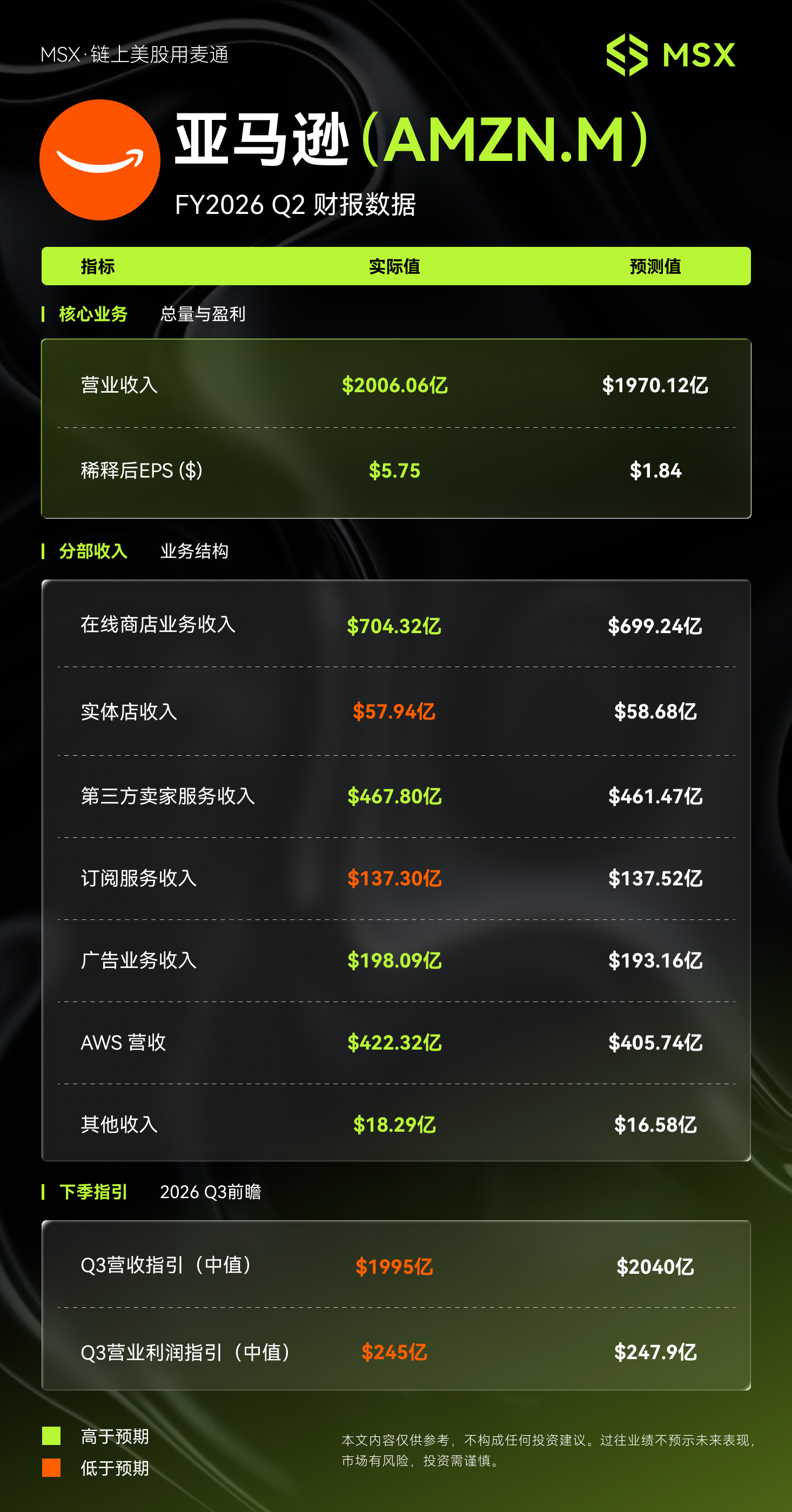
MSX US Stock Daily Insight: Amazon 2026 Q2 Earnings: AWS Records Fastest Growth in Five Years

**MSX Daily US Stock Observation: Amazon's Q2 2026 Earnings: AWS Achieves Fastest Growth in Five Years** Amazon's latest quarterly results exceeded expectations, driven by a strong performance from its cloud computing unit. The company reported revenue of $200.66 billion, surpassing estimates of approximately $197 billion. The key highlight was Amazon Web Services (AWS), which generated $42.232 billion in revenue, surging 37% year-over-year. This marked the segment's fastest growth pace in 18 quarters, indicating robust demand for cloud services. Reported Earnings Per Share (EPS) of $5.75 significantly exceeded the $1.84 forecast. However, this figure included a substantial one-time, non-operating gain of $53.4 billion, primarily from the revaluation of Amazon's investment in AI company Anthropic. Excluding this item, core operating profit was $27.461 billion, a strong increase of 43% compared to the same period last year. Despite the positive results, Amazon provided guidance for the upcoming third quarter that fell short of market expectations. The company's revenue guidance midpoint is $199.5 billion, below the consensus estimate of around $204 billion. Operating profit guidance of $24.5 billion also slightly missed expectations of approximately $247.9 billion. Furthermore, Amazon raised its forecast for full-year capital expenditures to $220 billion, citing rising memory chip costs, which weighed on investor sentiment regarding future profitability. In summary, Amazon's quarter showcased accelerating momentum in its core AWS business. The underlying operational profit growth remains solid. However, cautious forward guidance and increased investment spending present key areas for monitoring in the coming quarters, as the market assesses whether the current growth phase will translate into sustained profit margin expansion.

Odaily星球日报6m ago

MSX US Stock Daily Insight: Amazon 2026 Q2 Earnings: AWS Records Fastest Growth in Five Years

Odaily星球日报6m ago

Cyclical Stock or Growth Stock? Coinbase's Q2 Earnings Report Reveals 'Valuation Disagreement'

Coinbase's Q2 2026 financial results revealed a mixed performance, reigniting debate over whether the company should be valued as a cyclical stock tied to crypto markets or a growth stock with future potential. Total revenue missed expectations at $1.22 billion, down 19% year-over-year. Transaction revenue fell to $599 million, with retail crypto spot trading revenue dropping 30% to $452 million, back to 2023 levels. The company reported a net loss of $359 million, marking its third consecutive quarterly loss. Despite CEO Brian Armstrong's positive commentary on metrics like a 10.3% overall crypto trading market share and 106% growth in prediction markets, the market reacted negatively, with shares dropping over 5% after-hours. A key issue is the decline in core retail trading. While Coinbase touted record market share, this figure includes derivatives and new products. Its traditional crypto spot trading share is likely shrinking. New ventures like prediction markets, while growing, contributed less than $30 million, insufficient to offset the core revenue decline. The valuation debate hinges on perspective. As a cyclical stock, Coinbase remains deeply tied to the crypto bear market, with user attrition and competitive pressures justifying a lower valuation. The company's strategy appears focused on surviving until the next bull cycle. Viewed as a growth stock, however, Coinbase shows promising diversification. Subscription and service revenue reached $555 million, nearly matching transaction revenue. Stablecoin revenue, its second-largest source at $292 million, remains strong through its partnership with Circle. Critically, Coinbase is positioning itself as a leader in the emerging on-chain "agent economy." Over 90% of agent-based stablecoin transactions occur on its Base network, which it believes could handle trillions in future agent transactions. The recent acquisition of Deribit also aims to boost its international derivatives offering. In summary, Coinbase's present struggles are clear, but its future hinges on whether its investments in revenue diversification, stablecoins, and the agent economy can ultimately transform its business model and justify a growth premium.

Odaily星球日报26m ago

Cyclical Stock or Growth Stock? Coinbase's Q2 Earnings Report Reveals 'Valuation Disagreement'

Odaily星球日报26m ago

Global Market Share Survey: Japanese Firms Lead in Semiconductor Materials

Global Market Share Survey: Japanese Firms Lead in Semiconductor Materials According to the 2025 "Major Goods and Services Market Share Survey" by Nikkei, Japanese companies maintain strong positions in semiconductor-related materials. In silicon wafers, Shin-Etsu Chemical ranks first with a 26.3% share, followed by SUMCO at 17.8%. Together, they hold 44.1% of the market, widening their lead over competitors from Taiwan, Germany, and South Korea. In photoresists, Tokyo Ohka Kogyo, JSR, and Shin-Etsu Chemical occupy the top three spots, with a combined share of 60.5%. Despite their strength in materials, Japanese firms have a weaker presence in core semiconductor segments like DRAM and NAND flash memory, where South Korean and U.S. companies dominate. For instance, SK Hynix and Samsung lead in DRAM, while China’s CXMT doubled its share to 6% in 2025. The semiconductor market is projected to grow rapidly, with WSTS forecasting a 90% increase to $1.5112 trillion by 2026. Major players like Samsung, SK Hynix, and Micron are making massive investments to expand capacity. To maintain their edge in materials, Japanese companies must similarly commit to large-scale, risk-taking investments. In contrast, Japan’s automotive sector shows stagnation. Toyota remains the global leader but with only a slight share increase to 12.3%, while Japanese brands are absent from the top five in the EV market. In shipbuilding, Imabari Shipbuilding rose to third place globally with a 7.2% share, benefiting from large container ship deliveries. However, Chinese and South Korean firms dominate the sector, holding the top two positions. Japan aims to revitalize its shipbuilding industry through government and corporate efforts, targeting a near doubling of output by 2035. Addressing labor shortages and adopting advanced technologies like physical AI will be critical for competitiveness.

marsbit51m ago

Global Market Share Survey: Japanese Firms Lead in Semiconductor Materials

marsbit51m ago

Trading

Spot
活动图片