OpenClaw Endorses Venice.ai, VVV Token Surges Over 500% in One Month

Odaily星球日报Published on 2026-03-04Last updated on 2026-03-04

Abstract

OpenClaw, an open-source self-hosted AI agent platform, has listed Venice.ai—a privacy-focused, uncensored generative AI platform—as a recommended model provider. This endorsement comes shortly after OpenClaw’s founder publicly discouraged young people from engaging with cryptocurrency, creating a notable contrast. Venice.ai, founded by crypto OG Erik Voorhees, positions itself as a decentralized alternative to ChatGPT. It emphasizes user privacy by not storing any data on its servers; all content remains encrypted on the user’s local device. The platform offers two privacy modes: Private (using open-source models on decentralized GPUs) and Anonymized (removing user metadata from prompts). The project features a dual-token economy: - VVV: A capital asset used for staking (currently ~19% APY) and minting DIEM. - DIEM: Represents perpetual AI compute credit. 1 DIEM = $1 daily API credit, usable across Venice’s models. This structure allows high-frequency users to access AI services at a lower marginal cost over time. VVV’s price surged over 500% in a month, rising from ~$1.5 to ~$8.4. This growth is attributed to both supply constraints—including a permanent burn of unclaimed airdropped tokens and reduced annual emissions—and rising demand, especially after OpenClaw’s integration. With over 25,000 API users and a staking rate of 38.8% for VVV, Venice is positioning itself as a privacy-backend solution for the expanding AI agent ecosystem, blending crypto-economic incentives...

Original | Odaily Planet Daily (@OdailyChina)

Author | DingDang (@XiaMiPP)
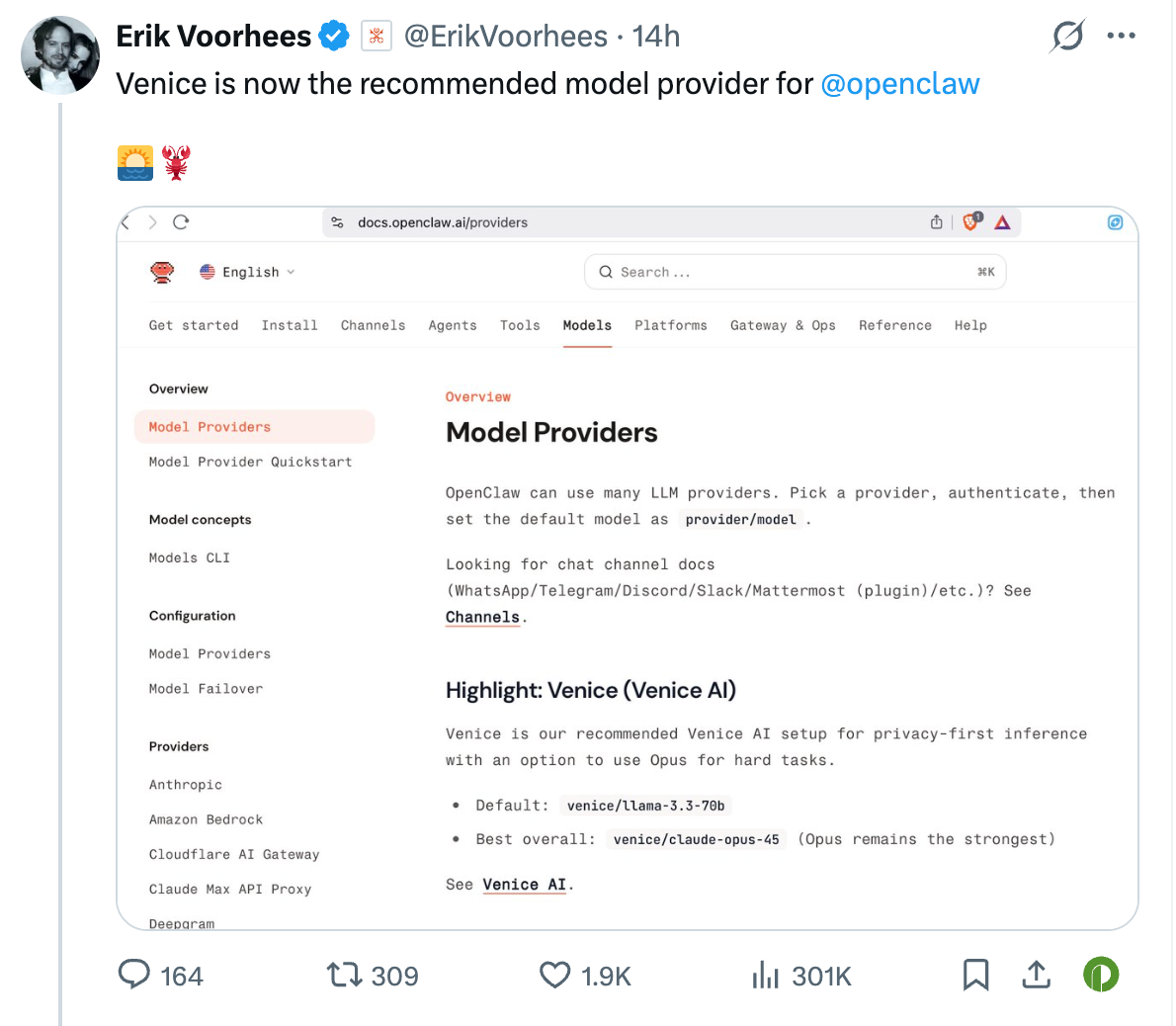
Last week, the statement from the founder of OpenClaw advising young people "not to waste time on cryptocurrency" stung the crypto industry. This week, however, the situation took a subtle turn. In the official OpenClaw documentation, an encrypted project with a native token, Venice.ai, was quietly listed as a recommended model provider. Over the past month, the price of Venice's native token VVV has also risen from a low of around $1.5 to a high of around $8.4, with a maximum increase of over 500%.

On one hand, there's discouragement; on the other, integration. Why did OpenClaw specifically push a project with an encrypted token economic structure to the forefront?
Venice's Origins: What Happens When a Crypto OG Does AI?

To understand Venice, one must first understand OpenClaw's positioning. It is an open-source, self-hosted AI agent platform that can integrate into chat software, becoming a user's 24/7 personal assistant, helping with tasks like sending and receiving emails and managing calendars. However, OpenClaw itself does not provide AI large language model (LLM) capabilities; it is merely an "execution and routing layer." The actual intelligence (thinking, planning, generating responses) must come from external model providers.

Venice is a generative AI platform focused on privacy and censorship resistance, positioning itself as a decentralized version of ChatGPT. The project launched in May 2024 but has not undergone any financing rounds, no VC funding, and was entirely personally funded and started by its founder, Erik Voorhees.

Erik Voorhees himself is a crypto old guard (OG), entering the crypto space in 2011. After the collapse of Mt. Gox in 2014, he founded ShapeShift, one of the first trading platforms to emphasize non-custodial and privacy-first principles. In 2021, he chose to transition ShapeShift to DAO governance, completing its decentralization. His career trajectory seems to revolve around "reducing reliance on trust in centralized structures."

Another core team member is Teana Baker-Taylor, with an impressive resume having held executive roles in operations and compliance at HSBC, Circle, Binance, and Crypto.com. Most other members are either anonymous or keep a low profile. According to current public data, the Venice team has approximately 20 members.

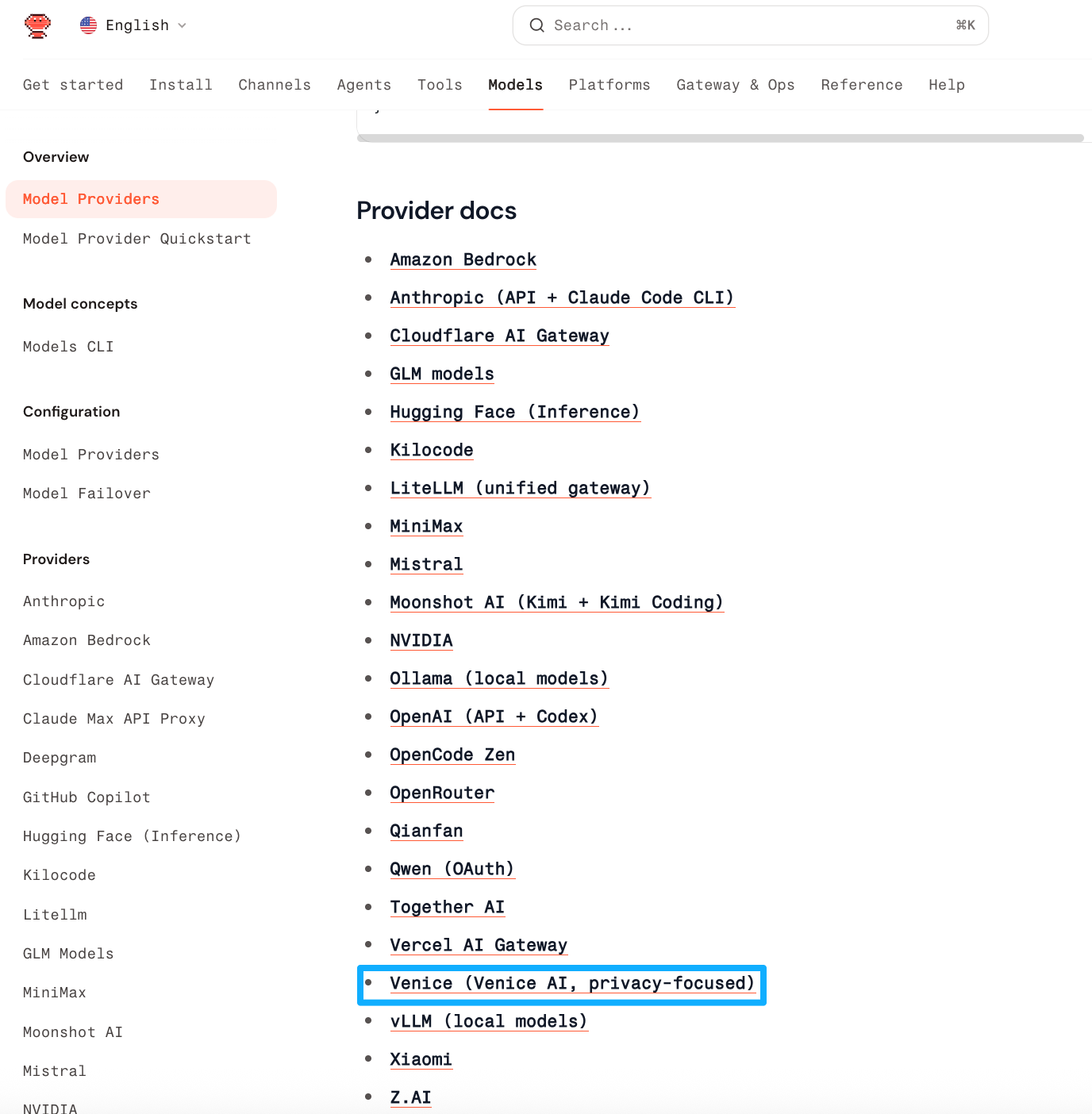
OpenClaw currently lists 22 model providers, including large tech companies like Amazon, Anthropic, and Cloudflare. In terms of size and brand, Venice is clearly not the most prominent one, and could even be considered the most inconspicuous. Yet, it was highlighted and recommended in the official documentation as a model provider with a native token economy. However, this might have been a merge operation error in the docs; the highlight has now been removed, but it had been on OpenClaw's list of model providers for some time.

Even so, why would OpenClaw choose a small, obscure company? The answer is simple: Privacy.

After all, alongside AI's great success, controversies surrounding data leaks and model training disputes continue to accumulate. Users are beginning to realize that the real risk is not whether the model is "smart," but whether data or information "will be leaked."
So, how exactly does Venice achieve its privacy? Its core philosophy is "You don’t have to protect what you do not have." Simply put, Venice does not store any user content—prompts, replies, generated images, uploaded documents—on any Venice servers at all. This data is only encrypted and saved locally in the user's own browser (or device). Once you clear your browser data or manually delete chat history, this content is permanently gone.

Venice also explicitly states that it does not use user data for model training, does not log, and does not analyze behavior. This stands in stark contrast to mainstream platforms (like OpenAI, Anthropic), which often store conversations long-term to improve models or for compliance reviews.

Furthermore, Venice distinguishes between two different levels of privacy modes: Private and Anonymized. The former is the highest privacy level, using open-source models that run on decentralized GPUs. During processing, no identity-related information is attached. The underlying compute nodes might briefly see the plaintext prompt, but Venice itself cannot see or access the user's history. The latter mode means the underlying provider can see the prompt content, but Venice strips all metadata (IP, account fingerprints, historical associations), making it impossible to trace back to the user.

So, although Venice isn't the most prominent name in the provider list, its privacy architecture made it the "privacy-first choice" specially highlighted in OpenClaw's documentation. Currently, OpenClaw's default model is Llama 3.3, but Erik himself suggested in a reply that users switch to the smarter GLM 4.6.

What does this mean for Venice itself?

OpenClaw is currently experiencing viral growth, with its call volume entering an exponential growth phase. With OpenClaw's official endorsement, it might pull Venice's inference capacity requirements to a new level. This means Venice is undergoing a qualitative change. It is no longer just "an AI project with a crypto background," but is attempting to become the default privacy backend for the mainstream open-source Agent ecosystem.

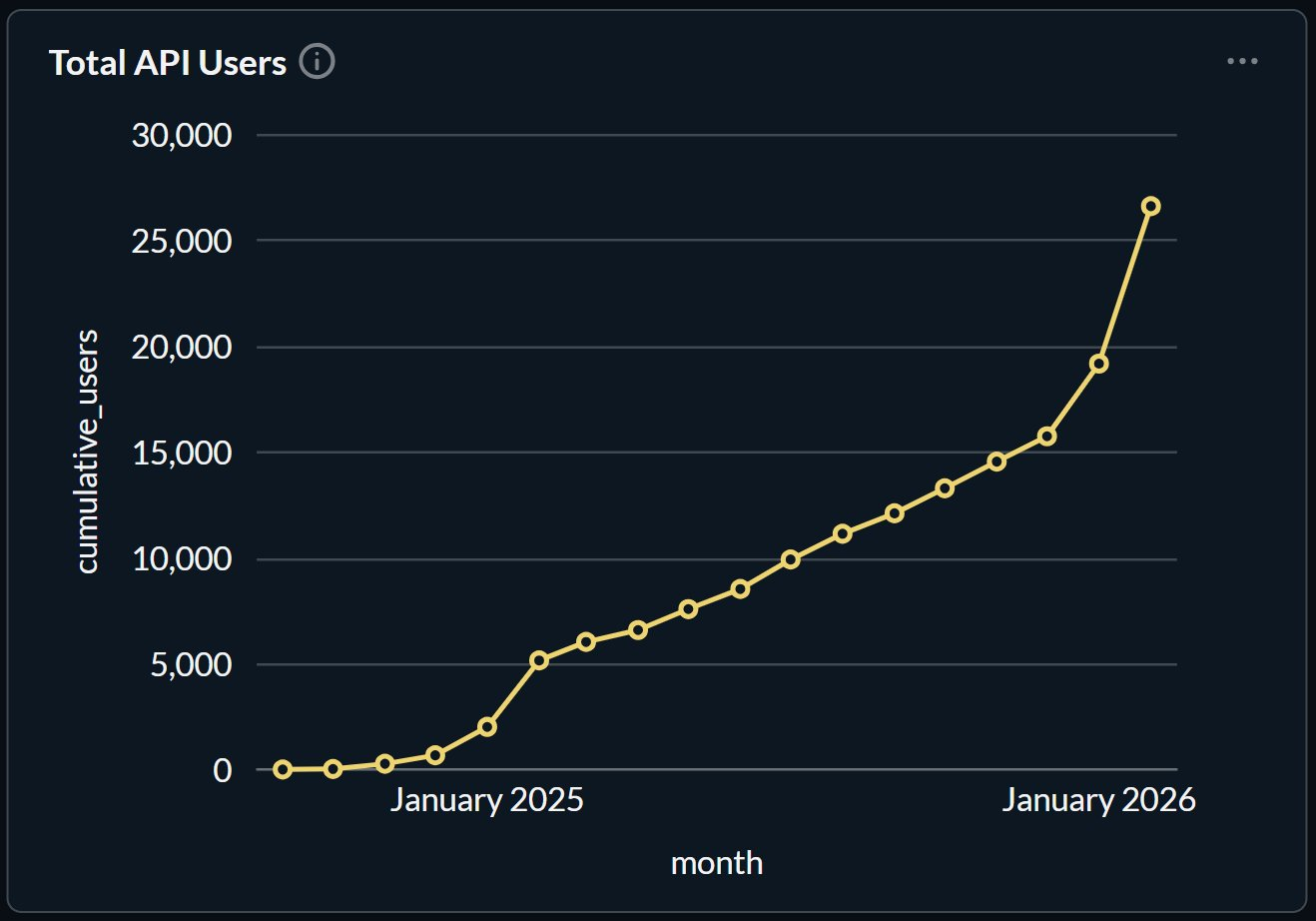
According to the latest data Erik released on March 1st, since the beginning of 2026, the number of API users on Venice has begun to grow rapidly, currently exceeding 25,000 users.
Token Model: One-Time Investment, Lifetime Compute Power

As a crypto project, can its token economy handle this level of traffic growth?

Within the Venice ecosystem, there are two core tokens: VVV and DIEM. They are tightly bound through a "one-way minting + reversible redemption" mechanism, forming a two-tier economic structure.

VVV is the capital asset of the entire ecosystem, which can be held directly or staked. Staking VVV yields continuous staking rewards, currently around 19% APY. Another key function of VVV is to mint DIEM, and it is the only way DIEM is generated.

After minting, DIEM can be traded on secondary markets, such as on DEXs like Aerodrome or Uniswap. Or it can be staked to activate spending credit. DIEM represents an ownable, perpetual AI computing asset. 1 DIEM = $1 per day of Venice API credit, used to call all of Venice's models (text generation, image/video generation, code, etc.), including the highest privacy, uncensored models in Private mode. This credit is permanently valid and automatically renewed daily during your staking period, effectively acting as a permanent AI subscription voucher.

The concept of $1 credit is abstract. Within the Venice ecosystem, it's not a fixed "number of tokens" but the ability to consume $1 worth of inference resources. The more expensive the model, the less content you generate; the cheaper the model, the more content you generate. This abstracted pricing makes DIEM a kind of "compute power share voucher." I asked Venice's AI to quantify what 1 DIEM credit can get me:
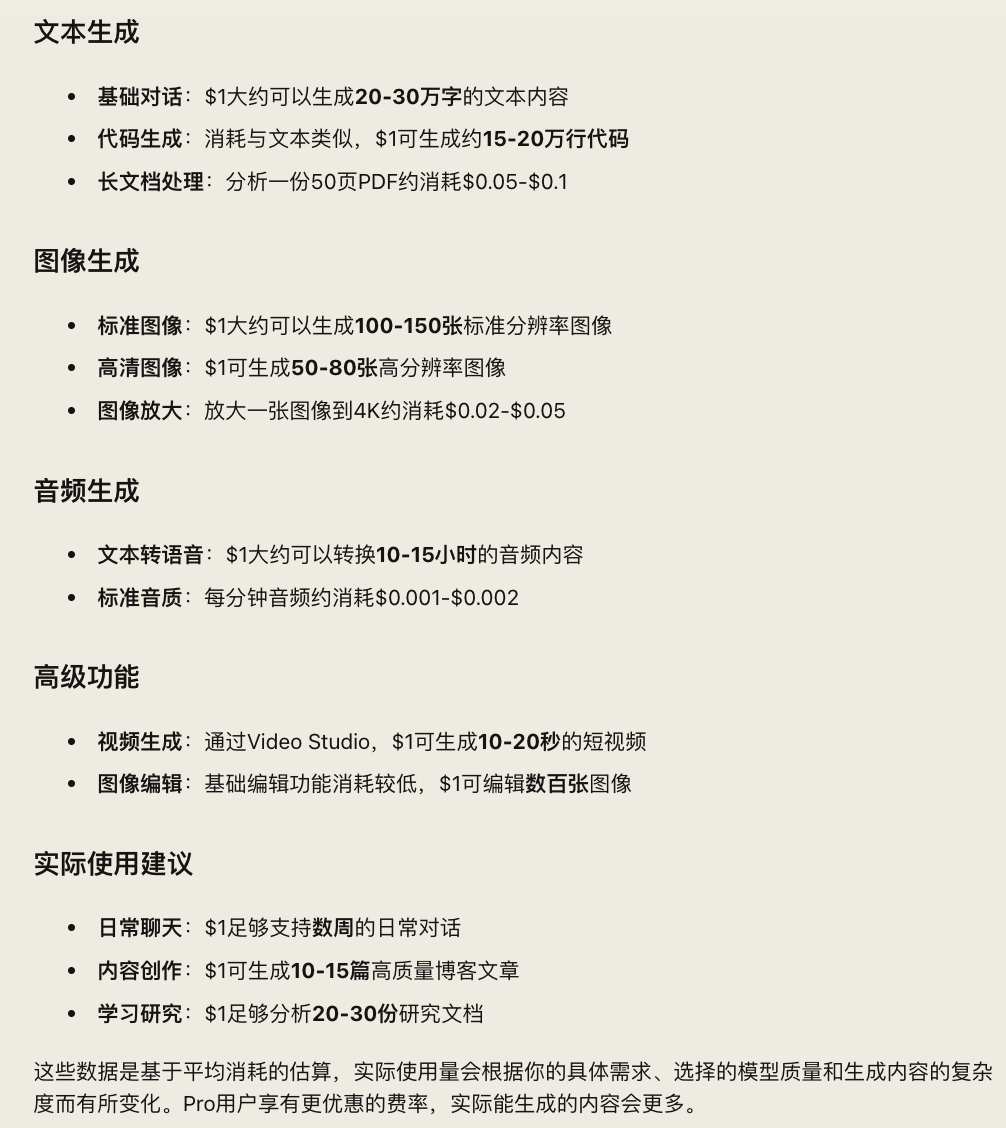
Because traditional AI APIs are pay-per-use, costs can explode exponentially for high-frequency, long-term, automated tasks (like an AI Agent making hundreds or thousands of calls per day). However, Venice, through DIEM, completely颠覆s this into a one-time investment for long-term fixed quotas. Currently, 1 DIEM is worth approximately $670. Once staked, it automatically grants $1 worth of API credit per day. To easily compare whether buying DIEM is more cost-effective than traditional pay-per-use, I used Grok to generate a rough table:
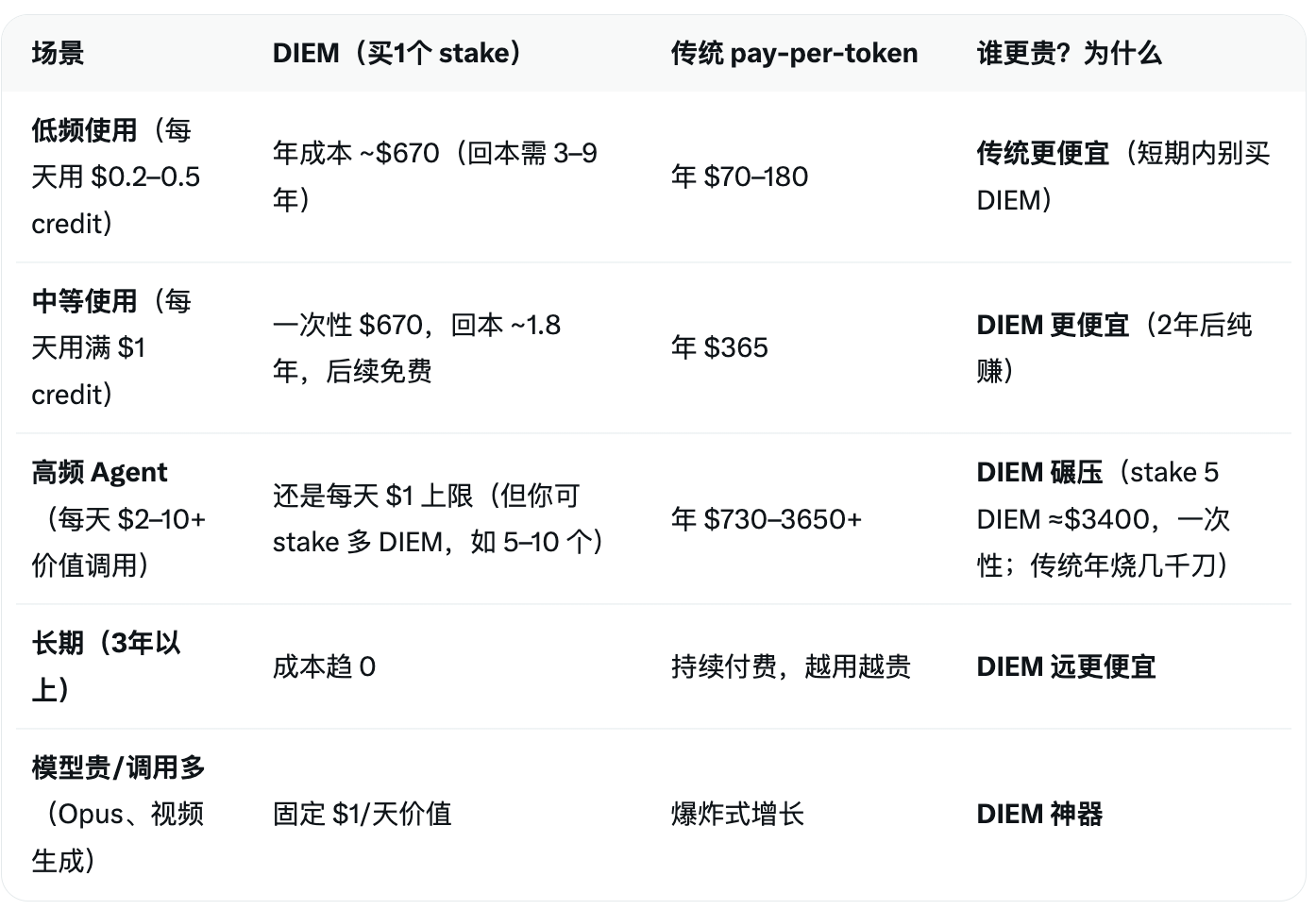
Based on the data above, for low-frequency users, there is no need to purchase DIEM at all. For medium to high-frequency users who need to run Agents daily and generate large amounts of content, the marginal cost decreases continuously with long-term use, giving DIEM a clear advantage.

Some users have already come forward to share their experiences. One user stated that staking 56 DIEM allows them to use the Claude Opus 4.6 model all day, with the principal cost being less than $10,000.
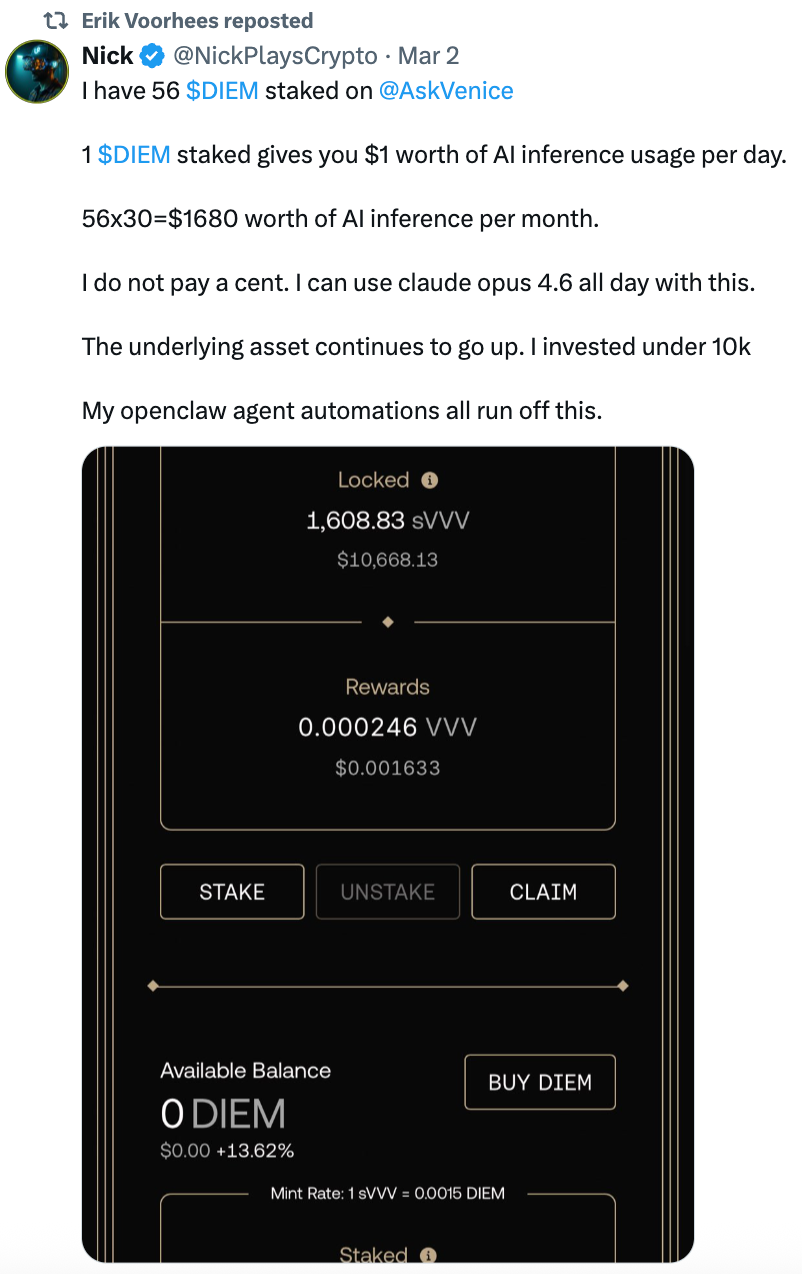
Moreover, community users have already developed a credit rental market (cheaptokens.ai) where unused credit can be sold. An ecosystem market around Venice's compute power is萌芽ing.

Overall, the core of Venice's economic model lies in separating the "growth logic" from the "usage logic". VVV, as a pure growth asset, carries the platform's overall valuation narrative, directly benefiting from user growth, network effects, and ecosystem expansion—positive flywheel effects. DIEM, as a permanent subscription-based utility asset, truly serves product usage and value consumption, handling the consumption logic for daily interactions and task execution.

Based on current data performance, DIEM shows clear advantages in long-term, high-frequency, continuous task scenarios, highly aligned with the current Agent-driven intensive usage模式. This strong genuine demand can, in turn, effectively stimulate users' willingness to stake VVV, forming a positive closed loop from the usage end to the growth end.

Supply and Deflation: The Real Background of the Price Surge

According to data provided on the Venice website, the current total token supply is 78.84 million tokens. Of these, 7.89 million are locked, and the staked amount is 30.60 million, resulting in a staking rate of 38.8%. The circulating supply is only 44.34 million tokens. In the initial economic model, the total VVV token supply was 100 million, with 50% allocated for community airdrops, targeting early Venice users, AI project parties, etc. The airdrop claim window lasted about 45 days. Ultimately, over 40,000 people claimed 17.40 million VVV, accounting for about 35% of the community allocation. The remaining unclaimed portion was approximately 32.68 million tokens, worth about $100 million at the time. The team decided to permanently burn these to reduce circulating supply and enhance scarcity.
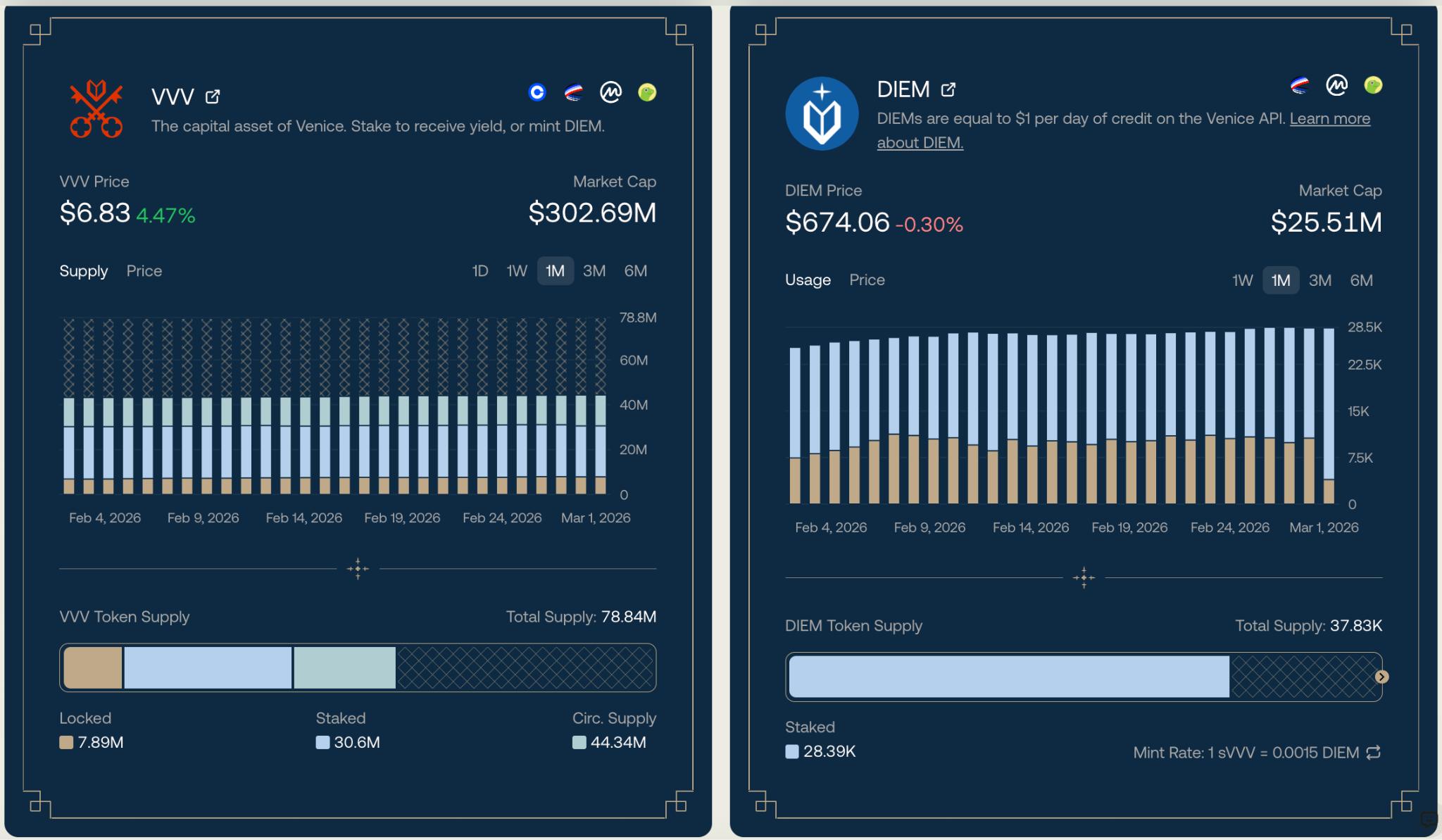
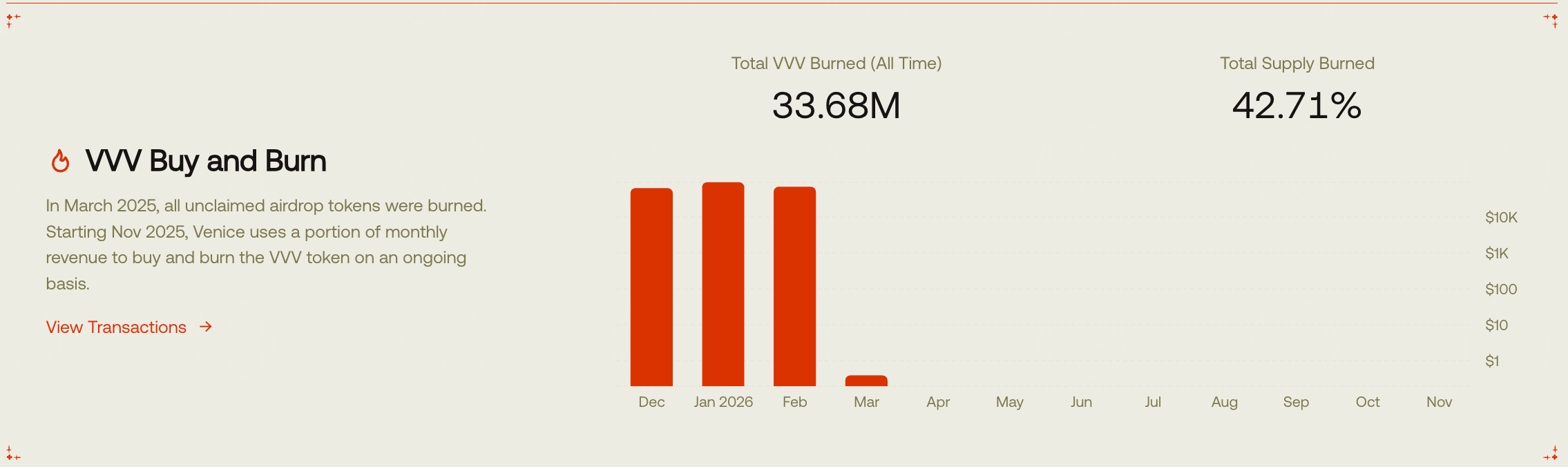
Starting in October 2025, Venice announced a reduction of the original emission plan from 10 million VVV/year to 8 million VVV/year. Simultaneously, it launched a monthly revenue buyback + burn mechanism. The current monthly burn capacity is 30,000 to 50,000 tokens, worth approximately $60,000 to $90,000. Currently, 42.71% of the token supply has been burned. Then, in early February 2026, the official announced another emission reduction plan, cutting from 8 million VVV/year to 6 million VVV/year. This series of adjustments directly changed the supply expectations. Looking at the token price performance, this was also the starting point for VVV's rise.

Therefore, the rise of VVV is not solely driven by narrative, but rather a combination of changed supply structure and growing demand.

Conclusion

As AI becomes the central narrative of the era, is Crypto really bowing out? Venice is trying to provide its own answer. If future intelligent agent systems require a privacy backend, if Agents need long-term stable compute structures, then perhaps the crypto logic hasn't disappeared after all.


Trending Cryptos

Related Questions

QWhat is the main reason OpenClaw highlighted Venice.ai in its official docs, despite Venice being a smaller provider?

AThe main reason is Venice.ai's strong focus on privacy. Its architecture ensures user data is not stored on its servers, aligning with OpenClaw's need for a privacy-first model provider.

QWho is the key founder of Venice.ai and what is his background?

AThe key founder is Erik Voorhees, a crypto OG who entered the industry in 2011. He is known for founding the non-custodial, privacy-focused exchange ShapeShift and later transitioning it to a DAO.

QHow does Venice.ai's token economy work with its two core tokens, VVV and DIEM?

AVVV is the capital asset that can be staked for yield (~19% APY) or used to mint DIEM. DIEM acts as a permanent AI computing asset; 1 DIEM staked provides $1 worth of daily API credits for life, functioning like a perpetual subscription.

QWhat recent change in VVV's tokenomics contributed to its price surge?

AThe price surge was driven by a combination of supply reduction, including a permanent burn of unclaimed airdropped tokens and a cut in annual emissions from 10M to 8M and then to 6M VVV, alongside growing demand from OpenClaw's integration.

QWhat is the key advantage of using DIEM tokens for AI API consumption compared to traditional pay-per-use models?

ADIEM offers a significant cost advantage for high-frequency, long-term users. A one-time purchase of DIEM provides perpetual daily credits, drastically reducing the marginal cost for heavy, continuous usage like AI agent tasks, unlike traditional models where costs scale with usage.

Related Reads

Wall Street's Most Famous 'Cassandra' Now Has His Sights Set on Nvidia

Michael Burry, the famed "Big Short" investor, has once again captured Wall Street's attention with a series of short positions against major tech and semiconductor stocks, most notably Nvidia. In late June and July, through his "Cassandra Unchained" newsletter, Burry disclosed short bets against Nvidia, Tesla, Applied Materials, Caterpillar, the SOXX semiconductor ETF, and later, Micron Technology. His core thesis revolves around potential distortions in the AI infrastructure boom, specifically questioning whether extended depreciation schedules (e.g., 6 years vs. a realistic 2-3 years for AI chips) by cloud giants like Microsoft and Google artificially inflate profits. He also raises concerns about possible "off-balance-sheet circular financing," where chip demand might be propped up by vendor-backed funding to clients. Nvidia's stock experienced volatility following these disclosures, briefly dipping but largely holding near Burry's reported entry points, leaving his positions roughly flat or slightly underwater as of late July. This move is part of a pattern for Burry, whose track record since his legendary 2008 bet is mixed. He has faced notable losses, such as on Tesla in 2021, while scoring on broader market turns like the 2020 pandemic crash. His methodology focuses intensely on free cash flow and scrutinizing original financial documents to spot overvaluation and structural risks, but it often struggles with timing the market. The article contrasts Burry's stance with other prominent investors. Steve Eisman, another "Big Short" figure, is not shorting Nvidia, citing strong fundamentals but expressing nervousness about sustainability. Jim Chanos agrees with the broad "accounting mismatch" concern—comparing it to the dot-com bubble—but targets financial leverage in private equity firms rather than the chip stocks themselves. While Nvidia's short interest remains relatively low at 1.3-1.4% of float, the massive stock size means absolute short losses have been significant, exceeding $5 billion earlier this year. The piece concludes that for ordinary investors, the key takeaway is not replicating specific short bets but learning from the critical frameworks these investors use: questioning rosy accounting, identifying structural vulnerabilities, and maintaining skepticism during market euphoria, even if pinpointing the exact catalyst for a downturn remains elusive.

marsbit9m ago

Wall Street's Most Famous 'Cassandra' Now Has His Sights Set on Nvidia

marsbit9m ago

Weekly Selection丨Epic Stock Market Volatility, Changxin Tech's IPO Reshapes Storage Landscape, Saylor Aims to Re-Anchor STRC Around September 8th

PANews Weekly Digest: Market Turmoil, Tech Breakthroughs, and Crypto Developments. The week saw significant volatility across global markets. South Korea's KOSPI index experienced extreme turbulence, including multiple trading halts, largely driven by sharp declines in AI hardware stocks like SK Hynix. In contrast, China's Changxin Xinqiao (CXC) achieved a landmark IPO with a market cap surpassing 4 trillion yuan, marking a major success for the domestic DRAM industry after a decade of losses. In the crypto and Web3 space, several key narratives emerged. AI is driving demand for new infrastructure, with projects like AI agent wallets and programmable payments gaining traction, attracting interest from firms like Coinbase. The Bitcoin mining sector is pivoting, with companies like MARA focusing on energy management as electricity becomes a core AI-era asset. Meanwhile, the RWA (Real World Assets) sector faces a "utilization puzzle," with hundreds of billions in on-chain assets remaining dormant. Notable market movements included a historic single-day surge of over 17% for the KOSPI index and a significant migration of $16.5 billion in staked ETH within the Lido ecosystem. Michael Saylor announced a target to re-peg the STRC stablecoin around September 8th. Other highlights include discussions on Ethereum's ambitious 2030 roadmap for scaling and privacy, analysis showing high protocol revenues not always translating to token price gains, and warnings from Citi about potential extreme commodity price shocks by late 2026.

marsbit14m ago

Weekly Selection丨Epic Stock Market Volatility, Changxin Tech's IPO Reshapes Storage Landscape, Saylor Aims to Re-Anchor STRC Around September 8th

marsbit14m ago

When the Market Begins to Question AI Capex: A Full Analysis of Q2 Earnings Reports from Five Tech Giants

In late July 2026, five major US tech giants—Alphabet, Intel, Microsoft, Meta, and Apple—released their Q2 earnings reports. While all companies exceeded revenue and profit expectations, driven by strong AI-related business growth, investor reactions diverged sharply due to concerns over escalating AI capital expenditures (capex) and their impact on free cash flow. Alphabet reported strong revenue growth and a surging cloud business, but its stock fell after announcing a doubled year-on-year capex and negative quarterly free cash flow for the first time. Intel posted its strongest revenue growth in over 15 years, but its stock experienced volatile trading after significantly raising its full-year capex guidance. Microsoft saw its stock surge after beating estimates and, crucially, lowering its capex forecast while projecting positive free cash flow. Meta faced the most severe sell-off as its profits declined despite revenue beats, with free cash flow plunging over 90% and its capex guidance raised. Apple reported record June-quarter results, but its stock plummeted after providing Q4 revenue guidance that fell short of expectations, citing supply chain constraints and forex headwinds. The overall takeaway is that the market's focus has shifted from validating AI demand to scrutinizing the timeline for returns on massive AI investments. Companies demonstrating a clearer path to managing capex and preserving free cash flow, like Microsoft, were rewarded, while those signaling continued aggressive spending faced investor skepticism.

Odaily星球日报23m ago

When the Market Begins to Question AI Capex: A Full Analysis of Q2 Earnings Reports from Five Tech Giants

Odaily星球日报23m ago

a16z: From Companies to DAOs, DUNA May Become the Next Generation Organizational Form

This article, "From Companies to DAOs: How DUNA Could Become the Next Organizational Form," traces the 500-year evolution of business collaboration. It begins with medieval structures like the *commenda* and Florentine *compagnia*, which exposed partners to personal risk. The modern corporation, exemplified by the Dutch East India Company (VOC), was a revolutionary leap, enabling large-scale, capital-intensive ventures by offering limited liability and reducing coordination costs. However, corporations introduced new challenges like principal-agent problems and bureaucratic overhead. The piece argues that software and internet-native protocols are now reducing these traditional overheads. Decentralized Autonomous Organizations (DAOs) emerged as a new model for coordination without centralized management. Yet, DAOs face a significant legal vacuum: they lack legal recognition, leaving members exposed to unlimited personal liability, and their tokens are vulnerable to being classified as securities under unclear regulations (e.g., the Howey Test). This has forced projects into suboptimal workarounds like offshore foundations. The article identifies the Decentralized Unincorporated Nonprofit Association (DUNA) as a potential solution. Recently legalized in states like Wyoming, the DUNA provides a legal wrapper for decentralized networks. It grants key protections—legal personality, limited liability, and perpetual existence—to a group without imposing a traditional hierarchical management structure. This allows token-holder communities to govern, hold assets, and contract as a single legal entity, aligning with their decentralized nature. While DUNA doesn't solve all governance challenges or magically resolve securities law questions, it represents a crucial step. It fills the legal recognition gap, offering a native legal form for internet-scale, decentralized collaboration and extending the separation of personal risk from organizational venture into a new domain.

marsbit1h ago

a16z: From Companies to DAOs, DUNA May Become the Next Generation Organizational Form

marsbit1h ago

2026 Mid-Year Report On-Chain RWA: Tokenized Stock Market Cap Doubles in a Year, But 90% of Rights Are Hollow Shells

The 2026 Mid-Year Report on On-Chain RWA highlights a significant growth in tokenized stock market capitalization, which nearly doubled from $951 million in March to $1.89 billion by July. However, the report reveals a fundamental contradiction in this "layer 2.5" ecosystem: products with the strongest legal foundation (like regulated U.S. infrastructure) lack liquidity and distribution, while freely tradable offshored wrapper products often lack substantive ownership rights. The increase is driven largely by a few products (SECZ, FGRS, STRCx) and platforms (Ondo, xStocks, Securitize collectively hold over 85% share). While distributed value across networks like Ethereum, Solana, and BNB Chain has grown, the market remains fragmented. Products referencing the same underlying asset (e.g., Apple stock) are distinct legal liabilities with different intermediaries and jurisdictional rules, offering varying degrees of legal claim. The report cautions that headline numbers are misleading, as they reflect changes in distributed token value—driven by issuance, conversions, and price movements—not pure investor inflows. True "canonical shares" with legal ownership, wide wallet distribution, institutional liquidity, and independent on-chain price discovery do not yet exist at scale. Tokenized treasuries show stronger product-market fit, and ETFs may be easier to scale than single stocks. The core takeaway is a trade-off: legal certainty versus liquidity and composability.

marsbit1h ago

2026 Mid-Year Report On-Chain RWA: Tokenized Stock Market Cap Doubles in a Year, But 90% of Rights Are Hollow Shells

marsbit1h ago

Trading

Spot

Hot Articles

How to Buy ONE

Welcome to HTX.com! We've made purchasing Harmony (ONE) simple and convenient. Follow our step-by-step guide to embark on your crypto journey.Step 1: Create Your HTX AccountUse your email or phone number to sign up for a free account on HTX. Experience a hassle-free registration journey and unlock all features.Get My AccountStep 2: Go to Buy Crypto and Choose Your Payment MethodCredit/Debit Card: Use your Visa or Mastercard to buy Harmony (ONE) instantly.Balance: Use funds from your HTX account balance to trade seamlessly.Third Parties: We've added popular payment methods such as Google Pay and Apple Pay to enhance convenience.P2P: Trade directly with other users on HTX.Over-the-Counter (OTC): We offer tailor-made services and competitive exchange rates for traders.Step 3: Store Your Harmony (ONE)After purchasing your Harmony (ONE), store it in your HTX account. Alternatively, you can send it elsewhere via blockchain transfer or use it to trade other cryptocurrencies.Step 4: Trade Harmony (ONE)Easily trade Harmony (ONE) on HTX's spot market. Simply access your account, select your trading pair, execute your trades, and monitor in real-time. We offer a user-friendly experience for both beginners and seasoned traders.

4.6k Total ViewsPublished 2024.03.29Updated 2026.06.02

How to Buy ONE

Discussions

Welcome to the HTX Community. Here, you can stay informed about the latest platform developments and gain access to professional market insights. Users' opinions on the price of ONE (ONE) are presented below.

活动图片