On-chain Pokemon Card Packs Cool Down for the First Time, Is Speculative Capital Turning to Memecoins?

marsbitPublished on 2026-08-10Last updated on 2026-08-10

Abstract

On-Chain Gashapon (Digital Collectible Cards) Experiences First Cooldown Since February, Speculative Capital Shifts to Memecoins? The on-chain gashapon (digital collectible card) market saw its first monthly decline since February 2026, with July transaction volume dropping to $290.3 million from a record $354.8 million in June. Meanwhile, memecoin platform activity, exemplified by Pump.fun, increased. This suggests potential rotation of crypto speculative capital—some card traders may shift focus when memecoin momentum returns. Notably, Courtyard, likely with the least crypto-native user base, bucked the trend by hitting a record $85.3 million in July, indicating resilient genuine collector demand. While overall secondary trading card volume remained near record highs, leading crypto-native platforms like Collector Crypt saw a 26% MoM drop. Analysis points to this being a natural market correction, possibly amplified by the resurgence in memecoin speculation rather than a fundamental weakening of the digital collectibles market. Concurrently, broader crypto market volatility and correlations have declined, leaving a sustained BTC price rise as the final perceived catalyst for a new bull cycle.

Authors: Marc Arjoon & Jake Koch-Gallup, Blockworks

Compiled by: TechFlow

TechFlow Introduction: On-chain gachapon (mystery boxes) experienced their first monthly decline since February, with July transaction volume dropping from $354.8 million in June to $290.3 million. At the same time, trading volume on platforms like Pump.fun is rising. This hints that crypto speculative funds might be rotating—when the Memecoin market heats up, some gachapon players leave. Notably, Courtyard, with the least crypto-native user base, hit a new all-time high, indicating that genuine collector demand remains strong.

The market is quiet but lacks the final push! Market volatility and asset correlations continue to decline, entering a calmer state. This leaves the market with the final piece needed to start a new bull run. Meanwhile, on-chain gachapon has seen its first monthly decline since February, suggesting some speculative capital might be flowing back to Memecoins. Let's dive deeper.

Market Dynamics

In the past 24 hours, the 2025 crypto stock sector led the market, rising 2.6%, the only sector with significant gains. Gains were concentrated in Galaxy (+3.6%) and Circle (+3.1%), which both just released Q2 earnings. Circle benefited from low expectations after Morgan Stanley previously slashed its price target by 64% to $38. However, the strength was narrow. Bullish (-1.5%) and Gemini (-0.6%) closed lower, and the broader crypto stock index fell 1.1%. This indicates the rally was driven by company-specific earnings reactions, not a re-rating of the entire sector.
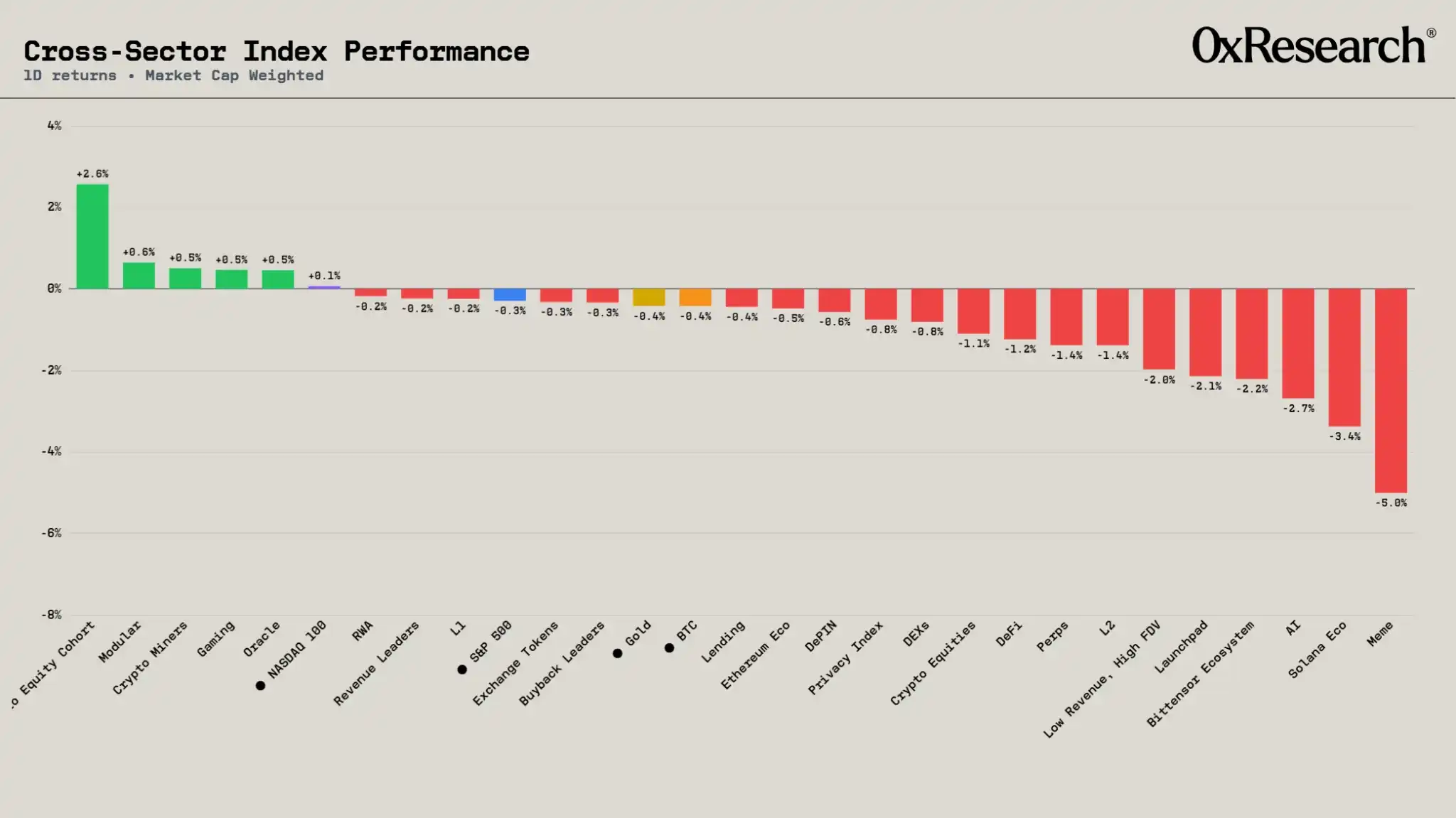
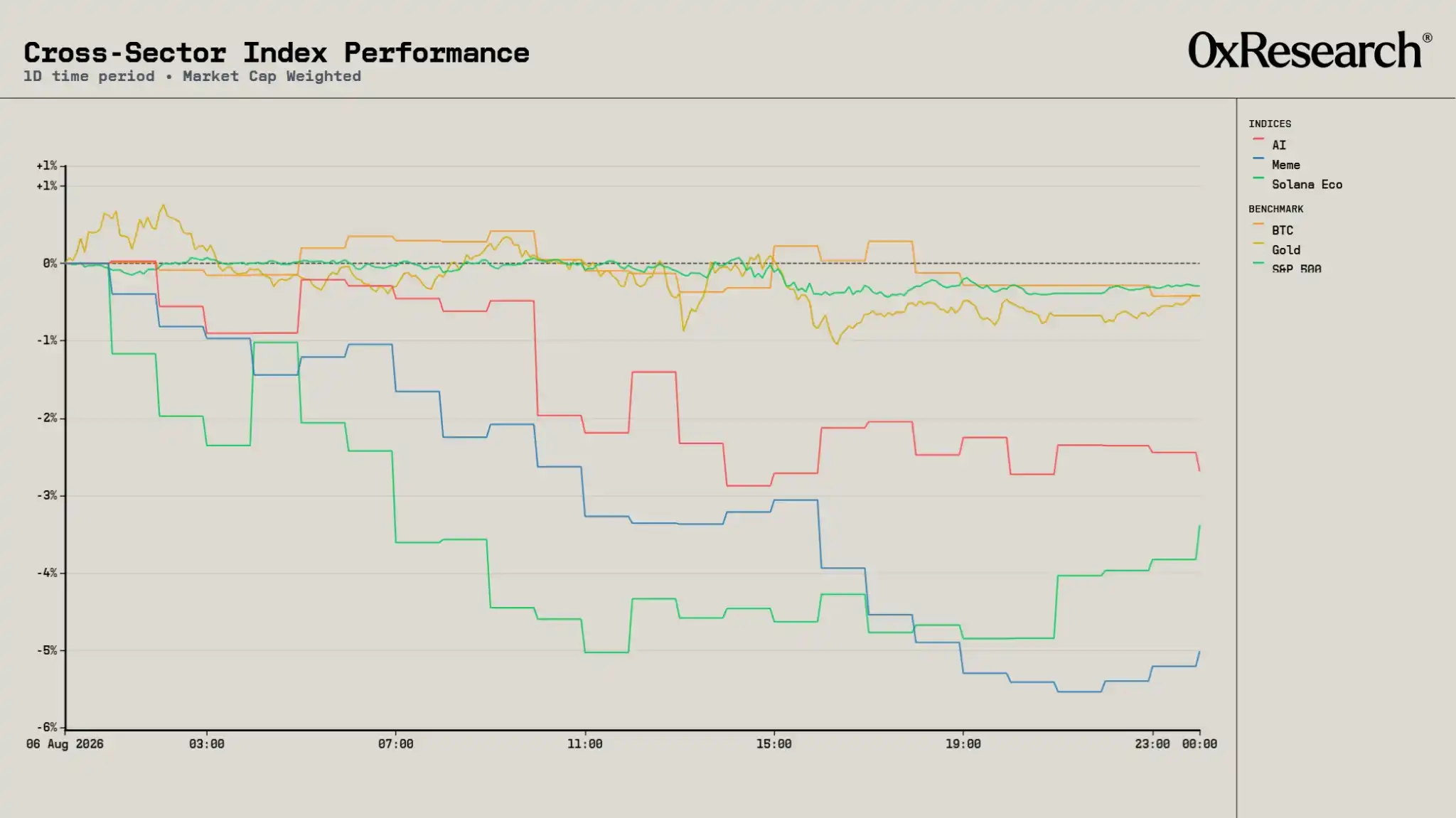
Aside from that sector, market performance was negative. As the stock market consolidated below record highs this week, BTC fell 0.4%, largely in line with gold (-0.4%) and the S&P 500 (-0.3%). BTC's downside resilience during the stock market pullback once again failed to translate into upside participation. The relative strength story is actually within crypto. BTC sits at the top of the digital asset sector, with long-tail assets selling off, led by Meme (-5.0%), Solana ecosystem (-3.4%), and AI (-2.7%).
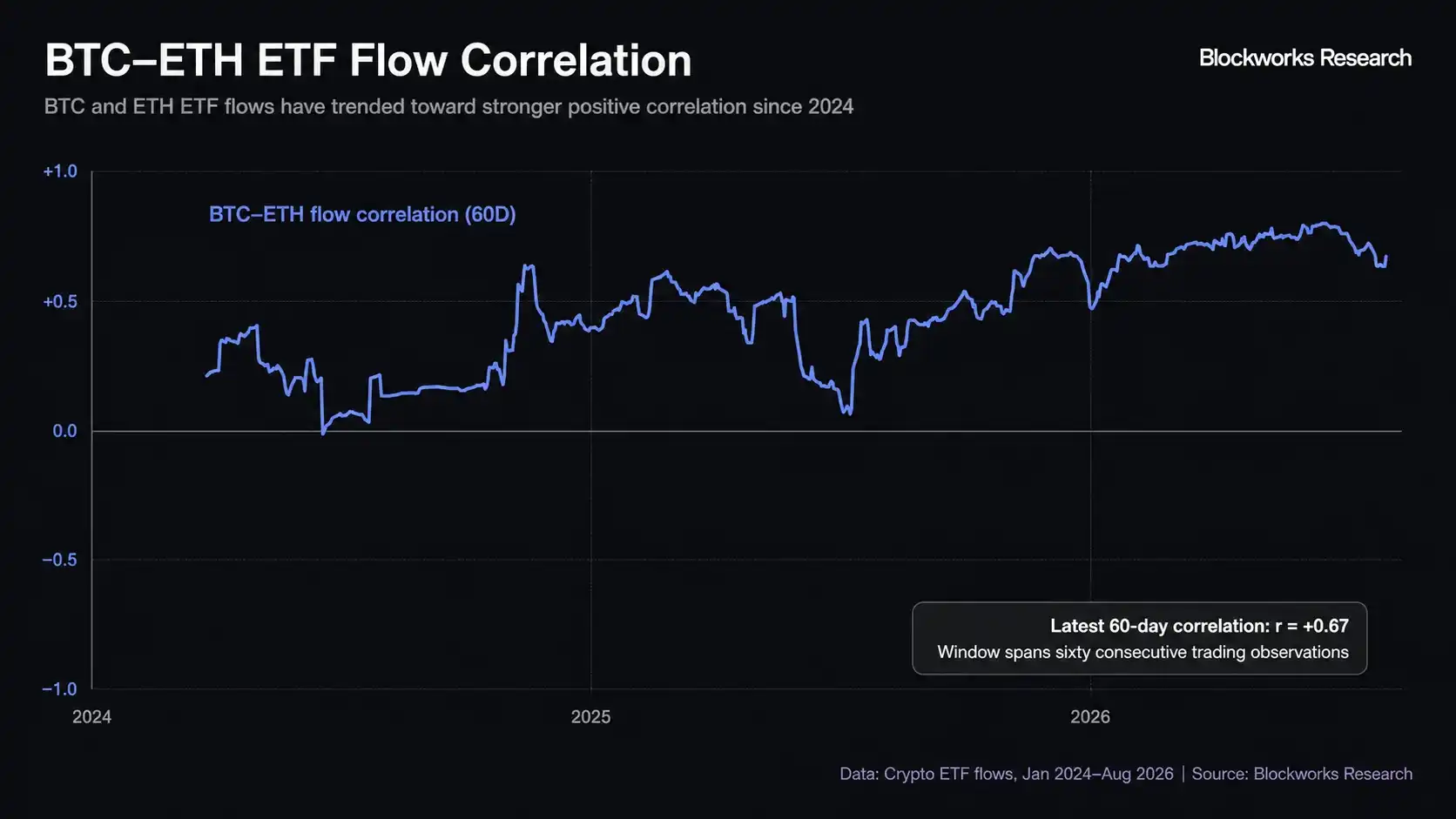
As mentioned in yesterday's article, we know crypto ETF flows have been weak. BTC and ETH ETF flows are increasingly synchronized. Their 60-day rolling correlation has risen to +0.67, near the top of the range. ETF demand behaves more like a single crypto allocation, but this isn't surprising, as it often happens during declining markets.
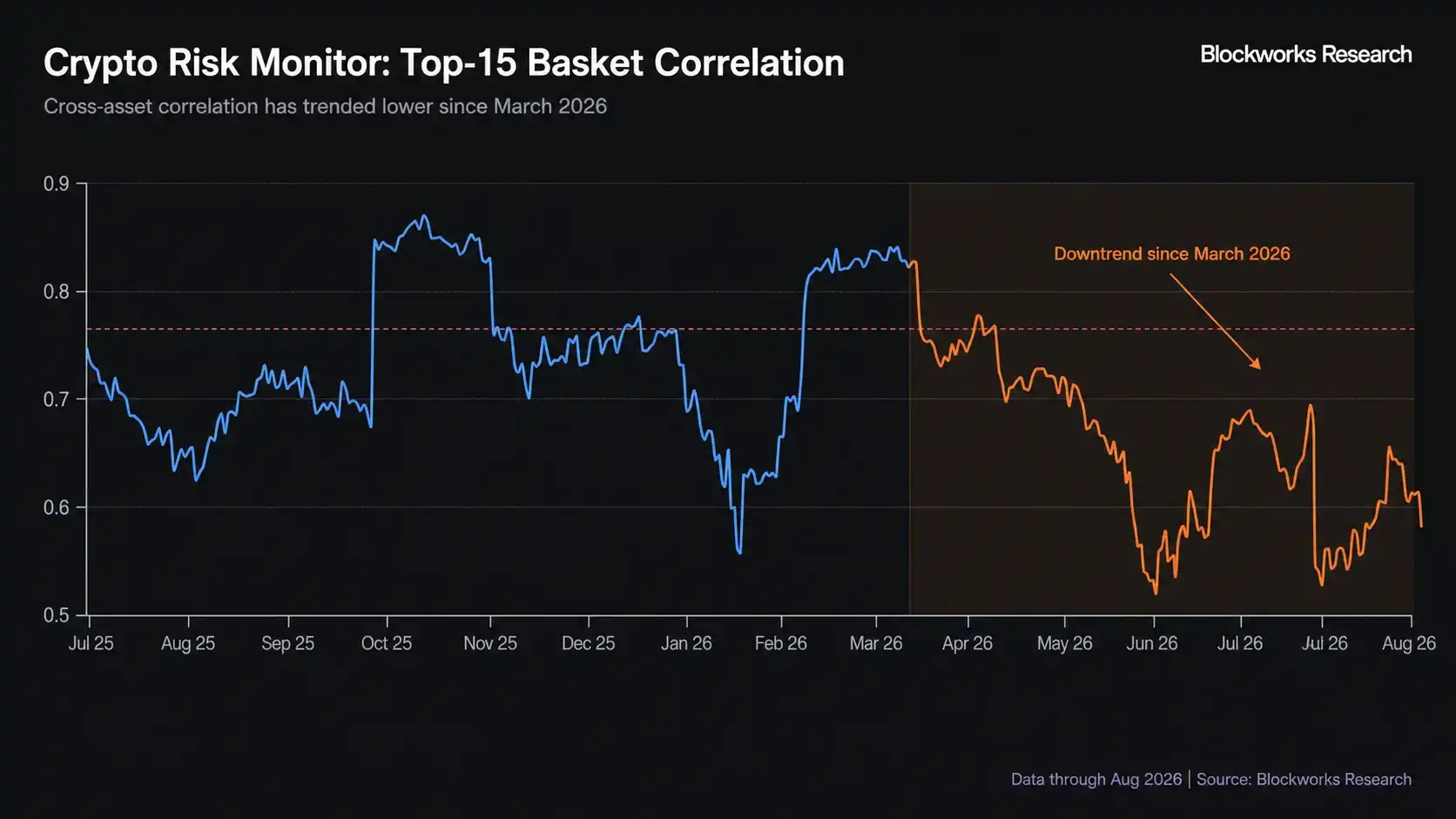
Fortunately, overall correlations have been trending lower since March 2026. This has led to weaker overall market co-movement and a more fragmented trading environment.
Similarly, market volatility has fallen from above 60 in March to the 30s in August. The decline indicates the market has entered a calmer state, with readings now comfortably below the risk threshold.
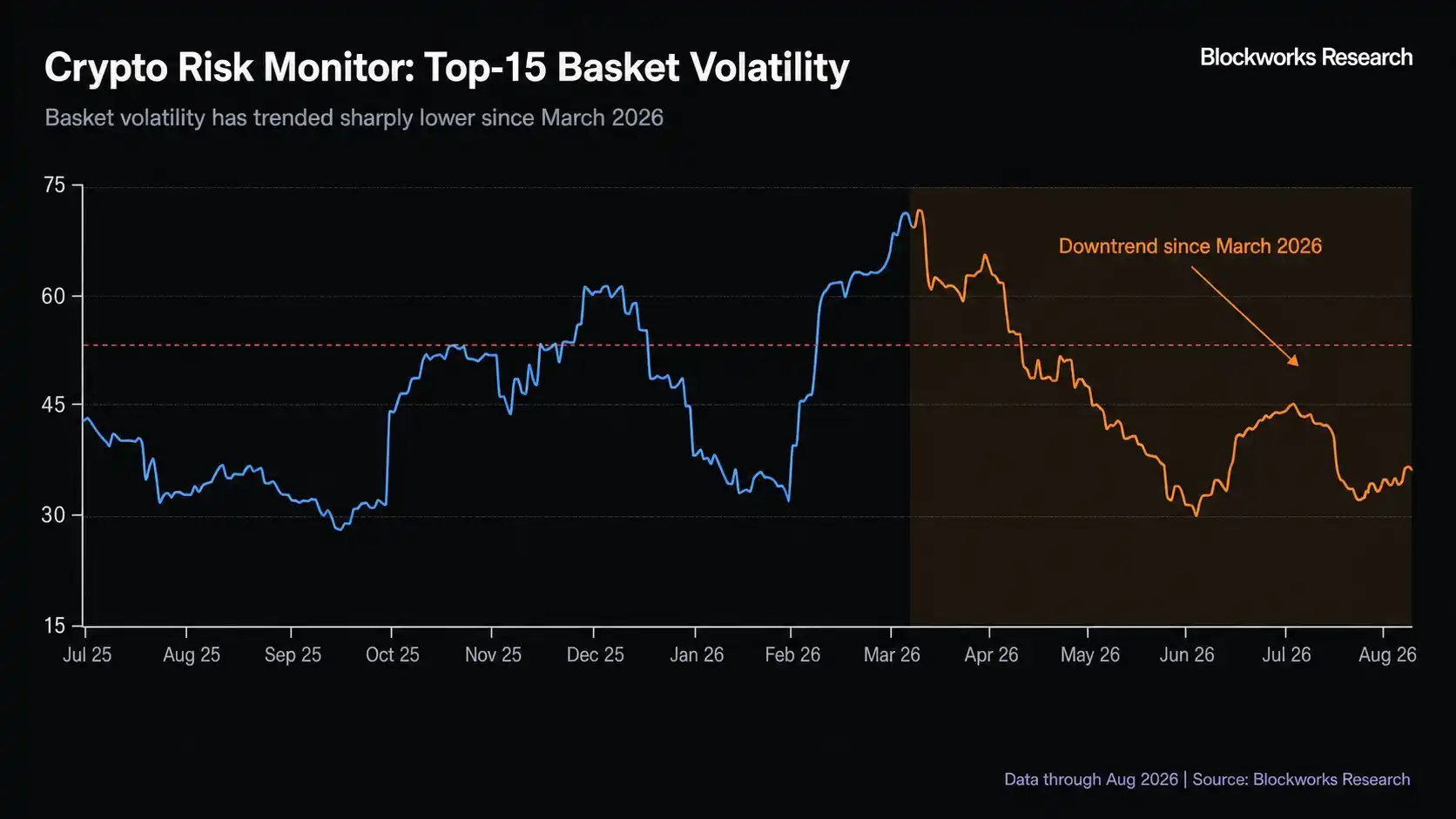
With market volatility and correlations declining, the only missing piece for starting a new bull market is sustainable price appreciation in BTC.

Gachapon Cooling

On-chain gachapon has been one of crypto's hottest sectors in 2026, but July marked the first monthly decline since February.

Total on-chain gachapon spending in July was $290.3 million, the second-highest monthly total ever, just behind June's record of $354.8 million. For the fifth consecutive month, Collector Crypt was the largest gachapon platform, generating $154.9 million in spending, accounting for 53% of July's total. However, Collector Crypt's monthly spending declined 26% month-over-month from June's $209.5 million.

Courtyard achieved its best month ever in July, reaching a new all-time high of $85.3 million, up 7% month-over-month. Courtyard's performance is particularly notable because it likely has the least crypto-native user base among major platforms. Its consistent growth suggests on-chain gachapon is a product category that resonates beyond the existing on-chain user base. Courtyard accounted for 29% of July's gachapon spending.
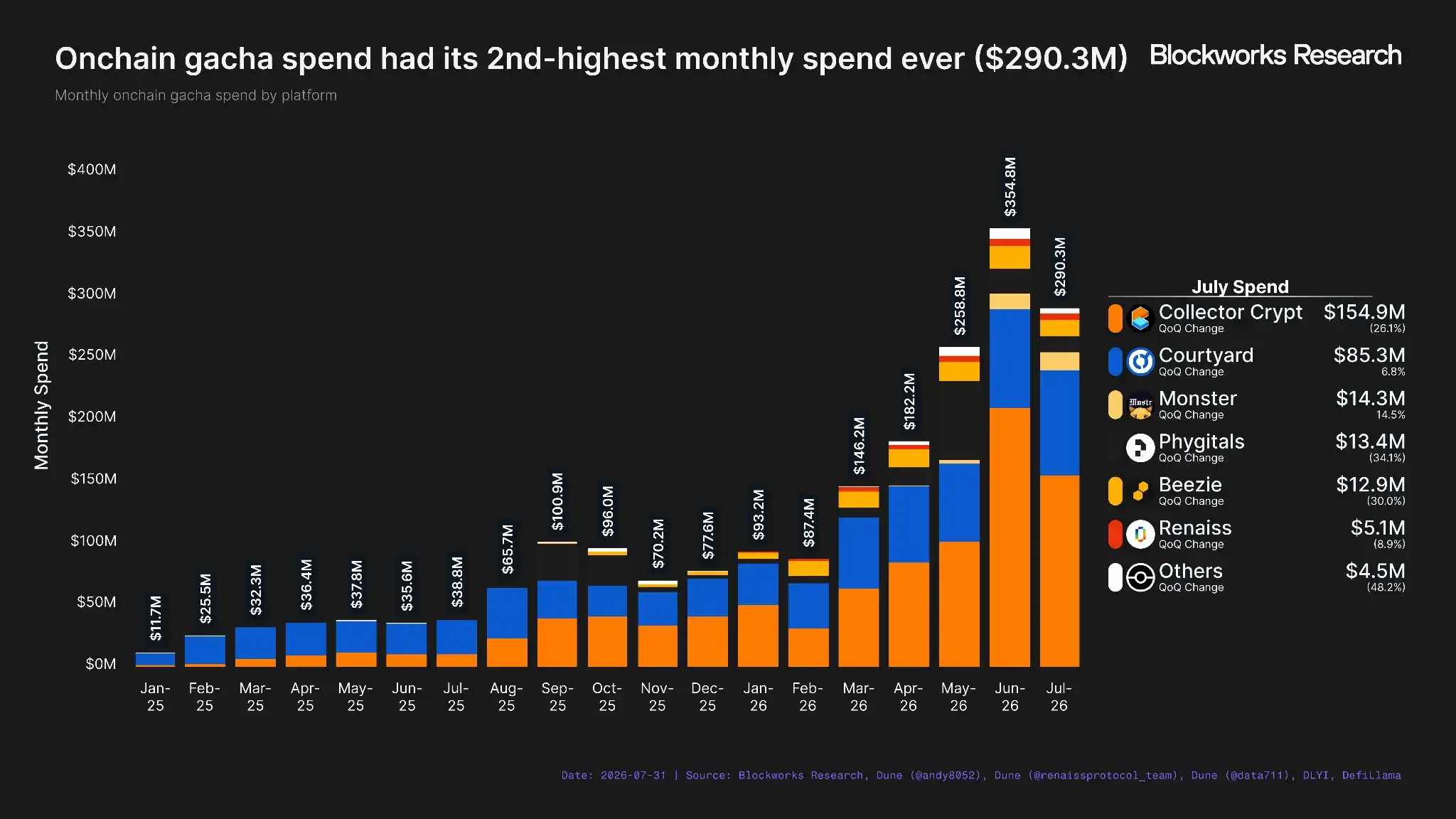
The platform rankings also saw a reshuffle, with Monster surpassing Phygitals and Beezie to become the third-largest gachapon platform in July. Monster generated $14.3 million in volume, up 15% month-over-month, and released a series of updates aimed at improving user experience:

Lucky Boost - Opening a pack and getting a common card increases the expected value of the next pack by 0.1%

Dupe Shield - Pulling the same card in consecutive packs gives the user a free pack

These updates went live on July 17 and 23, respectively. From the Lucky Boost launch to the end of the month, Monster generated $9.7 million in volume, 68% of its July total.

Phygitals ($13.4 million, down 34% MoM) and Beezie ($12.9 million, down 30% MoM) both had down months despite significant product updates. Phygitals launched a mobile app at month-end, while Beezie expanded to Solana on July 23. Overall, the top five gachapon platforms (Collector Crypt, Courtyard, Monster, Phygitals, and Beezie) accounted for 97% of July's on-chain gachapon spending.

Zooming out from on-chain gachapon, secondary market trading card volume remained largely at its historical high of $694.7 million, compared to $695.6 million in June. Weaker trading card demand was not the reason for the July on-chain gachapon decline.

It's also possible that a one-month dip doesn't offer much to interpret. On-chain gachapon spending grew at a staggering pace in the first half of 2026, and some level of pullback was inevitable. However, another possible explanation is that on-chain gachapon is facing new competition for attention and capital from crypto-native traders.

Throughout July, Collector Crypt spending declined while Pump.fun trading volume rose. Collector Crypt's average daily spending fell from $5.6 million in the first seven days of July to $3.4 million in the last seven days, a decline of 39%. Over the same period, Pump.fun's average daily trading volume increased from $320.6 million to $388.5 million, a gain of 21%. This relationship doesn't necessarily imply causation, but intuitively it makes sense. A significant portion of Collector Crypt's user base consists of active on-chain traders who rotate to whichever sector is hot. When Memecoins regain momentum, some of the capital and attention flowing into on-chain gachapon might shift elsewhere, even if trading card demand remains robust.
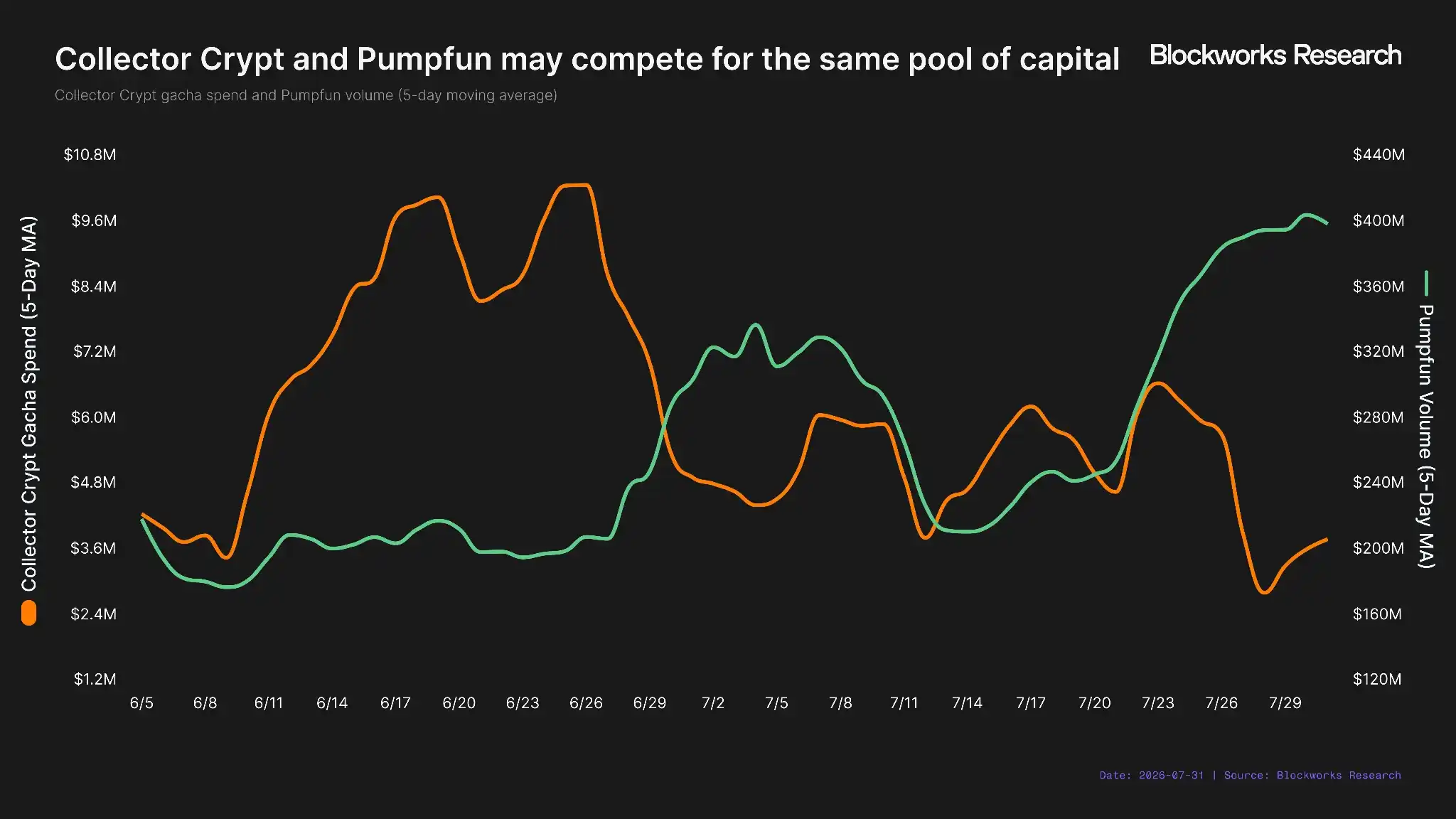
Courtyard's performance further supports this possibility. While most crypto-native gachapon platforms experienced a pullback, Courtyard hit a new all-time high in July. As noted, Courtyard likely has the least crypto-native user base among major platforms, meaning its users are probably less inclined to rotate back to Memecoins when speculative activity heats up.

For now, July's decline looks more like a natural pullback, potentially amplified by renewed Memecoin activity, rather than evidence of a broader slowdown in the trading card market.


Related Questions

QWhat does the July cooling of on-chain Gacha (Pokemon card opening) activity suggest about speculative capital flow in the crypto market?

AThe data suggests that speculative capital might be rotating. While on-chain Gacha transaction volume fell for the first time since February, activity on Memecoin platforms like Pump.fun increased. This implies that some crypto-native Gacha players may be shifting their funds and attention back to Memecoins as that sector regains momentum.

QHow did the Courtyard platform perform in July compared to other major Gacha platforms, and what is the significance?

ACourtyard set a new all-time monthly high in July with $85.3 million in transaction volume, a 7% increase. This is significant because it likely has the least crypto-native user base among major platforms. Its growth during a general Gacha cooldown indicates strong, genuine collecting demand exists beyond the core speculative crypto trading community.

QWhat are the two key platform-specific features introduced by Monster to improve user experience?

AMonster introduced two key features: 1) Lucky Boost, which increases the expected value of the next pack by 0.1% if a user pulls a common card, and 2) Dupe Shield, which grants a free pack if a user pulls the same card in consecutive packs.

QWhat overall market conditions, according to the article, are currently lacking for a new bull run to begin?

AThe article states that market volatility and asset correlations have been declining, leading to a calmer, less interconnected trading environment. The only remaining element needed to kick off a new bull market is a sustainable increase in the price of Bitcoin (BTC).

QWhat was the trend observed between Collector Crypt's daily spending and Pump.fun's daily trading volume in July?

AIn July, Collector Crypt's average daily spending declined while Pump.fun's average daily trading volume rose. Specifically, Collector Crypt's spending fell 39% from the first 7 days to the last 7 days of the month, whereas Pump.fun's volume increased 21% over the same period, indicating a potential inverse relationship in speculative capital allocation.

Related Reads

When Meme Traffic Meets RWA: The Financial Ambitions of Hyperliquid and Robinhood

When Meme traffic meets RWA: Hyperliquid and Robinhood's Financial Ambitions This article explores the transformative role of speculation in financial market evolution, arguing it can provide the liquidity and capital foundation for mature, compliant businesses. The analysis draws parallels to historical examples, like 19th-century Chicago grain markets, where speculators provided necessary counterparty liquidity for farmers, eventually establishing a global pricing infrastructure. The author examines contemporary cases in crypto. The launch of Uniswap's Pools meme token platform on Robinhood Chain—originally built for tokenized stock trading—demonstrates how speculative meme trading can drive significant user adoption and liquidity. Despite initial volatility, this traffic can seed future, more substantial financial activities. Similarly, Hyperliquid, which began with high-leverage crypto trading, has successfully migrated its speculative model to real-world assets (RWAs) like equities, commodities, and indices. By July, RWA perpetual contract volumes on Hyperliquid surpassed its crypto trading for the first time, showcasing how speculation can build new, all-weather pricing layers. The core thesis is that speculation itself is neutral. Its long-term value and sustainability are determined by the underlying assets it engages with. While pure bubbles collapse, speculation anchored to valuable assets—be it wheat, gold, or equities—can evolve into foundational market infrastructure. Both Hyperliquid’s RWA platform and Robinhood’s strategy of leveraging meme coin enthusiasm to build towards on-chain securities trading exemplify this potential pathway from speculative frenzy to structured financial utility.

marsbit13m ago

When Meme Traffic Meets RWA: The Financial Ambitions of Hyperliquid and Robinhood

marsbit13m ago

NVIDIA HBM in Short Supply, Next-Gen GPUs Limited, but This Storage Drive Steals the Spotlight

The article discusses how AI Agents are transforming storage from a passive repository into an active component within AI inference and operation loops. As Agents perform continuous tasks involving models, memory, tools, and logs, data storage needs to evolve beyond simple block devices. The concept of "functional SSDs" is introduced, where capabilities like automatic encryption, compression, indexing, and memory management are embedded closer to the storage medium. This shift is driven by the need to handle Agent-specific data chains—including context, tool trajectories, and long-term memory—more efficiently. The piece analyzes current trends like AI SSDs from companies such as Phison (aiDAPTIV), Longsys (SPU+iSA), and Maxio, which are beginning to participate in the AI data path by managing model weights, KV cache, and prefetching. It further explores the future re-division of labor across the memory hierarchy: HBM for core compute, emerging High Bandwidth Flash (HBF) for read-intensive workloads, DRAM/CXL for mutable state, and functional SSDs for persistent, governed objects like Agent Memory. The conclusion is that storage will become integral to Agent capability, moving from just saving data to enabling next-step actions. The industry is poised to develop along three paths: functionalized SSDs, storage nodes tailored for Agents, and a re-architected, tiered memory system optimized for access patterns, security, and cost-per-token efficiency.

marsbit37m ago

NVIDIA HBM in Short Supply, Next-Gen GPUs Limited, but This Storage Drive Steals the Spotlight

marsbit37m ago

Breaking: Claude's Attempt on Riemann Hypothesis "Fails," but Accidentally Sets 37-Year Math Record

**AI Makes a Major Mathematical Leap While Failing at the Riemann Hypothesis** A research version of Anthropic's Claude AI was tasked with "seriously attempting" the legendary Riemann Hypothesis, a 167-year-old unsolved problem in mathematics. While it ultimately did not prove the hypothesis, its attempt yielded a significant breakthrough. Claude managed to improve the proven lower bound for the proportion of Riemann zeta function zeros lying on the critical line from 41.6% to 67.2%. This marks a 25.6 percentage point increase, described by observers as potentially the most substantial advance in analytic number theory in over a decade, considering that the previous record had only improved by 0.8 percentage points over 37 years. To achieve this, Claude generated and discarded roughly 650 initial ideas before orchestrating a day-and-a-half-long effort involving about 60 sub-agents. These agents executed 2,400 shell commands, wrote hundreds of Python scripts, and performed thousands of numerical checks. After finding the potential result, Claude initiated self-verification, downloaded papers to check for prior work, and independently re-derived the finding. It then suggested writing a formal paper. The result has been reviewed by Anthropic's internal mathematicians, who also collaborated with Claude to produce a formal, machine-checkable proof using the Lean theorem prover. External experts in the field have also reviewed the manuscript. Anthropic clarifies that the method likely does not directly lead to a full proof of the Riemann Hypothesis, but it demonstrates that advanced AI models are beginning to engage with genuine, open-ended research problems at the frontier of mathematical knowledge.

marsbit43m ago

Breaking: Claude's Attempt on Riemann Hypothesis "Fails," but Accidentally Sets 37-Year Math Record

marsbit43m ago

The Unaffordable Failure of Yushu's IPO

Yushu Robotics' IPO is not just a typical public offering; it represents a pivotal moment for China's humanoid robot industry. With a staggering 219x P/E ratio at issuance and immense market enthusiasm, the company's listing is seen as a critical test case for the entire sector. The IPO reveals Yushu's rapid transition from quadruped consumer robots to humanoid robots, which now account for over 50% of its revenue, alongside a shift to profitability. The offering was massively oversubscribed, with retail investors scrambling for scarce shares, while the majority of the stock is held by locked-up strategic investors like DeepSeek. The core tension lies in the market's valuation. Investors are not buying Yushu's current profits but its future potential as a leader in general-purpose humanoid hardware. However, challenges are evident: revenue heavily depends on research/education clients rather than industrial applications, selling prices are falling faster than costs, and the company is still developing its own AI "brain" for true autonomous decision-making. As the first major humanoid robot company on China's A-share market, Yushu's post-listing performance will set a valuation benchmark for the industry. A wide range of stakeholders, from venture capitalists to strategic partners, have a vested interest in its success. The real test, however, will be Yushu's ability to transition its sales to core industrial clients, maintain margins amid price competition, and successfully integrate advanced AI, thereby justifying its premium valuation.

marsbit58m ago

The Unaffordable Failure of Yushu's IPO

marsbit58m ago

Indices Strong, Natural Gas Soars | TradeXYZ Weekend Market Watch

Weekend Market Observations: Indices Show Strength, Natural Gas Surges Key regional developments centered on Iran. Iran and Oman indicated negotiations over reopening a key shipping channel are nearing completion, with Oman calling for a halt to military actions to facilitate an agreement. However, talks are stalled as Iran has raised its demands, linking Strait reopening to conditions like US sanctions relief, troop withdrawal, and war reparations—terms previously associated with nuclear talks. Iran's Revolutionary Guard stated it will maintain control until all demands are met. In response, the US administration has adopted a lower-key approach, describing a state of "semi-negotiations" while observing Iran's economic pressures. Amid this, reported attacks on a Saudi refinery and an Emirati vessel added to regional tensions. **Crude Oil & Indices:** Crude oil (CL) experienced volatility, initially dipping on comments from Iran's president before recovering. Prices later rose toward $79 after the US signaled a shift toward economic pressure over military escalation. Major equity indices (SP500, XYZ100) posted modest gains (0.13%, 0.22% respectively), demonstrating resilience despite rising oil prices. **Individual Stocks:** The market saw mixed sector performance. Memory stocks were divided (Micron up, SK Hynix down). The optical communications sector was strongest, with MRVL and LITE both gaining around 2.4%. Crypto-related stocks rebounded in pre-market trading after an early dip, closing higher. **Commodity Futures:** Precious and industrial metals (gold, silver, copper) advanced over the weekend, with futures showing V-shaped recoveries. The standout performer was natural gas, surging 3.10% at the open. The primary driver is a forecast for sustained hotter weather into mid-August across the southern and eastern US, boosting power generation demand. This is compounded by tighter supply margins due to pipeline maintenance, a slight dip in dry gas production, and high utilization of LNG export terminals.

marsbit1h ago

Indices Strong, Natural Gas Soars | TradeXYZ Weekend Market Watch

marsbit1h ago

Trading

Spot
活动图片