Nvidia's Wednesday 'Big Test': The Battle That Will Determine the Fate of the AI Bull Market is Here!

marsbitPublished on 2026-05-19Last updated on 2026-05-19

Abstract

NVIDIA Faces Key AI Bull Market Test with Wednesday Earnings Report NVIDIA is set to release its quarterly earnings after the market close on Wednesday, May 20th (US Eastern Time). This report is seen as a critical stress test for the current AI-driven bull market cycle. The semiconductor sector is technically severely overbought, with extremely bullish options positioning. The rare signal of stock prices and implied volatility rising simultaneously indicates significantly amplified two-way risk around this earnings event. The core tension identified by analysts is strong fundamental demand for AI versus mounting technical pressures. The Philadelphia Semiconductor Index (SOX) is trading approximately 60% above its 200-day moving average, a deviation not seen since the peak of the dot-com bubble in 1999/2000. While NVIDIA's current quarter revenue is expected to beat estimates by a substantial margin, market focus is intensely on the guidance for the next quarter. Historically, NVIDIA's stock has frequently declined on the day following its last five earnings reports. The options market presents contradictory signals: extreme bullish call skew persists, yet there is notable activity in tail-risk hedging via put options on broader indices and semiconductor ETFs. This suggests traders are chasing gains while simultaneously preparing for potential sharp volatility. A broader market concern is narrowing breadth. Despite the S&P 500's YTD gain, only about half of its constitue...

Nvidia will release its quarterly report after the market closes on Wednesday, May 20th (Eastern Time), marking a crucial stress test for the current AI bull market cycle.

The semiconductor sector is severely overbought technically, options positioning is heavily skewed towards bullish bets, and a rare signal of "stock price and implied volatility rising simultaneously" has significantly amplified two-way risks around this earnings window compared to the past.

Peter Callahan, Goldman Sachs' TMT chief expert, released a brief titled "Yellow Light" on Monday, noting that the Nasdaq 100 Index (NDX) and the Philadelphia Semiconductor Index (SOX) recorded their first weekly decline of the quarter last week; the 10-year US Treasury yield rose to about 4.60%, marking its largest weekly gain in over a year; oil prices rebounded to around $109 per barrel; and the VIX also climbed.

He pointed out that the core contradiction facing the AI and semiconductor themes currently is: fundamentals remain strong, while technical pressure continues to accumulate.

Options analysis firm SpotGamma noted in a recent report that the market is displaying a rare concurrent pattern of "rising stock prices with simultaneously climbing volatility"—typically, the two should have an inverse relationship. This signal indicates that traders are chasing the rally while also paying a premium for protection against significant volatility.

Nvidia's earnings report currently implies a volatility move of around 6%, with market attention highly concentrated on this timing.
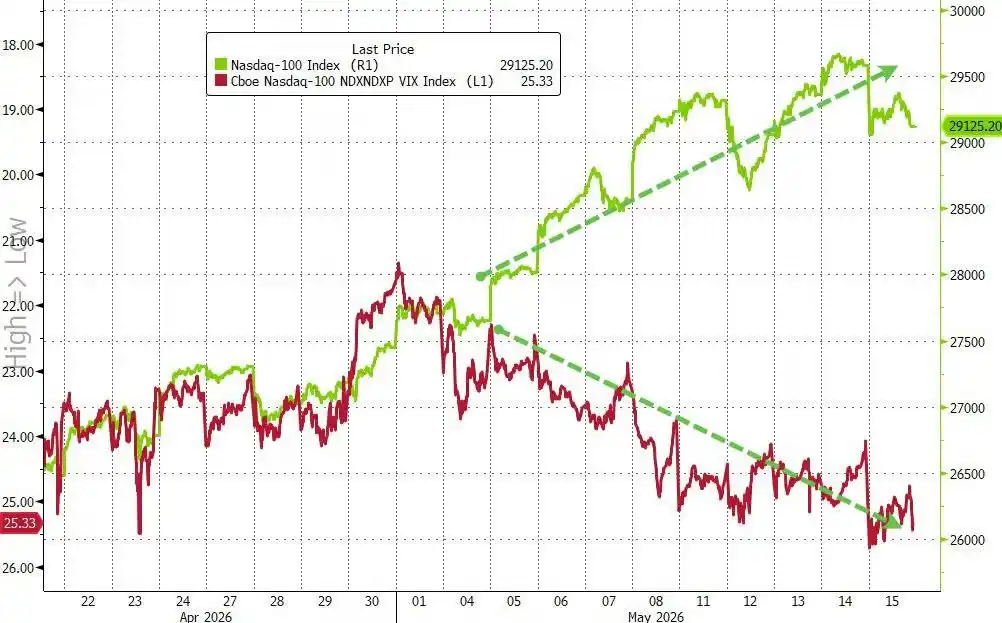
The earnings results and forward guidance will directly test the market's conviction in the AI computing super-cycle thesis. Given Nvidia's high correlation with the semiconductor and broader technology sectors, its earnings performance, whether positive or negative, is expected to trigger widespread ripple effects across the market.

1. Technical Indicators Flash Most Extreme Warning Since 1999/2000

The magnitude and speed of the recent semiconductor rally have pushed technical indicators to historically overbought levels.

Goldman Sachs data shows that the SOX index has surged approximately 70% from its late March low, adding over $5 trillion in market value along the way.

Driving factors include a temporary easing of geopolitical tensions, better-than-expected corporate earnings—such as AMAT raising its full-year guidance more than expected, CSCO reporting a 35% year-over-year growth in product orders—and investors' growing confidence in AI computing demand; earnings expectations for the semiconductor industry have been revised upwards by over 25% year-to-date.

However, Peter Callahan specifically pointed out that the SOX index is currently about 60% above its 200-day moving average, a deviation magnitude not seen since the peak of the dot-com bubble in 1999/2000.

He also noted that Goldman Sachs' high-momentum factor portfolio has experienced 12 trading days with intraday swings exceeding ±5% year-to-date, accounting for nearly 15% of the year's trading sessions; the rapid expansion of leveraged ETFs and options products has further amplified this two-way elasticity.
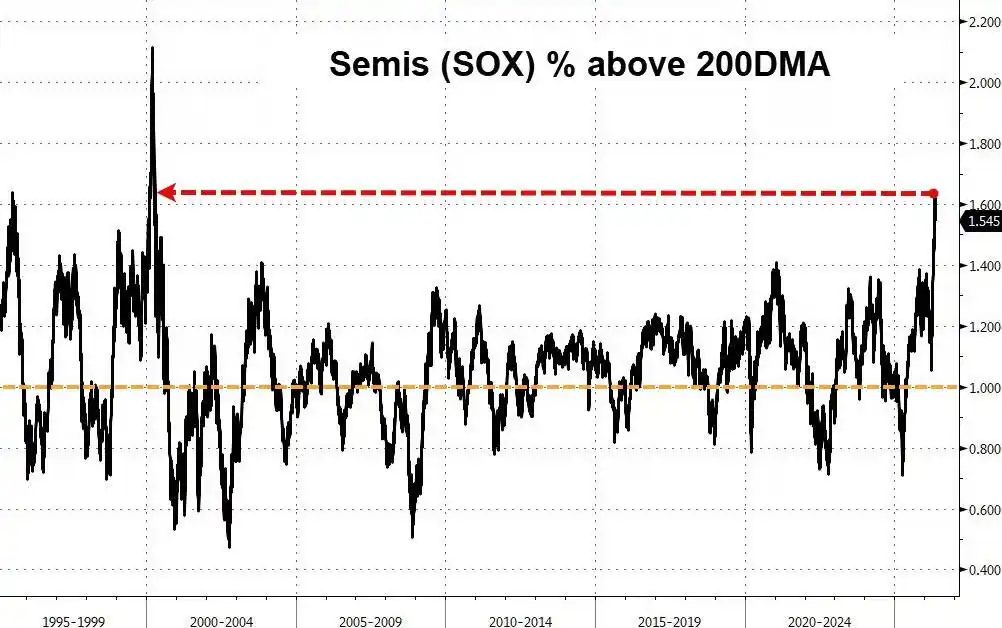
"It's worth keeping these tactical dynamics in mind heading into summer trading as this week's earnings season (Nvidia, May 20th) concludes," Callahan wrote. While Goldman's trading desk maintains a constructive medium-term stance on the AI and semiconductor theme, it advises investors to remain tactically cautious about technical challenges.

2. Nvidia Earnings: Forward Guidance May Be More Critical Than Current Quarter Results

The market remains optimistic about Nvidia's fundamental outlook, but recent stock price movements have already priced in some of these expectations to an extent.

According to Goldman Sachs' Nvidia earnings preview report, analysts generally expect Nvidia's revenue this quarter to exceed market estimates by about $2 billion—historically, the company's beat margin has typically been between 2% and 3%.

The market is more focused on the forward guidance for the next quarter, with the current analyst consensus estimate around $86 billion, representing a sequential increase of about 9%.

Other areas of focus include: whether there is further upside to Nvidia's cumulative data center revenue guidance of approximately $1 trillion, and the narrative of accelerating Agentic AI inference demand—especially its pure CPU rack products expected to begin shipping in the second half of 2026.

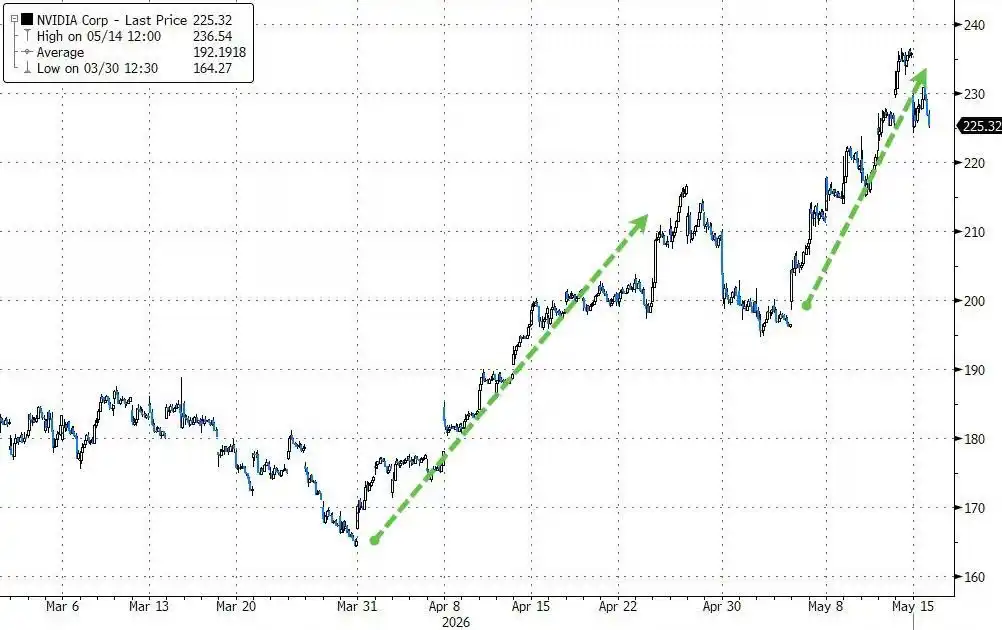
Looking at recent price action, Nvidia has risen for seven consecutive trading days, gaining 20% over that period, marking its longest winning streak in nearly two years; the stock has added about $1.7 trillion in market value since its late March low.

However, Goldman Sachs data also shows that in the trading session (T+1) following Nvidia's past five earnings releases, the stock declined four times. In fact, significant single-day rallies triggered by earnings reports have not occurred since May 2022.
3. Options Market: Extreme Bullish Bets and Tail Hedging Simultaneously in Place

The options positioning structure presents a set of inherently contradictory signals.

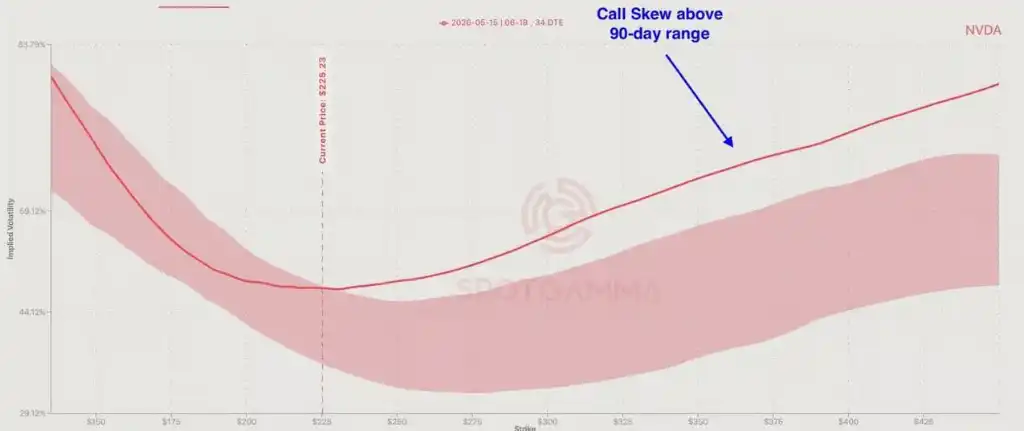
According to SpotGamma data, the overall positioning direction remains extremely skewed towards bullish bets, with traders continuously rolling Nvidia call options to higher strike prices. Call skew remains at the high end of its 90-day historical range, while demand for downside protection is extremely limited.

Citing data, 22V Research reported that last Friday saw a record $2.6 trillion in notional call option volume for the S&P 500, with call options making up a high 60% of total options volume; the Philadelphia Semiconductor Index's RSI also rose to its highest level since March 2000.
At the same time, hedging against downside risks is also quietly underway.

SpotGamma points out that significant put option structures and buying activity have noticeably increased around the S&P 500 (SPY), semiconductor ETF (SMH), and DRAM-related assets, concentrated in deep out-of-the-money strike price ranges, indicating their function is closer to tail risk hedging rather than purely directional bets. "Market participants are not bearish on Nvidia, but preparation for downside scenarios is not trivial," SpotGamma wrote in its report. "Any directional shift will almost immediately ripple through the broader market."

SpotGamma added, Nvidia has risen over 35% since its March low, and the size of current call option positioning implies that if earnings disappoint the market or trigger large-scale profit-taking, it could potentially trigger a significant directional reversal.

4. Market Breadth Concerns: Rally Supported by a Handful of Stocks

Beneath the strong performance of semiconductors and large-cap tech stocks, a lack of broad market participation is creating structural concerns.

Peter Callahan noted in his report that while the S&P 500 is up about 8% year-to-date, only about 52% of its constituents have posted positive returns. Sectors that have significantly lagged year-to-date span residential real estate, medical devices, engineering & construction without government exposure, federal IT services, software & services, independent power producers, restaurant chains, commercial real estate brokers, and insurance brokers, among others.

Callahan admits that when reviewing the charts of these sectors, it makes him question whether the current market performance reflects overall "health" or is merely a "funding source" effect where investors are forced to concentrate capital in a few large-cap AI stocks.

Oppenheimer's equity derivatives team also pointed out that only about one-fifth of S&P 500 constituents outperformed the index over the past month, the dispersion index rose to its highest level in over a year, while implied correlation hovered near year-to-date lows.

Latest data from Goldman Sachs' Prime Brokerage (PB) department also shows clear signs of "risk-off" activity in the technology sector recently.

Trending Cryptos

Related Questions

QAccording to the article, what is the core contradiction currently faced by the AI and semiconductor theme?

AThe core contradiction is that the fundamentals remain strong while technical pressure continues to build up.

QWhat does the article state is a key technical warning sign for the semiconductor sector, comparing it to a historical period?

AThe SOX index is currently trading about 60% above its 200-day moving average, a deviation magnitude not seen since the peak of the 1999/2000 internet bubble.

QRegarding Nvidia's upcoming earnings, what does the article suggest might be even more crucial than the actual quarterly results?

AThe market's focus is more on the forward guidance for the next quarter, which analysts currently expect to be around $86 billion, representing a sequential growth of about 9%.

QWhat contradictory signals are observed in the options market positioning around Nvidia?

AThe positioning is extremely bullish with call skew at the high end of its historical range, but there is also a noticeable build-up of deep out-of-the-money put options on related assets for tail-risk hedging.

QWhat concern does the article raise about the breadth of the current US stock market rally?

AThe concern is that the rally is being supported by only a few large-cap AI stocks, with many sectors underperforming, raising questions about the overall health of the market versus a 'funding source' effect.

Related Reads

Navigating the World of Event Trading: Top 5 Prediction Markets for Every Type of User

The prediction market industry has grown significantly, with trading volumes exceeding $20 billion monthly by mid-2026, driven by sports, politics, and macroeconomics. Success now depends heavily on platform choice and execution logistics. This guide compares five leading networks: **Polymarket**: A high-volume, decentralized platform on Polygon, using USDC for international and crypto-native users. It offers diverse markets but lacks built-in risk tools. **Kalshi**: A CFTC-regulated U.S. exchange for institutional traders, using direct fiat. It leads in regulated volume, especially for major sports and economic events, but has limited contract listings. **Outpoll**: A CeDeFi platform for advanced traders, focusing on professional tools. It uniquely features built-in stop-loss/take-profit orders, 0.1% fees, and full API support, with settlement in USDC. **OG Predictive**: A CFTC-regulated, sports-focused platform from Crypto.com. It offers granular player props and a flat fee structure, appealing to long-term position traders. **Manifold Markets**: A play-money, no-KYC platform for casual users and developers. It allows user-generated markets on any topic with zero fees, serving as a sandbox for strategy testing. Key differentiators include regulatory models (regulated vs. decentralized), funding (fiat vs. crypto), order types, risk management features, API access, and mobile support. The conclusion emphasizes that in today's event trading, profitability hinges not just on accurate predictions but on optimizing execution through platform infrastructure, liquidity, fees, and risk tools.

TheNewsCrypto9m ago

Navigating the World of Event Trading: Top 5 Prediction Markets for Every Type of User

TheNewsCrypto9m ago

Why Are Large-Scale Crypto Conferences No Longer Glamorous?

Why Are Major Crypto Conferences Losing Their Allure? A growing sense of fatigue surrounds large in-person crypto conferences, with many founders and investors now avoiding events they would never have missed just two years ago. While complaints cite declining ROI and information quality, the root causes are more structural. Crypto, global from inception, once relied on these mega-conferences as neutral hubs for essential face-to-face connections. However, their core value has been fragmented. High-quality participants—developers, investors—have largely migrated to smaller, private side-events, leaving main stages for repetitive content already shared online. The main conference often just becomes the excuse for being in the same city, with attendees scrambling between exclusive dinners and micro-events. While these intimate gatherings offer signal-rich conversations, they lose the "serendipitous encounters" of large conferences and can create insular echo chambers, especially as talent concentrates in hubs like New York. Meanwhile, invite-only, high-caliber summits are rising, offering quality and scale but at the cost of accessibility and crypto's early egalitarian ethos. This shift isn't unique to crypto; AI events in San Francisco show a similar trend. The perception of higher-value interactions drives core groups towards smaller, private settings, potentially creating a vicious cycle that drains larger events of their vitality. Yet, a more optimistic view exists. The apparent decline of crypto-centric events may signal industry maturation. Leading projects are now focused outward—on stablecoins for traditional finance, consumer-facing digital banks, or real-world assets. Crypto topics are increasingly integrated into mainstream finance and tech conferences. Just as dedicated "internet conferences" faded, dedicated crypto summits may become redundant as the technology embeds into every sector. The future likely holds far fewer large, inward-looking crypto conferences. The industry has moved past needing frequent self-congratulatory gatherings. True growth lies in engaging with the broader economy. This evolution towards private networking and mainstream integration, for better or worse, is a mark of the industry coming of age.

marsbit21m ago

Why Are Large-Scale Crypto Conferences No Longer Glamorous?

marsbit21m ago

Coin & Stock Compass: Global Listed Companies Net Sold $85.45 Million in BTC Last Week, Strategy's Dollar Reserves Scale Up to $3 Billion (July 14)

Global Public Companies Net Sell $85.45 Million in BTC; Strategy's Dollar Reserves Hit $3 Billion (July 14) Last week saw a significant net sell-off of Bitcoin by global public companies, excluding miners, totaling $85.45 million—a 908.42% decrease from the prior week. Major buyers like Strategy (formerly MicroStrategy) and Japan's Metaplanet were notably absent from the market. However, two companies, Brazil's OrangeBTC and asset manager Strive, made purchases, adding 8 and 18 BTC, respectively. The aggregate BTC holdings of tracked public companies now stand at 1,139,635 BTC, valued at approximately $71.38 billion and representing 5.7% of Bitcoin's circulating market cap. In corporate updates, Strategy announced its dollar reserves have grown by $450 million to reach $3 billion, while its BTC holdings remain at 843,775 coins. Hyperscale Data increased its BTC reserves past 1,000 coins. Strategy will report its Q2 2026 financial results on July 30. Mining firm Cleanspark added 454 BTC, bringing its total to 13,924 BTC. Conversely, BitFuFu sold 184 BTC, Bitdeer maintained zero net BTC holdings after selling its weekly production, and Empery Digital sold 1,400 BTC to fund an AI data center project and repay debt. Overall, public companies purchased 110,000 BTC in Q2 2026, 1.8 times the volume of the previous two quarters combined. In other cryptocurrency-related corporate news, Ethereum treasury company Bitmine increased its ETH holdings by 27,801 coins, with total staked ETH exceeding 4.9 million. Solana-focused company DFDV transferred daily operations of its meme coin DONT to an independent team. BNB treasury company BNB Plus was delisted from Nasdaq for failing to meet the $1 minimum bid price and moved to trade on the OTCQB market under the symbol BNBX. The broader equity markets showed mixed signals. Bank of America warned that bullish investor positioning indicated a potential pullback risk for stocks. In contrast, Morgan Stanley predicted the ongoing earnings season could broaden market gains beyond tech giants. Specific regional highlights included continued foreign investor outflows from South Korean stocks, pressure on US equities, and the upcoming IPO of Chinese memory chip maker ChangXin Memory. Most crypto-linked stocks remained in a downtrend.

marsbit34m ago

Coin & Stock Compass: Global Listed Companies Net Sold $85.45 Million in BTC Last Week, Strategy's Dollar Reserves Scale Up to $3 Billion (July 14)

marsbit34m ago

Why Are Major Crypto Conferences Losing Their Luster?

Why Are Major Crypto Conferences Losing Their Appeal? A growing sense of fatigue surrounds large-scale offline crypto conferences. Participants complain of declining returns and less substantial information, but the root cause is deeper. Initially, these global summits were vital for a decentralized industry without a physical hub, enabling crucial face-to-face connections. However, the value of large main-stage events has been eroded. High-quality developers and investors have migrated to exclusive, invitation-only side events and private dinners. While these offer focused networking, they lose the "serendipitous encounters" of larger gatherings and can create elitist barriers, contradicting crypto's open ethos. This fragmentation triggers a vicious cycle: as key people leave main events, their value diminishes further. Simultaneously, the industry's focus is shifting outward. Leading crypto firms are now engaging with traditional finance and real-world applications like stablecoins, digital banking, and prediction markets. Consequently, crypto-specific topics are increasingly integrated into mainstream financial conferences, making dedicated crypto summits potentially redundant. Looking ahead, the frequency of top-tier crypto conferences will likely decrease significantly. The industry has moved past its inward-looking phase. The migration of quality discourse to private settings and the push for mainstream adoption, while diluting the large conference model, are ultimately signs of the sector's maturation.

Foresight News46m ago

Why Are Major Crypto Conferences Losing Their Luster?

Foresight News46m ago

Trading

Spot

Hot Articles

Discussions

Welcome to the HTX Community. Here, you can stay informed about the latest platform developments and gain access to professional market insights. Users' opinions on the price of S (S) are presented below.

活动图片