Author: KarenZ, Foresight News
Most NFTs, once bought and sent to a wallet, have a primary job of "sitting around."
StonkBrokers, however, has assigned 4444 pixel brokers an on-chain job: each NFT comes with its own wallet capable of receiving stock tokens; holders can use the project's token to activate it, increase its reward weight, or pledge it for loans. Around these NFTs and the related token STONKBROKER, CLUTCH is also planning token issuance and decentralized exchange products.
The market has shown high enthusiasm for this design. According to GMGN data, the StonkBrokers token STONKBROKER once saw its market capitalization exceed $15 million, with a 24-hour increase of over 300%, rising more than 14 times in the past 2 days, and is currently oscillating around $13 million. OpenSea data shows the StonkBrokers NFT floor price has also risen to 1.88 ETH, up over 306% in 24 hours.
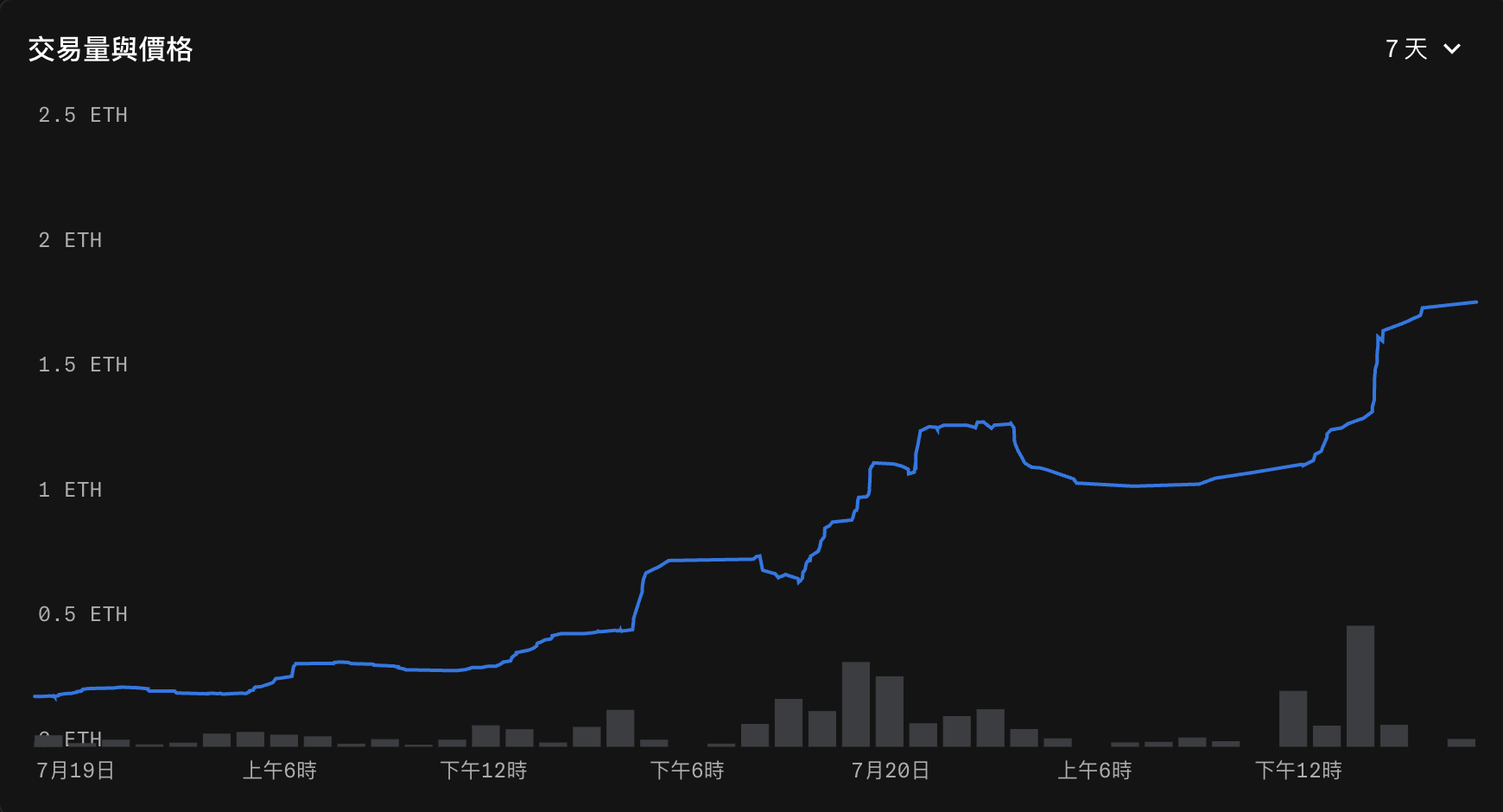
StonkBrokers NFT trading volume and price, Source: OpenSea
Who is CLUTCH, and What is StonkBrokers?
CLUTCH, more fully known as Clutch Labs, is an independent Web3 development team focused on on-chain market infrastructure. Its publicly disclosed products involve directions such as prediction markets, NFT liquidity protocols, perpetual contracts, on-chain games, and AI Agents.
The CLUTCH website lists 0xSimpleFarmer as a project builder, and their X account also introduces themself as the founder of Clutch Markets.
CLUTCH didn't start developing products with StonkBrokers. According to the timeline on its website, the team initially entered the market with on-chain parlay prediction markets and subsequently launched products like prediction markets, Clutch Puppies, Pixel Pups, an NFT marketplace, and the Anvil NFT AMM on networks such as Arbitrum, ApeChain, and Ethereum.
StonkBrokers can be understood as CLUTCH's combinatorial attempt, applying their previous experience with NFTs, AMMs, and DeFi on the Robinhood Chain.
The project was originally an experimental development by the team on the Robinhood Chain testnet during the Arbitrum Buildathon. 0xSimpleFarmer stated that this test version was showcased by the Robinhood Chain team at the event. About seven months later, the project launched on the Robinhood Chain mainnet on July 17, 2026, and completed the issuance of 4444 NFTs.
The mainnet launch of StonkBrokers was described by the project as a "free mint," but "free" here only refers to the NFT mint price being 0, not that all participants could obtain NFTs at zero cost. Users needed to burn the Pup Cup NFT on Ethereum or the Clutch Puppies NFT on ApeChain before the deadline to receive corresponding StonkBrokers minting slots, with one old NFT corresponding to one slot. This channel is now closed, and all 4,444 StonkBrokers have been minted. To obtain an NFT now, one must purchase it through the Anvil AMM or on the secondary market.
How Do NFTs, Bound Accounts, and the STONKBROKER Token Connect?
Each StonkBroker NFT is associated with an ERC-6551 Token-Bound Account.
In simple terms, an NFT is not just a picture in a wallet; it itself possesses an on-chain account. This account can hold ERC-20 tokens or other on-chain assets, and control of the account follows the transfer of NFT ownership: whoever owns the NFT can control its bound wallet.
The NFT receives initial stock tokens upon minting, and subsequent stock token rewards also go directly into the corresponding bound account. If a StonkBroker's bound account holds stock tokens, these assets will transfer along with the NFT to the new holder.
The StonkBroker NFT is a non-fungible ERC-721 asset, with a total supply of 4444; STONKBROKER is a freely divisible and transferable ERC-20 token. The two are connected via CLUTCH's Anvil NFT AMM.
The protocol sets a base redemption unit of 666,666 STONKBROKER tokens for each NFT. Users can pay 666,666 STONKBROKER plus a transaction fee in ETH to the Anvil treasury to redeem the next NFT from the treasury; if a specific token ID is desired, they can use the "snipe" function to select a designated NFT (with a higher ETH fee). The project's current documentation lists ETH transaction fees as 10% for regular redemption and 15% for designated NFT redemption. Relevant parameters should still be verified against the actual trading interface and contract calls.
This structure can, to some extent, address liquidity issues for certain NFTs. Traditional NFT trading relies on buyers and sellers placing orders; if an NFT temporarily has no buyer, the holder might find it difficult to exit immediately. Anvil establishes a protocol-based redemption channel between NFTs and ERC-20 tokens of the same series.
It's important to note that "each NFT corresponds to 666,666 tokens" should not be misinterpreted as a risk-free price guarantee. Both NFTs and STONKBROKER will fluctuate with market trading, and the actual value paid or received by users is also affected by token price, ETH fees, treasury inventory, and protocol parameters.
Furthermore, Anvil provides a protocol-level redemption channel with a 10%/15% ETH fee, which is better than having no liquidity, but it is not a low-cost, high-efficiency liquidity solution.
From Activation to Clock In: How Are Stock Token Rewards Generated?
However, initial stock token funding and subsequent rewards are two different mechanisms. Subsequent stock token rewards supported by Anvil trading fees will only be distributed to already activated StonkBrokers, with weights calculated based on activation level.
Merely holding a StonkBroker does not mean automatically receiving subsequent stock token rewards. Holders need to first activate the NFT using STONKBROKER tokens on the project's page to include it in the reward distribution system.
The current StonkBrokers documentation sets five activation tiers: the base tier requires 66,666 STONKBROKER, the highest tier requires 1,666,666, with corresponding reward weights increasing from 1x to approximately 3.33x.
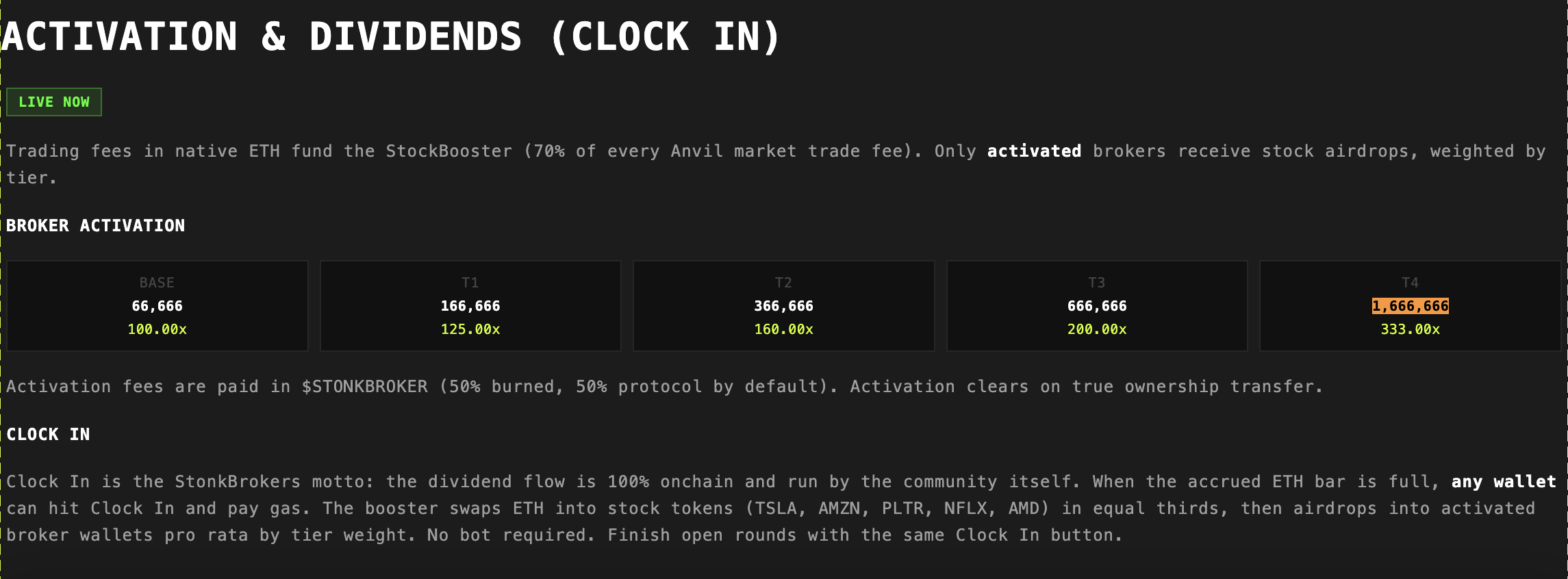
According to current contract parameters, the StonkBroker activation fee is set by default to 50% burned and 50% sent to the protocol; after a genuine ownership transfer of the NFT, the previous activation status is cleared, and the new holder needs to reactivate. However, stock tokens already deposited into the bound account are not cleared.
The funds for stock token rewards currently primarily come from Anvil's ETH transaction fees. According to the current documentation, 70% of these fees go to StockBooster, and 30% go to the protocol. When StockBooster accumulates to a set condition, any user can call the "Clock In" function and pay Gas, triggering the protocol to swap ETH for the currently configured stock tokens, which are then distributed to the bound wallets of each NFT based on activation level weights.
The whole process can be simplified as:
Trading NFTs on Anvil generates ETH fees → 70% of fees go to StockBooster → Community users call Clock In → ETH is swapped for stock tokens → Stock tokens enter the bound accounts of activated NFTs.
From NFT Lending to Launcher and vDEX
On top of this, StonkBrokers also offers NFT collateralized lending functionality. Holders can lock their NFT into the Loan Vault to borrow principal denominated in STONKBROKER. Documentation lists the principal benchmark as 666,666 STONKBROKER, with borrowing fees prepaid in ETH and calculated based on loan duration, a 15% annualized fee rate, and the ETH market value of the NFT.
Borrowing fees are also distributed with 70% going to StockBooster and 30% to the protocol. After the borrower repays the agreed amount of STONKBROKER, they can retrieve the NFT; if overdue, additional ETH fees must be paid, and persistent default may lead to loss of the pledged NFT.
Furthermore, StonkBrokers will subsequently launch the launch platform Stonk Launcher and Stonk Exchange on July 30.
Among these, the launch platform supports fixed-price, bonding curve, and custom launch configurations. According to the project design, this step will also automatically create LP positions, fee distribution contracts, and the token's own staking vault. Token holders can deposit newly issued tokens into the staking vault and share the corresponding LP fees proportionally.
The project describes Stonk Launcher as a launch platform governed by STONKBROKER holders and activated StonkBroker NFTs, sharing governance and fee streams. A portion of the fees and royalties generated by Launcher is planned to support stock token rewards. Specific allocation ratios and implementation methods still need to be verified against the officially deployed mainnet contracts.
The Stonk Exchange, accompanying Launcher, is scheduled to launch on August 29 at 8:00 PM Eastern Time, corresponding to the morning of August 30 Beijing time. The project calls it a "Vote Directed DEX," or vDEX for short, meaning a DEX where the flow of trading fees can be determined by voting.
At the basic trading level, Stonk Exchange plans to adopt the Uniswap V3 architecture. Users can perform token swaps, create concentrated liquidity pools, and allocate funds within custom price ranges. Unlike traditional AMMs that spread liquidity uniformly across the entire price range, Uniswap V3 liquidity providers can concentrate their capital in price ranges expected to be more active to improve capital efficiency. However, once the price moves outside the selected range, the LP position may stop earning trading fees and face risks like impermanent loss.
Project documentation outlines three tiers of trading fees: 0.05% primarily for relatively stable trading pairs, 0.3% for ordinary pairs, and 1% for assets with lower liquidity or higher volatility. STONKBROKER is planned as a governance tool, allowing holders to vote on the direction of some fee flows, such as which liquidity pools or ecosystem incentive programs receive support.
It's important to distinguish that existing information does not confirm that trading fees generated by Stonk Exchange will be fixedly directed to StockBooster or the stock token reward system. What can be confirmed currently is that the flow of these fees will be determined by STONKBROKER governance mechanisms; whether they are used for stock token rewards still depends on the contract design and governance outcomes at that time.
Conclusion
The most noteworthy aspect of StonkBrokers might not be "how much ETH an NFT rose to" or "how high the token's market cap climbed," but rather its attempt to answer a long-standing question plaguing the NFT market: beyond being a profile picture or community status symbol, can an NFT become a truly operable on-chain account and maintain an ongoing relationship with trading, lending, and RWA?
CLUTCH has already deployed part of the mechanism to the mainnet, but subsequent modules like Stonk Launcher and Stonk Exchange still await delivery. Whether StonkBrokers ultimately forms a sustainable on-chain financial system or merely completes a high-volatility product experiment under attention remains to be answered by real protocol revenue, subsequent product implementation, and more thorough security verification.
Simultaneously, the Robinhood Chain ecosystem is still in its early stages, with network activity, asset liquidity, and infrastructure maturity all requiring observation. StonkBrokers also faces uncertainties such as smart contract security, team delivery, governance parameter adjustments, and regulatory policy changes. Its NFTs, STONKBROKER token, and related stock tokens may all experience significant price volatility. The stock token rewards mentioned by the project are not equivalent to stable returns or traditional stock dividends, and participants still need to fully assess the associated risks.