‘Never Skip a Leg Day’: The Mantra to Break the Crypto Downturn?

bitcoinistPublished on 2026-02-05Last updated on 2026-02-05

Abstract

The article "‘Never Skip a Leg Day’: The Mantra to Break the Crypto Downturn?" draws a parallel between Bitcoin's current market consolidation and the disciplined effort of a gym workout. It suggests that Bitcoin ($BTC) is in a necessary accumulation phase, with technical indicators like a flag pattern and RSI pointing toward a potential breakout toward $80K–$85K by year-end, supported by macroeconomic shifts and renewed institutional ETF inflows. Meanwhile, the piece highlights Maxi Doge ($MAXI), a presale project embracing the "never skip a leg day" ethos, targeting leverage traders with a high-risk, high-reward model. Having raised over $4.5M, it appeals to those seeking volatility amid Bitcoin’s foundational build-up. The analysis includes bullish, base, and bearish scenarios for Bitcoin, while emphasizing that cryptocurrency investments carry significant risk.

‘Never skip a leg day’ a key mantra for gym goers and $MAXI enthusiasts alike, but it may hold the key to a $BTC resurgence.

The crypto market has felt like a grueling gym session lately. Lots of sweat, heavy lifting, sideways grinding, but very little visible flexion. For Bitcoin ($BTC), this consolidation phase (often agonizing for retail traders addicted to ‘up only’ charts) resembles the necessary pain of ‘never skipping a leg day.’

Simple physics: You don’t get the explosive vertical jump without first enduring the squats.

This downturn marked by choppy price action around $70K, seems to be reaching a breaking point. Macroeconomic pivots, specifically the Federal Reserve’s shift toward rate cuts, combined with renewed institutional flows into Spot ETFs, suggest the accumulation phase is maturing.
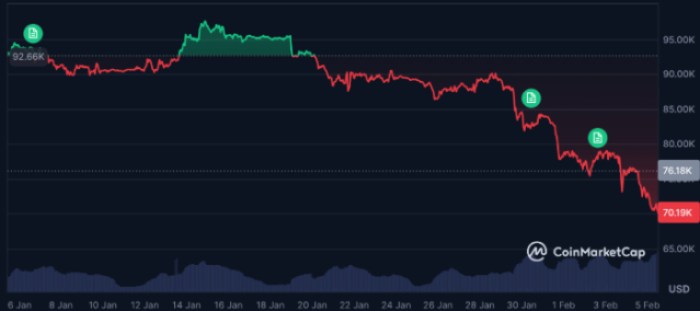
We could be entering a period of structural ‘muscle building’ which could propel Bitcoin toward the $80K mark by year-end.

That market structure creates a dual narrative. While Bitcoin builds the foundation, capital is rotating into high-beta assets that thrive on this exact ‘grindset’ culture. This dynamic has spotlighted presale projects like Maxi Doge ($MAXI), which literally adopts the ‘never skip leg day’ ethos as a core tenet of its leverage-trading community.

START PUMPING AND BUY YOUR $MAXI NOW

Bitcoin Technicals: Building the Base for a Vertical Move

Bitcoin is currently compressing within a classic flag pattern. That technical setup usually resolves in a continuation of the broader uptrend. Data from trading desks indicates the ‘pain point’ for shorts is building above $72K. A decisive breakout there would validate the leg day thesis, confirming the quiet accumulation was just energy storage for the next expansion.

Plus, the Relative Strength Index (RSI) on daily charts is teetering back to neutral territory. That implies ample room for a move to $85K (or higher) without hitting immediate overbought conditions.

But can it actually deliver? The ‘skip leg day’ risk remains. If Bitcoin fails to hold local support during a macroeconomic shock, the thesis is invalidated, likely sending prices to retest a lower demand zone. Yet, with ETF inflows returning to net-positive territory, the base case leans bullish.

Scenario Watch:
Bull Case: A high-volume close above $73.7K triggers a squeeze to $85K.
Base Case: Continued chop between $64K and $71K.
Bear Case: Loss of $58K support opens the door to $52K.

Maxi Doge: The Asset That Literally Never Skips Leg Day

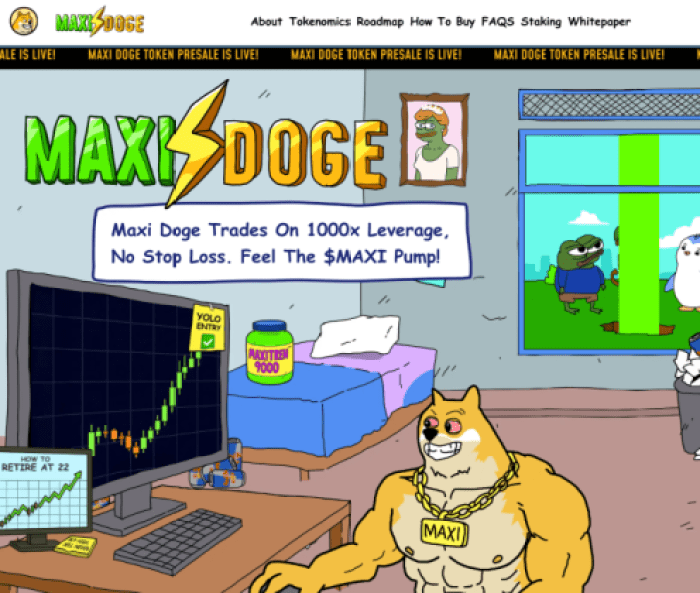
While Bitcoin handles the heavy institutional lifting, the retail market is hunting for volatility in assets that embody the aggressive spirit of the bull run. Enter Maxi Doge ($MAXI). This project has turned the ‘never skip leg day’ meme into a financialized culture for leverage traders.

Unlike standard meme coins that rely on passive holding, Maxi Doge targets the high-octane trading demographic. Think of it as the ‘gym bro’ of the crypto world, a 240-lb canine juggernaut designed for those who view 1000X leverage not as a risk, but as a lifestyle. The project plans to back this ethos with holder-only trading competitions and a ‘Maxi Fund’ treasury to support liquidity.
Smart money is already positioning. On-chain data shows 2 whale wallets bought $314K, signaling high-conviction positioning from deep-pocketed investors.

$MAXI’s presale performance reflects this appetite for high-energy assets. It has already raised over $4.5M, with tokens currently priced at $0.0002802. To entice you further, it also offers staking rewards, currently around 68%.

For investors, $MAXI offers a dynamic staking model where rewards are planned to drop daily, keeping with the ‘gains’ theme. However, like any high-leverage environment, the risks are distinct. Regulatory shifts or a failure in community retention could stall momentum.

But for now, as Bitcoin builds strength, Maxi Doge ($MAXI) looks like the spotter ready to capitalize on the pump.

BUY YOUR $MAXI FROM THE OFFICIAL PRESALE PAGE

This article is not financial advice. Cryptocurrency markets are volatile and carry significant risk. Readers should conduct their own independent research and consult with financial professionals before making any investment decisions.


Related Questions

QWhat is the main mantra mentioned in the article and how is it applied to both fitness and the crypto market?

AThe main mantra is 'Never skip a leg day,' which is a key principle for gym goers. In the crypto context, it symbolizes the necessary, often painful, consolidation or accumulation phase (like Bitcoin's recent price consolidation) that builds a strong foundation for future explosive growth, similar to how leg muscles are built for a powerful vertical jump.

QAccording to the article, what are the key factors suggesting that Bitcoin's accumulation phase is maturing and could lead to a rise to $80K?

AThe key factors are macroeconomic pivots, specifically the Federal Reserve's shift toward interest rate cuts, combined with renewed institutional capital flowing into Spot Bitcoin ETFs. These elements suggest the accumulation phase is ending and could propel Bitcoin toward $80K by year-end.

QWhat is the technical setup for Bitcoin's price, and what are the potential price scenarios outlined in the article?

ABitcoin is compressing within a classic flag pattern, which typically resolves with a continuation of the uptrend. The potential scenarios are: Bull Case - a high-volume close above $73.7K triggers a squeeze to $85K; Base Case - continued choppy trading between $64K and $71K; Bear Case - a loss of $58K support opens the door to a drop to $52K.

QHow does the project Maxi Doge ($MAXI) embody the 'never skip a leg day' ethos, and what is its target audience?

AMaxi Doge embodies the ethos by targeting the high-octane, high-leverage trading demographic, turning the meme into a financialized culture. Its target audience is leverage traders who view 1000X leverage as a lifestyle, not just a risk, akin to the 'gym bro' mentality in the crypto world.

QWhat are some of the features and current performance metrics mentioned for the Maxi Doge ($MAXI) presale?

AThe presale has raised over $4.5 million, with tokens priced at $0.0002802. It offers staking rewards currently around 68% and features a dynamic staking model where rewards are planned to drop daily. On-chain data also shows significant whale activity, with two wallets buying $314K worth of tokens.

Related Reads

AI "Transfer Station" Earning Millions Monthly? Five Questions Uncover the Truth of Token Arbitrage

The article "AI 'Transfer Station' Earns Millions Monthly? Five Questions Uncover the Truth of Token Arbitrage" explores the emerging business of API token transfer stations, which profit from global AI service price disparities and access barriers. These intermediaries purchase low-cost tokens from overseas AI providers (e.g., OpenAI, Claude) through grey-market methods—such as exploiting enterprise credits, bulk accounts, or subscription benefits—and resell them to Chinese users at a markup. Key drivers include the high cost of using top AI models (e.g., Claude Code costs ~$5 per million tokens), the performance gap between domestic and foreign models, and mismatches between subscription and API pricing. However, the practice carries significant risks: upstream token sources may be unstable or illegal; user data passing through intermediaries can be harvested or injected with hidden prompts; and models might be downgraded without disclosure. The market is evolving, with some operators now exporting cheaper Chinese models (e.g., Qwen3.5 at ~$0.11 per million tokens) to overseas users, leveraging price gaps. Yet, sustainability is low due to compliance crackdowns, instability, and reputational risks. Users are advised to employ detection methods (e.g., prompt adherence tests) and avoid sensitive data usage. The authors caution that while transfer stations offer short-term arbitrage, they lack long-term reliability and security compared to official APIs.

marsbit6m ago

AI "Transfer Station" Earning Millions Monthly? Five Questions Uncover the Truth of Token Arbitrage

marsbit6m ago

The Cost of an 11.5% Annualized Return: Will MicroStrategy's STRC Face a Moment of Reckoning?

This article analyzes the potential risks associated with MicroStrategy's (MSTR) use of structured financial products like STRC to leverage its BTC exposure. While these tools have enabled impressive returns (e.g., 11.5% annualized) and fueled significant capital inflows ($13.5B outstanding), they also create substantial annual dividend obligations (~$400M). The author argues that this structure, while effective in a bull market, could become a liability if BTC price stagnates or declines. The core risk is a potential negative feedback loop: the growing dividend burden from continued STRC issuance may eventually outweigh the benefits of increased BTC holdings. To meet these obligations, MicroStrategy might need to use new issuance proceeds for dividends instead of buying more BTC, which could disappoint equity investors. If the market capitalization (mNAV) falls below the value of its BTC holdings, the company could be forced to sell BTC instead of issuing new shares, potentially triggering a panic. The author estimates a potential inflection point in 6 months, where annual dividend costs reach $3-4B. At that stage, CEO Michael Saylor might face a difficult choice: sell BTC to meet obligations or sacrifice the credibility of the preferred shares by halting dividends. The article concludes that this financial engineering, while powerful, could ultimately "backfire" on MicroStrategy if market conditions turn.

marsbit1h ago

The Cost of an 11.5% Annualized Return: Will MicroStrategy's STRC Face a Moment of Reckoning?

marsbit1h ago

Trading

Spot
Futures
活动图片