Nasdaq to Acquire LeveL Markets to Develop 24/7 Markets

cryptonews.ruPublished on 2026-08-11Last updated on 2026-08-11

Abstract

Nasdaq has agreed to acquire LeveL Markets, the third-largest alternative trading system (ATS) in the US by trading volume, to advance tokenized markets and 24/7 trading. The platform, which Nasdaq first invested in during 2021, processes hundreds of millions of shares daily and serves over 2,500 clients. Post-acquisition, LeveL Markets will retain its FINRA-regulated ATS status and operate within Nasdaq's new Digital Liquidity Networks division, aimed at programmable, round-the-clock markets. This move is part of Nasdaq's broader strategy to develop tokenized securities markets, building on its 2025 proposal for trading tokenized stocks and its 2026 partnership with Kraken and Backed. Other major exchanges like Cboe, the London Stock Exchange, and the New York Stock Exchange are also pursuing similar 24/7 trading initiatives. The SEC plans a roundtable in September 2026 to discuss the transition to 24-hour US stock trading, reflecting significant market evolution. The tokenized stock market has grown over sixfold in the past year, from approximately $381 million in August 2025 to nearly $2.5 billion.

Nasdaq has agreed to acquire LeveL Markets — the third-largest Alternative Trading System (ATS) in the US by trading volume — to develop tokenized markets and around-the-clock trading.

According to Nasdaq, LeveL Markets processes hundreds of millions of shares daily and serves over 2,500 clients on both sides of the market. The platform will join the new Nasdaq Digital Liquidity Networks division, led by Roland Chai. He has overseen the company's digital asset strategy since the beginning of this year.

Nasdaq first invested in LeveL Markets in 2021. Since then, the platform has expanded: it now executes trades for over 7,000 instruments daily and serves more than 300 institutional buy-side clients. Its average daily trading volume in 2025 grew by 56%.

An announcement released on Tuesday stated that following the acquisition, LeveL Markets will retain its status as a FINRA-regulated Alternative Trading System and its own management team. The financial terms of the deal were not disclosed. It still requires regulatory approval.

Nasdaq stated that it will integrate LeveL's institutional execution network into its broader strategy for developing programmable, around-the-clock markets. The Digital Liquidity Networks division combines liquidity platforms, tokenization solutions, and digital asset technologies.

Related: RWA Tokenization Growth to $4 Trillion Could Propel LINK to $200 by 2030: Standard Chartered

Nasdaq Expands Development of Tokenized Markets with 24/7 Trading

Nasdaq first proposed allowing the trading of tokenized securities on its exchange in September 2025. In January 2026, the U.S. Securities and Exchange Commission (SEC) published an updated proposal document. It specified that eligible stocks and exchange-traded products could be traded in tokenized form alongside traditional stocks, with the Depository Trust Company handling blockchain-based tokenization and settlement as part of a three-year pilot program.

In March, Nasdaq advanced this work through a partnership with Kraken and tokenization company Backed to develop infrastructure linking traditional stocks with blockchain networks.

Other exchange operators are also extending trading hours. Cboe and the London Stock Exchange are pursuing similar plans, while the New York Stock Exchange is developing a separate platform for 24/7 trading and on-chain settlement of tokenized securities.

In July, the SEC announced a roundtable on September 17th focused on transitioning to 24/7 stock trading in the US. SEC Chairman Paul Atkins stated: "We are moving toward a new day — and a new night — in U.S. stock markets."

According to RWA.xyz, the tokenized equity market has grown more than sixfold over the past year: the asset value increased from approximately $381 million in August 2025 to nearly $2.5 billion.
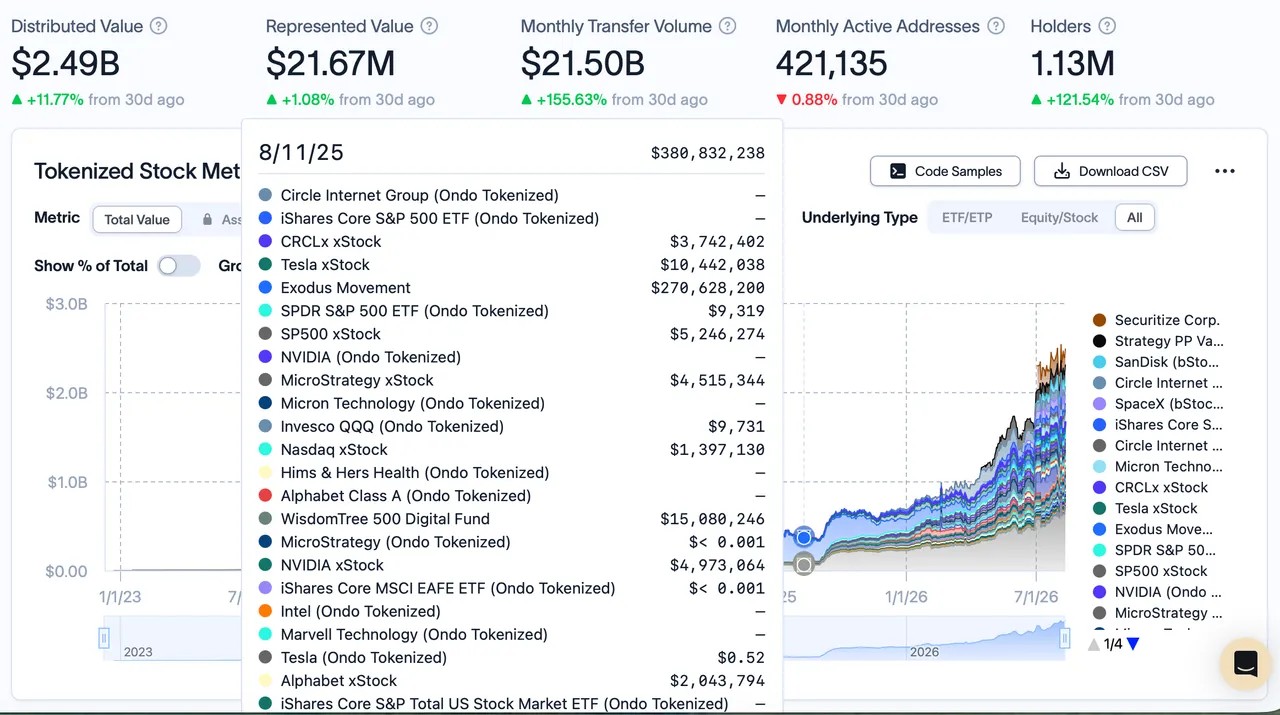
Tokenized Equities. Source: RWA.xyz

Magazine: Thai Crypto Tax — 0%. Bitcoin Red Team Forced to Use Chinese AI: Asia Express

Related Questions

QWhat is Nasdaq acquiring according to the article, and what is the stated purpose of this acquisition?

AAccording to the article, Nasdaq is acquiring LeveL Markets, the third-largest US alternative trading system by volume. The stated purpose is to develop tokenized markets and enable continuous, 24/7 trading.

QHow has LeveL Markets grown since Nasdaq first invested in it in 2021?

ASince Nasdaq's initial investment in 2021, LeveL Markets has expanded to now execute trades with over 7,000 instruments daily and serve over 300 institutional buy-side clients. Its average daily trading volume in 2025 grew by 56%.

QWhat is the role of the new Nasdaq Digital Liquidity Networks division, and who is leading it?

AThe Nasdaq Digital Liquidity Networks division combines liquidity platforms, tokenization solutions, and digital asset technologies. It will be led by Roland Chai, who oversees the company's digital asset strategy.

QWhat major step towards 24/7 trading did the SEC announce in July 2026?

AIn July 2026, the SEC announced it will hold a roundtable on September 17 to discuss the transition to 24/7 trading of US stocks. SEC Chair Paul Atkins commented, 'We are moving into a new day — and a new night — for U.S. stock markets.'

QHow has the market for tokenized equities performed over the last year according to RWA.xyz?

AAccording to RWA.xyz, the tokenized equities market grew more than sixfold over the last year, with asset volume increasing from roughly $381 million in August 2025 to nearly $2.5 billion.

Related Reads

Is It Time to End the Era of Perp DEXes Burning Cash for Growth?

The article questions whether the era of perpetual decentralized exchanges (Perp DEXes) relying heavily on token incentives for growth should end. It argues that while token incentives (points, airdrops, farming) are useful for bootstrapping liquidity and attracting users, they often attract short-term, incentive-driven behavior rather than genuine, long-term traders. The piece analyzes how platforms use future token value to acquire current trading volume and liquidity, but notes this creates data that is difficult to interpret. A key test comes after the Token Generation Event (TGE), when the removal of incentive expectations reveals whether user retention is based on product quality or continued subsidies. Data from platforms like Hyperliquid, Lighter, and edgeX shows varying success in converting airdrop attention into sustained trading relationships post-TGE. Post-TGE, the focus often shifts from distributing tokens to supporting the token's value through mechanisms like fee revenue buybacks and burns. However, this ties value redistribution to token holdings rather than direct trading contributions. Analysis of user behavior on platforms like Hyperliquid reveals that holding a platform's token, participating in its financial products, and engaging in perpetual trading are often distinct activities, indicating that broad token ownership does not equate to genuine trading demand. This creates a tension for platforms, which must manage both a trading market and a token market with potentially conflicting goals. The article concludes by introducing PopDEX, an approach backed by Foresight Ventures, which proposes a different model. Instead of channeling value first through a platform token, PopDEX aims to establish a "100% value return" framework. This system is designed to directly and transparently redistribute the value generated from trading fees back to those who create it—such as active traders, referrers, and affiliates—based on verifiable market contributions. The piece suggests that as the Perp DEX industry matures, exploring alternative incentive structures that move beyond pure token-driven growth is a necessary evolution.

marsbit10m ago

Is It Time to End the Era of Perp DEXes Burning Cash for Growth?

marsbit10m ago

Chinese Data Generation Team Makes Debut in Nature Journal

A Hong Kong-based startup, Weina AI, has become China's first and the world's fourth data-generation technology company to publish in a leading Nature journal (IF>10 in recent three years) with a paper on AI-assisted kidney cancer surgery decision-making. Founded by Professor Liu Qifeng, who previously led the creation of the world's first thousand-card H800 SuperPod cluster at HKUST, the company focuses on enhancing AI's "questioning" ability to generate high-quality reasoning Q&A data, which is key for AI self-learning. The published Nature Communications paper, co-authored with medical experts, addressed a clinical challenge in renal surgery. Using an RDPM model on multi-source data from 1,621 patients, the AI achieved high predictive accuracy for long-term kidney function decline, providing a quantitative basis for surgical decisions. Professor Liu outlines AI development in three stages: from data to models, from models to token generation, and crucially, from tokens back to data—where AI actively generates questions, reasoning steps, and verified answers (cQrA: context, Question, reasoning, Answer). Weina AI's mission is to create this "data → model → token → data" feedback loop, enabling Agentic AI to autonomously evolve in professional domains. This moves beyond costly manual data annotation by using AI agents to generate scalable, chain-of-thought data. The company raised a HK$50 million seed round led by Lenovo Capital. Instead of focusing deeply on one sector, it adopted a "breadth-first" strategy, successfully deploying its technology across four high-accuracy, disparate fields: value-alignment safety, government affairs, insurance, and horse racing, proving cross-industry replicability. Liu argues that the future core of AI is not the model or data alone, but this self-reinforcing closed loop. This logic extends to embodied AI, where training shifts from imitation to autonomous generation of action data (cTrA: context, Task, reasoning, Action) through trial, error, and feedback. Weina AI's vision is to leverage this paradigm to "generate the world."

marsbit10m ago

Chinese Data Generation Team Makes Debut in Nature Journal

marsbit10m ago

A New Scaling Variable for Text-to-Image Generation, Discovered by ByteDance's Seed Team

ByteDance's SEED team investigated a crucial but often overlooked scaling variable in text-to-image diffusion models: the amount of image-grounded information in training captions. They found that simply increasing caption length with natural language does not improve model performance, as it often adds redundancy without new, usable visual supervision. The core discovery is that the final training loss of a diffusion model can be predicted by the *information content* of its text condition, measured by two complementary metrics: Grounded Perplexity Gain (GPG) and Effective Detailness (ED). This establishes a scaling relationship for text conditioning. To systematically increase information content, the team proposed **Structured Prompt (SP)**, a JSON-based representation that organizes visual variables (global scene, object attributes, spatial relationships) into clear fields, enhancing **Diffusability**—the model's ability to learn from captions. For inference, an LLM **Prompter** is trained to convert user queries into detailed SP instances, defining **Promptability**. The overall generation quality is viewed as a product of Diffusability and Promptability. A three-stage training strategy (SFT, cold-start reasoning distillation, and verifier-guided reinforcement) significantly improves the prompter's capability. The structured format also enables efficient iterative refinement through a *refine-render-judge* loop. In matched-control experiments using the same Qwen-Image backbone, data, and compute, the SP-based system substantially outperformed its natural-language counterpart, demonstrating that gains stem from the structured information interface, not just more training. The work shows that scaling text-to-image models requires scaling the *usable visual information* in conditions, not just model size or data volume.

marsbit30m ago

A New Scaling Variable for Text-to-Image Generation, Discovered by ByteDance's Seed Team

marsbit30m ago

Trading

Spot
活动图片