Nasdaq Stalls, But Power Stocks Keep Hitting New Highs? AI's Second Half: A Deep Dive into the 2026 U.S. Grid Modernization Investment Map

marsbitPublished on 2026-02-27Last updated on 2026-02-27

Abstract

The U.S. stock market in 2026 shows a clear divergence: while the Nasdaq stagnates, industrial, energy, and utility stocks surge. This signals a shift in AI competition from algorithms to physical resources—specifically, power and grid infrastructure. The AI-driven explosion in data center energy consumption, alongside manufacturing reshoring and broader electrification (EVs, heat pumps), is straining an aging U.S. grid. Much of the infrastructure is decades old and ill-equipped for modern demands, leading to bottlenecks, extended delays for critical components like transformers, and rising costs. Grid modernization is not just about expansion but about creating a digital, bidirectional, and self-healing network. Key layers include: - Smart metering (AMI) for real-time data exchange, - Automation and self-healing systems (e.g., FLISR by GE Vernova), - Virtual power plants (VPPs) enabling decentralized energy distribution. Investment opportunities are stratified: - High-margin software/automation firms (e.g., GEV, Siemens, Itron), - Critical equipment manufacturers (e.g., Eaton, ABB, Schneider Electric), - Engineering and construction leaders (e.g., Quanta Services, MasTec) directly capturing infrastructure spending, - Regulated utilities (e.g., NextEra Energy, Duke Energy) managing upgraded networks. The value reassessment of power assets is underway, positioning the grid as a national strategic asset essential to AI and economic resilience.

Entering 2026, the U.S. stock market exhibits an extreme divergence: the Nasdaq has failed to hit a new high for four consecutive months, with the valuations of AI leaders suffering in the anxious stalemate awaiting a new round of rate cuts; yet, on the other end of the market, industrial, energy, and utility stocks are breaking through first amidst the roar of the "old world."

This divergence sends a clear signal: the competition in AI has decisively shifted from an algorithm race to a physical resource race. If 2024 was the "Year of the Chip," then 2026 is the "Year One of Grid Modernization."

Currently, the revaluation of power assets is unstoppable. The market was buying the "brain" (chips) in 2023-2024, while in 2025-2026, capital is flowing to the "heart and blood vessels" (power and grid).

This article will provide a complete recap for investors on the structural changes, competitive landscape, and the opportunities within the U.S. power and grid industry.

The RockFlow investment research team believes investors should focus on three tiers: the high-margin software and automation layer represented by GEV, the high-certainty equipment manufacturing layer centered on Eaton and Schneider, and the direct harvesters of the infrastructure boom led by PWR.

1. AI Demand Shock and the U.S. Grid's "Ailments of Age"
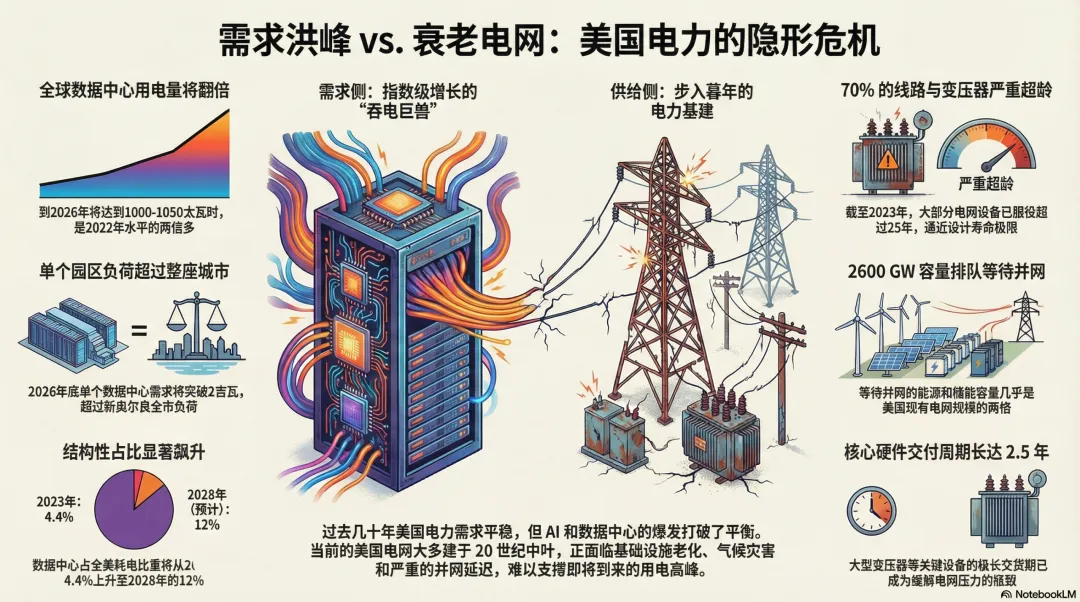
For the past few decades, Americans had almost forgotten what "power shortage" meant. In the early 2000s, thanks to the widespread adoption of LED lighting and the mandatory enforcement of the EPA's "Energy Star" certification, energy consumption in the U.S. miraculously plateaued despite population growth.

But this stagnation was completely shattered in 2025. With the exponential growth of large-scale data centers and AI applications, the energy demand curve experienced a near-vertical inflection point:

  • Doubled Consumption: Global data center consumption is expected to reach 1000-1050 Terawatt-hours (TWh) by 2026, more than double the 2022 level.
  • The Magnitude of a City: By the end of 2026, the power demand of a single, independent data center campus will exceed 2 Gigawatts (GW). This is equivalent to the power load of a medium-sized city.
  • Structural Share: In 2023, data centers accounted for only 4.4% of U.S. electricity consumption; by 2028, this figure is projected to soar to 12%.

Beyond AI, this "power-guzzling behemoth," the reshoring of manufacturing and overall societal electrification (EVs, heat pumps, etc.) are also simultaneously increasing the load. The power industry is transitioning from a "zero-growth" boring sector into a new period of rapid expansion.

In stark contrast to this are the "ailments of age" plaguing the U.S. grid.

The current U.S. grid was not designed to support the AI era. It more closely resembles a "Frankenstein's monster" patched together with mid-20th-century technology.

The grid consists mainly of three parts: generation, transmission, and distribution. The current problems lie in:

  • Aging Infrastructure: As of 2023, 70% of U.S. power lines and transformers are over 25 years old. Most of the grid was built in the 1960s and 70s, approaching the 50 to 80-year design life limit.
  • Climate Change's "Final Straw": The first half of 2025 alone saw dozens of weather disasters costing billions of dollars each. Grid failures caused by extreme heat (sagging lines) and hurricanes are becoming the norm for regional blackouts.

On the other hand, we see a desperate "queueing crisis." Nearly 2600 GW of energy and storage capacity (almost twice the size of the current U.S. grid) is currently queued up waiting for grid connection.

Reportedly, lead times for large transformers have stretched to 2.5 years. Just for the 2026/27 delivery year, customers of PJM Interconnection will pay an additional $3.5 billion in capacity costs due to interconnection bottlenecks.

2. Redefining the Smart Grid
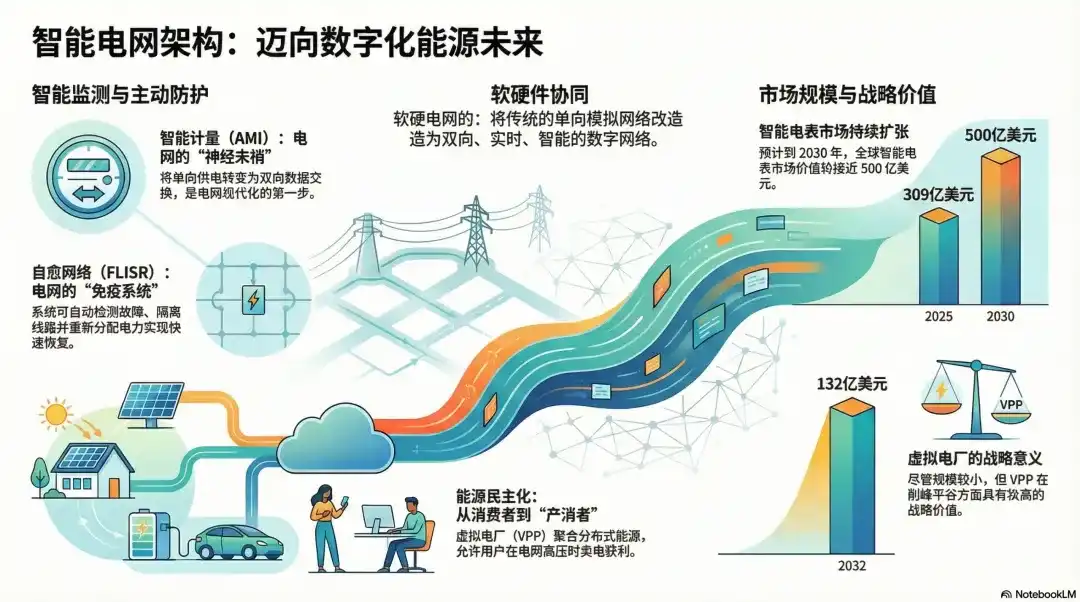
So-called grid modernization is not simply about stringing up more power lines; it's about transforming the traditional one-way analog network into a two-way, real-time, intelligent digital network.

Nerve Endings: Advanced Metering Infrastructure (AMI)

AMI is the first step in modernization. It turns one-way power supply into two-way data exchange. Its core lies in smart meters transmitting data back to the system via radio frequency or cellular networks.

Statistics show the global smart meter market was worth approximately $30.9 billion in 2025 and is expected to approach $50 billion by 2030.

Immune System: Automation and Self-Healing Networks (FLISR)

This is the infrastructure's shift from passive to active. Using software developed by companies like GE Vernova, upgraded power systems can:

1. Automatically Detect: Precisely locate the position of a fallen tree or exploding transformer.

2. Automatically Isolate: Instantly cut off the faulty line.

3. Automatically Restore: Redirect power from adjacent feeders to unaffected areas, achieving "self-healing."

Energy Democratization: Virtual Power Plants (VPP)

VPPs use cloud software to aggregate home solar systems and electric vehicle batteries. Consumers are no longer just buying electricity; they become "prosumers," selling power back to the grid for profit during times of high stress.

Although the niche market size is only in the hundreds of billions of dollars, its strategic importance for peak shaving and load balancing is immense.

3. Who is Sharing This Massive Pie?
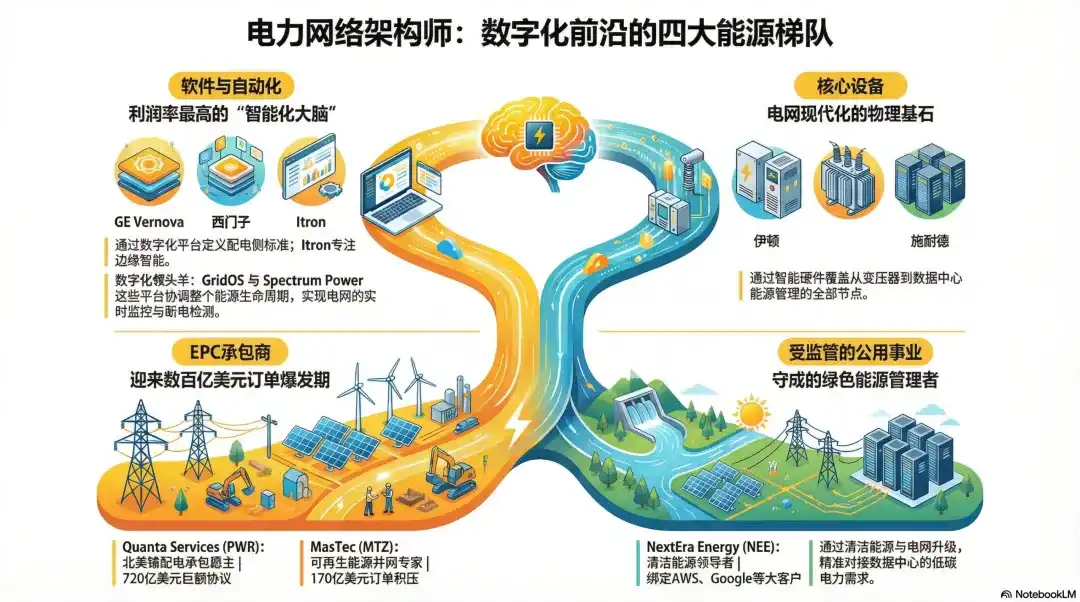
Based on the current industry attributes and profit structure of the U.S. power grid, the RockFlow investment research team categorizes the beneficiary companies into four tiers:

Software & Automation: The Intelligent "Brain"

This is the segment with the highest profit margins and the deepest moats.

  • GE Vernova (GEV): Coordinates the entire energy lifecycle through its GridOS platform. As a pure-play entity after the GE spin-off, it is the absolute leader in grid digitization.
  • Siemens (SIEGY): Possesses the leading Spectrum Power system. Its latest Gridscale X platform is defining the digital standards for the distribution side.
  • Itron (ITRI): The king of smart metering. Its "edge intelligence" products can detect outages in real-time without central processing, acting as the "guardian" at the distribution grid's endpoint.

Equipment Manufacturing & Power Electronics: The Critical Foundation

  • Eaton (ETN): A giant in electrical distribution equipment. From circuit breakers to transformers, Eaton's product portfolio covers almost every physical node of grid modernization.
  • ABB: A global expert in high-voltage products and automation. Its record order backlog is primarily driven by grid modernization projects.
  • Schneider Electric (SBGSY): Focuses on smart grid technology and microgrid solutions, providing end-to-end energy management solutions to help data centers maximize energy efficiency. It deeply integrates hardware with digital management through its EcoStruxure platform, holding a dominant position, especially in data centers and microgrids.

Engineering, Procurement & Construction (EPC): The Builders

  • Quanta Services (PWR): The dominant force in North American transmission and distribution contracting. Its recent massive $72 billion agreement with AEP is the best footnote to the grid upgrade trend. (Note: Corrected likely typo from 720 to 72 billion based on common scale)
  • MasTec (MTZ): Focuses on renewable energy interconnection. Its $17 billion order backlog foreshadows an earnings explosion over the next two years.

Regulated Utilities: The Established "Managers"

  • NextEra Energy (NEE): The largest clean energy company in the U.S., focused on wind and solar power generation. It owns extensive renewable energy assets and secures stable revenue through long-term Power Purchase Agreements (PPAs) with large customers.
  • Duke Energy (DUK): Owns extensive grid infrastructure covering multiple data center clusters. By modernizing its transmission and distribution networks, the company can provide efficient, low-loss power transmission services for data centers. Additionally, DUK is investing in clean energy generation to meet data center demand for green power.

Conclusion: The "Revaluation" of Power Assets Has Begun

In 2026, the power network is no longer that forgotten "utility" but a core asset concerning national security and the outcome of the AI race.

The RockFlow investment research team believes that for investors, software-driven automation companies (GEV, ITRI) possess the highest premium capability; equipment manufacturers (ETN, ABB) have the most certain order visibility; and EPC giants (PWR) are the direct harvesters of the infrastructure boom.

In the next five years, Alpha in U.S. stocks will no longer exist solely in code, but also in the hum of every smart transformer.


Related Questions

QWhat is the main reason for the current revaluation of power assets in the US stock market according to the article?

AThe revaluation is driven by the shift in AI competition from algorithms to physical resources, with massive electricity demand from data centers and AI applications, coupled with an aging US grid infrastructure that is ill-equipped to handle this new load.

QWhich three investment gradients does the RockFlow research team recommend focusing on for the US power grid modernization trend?

AThe three gradients are: 1) High-margin software and automation layer (e.g., GEV), 2) High-certainty equipment manufacturing layer (e.g., Eaton, Schneider), and 3) Direct infrastructure红利 harvesters in the EPC sector (e.g., PWR).

QWhat are the two major challenges facing the existing US power grid as highlighted in the article?

AThe two major challenges are: 1) Aging infrastructure, with 70% of lines and transformers over 25 years old, and 2) The 'queueing crisis,' where nearly 2600 GW of energy and storage capacity is waiting to connect to the grid, exacerbated by long lead times for critical components like large transformers.

QName one company mentioned as a leader in the 'Software and Automation' layer and describe its role.

AGE Vernova (GEV) is highlighted as the absolute leader in grid digitization. It coordinates the entire energy lifecycle through its GridOS platform, acting as the intelligent 'brain' for the modern grid.

QWhat is a Virtual Power Plant (VPP) and what role does it play in grid modernization?

AA Virtual Power Plant (VPP) uses cloud software to aggregate distributed energy resources like home solar panels and EV batteries. It turns consumers into 'prosumers' who can sell power back to the grid during peak demand, playing a crucial strategic role in peak shaving and balancing the grid.

Related Reads

Must-Watch Events Next Week|CLARITY Act Could Face Senate Vote; SpaceX, Circle to Report Earnings (8.3-8.9)

**Summary: Key Events and Developments to Watch (August 3-9)** The upcoming week is marked by significant financial disclosures, key legislative deadlines, and notable product updates. **Major Financial Events:** Several companies are scheduled to release their Q2 2026 earnings. American Bitcoin (ABTC) will report on August 3, followed by SpaceX and Hut 8 Mining Corp. on August 4, and Circle on August 5. Notably, a significant portion of SpaceX shares (up to 12% of total shares) will be unlocked on August 6 following their earnings release. **Key Legislative Deadline:** The U.S. Senate faces an August 7 deadline to secure 60 votes for the CLARITY Act, a bipartisan bill aiming to establish a federal regulatory framework for cryptocurrencies. The Senate may hold a full vote on the bill during the week. **Economic Data:** The U.S. July Non-Farm Payrolls report will be released on August 7, providing crucial labor market data. **Technology & Product Updates:** * **Shutdowns:** DeFi portfolio tracker Zapper and wallet app Ctrl Wallet will cease operations on August 3. * **Upgrades:** LayerZero will deprecate its v1 relayers on August 3. XRP Ledger's new version 3.3.0, featuring five new functions, is expected next week. * **AI:** Elon Musk announced that the advanced Grok 4.6 AI model is set for release around August 7. * **Bitcoin:** The BIP-110 forced signaling for a potential Bitcoin network change is scheduled to begin around August 8. **Other Notable Events:** Chinese robotics firm Unitree Tech has set its preliminary price inquiry for its IPO for August 5. South Korean exchange Upbit will delist AQT and AERGO tokens on August 3.

marsbit14m ago

Must-Watch Events Next Week|CLARITY Act Could Face Senate Vote; SpaceX, Circle to Report Earnings (8.3-8.9)

marsbit14m ago

Stocks Are Plummeting More Sharply Than Cryptocurrencies. Where Has the Money Gone?

Stock Markets Plunge Deeper Than Cryptocurrencies: Where Did the Money Go? In late July, Seoul's Kospi index triggered circuit breakers for two consecutive days, plummeting over 40% from its June high. The collapse was led by heavyweight stocks like SK Hynix, whose record profits still disappointed investors, and devastating leveraged ETFs, with one major product losing over 83% of its value. This signaled a global, forced deleveraging targeting the most crowded trades. Interestingly, while stocks exhibited extreme volatility akin to crypto markets, Bitcoin rose nearly 15% in July after a prior steep drop. Analysis shows the money fleeing equities did not flow into Bitcoin. Instead, Bitcoin had already absorbed its sell-off in May-June, when U.S. spot Bitcoin ETFs saw historic outflows. The true safe-haven beneficiary was gold, whose price rose over 20% year-on-year, highlighting a decoupling between Bitcoin and gold as "digital gold." The sell-off was a targeted unwinding of leveraged positions in tech and semiconductors, accelerated by broker-dealer risk management and shifts in the AI narrative, including new competition from Chinese memory chipmakers. The retreat path was clear: from high-valuation tech stocks to cash and U.S. Treasuries, then to gold. For Bitcoin to attract sustained institutional inflows, conditions like eased global liquidity pressure, a "soft-landing" Fed rate cut, and U.S. regulatory clarity via legislation like the stalled CLARITY Act are needed. Currently, Bitcoin is not a safe haven but an already-cleared asset. Its low correlation with tech stocks, however, makes it a potential diversification play for institutional portfolios once the storm passes. The money isn't here yet, but the positioning is underway.

marsbit14m ago

Stocks Are Plummeting More Sharply Than Cryptocurrencies. Where Has the Money Gone?

marsbit14m ago

In Conversation with Ray Dalio: We Are Currently in an AI Bubble, with 1% of My Portfolio in Bitcoin

Ray Dalio, founder of Bridgewater Associates, warns in an interview that the current AI boom shows classic bubble characteristics, which could lead to significant economic downturns as seen in past cycles like 1929 or 2000. He explains that speculative enthusiasm, fueled by debt and overvaluation, often precedes a crash when rising rates or taxation force asset sales, causing widespread losses and recession. Dalio also outlines his "Big Cycle" theory, describing an approximate 80-year pattern where widening wealth gaps, massive government deficits, and shifting geopolitical power (like China's rise) create internal conflict and global instability. He emphasizes that we are in a late-cycle, transitional phase where traditional powers like the US and UK face decline. For personal wealth protection, Dalio advises diversification beyond cash into assets like stocks, bonds, real estate, and particularly gold, which he prefers over Bitcoin. While he holds about 1% of his portfolio in Bitcoin as a non-printable hard asset, he views gold as more secure from technological or governmental threats. Regarding AI's impact, Dalio believes it will disproportionately benefit capital owners, worsening inequality by replacing both physical and cognitive labor. He suggests that human intuition and emotional intelligence, combined with AI, will be key for future workers. On taxation, Dalio argues that wealth taxes are impractical and risk triggering asset sell-offs, reducing productive investment. He points to the UK as a cautionary example of debt, low productivity, and political strife. Geopolitically, Dalio foresees a more regionalized world, with the US showing weakness in prolonged conflicts like with Iran, akin to past imperial declines. The ideal outcome, he suggests, is coexisting powerful blocs (e.g., Americas, China-Asia Pacific) without major war.

marsbit4h ago

In Conversation with Ray Dalio: We Are Currently in an AI Bubble, with 1% of My Portfolio in Bitcoin

marsbit4h ago

Daily 7.2 Trillion KRW: Foreign Capital's Record Net Buying on Friday! Wall Street Says Headwinds for Korean Stock Fund Flows Have Subsided

South Korean stock market sees a dramatic shift in fund flows. On July 31, foreign investors made a record net purchase of approximately KRW 7.2 trillion in KOSPI stocks, marking a fundamental reversal from the persistent large-scale net outflows seen in previous months. This contributed to a significant narrowing of foreign net selling in July to KRW 9.8 trillion, down sharply from KRW 48.4 trillion in June and KRW 44.5 trillion in May. Simultaneously, domestic institutional pressure eased. South Korean pension funds and asset managers turned to a net buying position in July, purchasing KRW 1.0 trillion worth of KOSPI shares, contrasting with net sales in May and June. Market volatility is expected to be dampened by new financial regulations. Effective July 31, the Financial Services Commission tightened access for retail investors to single-stock leveraged ETFs by raising the minimum cash deposit requirement. Trading volumes for these products subsequently dropped to about 50% of their monthly average. Citigroup Research maintains its year-end KOSPI target of 10,000 points. The firm cites several supportive factors: the substantial easing of headwinds from capital outflows, a robust fundamental outlook for the semiconductor sector, historically low market valuations, strong economic fundamentals, and the potential for policy support from financial authorities if needed.

marsbit4h ago

Daily 7.2 Trillion KRW: Foreign Capital's Record Net Buying on Friday! Wall Street Says Headwinds for Korean Stock Fund Flows Have Subsided

marsbit4h ago

Trading

Spot
活动图片




