Musk's Wealth Surpasses Bitcoin Market Cap: The Wealth Game Behind SpaceX's Soaring Value

marsbitPublished on 2026-06-18Last updated on 2026-06-18

Abstract

Musk's net worth, estimated at $1.32 trillion, has surpassed Bitcoin's market capitalization of $1.29 trillion, driven by SpaceX's stock surging over 50% since its IPO to a $2.7 trillion valuation. This shift highlights changing speculative capital flows, moving from the crypto market—where Bitcoin has retreated over 50% from its 2025 peak—toward high-growth tech stocks like SpaceX. Retail investors, particularly from South Korea, have fueled the rally, making SpaceX one of the most actively traded stocks and its leveraged ETFs record-breaking in volume. However, despite the enthusiasm, SpaceX reported a $49.4 billion net loss in 2025 and a $42.7 billion loss in Q1 2026, reflecting heavy investments in Starlink, AI, and launch infrastructure. Its current valuation largely hinges on Musk's ambitious projection of $1 trillion annual revenue by 2030. The comparison underscores that the market's biggest speculative bet is no longer a cryptocurrency but a rocket company, though questions remain about how long this growth narrative can sustain given SpaceX's significant ongoing losses.

Author:CryptoSlate

Compiled by: Deep Tide TechFlow

Deep Tide TechFlow Insight: SpaceX's stock has surged over 50% in its first week of trading, propelling Elon Musk's personal wealth to $1.32 trillion, exceeding Bitcoin's $1.29 trillion market capitalization. This isn't a failure for Bitcoin, but rather a sign that speculative capital is withdrawing from the crypto market and flooding into SpaceX, this "$2 trillion meme stock." However, the company reported nearly $5 billion in losses in 2025, and its current valuation hinges on Musk's promise of $1 trillion in revenue by 2030—how long can this gamble last?

According to the Bloomberg Billionaires Index, as SpaceX's share price surpassed $200, Musk's net worth has risen to approximately $1.32 trillion, surpassing Bitcoin's roughly $1.29 trillion market cap.

This milestone highlights how SpaceX's post-IPO meteoric rise is reshaping wealth rankings and shifting the focus of market discussions on speculative risk.
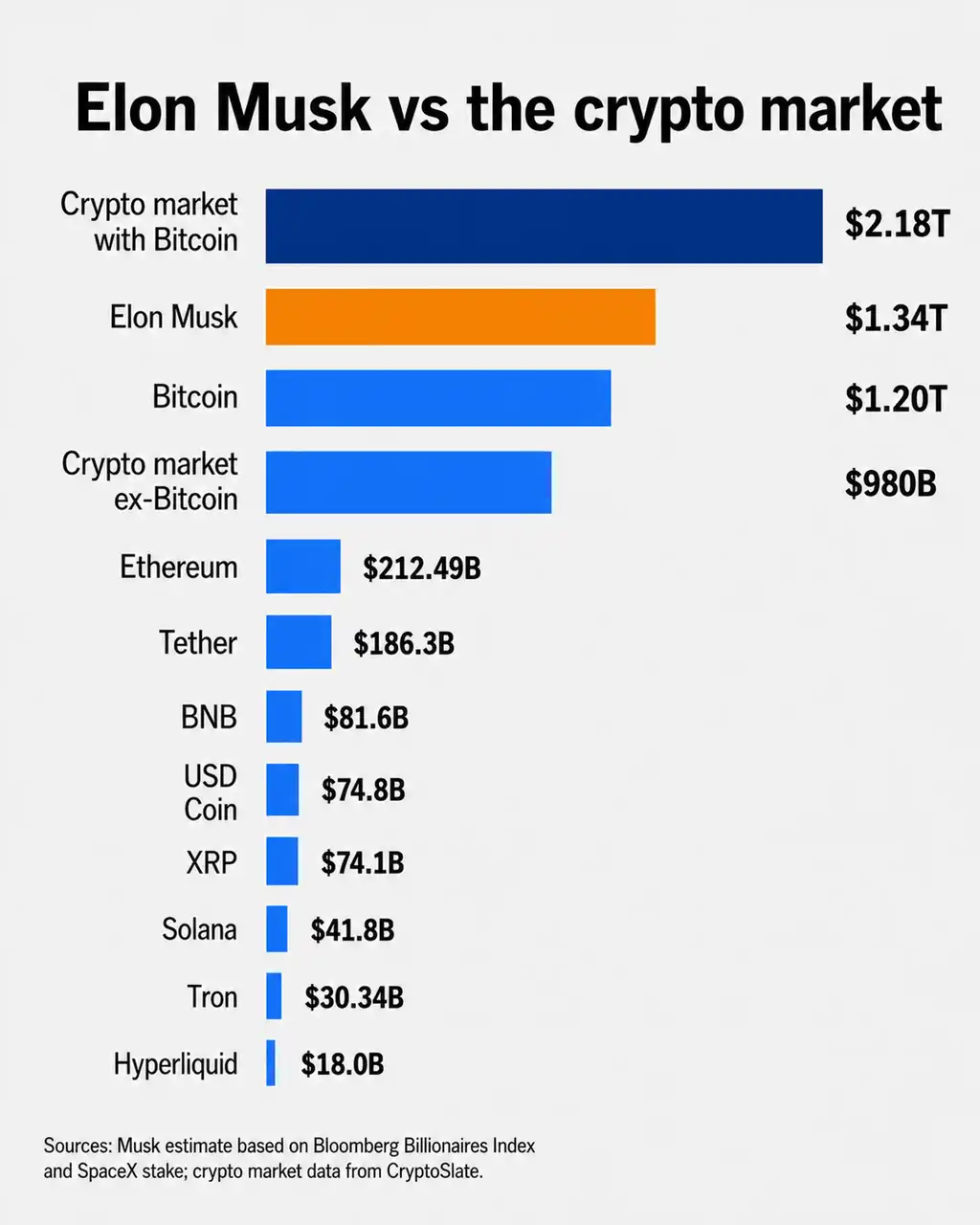
While such a comparison is not precise, it vividly illustrates how SpaceX's rapid ascent has become a focal point for global markets, pushing Musk's wealth to unprecedented heights.

Bitcoin Pullback Makes the Comparison Possible

Bitcoin remains the largest digital asset by market cap, but its lead has narrowed as the broader crypto market retreated from last year's highs.

According to CryptoSlate data, the total cryptocurrency market cap has fallen from a peak of about $4.21 trillion to around $2.23 trillion over the past year. During the same period, Bitcoin declined over 50% from its late-2025 all-time high near $126,000, experiencing months of selling pressure and waning risk appetite.

This reversal followed a strong rally that began during Trump's 2024 presidential campaign and extended into his return to the White House. At that time, Bitcoin first broke through $100,000 as investors reacted to expectations of industry-friendly appointments, regulatory proposals, and a more lenient stance from Washington on digital assets.

However, those gains have faded this year, with crypto exchange volumes declining, leveraged positions being liquidated, and capital flowing back into big tech stocks, private market proxies, and newly listed growth companies.

Against this backdrop, Musk's wealth milestone reflects less about Bitcoin losing its crypto benchmark status and more about SpaceX's astonishing speed in becoming the outlet for competing speculative capital.

Meanwhile, the comparison is even more stark beyond Bitcoin. The total crypto market is valued at about $2.23 trillion, with Bitcoin accounting for roughly $1.29 trillion. This means Musk's estimated wealth now exceeds the combined value of all other digital assets.

SpaceX Becomes the Market's New Crowded Trade

The direct driver behind Musk's wealth surge is SpaceX, which trades on Nasdaq under the ticker SPCX.

The company's IPO was priced at $135 per share and has since climbed more than 50%, pushing its market cap to approximately $2.7 trillion. This places SpaceX among the world's most valuable public companies, surpassing Amazon and nearing Microsoft's market cap.

This rally stems from a rare combination of scarcity, brand power, and momentum. As CryptoSlate previously reported, only a small portion of SpaceX equity entered public trading, sending investors scrambling for the limited float of one of the most anticipated public listings in years. This imbalance helped turn demand into price pressure.

Meanwhile, retail investors have been central to the stock's rapid ascent.

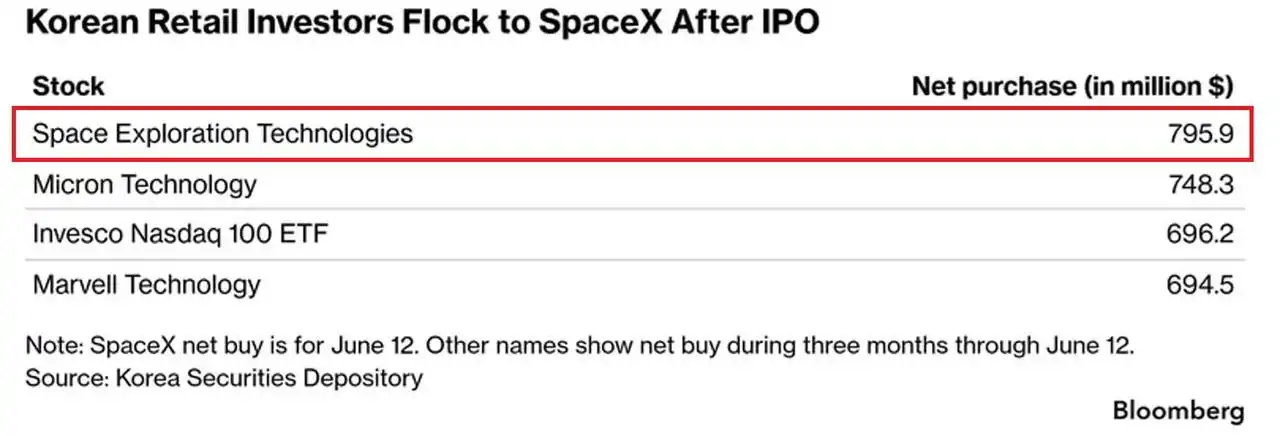
According to market flow data cited by Global Market Investor, South Korean retail investors purchased about $795.9 million worth of SpaceX shares on its first trading day, June 12. This made SPCX the most-purchased U.S. stock by South Korean retail investors in a single day.

This buying volume surpassed the net purchases of several major U.S. tech stocks over three months. According to the same data, over the past three months, South Korean retail bought $748.3 million of Micron Technology, $696.2 million of the Nasdaq 100 ETF, and $694.5 million of Marvell Technology.
Simultaneously, the frenzy for SPCX has manifested in leveraged exchange-traded funds tied to the company, which traded briskly in their first few days of listing.

Eric Balchunas, Senior ETF Analyst at Bloomberg Intelligence, noted that total trading volume for 2x SpaceX ETFs broke $3 billion, up from about $1 billion the previous day.

A product with the ticker SPCH saw about $1.3 billion in volume on its second day. Balchunas called this the second-highest day-two trading volume for an ETF ever, exceeding the roughly $500 million volume of BlackRock's spot Bitcoin ETF (IBIT) on its second day.
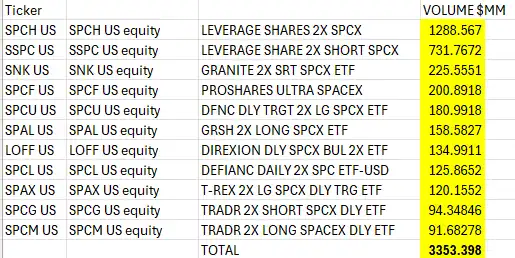
This demand is notable because many products track the same underlying stock and offer similar leverage. It suggests investors aren't just seeking long-term exposure to SpaceX; many are using these funds to express short-term directional bets.

Ultimately, these figures indicate SpaceX is being treated as a global momentum trade, not a traditional aerospace public company.

Investors who missed out on IPO allocations have been buying shares in the open market, while others have turned to exchange-traded funds, options, and crypto derivatives to get exposure to the same play.

Growing Questions Over SpaceX's Valuation

The speed of the rally has intensified questions about whether SpaceX's valuation has outrun its business fundamentals.

Musk has stated SpaceX could achieve $1 trillion in annual revenue by 2030, a target that has helped investors price the company as more than just a rocket and satellite business. The market is also assigning value to Starlink, artificial intelligence, launch infrastructure, and Musk's broader tech ecosystem.

Current financials show the company is still spending heavily to build that future. SpaceX recorded a net loss of $4.94 billion on $18.67 billion in revenue for 2025. The company posted another $4.27 billion loss in Q1 2026, reflecting capital expenditures on Starlink, launch capacity, computing infrastructure, and AI initiatives.
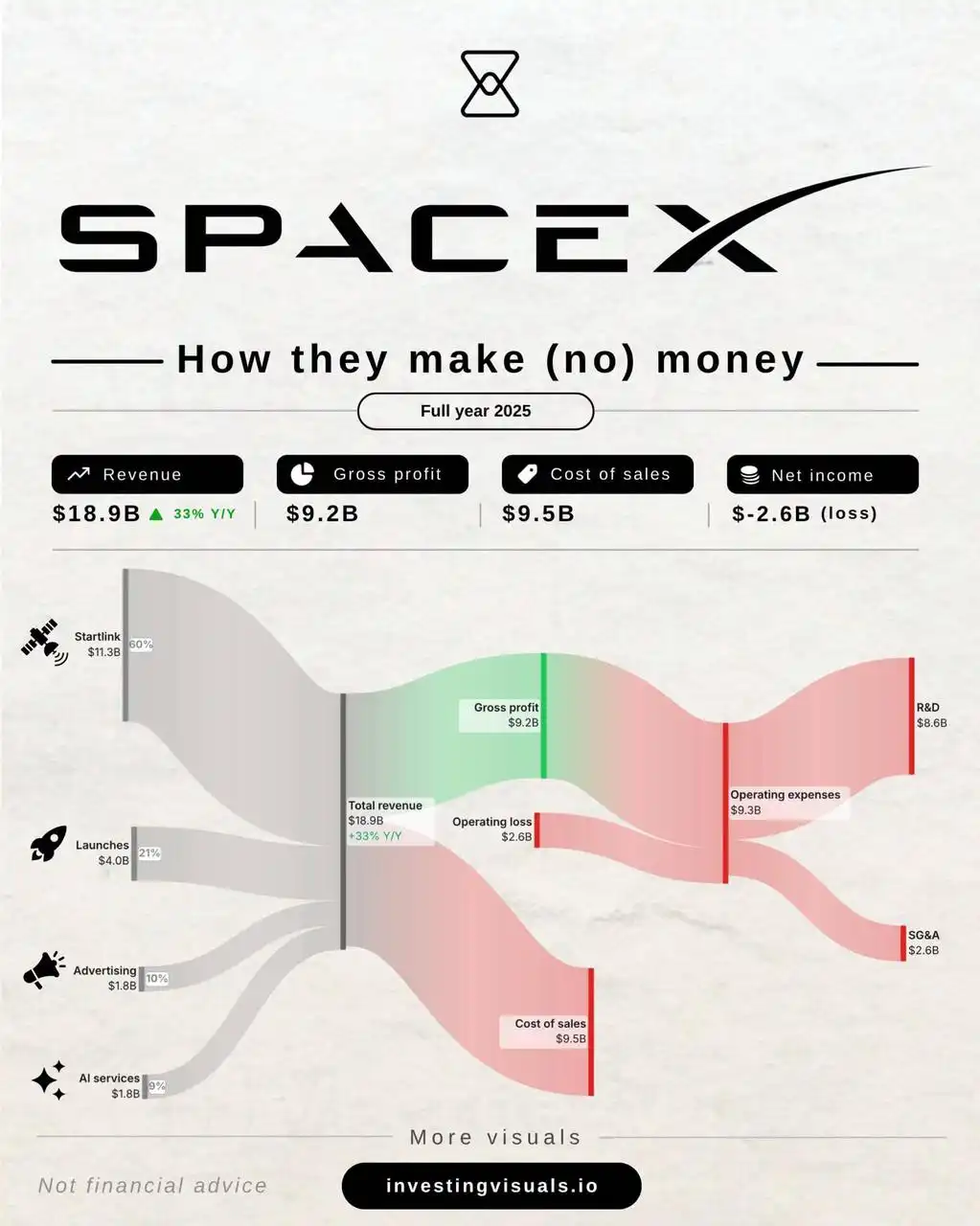
These losses haven't stopped the rally. But they widen the gap between SpaceX's current reality and the price investors are paying for its future.

This is where the comparison with Bitcoin becomes useful. Bitcoin's market cap has long hinged on what buyers are willing to pay for scarcity, network strength, and future monetary relevance. SpaceX is now being priced on a similar forward-looking logic, just through a public-company structure tied to Musk.

For now, public markets are rewarding this story more aggressively than crypto markets.

While Musk's wealth may not forever exceed Bitcoin's market cap—as SpaceX shares could fall, Bitcoin could rebound, or both could swing sharply in opposite directions—this milestone captures the current state of risk appetite: the biggest speculative trade in the market is no longer necessarily a token, but a rocket company.


Trending Cryptos

Related Questions

QWhat milestone did Elon Musk achieve recently in terms of his personal wealth compared to Bitcoin's market capitalization?

AElon Musk's personal wealth has reached approximately $1.32 trillion, surpassing Bitcoin's market capitalization of about $1.29 trillion.

QAccording to the article, what major factor is driving the shift of speculative capital away from the cryptocurrency market?

ASpeculative capital is shifting away from the cryptocurrency market and flowing into SpaceX, which is described as a 'trillion-dollar level meme stock.'

QWhat was the IPO price of SpaceX stock and how much has it risen since its listing?

ASpaceX's IPO was priced at $135 per share. Since its listing, the stock has risen by over 50%.

QWhat key revenue target has Elon Musk set for SpaceX by 2030, which is a major factor in its current valuation?

AElon Musk has stated that SpaceX could achieve $1 trillion in annual revenue by 2030.

QWhat is the primary reason cited in the article for the recent decline in Bitcoin's price from its 2025 high?

ABitcoin's price has declined from its 2025 high due to several months of selling pressure and a weakening risk appetite among investors.

Related Reads

NVIDIA CPU Advances, China's RISC-V Responds: Semiconductor Deep Dive - Part Four

NVIDIA is set to launch its new Vera AI data center CPU in China as early as August, with high pricing. While this move offers a new option, it highlights China's continued dependence on foreign-controlled Arm architecture. In response, the Chinese semiconductor industry is increasingly turning to RISC-V as a strategic alternative for achieving high-performance computing autonomy. The article explores the concept of the "impossible triangle" in CPU development—balancing prosperity, control, and autonomy—and posits that RISC-V's open-source, modular nature offers a unique path to achieving all three. While RISC-V is already dominant in embedded systems, the focus is now shifting to data centers and AI workloads. China has become a global hotspot for RISC-V development, driven by AI-driven compute demand, supply chain concerns from export controls, cost benefits of open-source, and strong policy support. Multiple Chinese companies have reportedly crossed the key performance threshold of 15 SPECint per GHz, a benchmark for entering the high-performance CPU club. Progress extends beyond single-core benchmarks. Companies are developing complete computing subsystems, including commercial-grade coherent network-on-chip (NoC) technology and server processors with up to 40 cores that strictly adhere to the RVA23 standard to ensure software compatibility. Real-world applications are emerging in areas like video transcoding and edge AI. However, significant challenges remain. The RISC-V ecosystem faces fragmentation, immature toolchains and verification processes, and gaps in single-core performance and energy efficiency compared to mature x86 and Arm architectures. The formidable software moat, epitomized by NVIDIA's CUDA, is a long-term hurdle. In conclusion, while RISC-V cannot immediately replace offerings like NVIDIA's Vera, it represents a viable long-term path for China to develop a self-sufficient, high-performance CPU ecosystem. The journey is acknowledged to be long and arduous, requiring sustained effort to overcome technical and ecosystem challenges.

marsbit1h ago

NVIDIA CPU Advances, China's RISC-V Responds: Semiconductor Deep Dive - Part Four

marsbit1h ago

My Coding Betting Dashboard is Profiting, but Polymarket is Truly Not a Good Place for 'Arbitrage'

The author built a custom monitoring dashboard for Polymarket, a prediction market platform, and tested it with $1,600, achieving over 30% returns. However, the core argument is that Polymarket is not a good venue for traditional arbitrage. The dashboard has two main sections: a "Portfolio Dashboard" for tracking active positions with key metrics like total capital, P&L, and a risk-control module using a tier system (T1, T2, T3), and an "Opportunity Watchlist" for monitoring markets. The article details a critical structural trap in binary markets: a bet with a high perceived probability of success still carries a 100% loss risk if wrong. The author's T1/T2/T3 system is designed to manage this by limiting position sizes based on conviction and time horizon, emphasizing that high confidence should not equal high concentration. A key insight is the danger of "pseudo-diversification"—betting on different markets driven by the same underlying variable. The author concludes that Polymarket offers few true low-risk, arbitrage opportunities. It is instead a high-risk environment where wins can create a false sense of mastery, leading to large losses. The platform is better viewed as a training ground for honing judgment through disciplined, framework-driven betting rather than a reliable income source. The tools help transform intuition into structured, rule-based decisions to mitigate the risk of catastrophic errors.

marsbit4h ago

My Coding Betting Dashboard is Profiting, but Polymarket is Truly Not a Good Place for 'Arbitrage'

marsbit4h ago

WeChat AI Card Hands-On Guide: Has the AI Shopping Era Arrived?

**"WeChat AI Card" Practical Test Guide: Has the Era of AI Shopping Arrived?** WeChat has officially launched the "AI Exclusive Card," a feature integrated into its Workbuddy AI assistant. This card is designed to handle payments for AI-initiated purchases. Our hands-on test reveals it's not yet a tool for fully autonomous AI shopping, but rather a controlled payment layer for AI agents. The AI Card functions as an isolated sub-wallet within WeChat Pay. Users must bind the card and transfer funds into it from their main wallet. Crucially, every transaction requires explicit user confirmation via smartphone scan; AI cannot spend autonomously. Currently accessible through the Workbuddy agent, the card targets specific digital consumption scenarios: purchasing paid content (reports, data), calling paid APIs/tools, and subscribing to services. Its design prioritizes security and control by separating funds and mandating approval for each payment. We tested a real-world scenario: ordering bubble tea via Workbuddy using a "Meituan Life Assistant" skill. The process encountered multiple hurdles: high "skill" usage costs (exceeding daily free credits), and most importantly, while a payment was successfully initiated, the AI purchased an incorrect product (a mismatched group-buy coupon instead of the desired drink). This highlights the current limitation: the **AI Card only solves the payment step**. The broader challenge lies in the **AI agent's execution chain**—accurately understanding intent, navigating third-party platforms, selecting the right product, and ensuring proper fulfillment. The payment succeeded, but the purchase failed to meet the user's need. In conclusion, the WeChat AI Exclusive Card is a cautious, early-step experiment in AI commerce. It provides a secure, user-controlled payment method for agent interactions but is not yet capable of reliable, end-to-end complex purchases. For now, it's best used for low-value, low-risk digital services with careful user verification at each step. The vision of AI handling complete shopping tasks remains a work in progress.

marsbit6h ago

WeChat AI Card Hands-On Guide: Has the AI Shopping Era Arrived?

marsbit6h ago

Trading

Spot
Futures

Hot Articles

Discussions

Welcome to the HTX Community. Here, you can stay informed about the latest platform developments and gain access to professional market insights. Users' opinions on the price of S (S) are presented below.

活动图片