Month-old Ethereum client bug blamed for Prysm outage

cointelegraphPublished on 2025-12-15Last updated on 2025-12-15

Abstract

A month-old bug in the Prysm Ethereum client caused a significant outage on December 4, leading to resource exhaustion and performance degradation. The issue occurred when Prysm nodes processed attestations from out-of-sync nodes, forcing them to recompute expensive state transitions. Although the bug had been present on testnets for a month prior, it wasn’t triggered until the mainnet incident. The network experienced an 18.5% missed slot rate for over 42 epochs, with participation dropping to 75%, resulting in approximately 382 ETH lost in attestation rewards. A patch was quickly deployed to resolve the issue. Developers emphasized that client diversity helped prevent a more severe impact, as Prysm only holds a 17.6% share of the network. However, they warned that Lighthouse, the dominant client with 52.6% share, is nearing a dangerous threshold where a single bug could finalize an invalid chain.

Prysm has revealed that a bug introduced in a testnet a month before Ethereum’s Fusaka upgrade was the cause of an Ethereum node validation issue that affected its client earlier this month.

Ethereum developer Terence Tsao posted a post-mortem on Sunday detailing the Fusaka mainnet Prysm incident that impacted the network on Dec. 4.

Prysm nodes experienced “resource exhaustion” when processing attestations from out-of-sync nodes, it stated. This caused Prysm to replay past epoch blocks and recompute expensive state transitions, resulting in a significant impact on performance due to the excessive workload.

The post-mortem revealed that the bug had been present on testnets for a month before the incident, but wasn’t triggered.

“The bug was introduced in Prysm PR 15965 and deployed to testnets a month before the incident without the trigger happening.”

Testnets are designed to identify bugs, but they aren’t a foolproof method.

In May 2023 — a month after the Shanghai hard fork — Ethereum developers were sent into a frenzy when the network temporarily lost transaction finality for around 25 minutes, then again for over an hour the following day, before the blockchain recovered on its own.

Prysm has been patched

Instead of using the current head state, Prysm regenerated prior states from scratch, creating a massive computational burden.

For more than 42 epochs, the network saw an 18.5% missed slot rate with participation dropping to 75% while validators lost approximately 382 Ether (ETH) in attestation rewards, it said.

Related: Vitalik Buterin says Ethereum can handle temporary loss of finality

Node operators were instructed to deploy a temporary solution while developers worked on an update patch for Prysm clients.

Client diversity saved the day

The incident could have been much worse if it had hit Ethereum’s dominant consensus client, Lighthouse, said developers.

Offchain Labs’ Prysm is the second-largest Ethereum client with a 17.6% share, according to ClientDiversity.

“Client diversity prevented a noticeable impact on Ethereum users. A client with more than 1/3rd of the network would have caused a temporary loss in finality and more missed blocks.”

However, the incident highlighted that Lighthouse is dangerously close to the two-thirds threshold where a single client bug could finalize an invalid chain.

Lighthouse currently has a client share of 52.6%, down from around 56% at the time of the incident.
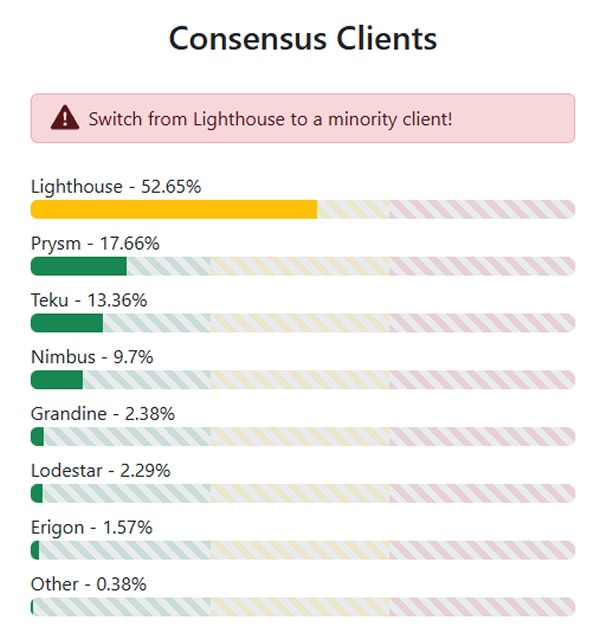
Ethereum developers are pushing for more client diversity. Source: ClientDiversity


Magazine: Big questions: Would Bitcoin survive a 10-year power outage?

Related Reads

"119 to 176 Dollars": Behind SpaceX's Listing, MSX Once Again Successfully Executes the Pre-IPO Closed Loop

Following May's 300% gain on Cerebras, MSX delivered another outstanding performance during SpaceX's listing night. On June 12, SpaceX (SPCX) launched on Nasdaq, reaching a high of $176. This marked the successful culmination of MSX's Pre-IPO project launched in March, where users subscribed at $119, achieving gains of approximately 40-48%. This event validated MSX's complete Pre-IPO mechanism, a crucial advantage in a market where access to top-tier private company equity is typically limited to institutions. MSX's model provides a full cycle for users: subscription (at $119 for SpaceX), real-time on-chain portfolio tracking, optional early redemption, seamless conversion to tradable spot assets (SPCX.M) upon IPO, and final settlement in stablecoins. This end-to-end process distinguishes MSX from platforms that faced settlement issues during the SpaceX IPO, highlighting that the core challenge of Pre-IPO is not just access, but a clear exit and conversion path post-listing. This success with SpaceX is MSX's second major Pre-IPO verification, following the Cerebras listing in May, which yielded ~300% returns for early participants. These back-to-back achievements demonstrate MSX's capability to source, structure, and deliver real assets through a replicable on-chain model. The true barrier for Pre-IPO products lies not in providing an entry point, but in ensuring reliable fulfillment from subscription through to post-IPO liquidity. MSX's proven闭环 (closed-loop) process addresses this, offering Web3 users a structured way to access high-growth, pre-public companies in sectors like AI and frontier tech. MSX plans to continue expanding its Pre-IPO portfolio with this focus on authenticity, transparency, and post-listing execution.

Odaily星球日报6h ago

"119 to 176 Dollars": Behind SpaceX's Listing, MSX Once Again Successfully Executes the Pre-IPO Closed Loop

Odaily星球日报6h ago

Trading

Spot
Futures

Hot Articles

Discussions

Welcome to the HTX Community. Here, you can stay informed about the latest platform developments and gain access to professional market insights. Users' opinions on the price of ETH (ETH) are presented below.

活动图片















