Source: The DeFi Report
Author: Michael Nadeau
Compiled and Edited by: BitpushNews
Whether you like it or not, we believe memecoins are here to stay. This article will share a macro perspective on the industry and delve into the meme coins we are closely monitoring.
Let's begin.
Why Focus on Memecoins
Our Methodology
Some people love memecoins, others despise them. We try to step outside this debate and simply observe the market. From our observations, memecoins have taken root. From a "Product-Market Fit (PMF)" perspective, they seem to be the ultimate crypto "game." People love trading, love gambling, love the social aspect, and love the risk-reward play. And we believe participants are very aware of the game they are playing.
After witnessing PEPE's success in the Ethereum ecosystem, we caught onto BONK and Solana in late 2023. This led us to research the space more deeply, including on-chain data and additional investments like GIGA, PEPE, and SPX6900. Our goal is to uncover unique properties in holder data that indicate a token's Staying Power and the conviction of its holders.
Why BONK, PEPE, SPX6900, PENGU, and USELESS?
-
Liquidity: Each token has ample liquidity and is tradable on major exchanges and retail channels.
-
Audience Reach: Each token has global audience interest (not limited to niche memes like specific politics).
-
Leadership/Embedded Culture: Each token is supported by at least one of the following: 1) A highly influential leader/holder community; 2) An established internet meme/culture; or 3) An existing popular brand.
-
Historical Performance: Each token has experienced multiple massive rallies followed by sharp pullbacks. This price action shows broad market interest and helps distribute the holder base, laying the foundation for the next expansion.
-
No Unlocks, No VCs: Only transparent on-chain data.
-
High Beta: Each token exhibits a high beta coefficient relative to BTC and the L1 assets of its ecosystem. With proper allocation (we target 3-5%), coin selection, and entry points, this can significantly enhance risk-adjusted returns.
Now, let's dive into the on-chain data to separate the wheat from the chaff.
Total Token Holders
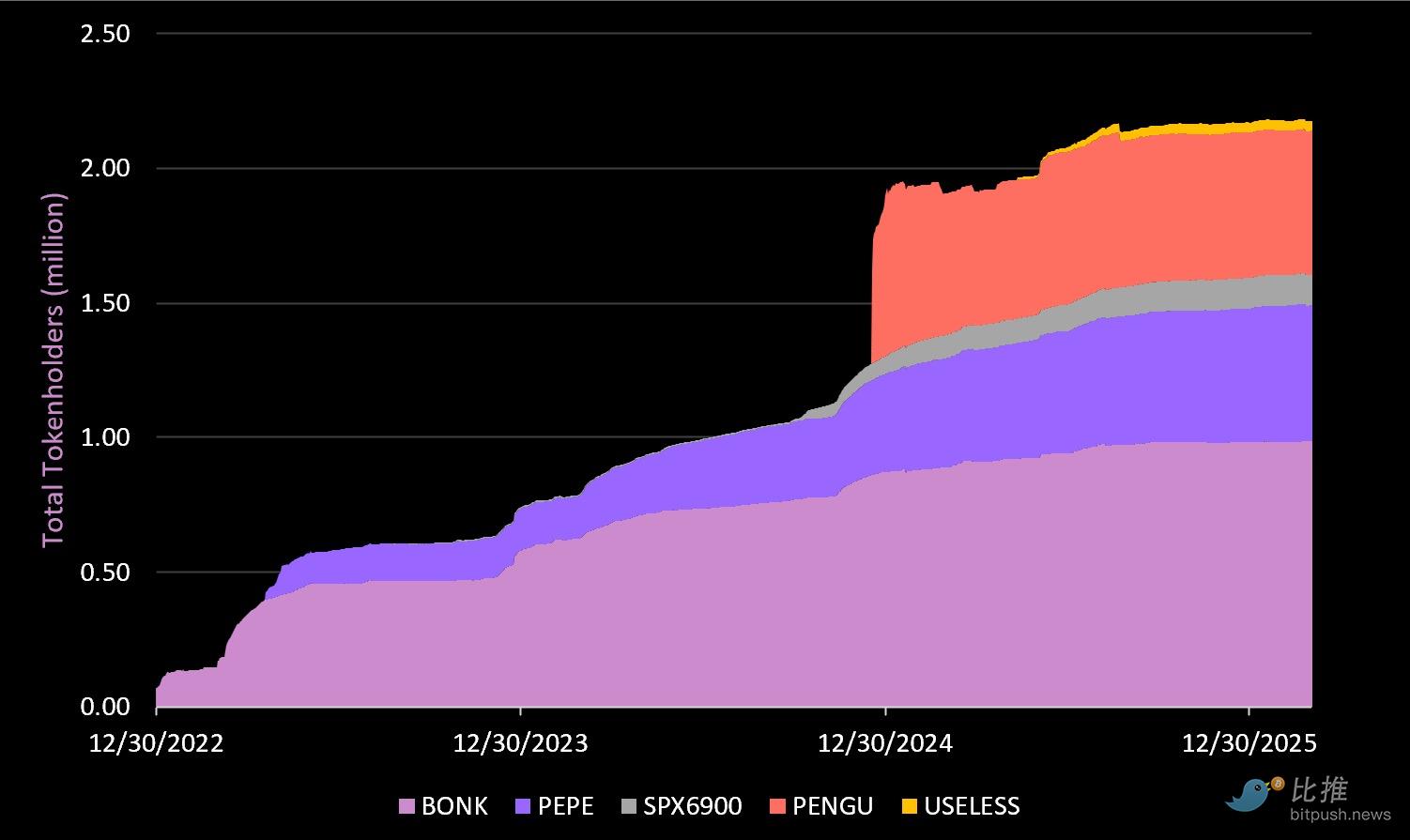
Data Source: The DeFi Report
-
BONK: 985.9K current holders (at an all-time high). BONK launched in Dec '22, is the largest memecoin in the Solana ecosystem, and is deeply integrated into various apps and wallets. Note: BONK executed a community-driven airdrop campaign, "seeding" a large number of wallets, which is reflected in the data in the table below.
-
PENGU: 534.1K holders (down 14% from peak). PENGU launched in Dec '24, representing social interest in the popular brand Pudgy Penguins. The total market cap of the Pudgy Penguins NFT collection today is ~$78.5M, while its memecoin market cap is $454M (5.7x the NFT collection, down from a $2.7B peak). We believe the value of the Pudgy Penguins brand (a strong crypto brand breaking into the mainstream) is likely to continue flowing to this memecoin.
-
PEPE: 505.7K current holders (down 1.51% from peak). PEPE launched in Apr '23. We believe PEPE is the purest expression of internet meme culture in crypto (especially on Ethereum). It's based on the globally recognized "Pepe the Frog," which has maintained a strong internet presence since the late 2010s.
-
SPX6900: 113K current holders (down 0.33% from peak). SPX6900 launched in Sep 2023, spawning a fervent internet community led by Murad, with the core ethos of "Flipping the stock market." The brand seems to combine financial satire with a "BTC-like" holder base that takes holding very seriously (as shown in the data below). We successfully traded SPX6900 in the last bull run and have been analyzing its community and on-chain data since Aug '24.
-
USELESS: 38.6K current holders (down 5.2% from peak). USELESS launched in May '25 as a satirical "Anti-utility" memecoin. It attracted a vertical and seemingly loyal community after its debut on LetsBONK (which took market share from Pump Fun at the time). Its current market cap is $44M with daily liquidity exceeding $10M (at bear market lows), and we believe USELESS could present interesting opportunities under the right market conditions.
Holders with Balances Under $100
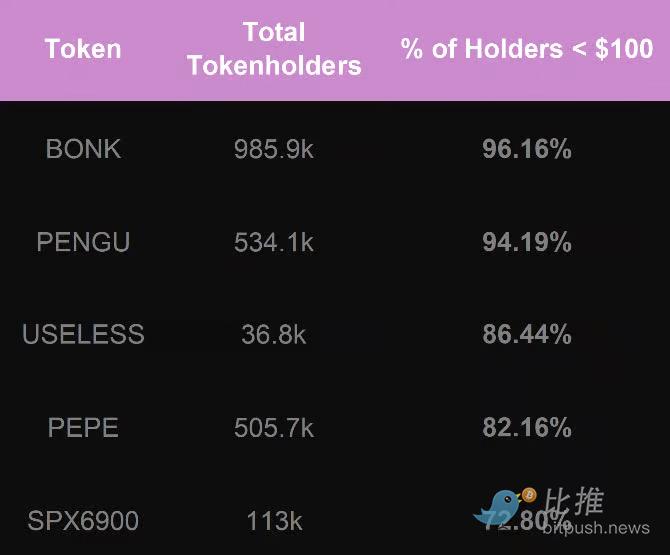
Conclusion:
BONK, PENGU, and PEPE already have very mature holder bases. SPX6900 shows a more resolute and loyal holder base (albeit smaller).
Holders with Balances Over $1,000
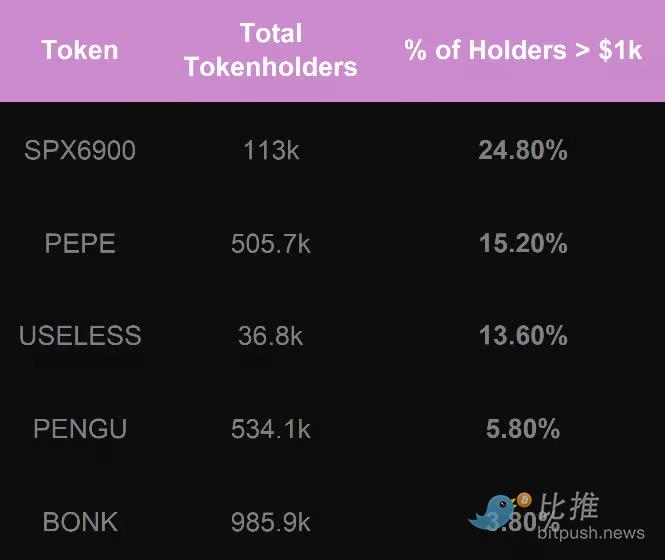
Note, $1,000 wallet classification: Split by the number of token units held at the token's All-Time High (ATH) price equivalent to $1,000.
Conclusion:
SPX6900 stands out here, as it consistently has since we started tracking this metric.
To better understand the retention of $1,000 holders, we normalized the ATH data for each token, calculating the number of token units required to be a "$1,000 holder" at that time.
Then, we tracked the holdings (number of units) of these wallets over time. This aims to strip out the noise of price fluctuations to more accurately gauge holder retention willingness.
Here are our findings:
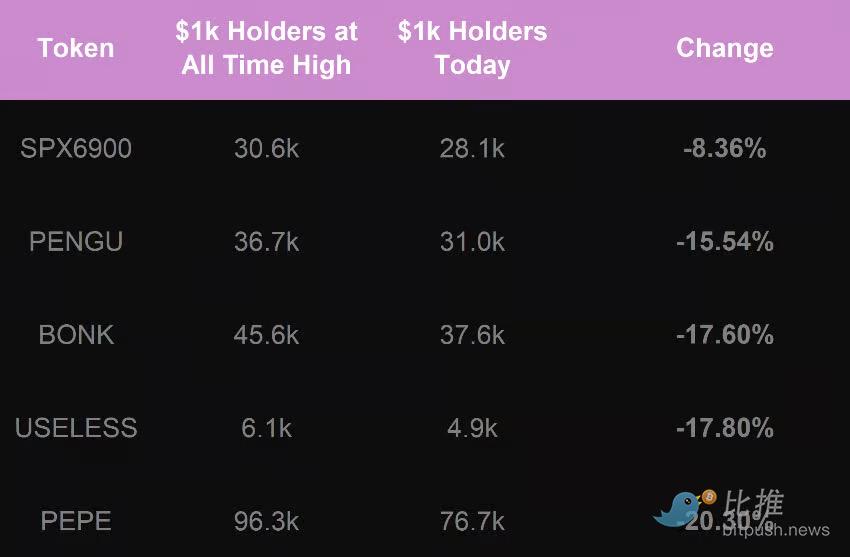
Conclusion:
In terms of "$1,000 holder" retention rate (measured in units to strip out price effects), SPX6900 seems to have separated itself from the pack.
Holders with Balances Over $100,000
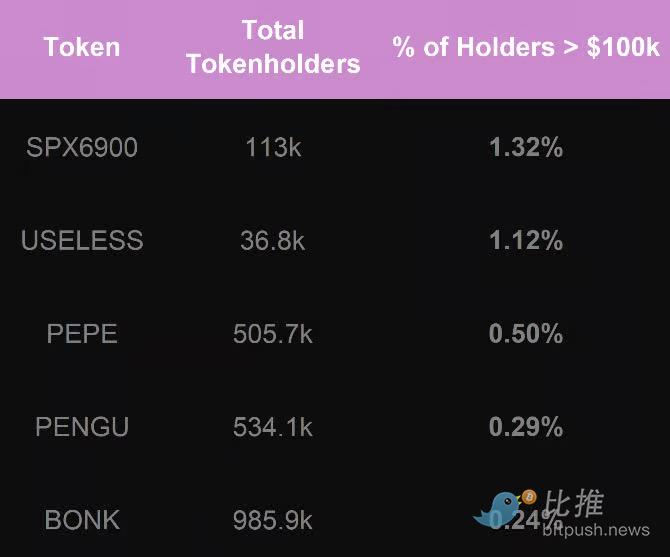
$100,000 wallet classification: Split by the number of token units held at the token's All-Time High (ATH) price equivalent to $100,000.
Retention Rate
Similar to the $1,000 holder data, we classified $100,000 wallets by their unit holdings at ATH.
Then, we tracked these wallets to determine the change in the total number of "$100,000 wallets" (by token units) over time.
Here are our findings:
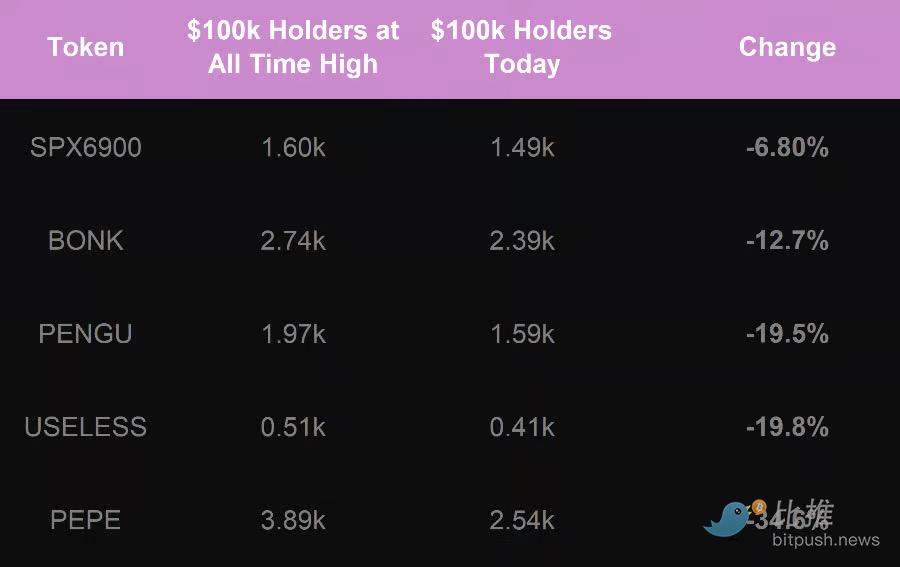
Conclusion:
Again, SPX6900 leads in the retention rate of holders at the $100,000 level.
Whale Retention Rate
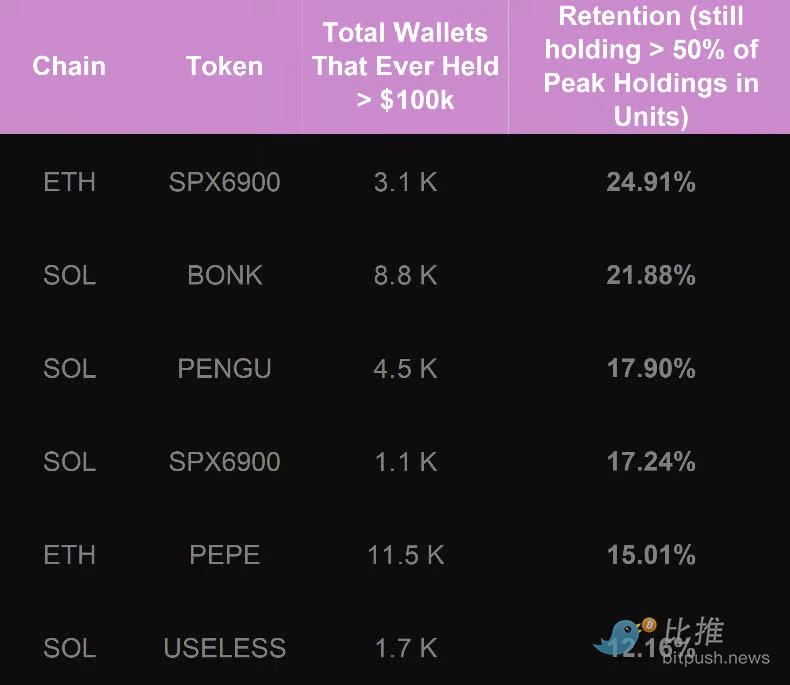
Another way to monitor whale retention is: Count all wallets that have ever held over $100,000 worth of the token and compare that to the number of wallets that still hold more than 50% of their peak holdings (in units).
Here are our findings:
Momentum & 50-Week Moving Average (WMA)
Relative Strength
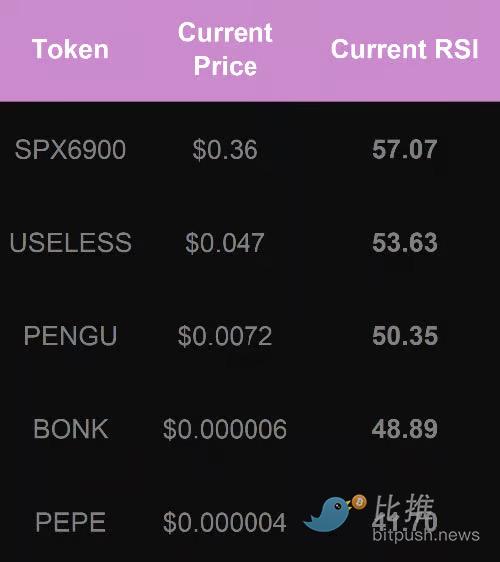
When we buy memecoins, we look for entry points where the 14-day RSI is at or near oversold territory (30).
50-Week Moving Average
-
SPX6900: Trading 64% below its 50 WMA.
-
BONK: Trading 62% below its 50 WMA.
-
PENGU: Trading 58% below its 50 WMA.
-
PEPE: Trading 57% below its 50 WMA.
Drawdown from All-Time High
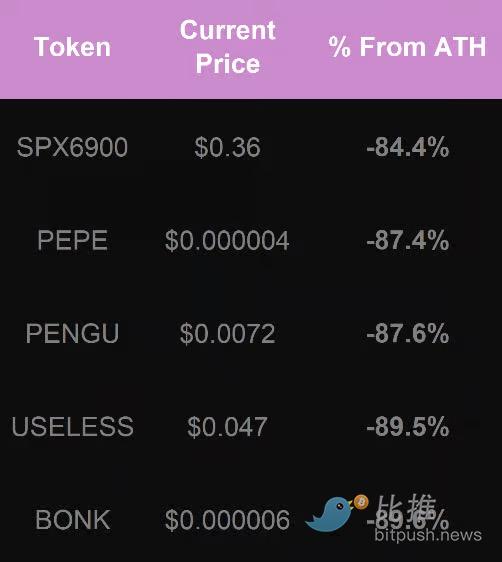
Given SPX6900's superior on-chain data, its relative resilience compared to the others is not surprising.
Conclusion
Given the industry's attention, we believe it is wise for crypto investors to pay attention to memecoins. We find them highly referential when monitoring broad risk-on/off sentiment and liquidity conditions in the crypto market.
Not to mention, with the right position sizing and entry points, the right assets can provide a "powerful catalyst" for a portfolio.
We successfully captured BONK and SPX6900 in the last bull run (exiting with a small portfolio allocation for 10x+ gains). We will look for similar entry opportunities in the future.
Twitter:https://twitter.com/BitpushNewsCN
Bitpush TG Discussion Group:https://t.me/BitPushCommunity
Bitpush TG Subscription: https://t.me/bitpush







