Mastercard Snags BVNK After Failed $2 Billion Coinbase Deal

bitcoinistPublished on 2026-03-18Last updated on 2026-03-18

Abstract

Mastercard has acquired stablecoin infrastructure firm BVNK for up to $1.8 billion, including $300 million in contingent payments. This follows BVNK’s earlier failed $2 billion merger talks with Coinbase. The acquisition aims to expand Mastercard’s capabilities in digital assets and on-chain payments, integrating fiat rails with blockchain-based transactions. BVNK operates in over 130 countries and previously partnered with Visa to enable stablecoin payments. The deal, pending regulatory approval, is expected to close by year-end. Meanwhile, the stablecoin market has seen slowed growth recently but remains resilient despite broader crypto market volatility. Bitcoin is trading around $74,700, up 7% over the past week.

Mastercard has announced an acquisition of stablecoins infrastructure firm BVNK, which was previously in talks with Coinbase over a $2 billion deal.

Mastercard Will Be Acquiring BVNK For Up To $1.8 Billion

As announced in a press release, Mastercard has reached a definitive agreement to acquire BVNK for up to $1.8 billion, including $300 million in contingent payments.

BVNK is an enterprise stablecoins infrastructure solutions provider that operates across more than 130 countries. Last year, the company was in discussion with cryptocurrency exchange Coinbase over a merger, but in November, the deal fell through.

Now, it would appear that Mastercard has been successful in obtaining a signature from the stablecoins infrastructure firm. “The deal further expands Mastercard’s end-to-end support of digital assets and value movement across currencies, rails and regions,” noted the press release.

In January, another major payments card provider, Visa, also formed a partnership with BVNK, seeking its expertise to enable stablecoin payments on the Visa Direct platform.

Mastercard is also eyeing an integration of its fiat rails with on-chain payments in this acquisition. Jorn Lambert, Mastercard Chief Product Officer, said:

This acquisition reinforces what we have always done, using innovation and technology to power economies and empower people. Adding on-chain rails to our network will support speed and programmability for virtually every type of transaction.

Stablecoins, which are cryptocurrencies tied to fiat currencies, have been gaining adoption around the world in recent years, owing to positive regulation like the United States’ GENIUS Act. “We expect that most financial institutions and fintechs will in time provide digital currency services, be it with stablecoins or tokenized deposits,” noted Lambert.

Mastercard’s transaction with BVNK is expected to close before the end of the year, but according to the statement, it’s subject to regulatory review and other customary closing conditions.

Jesse Hemson-Struthers, BVNK co-founder and CEO, said:

This deal brings together complementary capabilities to define and deliver the future of money. Together, we’re able to deliver an unprecedented infrastructure for digital currency-based financial services.

During 2024 and most of 2025, the stablecoin sector enjoyed a notable uptrend, with the combined market cap of these tokens ballooning in size. Since October, however, the slowdown in the wider cryptocurrency market has also affected the fiat-pegged coins, as data from DefiLlama shows.
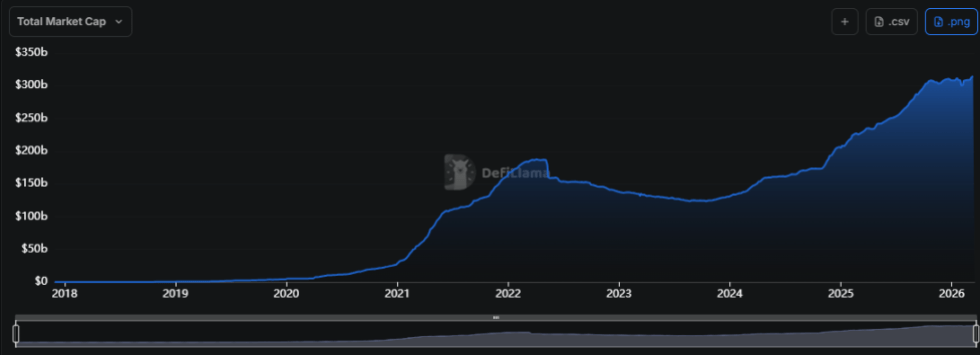
The value of the metric seems to have been moving sideways over the last few months | Source: DefiLlama

From the chart, it’s visible that the stablecoin market cap has seen its growth stall in recent months. However, unlike the rest of the sector, these assets haven’t actually faced any drawdown, at least not yet. As such, stablecoins have still been holding up relatively well in the wider context.

Bitcoin Price

At the time of writing, Bitcoin is trading around $74,700, up nearly 7% over the past week.

Looks like the price of the coin has shot up in the last couple of days | Source: BTCUSDT on TradingView


Related Questions

QWhat company did Mastercard announce the acquisition of, and for how much?

AMastercard announced the acquisition of stablecoins infrastructure firm BVNK for up to $1.8 billion, including $300 million in contingent payments.

QWhy did the previous deal between BVNK and Coinbase not go through?

AThe previous merger deal between BVNK and cryptocurrency exchange Coinbase fell through in November of last year, though the specific reasons were not detailed in the article.

QHow does Mastercard's Chief Product Officer, Jorn Lambert, believe this acquisition will benefit their network?

AJorn Lambert stated that adding on-chain rails to Mastercard's network will support speed and programmability for virtually every type of transaction.

QWhat recent partnership did Visa, another major payments provider, form with BVNK?

AIn January, Visa formed a partnership with BVNK to leverage its expertise to enable stablecoin payments on the Visa Direct platform.

QWhat is the current trend in the stablecoin market cap according to data from DefiLlama?

AAccording to DefiLlama, the stablecoin market cap has seen its growth stall and has been moving sideways in recent months, though it has not faced a significant drawdown.

Related Reads

Agents Take Over Traffic Distribution Power: What Are Tencent, ByteDance, and Alibaba Competing For?

In the race to dominate the AI era's entry point, China's tech giants—Tencent, ByteDance, and Alibaba—are aggressively deploying AI Agents to control the future of traffic distribution. Alibaba is pursuing a dual-track "closed loop + openness" strategy. Its Qianwen app is evolving into a super-Agent integrated across its ecosystem (Taobao, Alipay, etc.) to handle complex tasks like travel planning. Concurrently, it is opening its platform to external brands (Luckin Coffee, KFC) and has launched a B2B Agent platform, "Wukong," targeting enterprise automation. Its other flagship, Quark, aims to be an "AI super search box" for information and tasks. ByteDance is executing an omnipresent "sprawl strategy." Its Doubao app boasts over 300 million monthly active users and is evolving into a default AI entry point for daily life, with plans for paid versions and e-commerce integration. Its core weapon is the Kouzi platform, a visual "AI assembly factory" for developers to build custom Agents. ByteDance is also pushing hardware integration, collaborating on AI phones and developing smart glasses to embed Doubao everywhere. Tencent is playing its long-held "ultimate card" by quietly embedding an AI Agent directly into WeChat. This Agent, accessible via a swipe, can understand user commands and automatically execute tasks by calling upon WeChat's millions of mini-programs (e.g., finding and ordering coffee). This leverages WeChat's unparalleled 1.4-billion-user ecosystem to position the app as an AI-powered "service operating system," a move that could dramatically reshape the competitive landscape. The core battleground is shifting from competing for "user screen time" to competing to be the "default execution layer" for user intent. The business model is evolving from an "attention economy" to an "intent economy," where the Agent that can most efficiently fulfill a user's need gains control over service access and token flow. This represents a fundamental change in how users connect with digital services, making the fight for the Agent入口 (entry point) a pivotal moment for redefining industry leadership in the AI age.

marsbit1h ago

Agents Take Over Traffic Distribution Power: What Are Tencent, ByteDance, and Alibaba Competing For?

marsbit1h ago

Trading

Spot
Futures
活动图片


