Mass Protests Fuel Iran’s Crypto Boom, Shattering $7.8 Billion Mark

bitcoinistPublished on 2026-01-16Last updated on 2026-01-16

Abstract

Iran's on-chain cryptocurrency activity surged to $7.8 billion in 2025, largely driven by mass protests and economic instability. As the rial plummeted amid 40-50% inflation, citizens moved assets from banks to private crypto wallets for safekeeping. Bitcoin withdrawals spiked during brief internet windows amid government blackouts. Chainalysis data reveals that half of the crypto volume involved state-linked actors like the Islamic Revolutionary Guard Corps, while civilians used crypto to preserve savings and bypass traditional finance. The surge reflects crypto's dual role: a shelter for households and a channel for institutional fund movements during unrest.

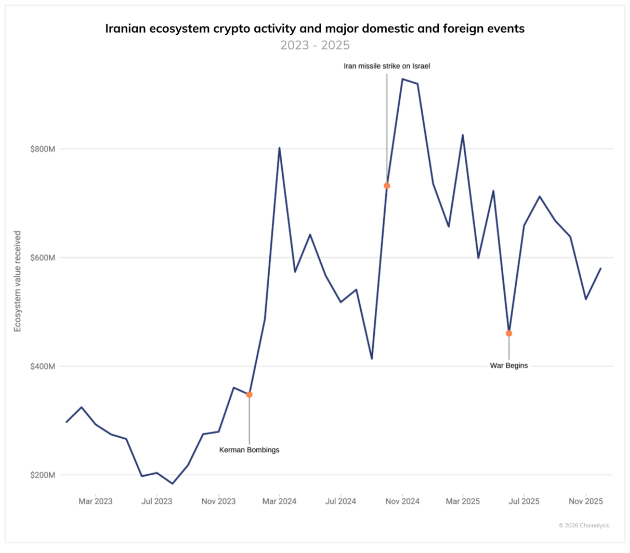
Iran’s on-chain crypto activity surged to about $7.80 billion in 2025, driven in large part by mass protests that began in late December 2025.

According to Chainalysis, the rise reflects both ordinary people moving assets out of banks and state-linked actors shifting funds on blockchain networks.

The shift was sharp and sudden; many withdrawals moved from local exchanges into personal wallets as people looked for ways to safeguard savings.

Iran Protests Push People Toward Bitcoin

Based on reports, Bitcoin withdrawals from Iranian exchanges rose noticeably during the unrest. Some transfers happened in short, intense bursts when internet access was still available.

Many Iranians chose self custody — sending crypto to private wallets rather than keeping it on exchanges — as the rial lost value and access to traditional finance tightened.

Inflation in the country was reported at about 40–50% in recent months, which helped push more households to seek alternatives for storing value.

Source: Chainalysis
State Actors And Civilian Use Diverge

Chainalysis data shows complexity in the flows. Addresses linked to the Islamic Revolutionary Guard Corps were tied to roughly half of the total crypto volume received in Iran during Q4 2025.

That does not mean ordinary use did not rise — it did. But the numbers point to crypto serving different roles at once: it can be a shelter for households when local currency collapses, and it can be a channel for state-linked actors to move funds. Analysts warn that these two uses can mask one another in on-chain tallies.
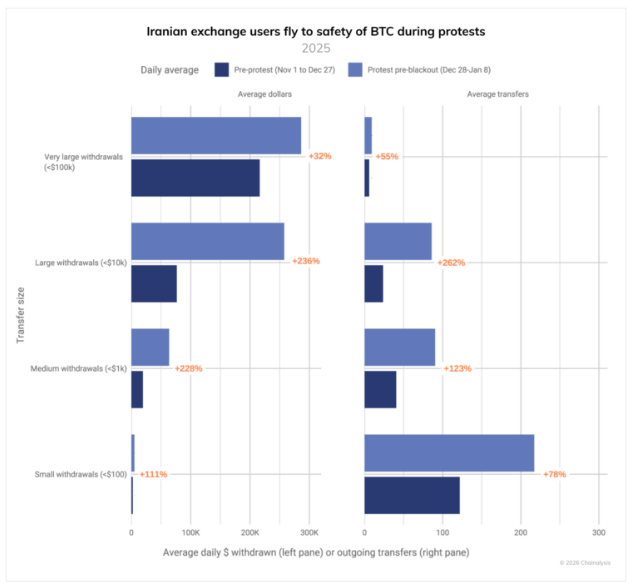
Daily crypto transfers and total transaction volumes have jumped sharply during periods of unrest in Iran.
Source: Chainalysis

Economic Fear Meets Practical Steps

People acted quickly. When banks and payment systems were uncertain or blocked, crypto offered a way to move value across borders without the usual banking rails.

Some transfers were small. Others were larger, tied to families or businesses trying to protect capital. According to the sources, these spikes in activity coincided with other significant occurrences involving geopolitical crises and specific cyber attacks that contributed to the erosion of faith in the local infrastructure.

BTCUSD trading at $95,642 on the 24-hour chart: TradingView

Internet Blackouts Drive Self Custody

The Iranian government has imposed internet blackouts in response to the escalating protests. By controlling the online access, Iranians resorted to the windows of opportunity to transfer money. The transfer of money to private accounts became a common practice during the online windows.

That pattern — brief but intense bursts of withdrawals — shows how people adapt quickly to changing conditions. It also explains why on-chain volume readings jumped so high in 2025.

What The Numbers Suggest

The $7.78 billion number measures on-chain crypto volume tied to Iranian activity over the year, not the market value of holdings inside the country. Based on reports, that figure captures a mix of ordinary transfers, commercial activity, and movements linked to sanctioned entities.

Featured image from Stringer/Via Reuters, chart from TradingView

Related Questions

QWhat was the total value of Iran's on-chain crypto activity in 2025, and what was a primary driver of this surge?

AIran's on-chain crypto activity surged to approximately $7.80 billion in 2025, driven in large part by the mass protests that began in late December of that year.

QAccording to the report, what were the two main types of actors contributing to the increased crypto volume in Iran?

AThe increased crypto volume was driven by both ordinary people moving assets out of banks and state-linked actors, such as the Islamic Revolutionary Guard Corps, shifting funds on blockchain networks.

QHow did internet blackouts imposed by the Iranian government affect how people used cryptocurrency?

ADuring internet blackouts, Iranians resorted to using brief windows of online access to transfer money, leading to intense bursts of withdrawals and a shift towards self-custody in private wallets.

QWhat economic condition in Iran pushed more households to seek cryptocurrency as an alternative?

AHigh inflation, reported at about 40–50% in recent months, eroded the value of the local currency (rial) and pushed more households to seek alternatives like cryptocurrency for storing value.

QWhat does the $7.78 billion figure reported by Chainalysis actually represent?

AThe $7.78 billion figure measures the total on-chain crypto volume tied to Iranian activity over the year, which includes a mix of ordinary transfers, commercial activity, and movements linked to sanctioned entities, not the market value of holdings inside the country.

Related Reads

From Payment to Deployment: Stripe Bets on the AI Agent Economy

From Payments to Deployment: Stripe Bets on the AI Agent Economy Stripe is redefining economic infrastructure for the AI era, shifting its focus from serving primarily human users and software companies to enabling machine agents as active economic participants. The core thesis is that AI agents are evolving from tools into independent buyers and builders on the internet, necessitating a complete overhaul of traditional payment, billing, and deployment models. To empower agents as **buyers**, Stripe, in collaboration with Tempo, developed the Machine Payments Protocol. This protocol allows businesses to programmatically accept payments from agents without human intervention, using machine-readable payment instructions. Furthermore, Stripe's consumer wallet, Link, is being adapted to let users securely authorize agents to spend on their behalf. To empower agents as **builders**, Stripe Projects aims to simplify the deployment process. It allows developers and their agents to register, manage, and integrate the services needed to deploy applications directly from the command line, making "vibe-deploying" as seamless as "vibe-coding." This agent-driven economy, where products have real, variable costs (like AI tokens), disrupts traditional SaaS models. **Token-based monetization** is becoming central, requiring usage-based billing that charges for actual resource consumption, as seen with companies like Lovable and ElevenLabs. However, this model introduces new challenges like **token theft**, where fraudsters exploit services and vanish before billing. Stripe Radar helps combat this by assessing new accounts and predicting abuse risks. A critical innovation to balance customer experience and financial risk is **streaming payments**. By combining Metronome (for real-time usage tracking) with Tempo (for low-cost, high-frequency stablecoin payments), Stripe enables AI companies to collect fees *as tokens are consumed*. This eliminates the trade-off between imposing hard usage caps and risking unpaid invoices. In summary, Stripe's vision for AI economic infrastructure now encompasses providing a commercial framework for agents, wallets for agents, deployment tools for agents, token-based billing, fraud prevention for token abuse, and streaming payment capabilities. As AI transforms both commerce and software creation, Stripe is building the foundational infrastructure to support it.

marsbit1h ago

From Payment to Deployment: Stripe Bets on the AI Agent Economy

marsbit1h ago

Trading

Spot
Futures

Hot Articles

Discussions

Welcome to the HTX Community. Here, you can stay informed about the latest platform developments and gain access to professional market insights. Users' opinions on the price of S (S) are presented below.

活动图片