Launching the License Defense Battle: US Banking Industry Plans to Sue OCC

marsbitPublished on 2026-03-10Last updated on 2026-03-10

Abstract

U.S. banking industry groups, including the Bank Policy Institute (BPI) representing major banks like JPMorgan and Citigroup, are considering legal action against the Office of the Comptroller of the Currency (OCC) to halt the issuance of national trust bank charters to cryptocurrency and fintech firms. The conflict escalated after the OCC approved charters for five crypto-native companies, including Circle and Ripple, in December 2025, followed by 11 applications within 83 days. Opponents, such as the Conference of State Bank Supervisors (CSBS) and Independent Community Bankers of America (ICBA), argue the OCC is creating a "Frankenstein charter" that allows unfair competition with lower regulatory standards. The legal dispute centers on Interpretive Letter 1176 (2021), which expanded trust charter permissions without formal rulemaking under the Administrative Procedure Act (APA). OCC Acting Comptroller Jonathan Gould defends the move, stating stablecoin services fall within traditional trust activities. The broader conflict reflects a struggle over financial system access, with crypto firms seeking federal legitimacy and banks warning of regulatory arbitrage. Potential lawsuits could mark the most significant banking legal battle since 2020.

Original Author: ChandlerZ, Foresight News

According to a report by The Guardian on March 9, the Bank Policy Institute (BPI), an industry group representing 40 major US banks including JPMorgan Chase, Goldman Sachs, and Citigroup, is seriously considering suing the Office of the Comptroller of the Currency (OCC) to prevent the latter from granting US bank trust charters to cryptocurrency companies and fintech startups. If the lawsuit proceeds, the conflict between traditional banking and the crypto industry over financial access rights will officially escalate into a legal confrontation.

83 Days, 11 Companies, a Race for Licenses

The trigger for the incident dates back to December 2025. That month, the OCC conditionally approved trust bank charters for five crypto-native companies at once, including Circle, Ripple, BitGo, Paxos, and Fidelity Digital Assets. This was the first time a federal regulator had issued such charters in bulk to crypto companies.

An application wave quickly followed. According to FinTech Weekly, within 83 days, 11 companies submitted applications for trust bank charters. The list included crypto and fintech companies such as Crypto.com, Bridge (Stripe's stablecoin subsidiary), and Zerohash, as well as traditional financial giants like Morgan Stanley. In February 2026, Crypto.com received conditional approval, just about four months after submitting its application.

More controversially, World Liberty Financial, a crypto company linked to the Trump family, also submitted a similar charter application in January of this year, planning to establish World Liberty Trust Company to directly issue its USD1 stablecoin. Senator Elizabeth Warren had pressured the OCC to suspend the approval process due to concerns about foreign ownership and conflicts of interest in the application, but OCC Comptroller Jonathan Gould refused.

Opposition Camp Continues to Grow

BPI is not the only voice of opposition. Currently, a multi-tiered alliance of opposition has formed around the OCC's policy.

The Conference of State Bank Supervisors (CSBS), which represents regulators from all 50 states, has taken a hardline stance. Its chairman, Brandon Milhorn, publicly stated that the OCC is cobbling together a "Franken-charter," transforming a narrowly defined charter originally intended for fiduciary management into a backdoor to full banking services. He also explicitly mentioned that "litigation is certainly a possibility," and if the OCC's charter expansion exceeds the boundaries of the National Bank Act, states will consider administrative actions and legal measures.

The Independent Community Bankers of America (ICBA), representing 5,000 community banks, also expressed opposition, arguing that these new charter holders will compete directly with traditional banks under a more relaxed regulatory framework, creating an unfair market environment.

The American Bankers Association (ABA) directly requested the OCC to suspend the approval process.

BPI CEO Greg Baer believes that trust banks do not need to meet the same regulatory and capital standards as federally insured full-service banks, and the trust charters approved by the OCC have far exceeded the statutory and historical use of trust bank charters.

Focus of Legal Dispute: An Interpretive Letter

The legal core of this conflict points to Interpretive Letter 1176 issued by the OCC in 2021. This letter redefined the business scope of trust banks, effectively lowering the threshold for crypto companies and fintech companies to obtain charters.

It is worth noting that the drafter of this letter was Jonathan Gould, then the OCC's Chief Counsel, who is now responsible for enforcing this rule as the OCC Comptroller. On February 27, 2026, the OCC further submitted a rule revision, changing the wording in the charter provisions from "fiduciary activities" to "trust company operations and related activities." This revision is scheduled to take effect on April 1. Critics argue that this wording change will further blur the business boundaries of trust banks.

The legal arguments of BPI and other institutions focus on the fact that the OCC has substantively changed the charter rules through the interpretive letter and wording revisions, bypassing the formal rulemaking procedures required by the Administrative Procedure Act (APA), including public comment periods. If litigation is initiated, this procedural flaw will be the main point of attack for the plaintiffs.

Gould, on the other hand, argues that trust companies have long provided both fiduciary and non-fiduciary custody services, stablecoin reserves constitute a narrow, segregated, non-credit-creating business, and the law requires the OCC Comptroller to approve all applicants who meet the statutory conditions, regardless of the technology they employ.

Behind the Charter Battle: Who Gets Access to the US Financial System?

On the surface, this dispute is about the approval standards for a single charter. At a deeper level, the core issue of the博弈 (game/struggle) is who has the right to enter the US financial system, and by what standards.

Traditional banking worries about regulatory arbitrage: crypto companies and fintech firms can operate in all 50 states through a single trust charter, providing payment, custody, stablecoin issuance, and other services, without bearing the same capital requirements, consumer protection obligations, and deposit insurance costs as full-service banks.

The logic of the crypto industry is equally clear: obtaining a unified compliance identity at the federal level is a key step towards mainstream adoption for the industry. If the OCC's charter pathway is closed, crypto companies will once again face the high compliance costs of applying state-by-state and a fragmented regulatory landscape.

Currently, BPI has not officially filed a lawsuit, but according to informed sources, its legal team is already preparing. The CSBS also retains the option of litigation. If one or both parties take action in the coming months, this will become the most significant legal confrontation in US banking regulation since the CSBS sued the OCC in 2020 to block fintech charters.

The OCC's response window, the rule revision set to take effect on April 1, and the subsequent handling of controversial applications like World Liberty Financial's will be the most critical nodes to watch.


Related Questions

QWhat is the main reason the Bank Policy Institute (BPI) is considering suing the OCC?

AThe BPI is considering suing the OCC to prevent it from granting national trust charters to cryptocurrency companies and fintech startups, arguing that these charters exceed their traditional legal and historical use and create an unfair competitive advantage due to lighter regulatory requirements.

QWhich companies were among the first five crypto-native firms to receive conditional approval for a trust bank charter from the OCC in December 2025?

AThe five crypto-native companies that received conditional approval for trust bank charters in December 2025 were Circle, Ripple, BitGo, Paxos, and Fidelity Digital Assets.

QWhat is the legal core of the conflict between the OCC and its opponents, according to the article?

AThe legal core of the conflict is OCC's Interpretive Letter 1176 from 2021, which redefined the business scope of trust banks and substantially lowered the threshold for crypto and fintech companies to obtain charters. Critics argue the OCC bypassed the formal rulemaking process required by the Administrative Procedure Act (APA).

QWhich major banking industry groups have expressed strong opposition to the OCC's charter approvals besides the BPI?

ABesides the BPI, major opponents include the Conference of State Bank Supervisors (CSBS), the Independent Community Bankers of America (ICBA), and the American Bankers Association (ABA).

QWhat is the underlying issue at stake in the 'charter battle' beyond the specific licensing standards?

AThe deeper issue is about who has the right to access the U.S. financial system and on what standards. It's a conflict between traditional banks fearing regulatory arbitrage and crypto/fintech firms seeking a unified federal compliance identity to mainstream their operations and avoid a patchwork of state-level regulations.

Related Reads

Wall Street's Most Famous 'Cassandra' Now Has His Sights Set on Nvidia

Michael Burry, the famed "Big Short" investor, has once again captured Wall Street's attention with a series of short positions against major tech and semiconductor stocks, most notably Nvidia. In late June and July, through his "Cassandra Unchained" newsletter, Burry disclosed short bets against Nvidia, Tesla, Applied Materials, Caterpillar, the SOXX semiconductor ETF, and later, Micron Technology. His core thesis revolves around potential distortions in the AI infrastructure boom, specifically questioning whether extended depreciation schedules (e.g., 6 years vs. a realistic 2-3 years for AI chips) by cloud giants like Microsoft and Google artificially inflate profits. He also raises concerns about possible "off-balance-sheet circular financing," where chip demand might be propped up by vendor-backed funding to clients. Nvidia's stock experienced volatility following these disclosures, briefly dipping but largely holding near Burry's reported entry points, leaving his positions roughly flat or slightly underwater as of late July. This move is part of a pattern for Burry, whose track record since his legendary 2008 bet is mixed. He has faced notable losses, such as on Tesla in 2021, while scoring on broader market turns like the 2020 pandemic crash. His methodology focuses intensely on free cash flow and scrutinizing original financial documents to spot overvaluation and structural risks, but it often struggles with timing the market. The article contrasts Burry's stance with other prominent investors. Steve Eisman, another "Big Short" figure, is not shorting Nvidia, citing strong fundamentals but expressing nervousness about sustainability. Jim Chanos agrees with the broad "accounting mismatch" concern—comparing it to the dot-com bubble—but targets financial leverage in private equity firms rather than the chip stocks themselves. While Nvidia's short interest remains relatively low at 1.3-1.4% of float, the massive stock size means absolute short losses have been significant, exceeding $5 billion earlier this year. The piece concludes that for ordinary investors, the key takeaway is not replicating specific short bets but learning from the critical frameworks these investors use: questioning rosy accounting, identifying structural vulnerabilities, and maintaining skepticism during market euphoria, even if pinpointing the exact catalyst for a downturn remains elusive.

marsbit22m ago

Wall Street's Most Famous 'Cassandra' Now Has His Sights Set on Nvidia

marsbit22m ago

Weekly Selection丨Epic Stock Market Volatility, Changxin Tech's IPO Reshapes Storage Landscape, Saylor Aims to Re-Anchor STRC Around September 8th

PANews Weekly Digest: Market Turmoil, Tech Breakthroughs, and Crypto Developments. The week saw significant volatility across global markets. South Korea's KOSPI index experienced extreme turbulence, including multiple trading halts, largely driven by sharp declines in AI hardware stocks like SK Hynix. In contrast, China's Changxin Xinqiao (CXC) achieved a landmark IPO with a market cap surpassing 4 trillion yuan, marking a major success for the domestic DRAM industry after a decade of losses. In the crypto and Web3 space, several key narratives emerged. AI is driving demand for new infrastructure, with projects like AI agent wallets and programmable payments gaining traction, attracting interest from firms like Coinbase. The Bitcoin mining sector is pivoting, with companies like MARA focusing on energy management as electricity becomes a core AI-era asset. Meanwhile, the RWA (Real World Assets) sector faces a "utilization puzzle," with hundreds of billions in on-chain assets remaining dormant. Notable market movements included a historic single-day surge of over 17% for the KOSPI index and a significant migration of $16.5 billion in staked ETH within the Lido ecosystem. Michael Saylor announced a target to re-peg the STRC stablecoin around September 8th. Other highlights include discussions on Ethereum's ambitious 2030 roadmap for scaling and privacy, analysis showing high protocol revenues not always translating to token price gains, and warnings from Citi about potential extreme commodity price shocks by late 2026.

marsbit27m ago

Weekly Selection丨Epic Stock Market Volatility, Changxin Tech's IPO Reshapes Storage Landscape, Saylor Aims to Re-Anchor STRC Around September 8th

marsbit27m ago

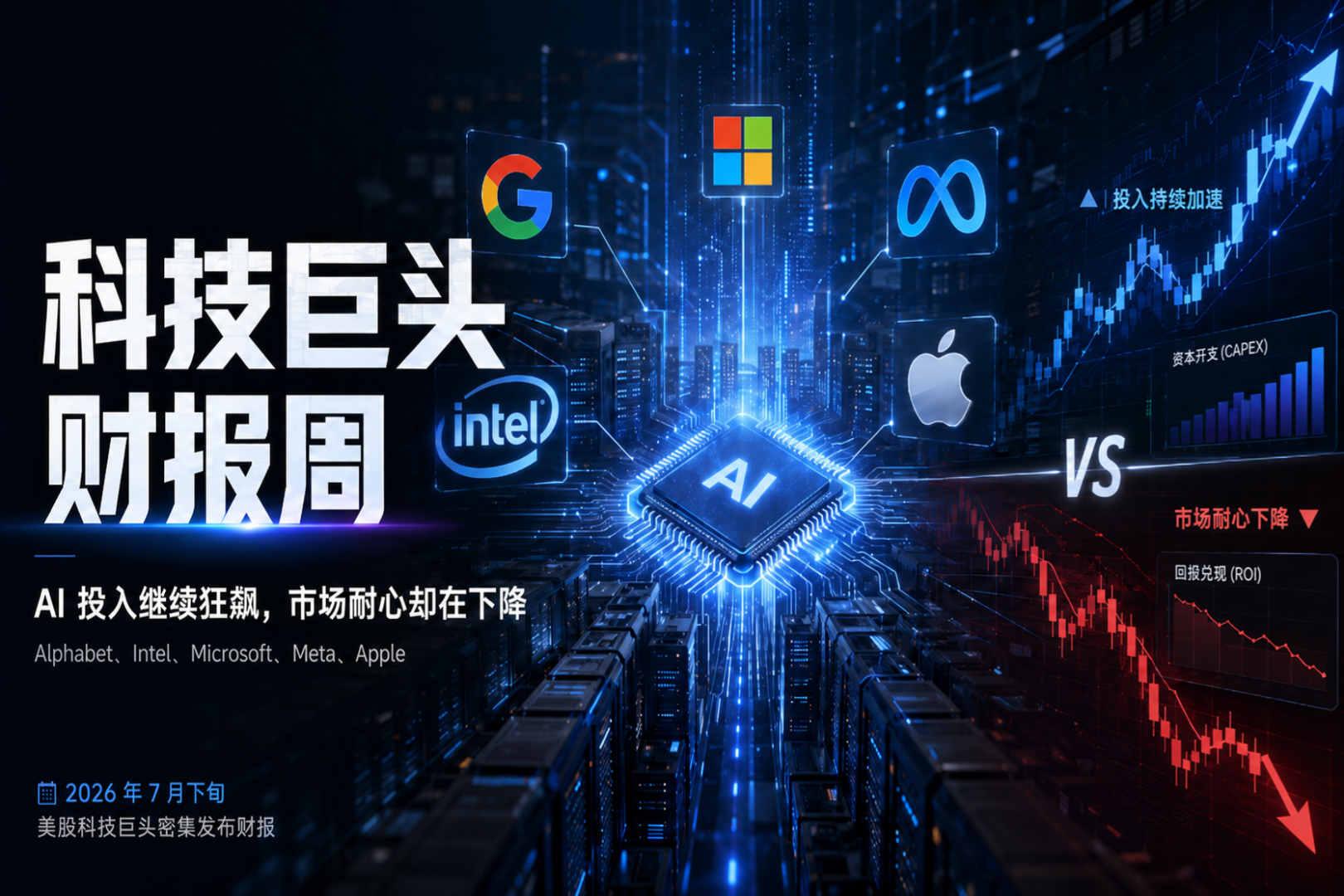
When the Market Begins to Question AI Capex: A Full Analysis of Q2 Earnings Reports from Five Tech Giants

In late July 2026, five major US tech giants—Alphabet, Intel, Microsoft, Meta, and Apple—released their Q2 earnings reports. While all companies exceeded revenue and profit expectations, driven by strong AI-related business growth, investor reactions diverged sharply due to concerns over escalating AI capital expenditures (capex) and their impact on free cash flow. Alphabet reported strong revenue growth and a surging cloud business, but its stock fell after announcing a doubled year-on-year capex and negative quarterly free cash flow for the first time. Intel posted its strongest revenue growth in over 15 years, but its stock experienced volatile trading after significantly raising its full-year capex guidance. Microsoft saw its stock surge after beating estimates and, crucially, lowering its capex forecast while projecting positive free cash flow. Meta faced the most severe sell-off as its profits declined despite revenue beats, with free cash flow plunging over 90% and its capex guidance raised. Apple reported record June-quarter results, but its stock plummeted after providing Q4 revenue guidance that fell short of expectations, citing supply chain constraints and forex headwinds. The overall takeaway is that the market's focus has shifted from validating AI demand to scrutinizing the timeline for returns on massive AI investments. Companies demonstrating a clearer path to managing capex and preserving free cash flow, like Microsoft, were rewarded, while those signaling continued aggressive spending faced investor skepticism.

Odaily星球日报36m ago

When the Market Begins to Question AI Capex: A Full Analysis of Q2 Earnings Reports from Five Tech Giants

Odaily星球日报36m ago

a16z: From Companies to DAOs, DUNA May Become the Next Generation Organizational Form

This article, "From Companies to DAOs: How DUNA Could Become the Next Organizational Form," traces the 500-year evolution of business collaboration. It begins with medieval structures like the *commenda* and Florentine *compagnia*, which exposed partners to personal risk. The modern corporation, exemplified by the Dutch East India Company (VOC), was a revolutionary leap, enabling large-scale, capital-intensive ventures by offering limited liability and reducing coordination costs. However, corporations introduced new challenges like principal-agent problems and bureaucratic overhead. The piece argues that software and internet-native protocols are now reducing these traditional overheads. Decentralized Autonomous Organizations (DAOs) emerged as a new model for coordination without centralized management. Yet, DAOs face a significant legal vacuum: they lack legal recognition, leaving members exposed to unlimited personal liability, and their tokens are vulnerable to being classified as securities under unclear regulations (e.g., the Howey Test). This has forced projects into suboptimal workarounds like offshore foundations. The article identifies the Decentralized Unincorporated Nonprofit Association (DUNA) as a potential solution. Recently legalized in states like Wyoming, the DUNA provides a legal wrapper for decentralized networks. It grants key protections—legal personality, limited liability, and perpetual existence—to a group without imposing a traditional hierarchical management structure. This allows token-holder communities to govern, hold assets, and contract as a single legal entity, aligning with their decentralized nature. While DUNA doesn't solve all governance challenges or magically resolve securities law questions, it represents a crucial step. It fills the legal recognition gap, offering a native legal form for internet-scale, decentralized collaboration and extending the separation of personal risk from organizational venture into a new domain.

marsbit1h ago

a16z: From Companies to DAOs, DUNA May Become the Next Generation Organizational Form

marsbit1h ago

2026 Mid-Year Report On-Chain RWA: Tokenized Stock Market Cap Doubles in a Year, But 90% of Rights Are Hollow Shells

The 2026 Mid-Year Report on On-Chain RWA highlights a significant growth in tokenized stock market capitalization, which nearly doubled from $951 million in March to $1.89 billion by July. However, the report reveals a fundamental contradiction in this "layer 2.5" ecosystem: products with the strongest legal foundation (like regulated U.S. infrastructure) lack liquidity and distribution, while freely tradable offshored wrapper products often lack substantive ownership rights. The increase is driven largely by a few products (SECZ, FGRS, STRCx) and platforms (Ondo, xStocks, Securitize collectively hold over 85% share). While distributed value across networks like Ethereum, Solana, and BNB Chain has grown, the market remains fragmented. Products referencing the same underlying asset (e.g., Apple stock) are distinct legal liabilities with different intermediaries and jurisdictional rules, offering varying degrees of legal claim. The report cautions that headline numbers are misleading, as they reflect changes in distributed token value—driven by issuance, conversions, and price movements—not pure investor inflows. True "canonical shares" with legal ownership, wide wallet distribution, institutional liquidity, and independent on-chain price discovery do not yet exist at scale. Tokenized treasuries show stronger product-market fit, and ETFs may be easier to scale than single stocks. The core takeaway is a trade-off: legal certainty versus liquidity and composability.

marsbit2h ago

2026 Mid-Year Report On-Chain RWA: Tokenized Stock Market Cap Doubles in a Year, But 90% of Rights Are Hollow Shells

marsbit2h ago

Trading

Spot
活动图片