The South Korean KOSPI index experienced its eighth volatility limit halt in 2026, losing an additional 8%. The index is being closely watched for signals to analyze the situation in the artificial intelligence and semiconductor sectors.
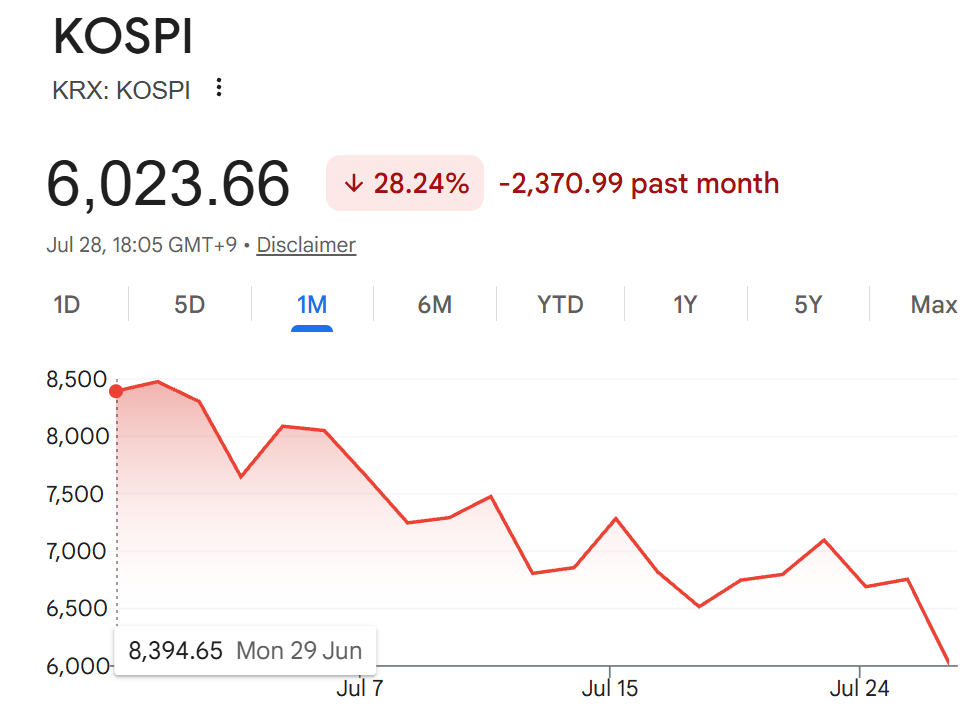
The South Korean KOSPI index hit a critical mark for the eighth time this year. The index plunged alongside other markets. The KOSPI's slump this year continued, coinciding with overall market weakness.
The KOSPI index lost 520 billion Korean won, or approximately 360 billion US dollars. Furthermore, some South Korean stocks were used as collateral, which could lead to further potential losses as leverage is unwound. During the market crash on July 9th, some considered this drop the last for KOSPI, but the index continued to decline, falling over 20% in recent weeks.
In addition, the SK Hynix index fell 50% from its June high due to weakness in the memory maker stock sector. Shares of many memory makers fell following the IPO of Changxin Memory Technology (CMXT) on Monday.
The South Korean market reacted to the reduction in shares of American chipmakers and a 4.4% drop in Nvidia (Nasdaq: NVDA) stock. Shares of Micron (Nasdaq: MU) and SanDisk (Nasdaq: SNDK) were also among the biggest decliners, falling 5% and 10% respectively.
Asian markets followed, with the Nikkei index falling 4%. At the same time, $BTC also broke out of its new price range and fell to $63,000.
Why Did the KOSPI Index Fall?
In 2026, the KOSPI index has exhibited extreme volatility, driven by both retail trading and the influence of semiconductor company stocks. As Cryptopolitan reported, just before the crash, KOSPI showed signs of recovery and closed in positive territory.
However, the recovery in AI and chipmaker stocks proved fragile. The cause of the fall was recent news that Nvidia supported OpenAI, allocating $250 billion to finance a new data center. Nvidia will also allocate $350 billion to purchase OpenAI's own chips, and the market has already priced in the "cyclical financing" of the AI economy.
These financial deals are leading to an increase in borrowing costs, calling into question the viability of AI scaling.
With Samsung accounting for 50% of the KOSPI index, the drop was rapid, leading to liquidations and the triggering of the automatic circuit breaker.
What Does the KOSPI Index Mean for the Cryptocurrency Market?
As of 2026, $BTC has lost its correlation with AI and chip development company stocks and has significantly lagged the trend. The KOSPI index crash may return some liquidity to the cryptocurrency market if the arguments for AI weaken.
The increased volatility of KOSPI is also not a problem for crypto traders. Blockchain-based exchanges have already taken up this challenge. Dextera Labs mentioned the possibility of launching a KOSPI-based perpetual futures market, potentially allowing bets on other dramaticmatic . A futures market for KOSPI could allow traders to speculate on a potential "short squeeze" or further decline.
Trading KOSPI via blockchain would be viable due totron directional movements of the index. Currently, the market is still awaiting the completion of the leverage unwinding process. Now KOSPI is also awaiting signals on whether a liquidity outflow will occur or simply a re-rating of risks in AI and memory company stocks.
Speculation on KOSPI has also crowded out token and altcoin trading, which remained popular among retail traders in South Korea.
end-content