Korean Stock Market Crashes, Are Koreans Rushing into Crypto Again? This Project Team Got Slammed...

比推Published on 2026-03-05Last updated on 2026-03-05

Abstract

Amid a significant downturn in the South Korean stock market, there is growing discussion about Korean retail investors shifting heavily into cryptocurrency as an alternative. Observers note that Koreans have a strong cultural tendency toward leverage and speculative investment, which may be driving renewed interest in crypto assets like Bitcoin, seen as a potential safe haven during economic instability. Bitcoin’s price recovery and increased institutional buying are also highlighted, with price targets such as $87,000 and even $100,000 being discussed. Some attribute Bitcoin’s strength to its perceived reliability during times of geopolitical tension. Additionally, former U.S. President Donald Trump is mentioned as pushing for clearer cryptocurrency regulation, which could bring more certainty to the market—though some express skepticism about his motives. The article also covers controversy around the project "Opinion" on the BSC chain, which has drawn criticism for its handling of user rewards and airdrops, leading to broader discussions about the sustainability of airdrop models and the need for genuine user engagement rather than speculative farming. The content is compiled from social media platforms and does not constitute investment advice.

Hello dear readers~

What were the crypto KOLs talking about in the past 24 hours?

Note: The following content is compiled from the X platform and represents personal opinions. It does not represent the stance of this platform and certainly does not constitute investment advice.

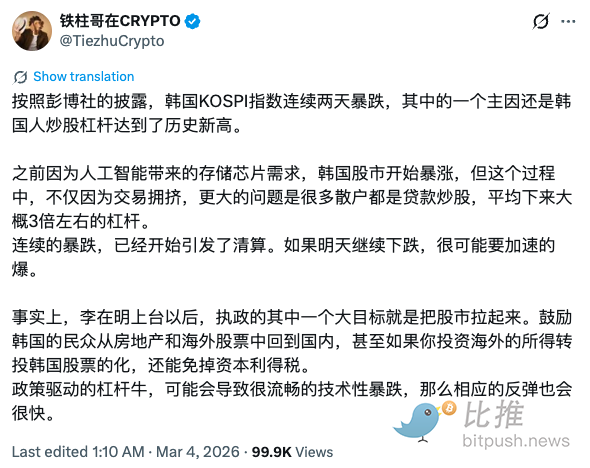
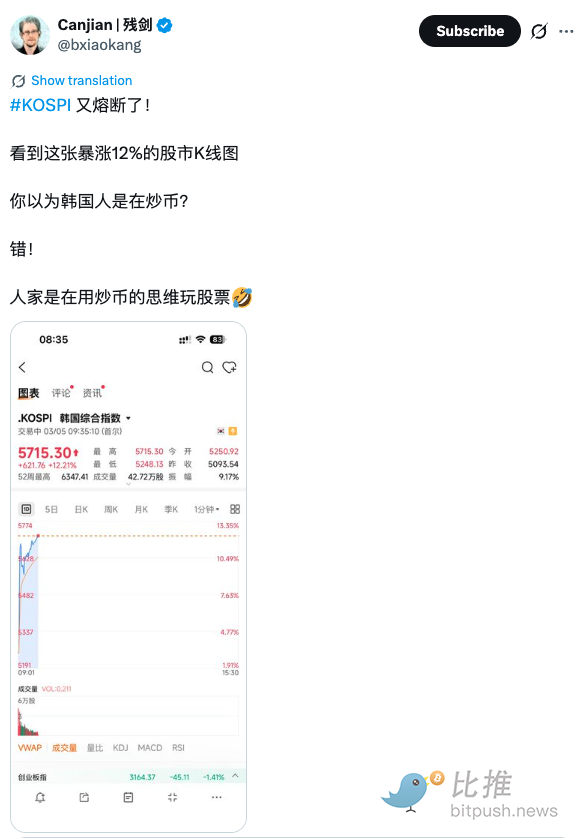
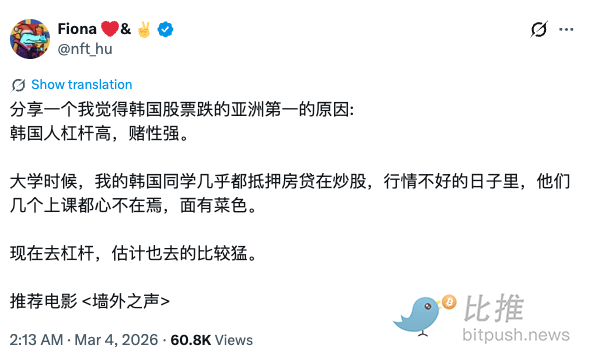
Koreans' Love for Leverage is in Their DNA
Popular Replies:

Koreans' love for leverage is in their DNA. The stock market crashes, the crypto market picks up the slack.

Addicted to gambling. Koreans' speculative nature is number one in Asia.

South Korea's household debt level has always been high. The impact of the past few major deleveraging operations has been very significant.

This wave of Korean Won depreciation + stock market爆仓 (liquidation), BTC's safe-haven属性 (attribute) has been verified again, Koreans are rushing in.

Koreans should already be on their way, Upbit trading volume is about to explode, right?

FOMO indiscriminately, classic Korean retail investor style.

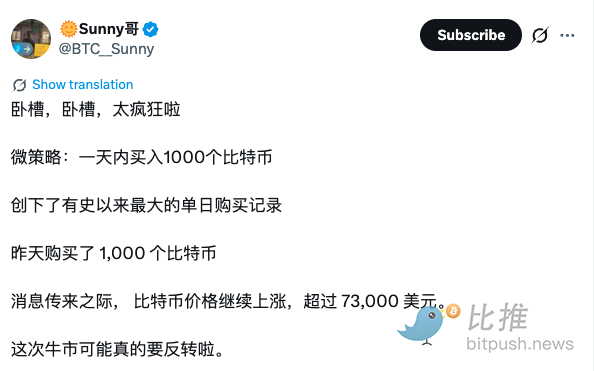
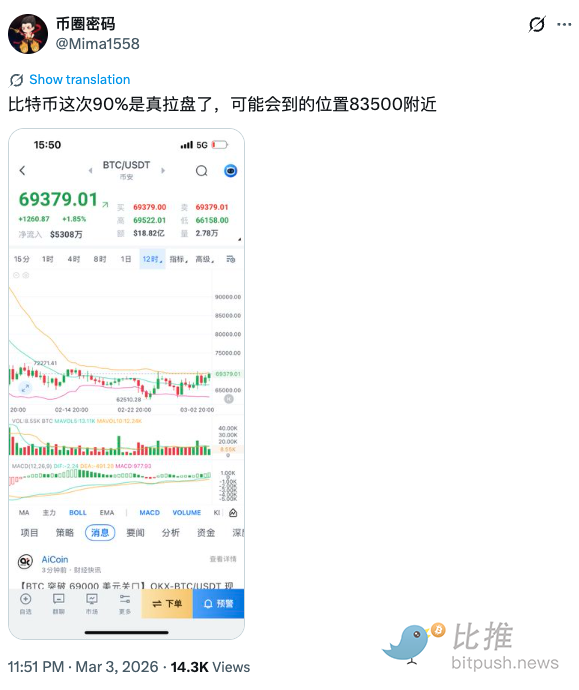
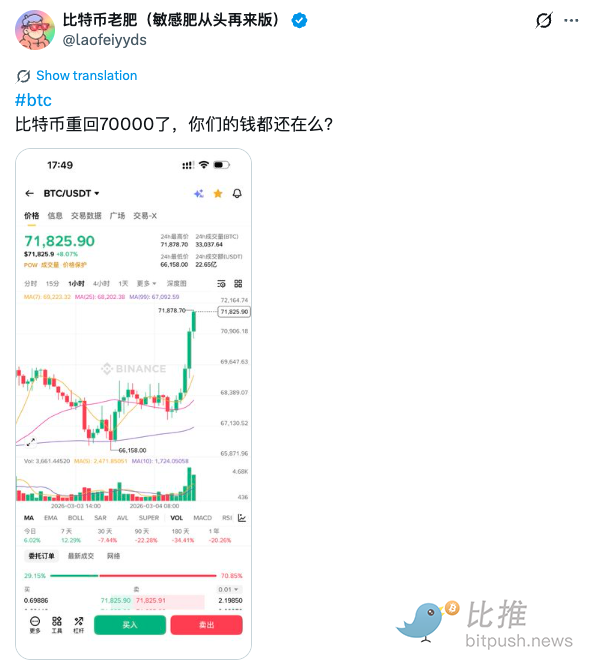
BTC Price Rebounds, Institutions Buying
Popular Replies:

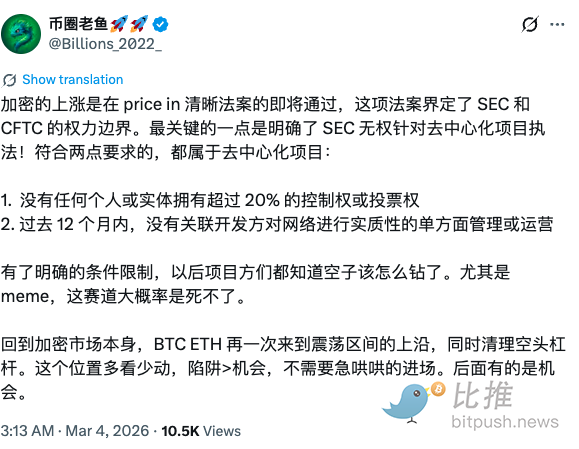
71000—78000—87000, these are all key points if it rallies.

First break 73500, if that happens, next is 83300.

Money in, people in, target $100k,绝对不提前下车 (absolutely not getting off early this time)!

War has made people understand that Bitcoin is reliable.

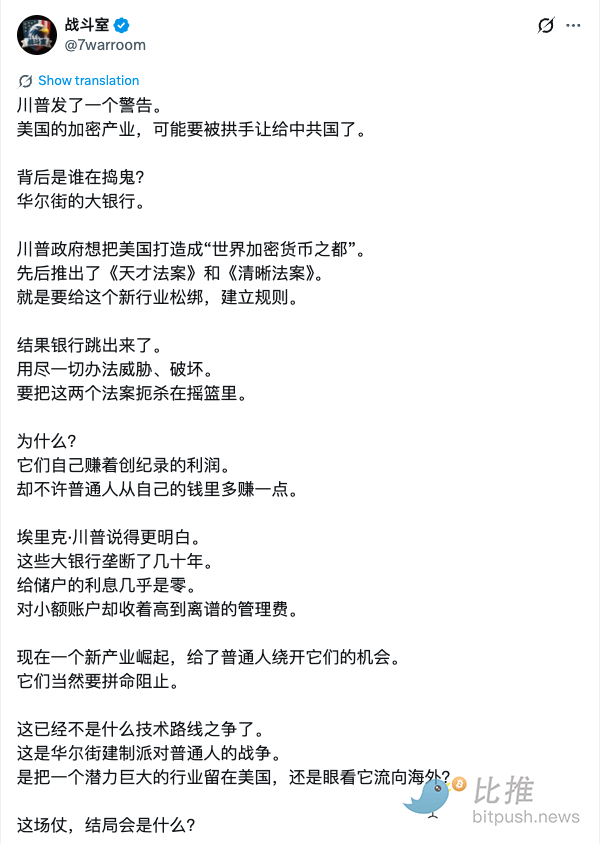
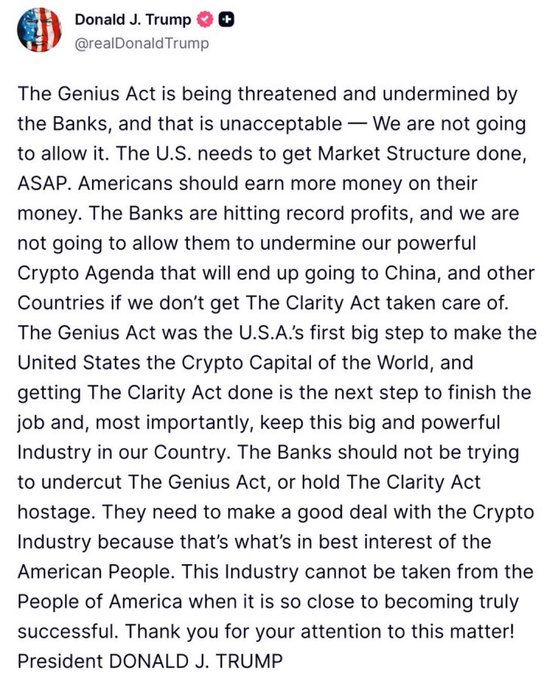
Trump Personally Pushing Crypto Bill!

Popular Replies:

If a clear bill isn't pushed forward, the market might徘徊 (linger) for a long time again. The crypto industry is actually welcoming the most friendly president now. If it's not pushed during Trump's term, there's a high probability of getting beaten up again later.

Feels like Trump's tweet means the talks broke down, seems like a negative?

不会是缺军费,再来收割一波把? (Could it be lacking military funds, coming to harvest another wave?)

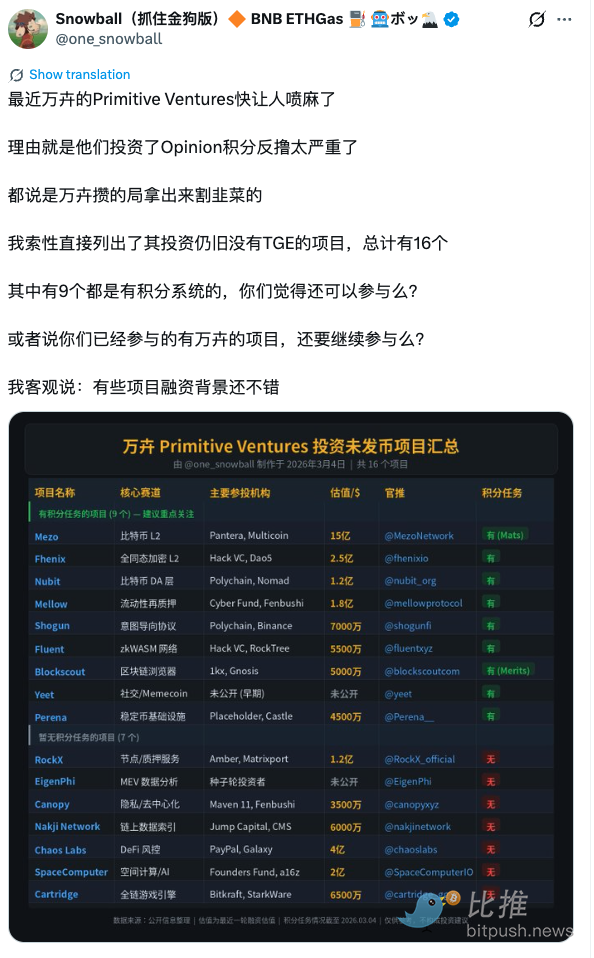
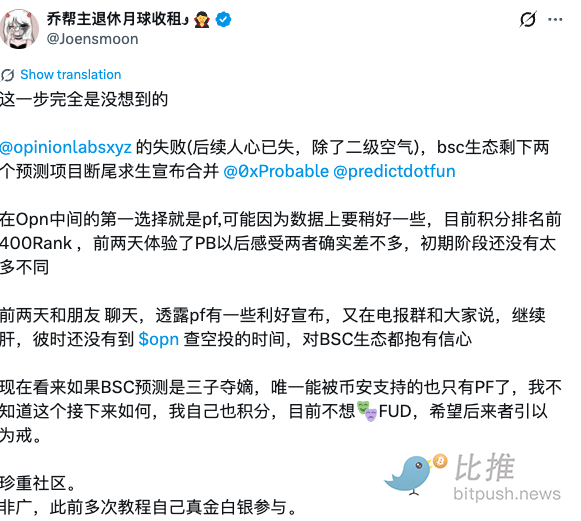
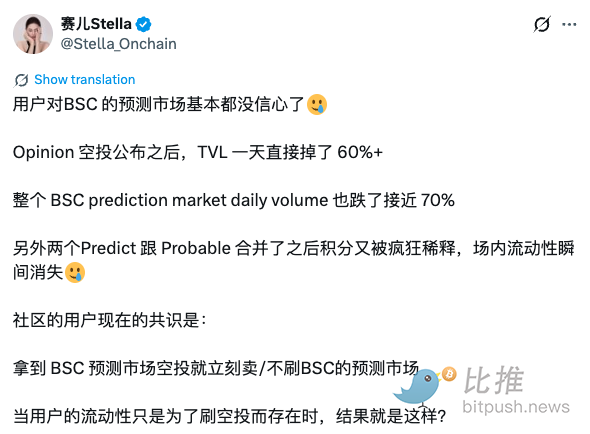
Opinion Controversy

Popular Replies:

Opinion ruined the prediction track on BSC, who dares to touch BNB Chain prediction projects in the future;

Learn from River, they compensated for二级 (secondary market) losses, Opinion directly反撸 (screwed people over);

I actually think there's no need to骂 (curse) the investment institutions:

  1. These were all the project's decisions

  2. Couldn't get on bn without前期数据 (early data)

  3. Tokens given out were basically picked up by the secondary market, no one is picking them up now

  4. The logic of airdrops has changed, those bringing data without real cash flow will be淘汰 (eliminated), and no one will use them either

  5. The farming era has ended, what's next is real payment for tokens


Twitter:https://twitter.com/BitpushNewsCN

Bitpush TG Discussion Group:https://t.me/BitPushCommunity

Bitpush TG Subscription: https://t.me/bitpush

Original article link:https://www.bitpush.news/articles/7616877

Related Questions

QWhat is the main reason discussed in the article for Koreans turning to the cryptocurrency market?

AThe article suggests that Koreans are turning to the cryptocurrency market as a safe haven after the Korean stock market crash, leveraging their inherent tendency for high-risk investments and speculation.

QHow did the community react to the Opinion project mentioned in the article?

AThe community criticized the Opinion project for mismanaging the BSC prediction track, accusing it of exploiting users without compensation, unlike other projects that offered reimbursements for losses.

QWhat role is former President Trump playing in the cryptocurrency space according to the article?

AThe article states that former President Trump is personally advancing cryptocurrency legislation, which is seen as a positive development for the industry, though some speculate it might be a tactic to raise funds.

QWhat are the key Bitcoin price levels mentioned by traders in the article?

ATraders identified key Bitcoin price levels at $71,000, $78,000, and $87,000, with $73,500 and $83,300 being critical resistance points to watch for further gains.

QWhat is the article's perspective on the changing dynamics of airdrops and token distribution?

AThe article notes that the era of meaningless airdrops is ending, and future token distributions will require genuine user engagement and financial contributions, rather than just data farming.

Related Reads

Vitalik's Vision for the Next Evolution of On-Chain Finance: How to Reconstruct DeFi with an 'Options Mindset'?

Vitalik Buterin recently proposed a conceptual shift for DeFi: replacing traditional Collateralized Debt Positions (CDPs) and forced liquidations with an options-based mechanism. This aims to address key vulnerabilities in current DeFi lending. The traditional CDP model, foundational to protocols like MakerDAO and Aave, allows users to borrow against collateral but relies on real-time oracles and triggers sudden, mandatory liquidations during price volatility. This can cause cascading sell-offs, oracle manipulation risks, and significant MEV extraction, exacerbating market stress. Vitalik's alternative envisions splitting an asset like 1 ETH into two complementary components: one offering stable/index-like exposure and the other absorbing the opposite risk/reward. Instead of a hard liquidation threshold, a user's exposure to the target asset would gradually and smoothly deviate (following a near-quadratic curve) as the collateral price moves. The system would primarily depend on "slow oracles" for periodic settlement rather than instant price feeds. Key potential benefits include: the elimination of abrupt, forced liquidations; drastically reduced reliance on vulnerable real-time oracles; and inherent resistance to certain MEV exploits centered on liquidation auctions. The article posits that for Ethereum DeFi to maintain its relevance amid competition from faster, cheaper chains, it must compete on sophisticated financial engineering and robustness—not just transaction speed or yields. The core value proposition should shift towards offering users clearer, more manageable risk structures, greater autonomy, and resilience in extreme scenarios, moving DeFi from high-risk experimentation towards becoming reliable financial infrastructure.

marsbit30m ago

Vitalik's Vision for the Next Evolution of On-Chain Finance: How to Reconstruct DeFi with an 'Options Mindset'?

marsbit30m ago

AI Agent Completely Transforms Web3 Gaming: From the Rugpull Bakery Bot Controversy to the New 2026 Agent Paradigm

This article explores how the AI Agent paradigm is fundamentally transforming Web3 gaming, moving from a disruptive force to a core, legitimized element. It begins with the controversy in the competitive baking game Rugpull Bakery, where automated scripts caused fairness issues. Instead of banning them, the developers integrated AI Agents into the official gameplay by providing technical documentation (skill.md, agent.json), marking a shift towards "Agentic Gaming." The piece outlines three primary implementation models for AI Agents in Web3 games by 2026: 1. **Autonomous Competitors & Economic Entities:** AI Agents act as independent players with unique strategies. Examples include TEN Protocol's poker agents, AI Arena's trainable NFT fighters, and Satoshi Strike Force's "Digital Athletes" trained on player data. The Somnia blockchain is highlighted as a dedicated "Agentic L1" infrastructure supporting this model at scale. 2. **Modular Infrastructure & Programmable Environments:** This model, exemplified by EVE Frontier, allows AI Agents to program game world logic itself. Using "Smart Assemblies" (e.g., Smart Turrets, Smart Gates), Agents can modify shared economic and physical rules on-chain, creating dynamic, player/AI-built worlds. The ERC-8183 standard further enables these automated entities to hire other AI services for complex tasks. 3. **Hybrid Companions & Dynamic Adaptation:** Here, AI serves as a collaborative partner. In Parallel Colony, highly autonomous AI Avatars work alongside human players who provide high-level guidance. Illuvium plans to use AI to make NPCs dynamic and responsive, creating personalized, emergent narratives for each player. The conclusion posits that Web3 gaming has reached a "post-human" inflection point. Blockchains' transparency and programmability, combined with new standards and infrastructure like Somnia, make integrating and governing AI Agents not just viable but essential. The future lies in a symbiotic digital order where players transition from manual laborers to commanders and partners of algorithmic intelligence.

marsbit1h ago

AI Agent Completely Transforms Web3 Gaming: From the Rugpull Bakery Bot Controversy to the New 2026 Agent Paradigm

marsbit1h ago

Trading

Spot
Futures
活动图片