Judge Halts Pentagon's Retaliation Against Anthropic | Rewire News Evening Edition

marsbitPublished on 2026-03-27Last updated on 2026-03-27

Abstract

Federal Judge Rita Lin blocked the Pentagon from labeling Anthropic as a "supply chain risk," calling the rationale "Orwellian." The decision came after Anthropic refused to use its Claude AI for autonomous weapons and domestic surveillance. On the same day, Anthropic's new model "Mythos" was accidentally exposed, and the company is reportedly planning an IPO with a $380 billion valuation. In other news, Huawei's new AI chip Ascend 950PR received orders from ByteDance and Alibaba, with performance reportedly doubling Nvidia's H20. Meanwhile, Reuters revealed that SMIC provided chipmaking equipment to Iran's military. The Pentagon is considering deploying 10,000 additional troops to the Middle East, while Trump extended the deadline for striking Iranian energy facilities and appointed JD Vance as chief negotiator with Iran. OpenAI's ChatGPT advertising pilot reached a $100 million annualized run rate in six weeks, but the company is losing enterprise market share to Anthropic. Additional developments include Meta increasing its Texas AI data center investment to $10 billion, Moonshot AI seeking a Hong Kong IPO, and Tether hiring KPMG for a USDT reserve audit.

A federal judge used the term "Orwellian" to block the Pentagon's supply chain risk designation for Anthropic. Huawei's AI chips receive first orders from ByteDance and Alibaba, while SMIC's supplies to Iran are exposed.

1| Judge Halts Pentagon's Retaliation Against Anthropic, New Model Leak and IPO Plans Exposed Same Day

California federal judge Rita Lin ruled on Thursday to suspend the Pentagon's decision to label Anthropic as a "supply chain risk." The ruling stated that the Pentagon's reason for the label was Anthropic "expressing hostility through the media." Judge Lin characterized this logic as "Orwellian," labeling a U.S. company as an adversary due to dissent.

The conflict began when Anthropic refused to use Claude for autonomous weapons and domestic surveillance. The Pentagon subsequently invoked military powers typically used against foreign hostile forces, ordering all federal agencies to stop using Claude. The court's position was straightforward: an AI company suffering political retaliation for saying "no" is legally untenable.

On the same day, Fortune discovered an Anthropic CMS misconfiguration that exposed a new model codenamed Mythos, which Anthropic confirmed represents a "step-function increase in capabilities." Bloomberg reported that Anthropic is discussing an IPO as early as October, with a valuation of $380 billion. The court blocked political retaliation while the market simultaneously saw technological leaps and signals for a public listing.

(Sources: Fortune / Bloomberg / The Information / The Verge / CNBC / U.S. Federal Court)

2| Huawei's Ascend 950PR Secures Orders from ByteDance and Alibaba, SMIC's Chip Supplies to Iranian Military Exposed

Reuters exclusively reported on Thursday that Huawei's new AI chip, the Ascend 950PR, performed well in customer tests, with ByteDance and Alibaba planning to place orders. Its computing power reaches 1.56 petaflops (FP4), double that of Nvidia's China-specific H20. Huawei plans to ship about 750,000 units this year, with mass production starting by the end of April.

Another Reuters exclusive on the same day stated that U.S. officials indicated SMIC began providing chip manufacturing equipment and technical training to the Iranian military about a year ago. These two threads intersect with the morning report's chip smuggling case, showing the U.S. export control system loosening at both ends: on one end, Chinese alternative chips are reaching practical thresholds, and on the other, sanctioned targets are forming a mutual technical assistance network.

NeurIPS 2026 for the first time linked paper submissions to U.S. sanctions. The China Computer Federation called for a boycott, and senior researchers from Alibaba and Tencent publicly resigned from their conference positions. Decoupling is penetrating the most fundamental layers of technical exchange.

(Sources: Reuters / CNBC / SCMP / China Computer Federation)

3| Pentagon Considers Deploying 10,000 Additional Troops to the Middle East, Vance Appointed Chief Negotiator for Iran Talks

Axios reported that the White House and Pentagon are considering deploying at least 10,000 additional ground combat troops to the Middle East, joining the already deployed 5,000 Marines and 82nd Airborne Division paratroopers. The likely deployment location is within the strike range of Iran and Kharg Island. Kharg Island handles 90% of Iran's oil exports, which Trump called Iran's "crown jewel."

The troop increase and negotiation window are advancing simultaneously. Trump announced on Thursday an extension of the deadline to strike Iranian energy facilities by 10 days to April 6. Signals from Tehran indicated a preference not to negotiate with Vitekoff and Kushnar but rather with Vance. Trump officially confirmed Vance as the chief negotiator during Thursday's cabinet meeting.

The troop increase and deadline extension, while seemingly contradictory, are logically consistent. The deployment of 10,000 troops prepares militarily for seizing the island, while the negotiation window gives Iran a final chance to concede. Vance taking over the negotiations is itself a concession signal, as he is the most skeptical cabinet member regarding this war. (Continuing the morning report)

(Sources: Axios / Stars and Stripes / NPR / Pentagon)

4| OpenAI's Ad Pilot Reaches $100 Million Annualized in Six Weeks, But Enterprise Clients Are Accelerating Their Departure

OpenAI's ChatGPT ad pilot, launched in the U.S. just six weeks ago, has already reached an annualized revenue of over $100 million. More than 600 advertisers have joined, and about 85% of free users can see ads, but the actual daily active user reach is less than 20%. OpenAI is testing expansion into Canada, Australia, and New Zealand.

While the consumer side is accelerating monetization, the enterprise trend is截然不同 (completely different). The probability of enterprise clients choosing Anthropic over OpenAI for their first AI purchase is three times higher, and OpenAI's enterprise market share has dropped from 50% to 27%. Altman issued an internal "Code Red" alert late last year, planning to expand to 8,000 employees by year-end, cutting side projects to focus on coding and enterprise products.

The $100 million ad revenue proves the monetization pathway for free user traffic is clear. But enterprise clients care about security, controllability, and customization, not brand awareness—precisely the strengths of today's other主角 (protagonist), Anthropic. The divergence of the two AI business models became格外清晰 (exceptionally clear) in a single day.

(Sources: Reuters / The Information / CNBC)

Also Worth Knowing ↓

Meta increases its Texas AI data center investment to $10 billion. Adding infrastructure on the day the Nasdaq fell into correction territory, Meta AI's annual capital expenditure plan now exceeds $70 billion. (Source: Reuters)

Dow Chemical CEO warns that petrochemical shortages caused by the Iran war could last throughout the year. About 50% of global polyethylene supply is constrained or offline, with Asian naphtha cracking margins surging from $108/ton pre-conflict to over $400. Dow estimates it could take 275 days to解除瓶颈 (resolve the bottlenecks). (Source: Fortune / Dow Chemical)

Moonshot AI seeks Hong Kong IPO amid tightening regulations. This would be the first IPO case among Chinese AI large model startups. Anthropic also传出 (reportedly) IPO news on the same day, with Chinese and U.S. AI unicorns simultaneously冲击 (impacting) public markets. (Source: WSJ)

Tether hires KPMG to audit USDT reserves, brings in PwC for consulting, paving the way for U.S. market expansion. Stablecoin legislation advancement is accelerating the compliance countdown. (Source: CoinDesk)

Bitcoin falls to a two-week low, below $68,000, with $300 million in long positions liquidated. Bitcoin ETFs saw a net outflow of $171 million in a single day, the largest in three weeks. The 10-year U.S. Treasury yield approaches a one-year high of 4.5%. (Source: CoinDesk / Bloomberg)

Tencent Cloud unveils its first Agent product panorama, upgrading its MaaS platform to TokenHub. It covers five dimensions: infrastructure, model ecosystem, application scenarios, and security, opening up WeChat and Enterprise WeChat skill ecosystems. (Source: 36Kr)


Trending Cryptos

Related Questions

QWhy did the federal judge block the Pentagon's designation of Anthropic as a 'supply chain risk'?

AThe federal judge, Rita Lin, blocked the Pentagon's designation because she characterized the logic as 'Orwellian', stating that labeling a U.S. company as an adversary for expressing dissent through media was legally untenable and constituted political retaliation.

QWhat new AI chip from Huawei reportedly received orders from ByteDance and Alibaba, and how does its performance compare to Nvidia's H20?

AHuawei's new Ascend 950PR AI chip received orders from ByteDance and Alibaba. Its computing power is 1.56 petaflops (FP4), which is twice that of Nvidia's H20 chip tailored for the Chinese market.

QWhat military deployment is the White House and Pentagon considering in the Middle East, and what is its potential purpose?

AThe White House and Pentagon are considering deploying at least 10,000 ground combat troops to the Middle East, likely within range of Iran and its key oil export terminal on Kharg Island, potentially as a military preparation to seize the island if negotiations fail.

QHow has OpenAI's advertising pilot performed in terms of revenue, and what contrasting trend is observed in its enterprise business?

AOpenAI's ChatGPT advertising pilot reached an annualized revenue of over $100 million in just six weeks. However, its enterprise market share has dropped from 50% to 27%, with new enterprise customers being three times more likely to choose Anthropic over OpenAI.

QWhich Chinese AI startup is seeking an IPO in Hong Kong amidst regulatory tightening, and why is this significant?

AMoonshot AI is seeking an IPO in Hong Kong, which is significant as it would be the first IPO case among Chinese AI large model startups, occurring on the same day Anthropic also revealed its IPO plans, showing a同步冲击公开市场 (synchronized push to public markets) by AI unicorns in both China and the U.S.

Related Reads

Wall Street's Most Famous 'Cassandra' Now Has His Sights Set on Nvidia

Michael Burry, the famed "Big Short" investor, has once again captured Wall Street's attention with a series of short positions against major tech and semiconductor stocks, most notably Nvidia. In late June and July, through his "Cassandra Unchained" newsletter, Burry disclosed short bets against Nvidia, Tesla, Applied Materials, Caterpillar, the SOXX semiconductor ETF, and later, Micron Technology. His core thesis revolves around potential distortions in the AI infrastructure boom, specifically questioning whether extended depreciation schedules (e.g., 6 years vs. a realistic 2-3 years for AI chips) by cloud giants like Microsoft and Google artificially inflate profits. He also raises concerns about possible "off-balance-sheet circular financing," where chip demand might be propped up by vendor-backed funding to clients. Nvidia's stock experienced volatility following these disclosures, briefly dipping but largely holding near Burry's reported entry points, leaving his positions roughly flat or slightly underwater as of late July. This move is part of a pattern for Burry, whose track record since his legendary 2008 bet is mixed. He has faced notable losses, such as on Tesla in 2021, while scoring on broader market turns like the 2020 pandemic crash. His methodology focuses intensely on free cash flow and scrutinizing original financial documents to spot overvaluation and structural risks, but it often struggles with timing the market. The article contrasts Burry's stance with other prominent investors. Steve Eisman, another "Big Short" figure, is not shorting Nvidia, citing strong fundamentals but expressing nervousness about sustainability. Jim Chanos agrees with the broad "accounting mismatch" concern—comparing it to the dot-com bubble—but targets financial leverage in private equity firms rather than the chip stocks themselves. While Nvidia's short interest remains relatively low at 1.3-1.4% of float, the massive stock size means absolute short losses have been significant, exceeding $5 billion earlier this year. The piece concludes that for ordinary investors, the key takeaway is not replicating specific short bets but learning from the critical frameworks these investors use: questioning rosy accounting, identifying structural vulnerabilities, and maintaining skepticism during market euphoria, even if pinpointing the exact catalyst for a downturn remains elusive.

marsbit19m ago

Wall Street's Most Famous 'Cassandra' Now Has His Sights Set on Nvidia

marsbit19m ago

Weekly Selection丨Epic Stock Market Volatility, Changxin Tech's IPO Reshapes Storage Landscape, Saylor Aims to Re-Anchor STRC Around September 8th

PANews Weekly Digest: Market Turmoil, Tech Breakthroughs, and Crypto Developments. The week saw significant volatility across global markets. South Korea's KOSPI index experienced extreme turbulence, including multiple trading halts, largely driven by sharp declines in AI hardware stocks like SK Hynix. In contrast, China's Changxin Xinqiao (CXC) achieved a landmark IPO with a market cap surpassing 4 trillion yuan, marking a major success for the domestic DRAM industry after a decade of losses. In the crypto and Web3 space, several key narratives emerged. AI is driving demand for new infrastructure, with projects like AI agent wallets and programmable payments gaining traction, attracting interest from firms like Coinbase. The Bitcoin mining sector is pivoting, with companies like MARA focusing on energy management as electricity becomes a core AI-era asset. Meanwhile, the RWA (Real World Assets) sector faces a "utilization puzzle," with hundreds of billions in on-chain assets remaining dormant. Notable market movements included a historic single-day surge of over 17% for the KOSPI index and a significant migration of $16.5 billion in staked ETH within the Lido ecosystem. Michael Saylor announced a target to re-peg the STRC stablecoin around September 8th. Other highlights include discussions on Ethereum's ambitious 2030 roadmap for scaling and privacy, analysis showing high protocol revenues not always translating to token price gains, and warnings from Citi about potential extreme commodity price shocks by late 2026.

marsbit24m ago

Weekly Selection丨Epic Stock Market Volatility, Changxin Tech's IPO Reshapes Storage Landscape, Saylor Aims to Re-Anchor STRC Around September 8th

marsbit24m ago

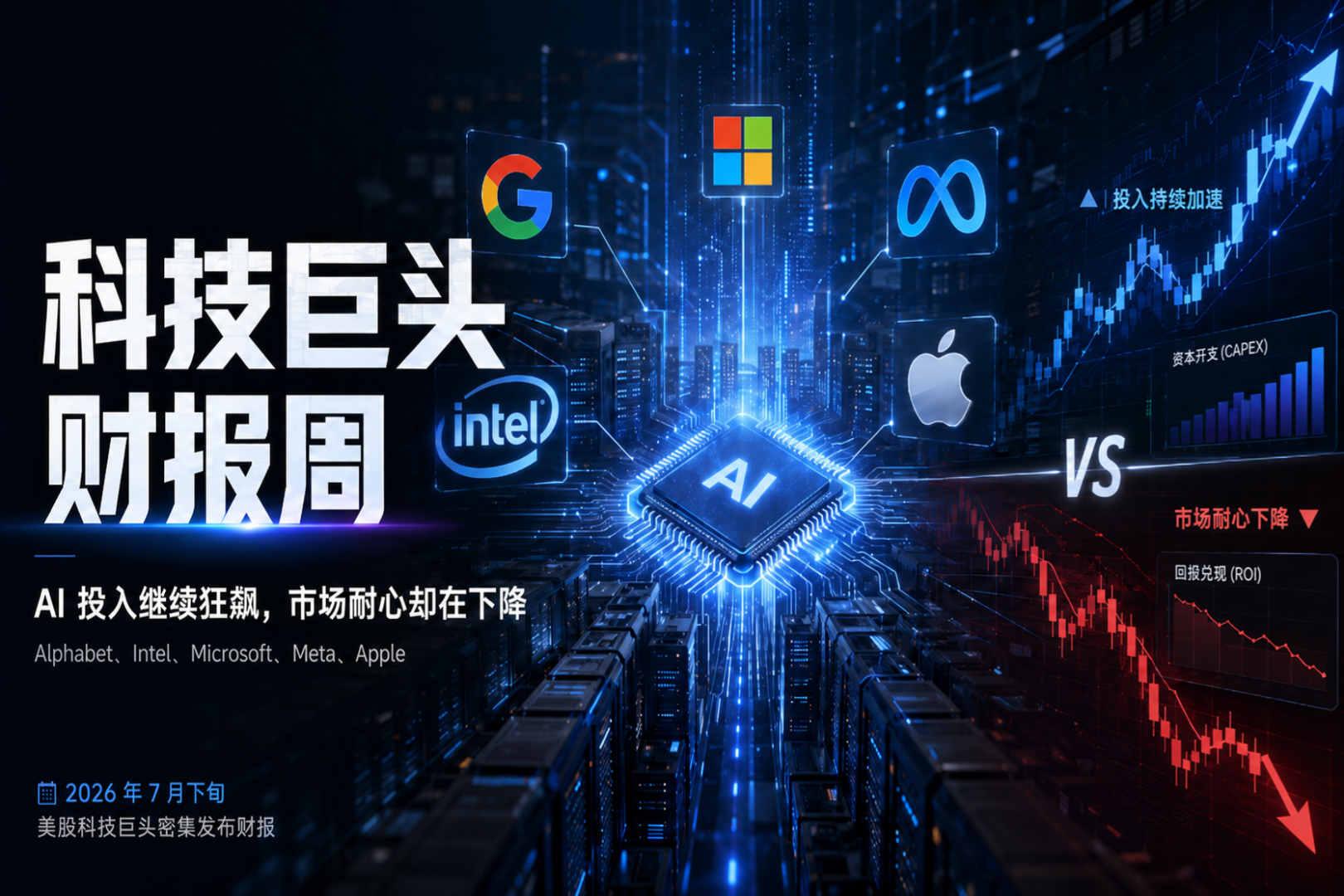
When the Market Begins to Question AI Capex: A Full Analysis of Q2 Earnings Reports from Five Tech Giants

In late July 2026, five major US tech giants—Alphabet, Intel, Microsoft, Meta, and Apple—released their Q2 earnings reports. While all companies exceeded revenue and profit expectations, driven by strong AI-related business growth, investor reactions diverged sharply due to concerns over escalating AI capital expenditures (capex) and their impact on free cash flow. Alphabet reported strong revenue growth and a surging cloud business, but its stock fell after announcing a doubled year-on-year capex and negative quarterly free cash flow for the first time. Intel posted its strongest revenue growth in over 15 years, but its stock experienced volatile trading after significantly raising its full-year capex guidance. Microsoft saw its stock surge after beating estimates and, crucially, lowering its capex forecast while projecting positive free cash flow. Meta faced the most severe sell-off as its profits declined despite revenue beats, with free cash flow plunging over 90% and its capex guidance raised. Apple reported record June-quarter results, but its stock plummeted after providing Q4 revenue guidance that fell short of expectations, citing supply chain constraints and forex headwinds. The overall takeaway is that the market's focus has shifted from validating AI demand to scrutinizing the timeline for returns on massive AI investments. Companies demonstrating a clearer path to managing capex and preserving free cash flow, like Microsoft, were rewarded, while those signaling continued aggressive spending faced investor skepticism.

Odaily星球日报33m ago

When the Market Begins to Question AI Capex: A Full Analysis of Q2 Earnings Reports from Five Tech Giants

Odaily星球日报33m ago

a16z: From Companies to DAOs, DUNA May Become the Next Generation Organizational Form

This article, "From Companies to DAOs: How DUNA Could Become the Next Organizational Form," traces the 500-year evolution of business collaboration. It begins with medieval structures like the *commenda* and Florentine *compagnia*, which exposed partners to personal risk. The modern corporation, exemplified by the Dutch East India Company (VOC), was a revolutionary leap, enabling large-scale, capital-intensive ventures by offering limited liability and reducing coordination costs. However, corporations introduced new challenges like principal-agent problems and bureaucratic overhead. The piece argues that software and internet-native protocols are now reducing these traditional overheads. Decentralized Autonomous Organizations (DAOs) emerged as a new model for coordination without centralized management. Yet, DAOs face a significant legal vacuum: they lack legal recognition, leaving members exposed to unlimited personal liability, and their tokens are vulnerable to being classified as securities under unclear regulations (e.g., the Howey Test). This has forced projects into suboptimal workarounds like offshore foundations. The article identifies the Decentralized Unincorporated Nonprofit Association (DUNA) as a potential solution. Recently legalized in states like Wyoming, the DUNA provides a legal wrapper for decentralized networks. It grants key protections—legal personality, limited liability, and perpetual existence—to a group without imposing a traditional hierarchical management structure. This allows token-holder communities to govern, hold assets, and contract as a single legal entity, aligning with their decentralized nature. While DUNA doesn't solve all governance challenges or magically resolve securities law questions, it represents a crucial step. It fills the legal recognition gap, offering a native legal form for internet-scale, decentralized collaboration and extending the separation of personal risk from organizational venture into a new domain.

marsbit1h ago

a16z: From Companies to DAOs, DUNA May Become the Next Generation Organizational Form

marsbit1h ago

2026 Mid-Year Report On-Chain RWA: Tokenized Stock Market Cap Doubles in a Year, But 90% of Rights Are Hollow Shells

The 2026 Mid-Year Report on On-Chain RWA highlights a significant growth in tokenized stock market capitalization, which nearly doubled from $951 million in March to $1.89 billion by July. However, the report reveals a fundamental contradiction in this "layer 2.5" ecosystem: products with the strongest legal foundation (like regulated U.S. infrastructure) lack liquidity and distribution, while freely tradable offshored wrapper products often lack substantive ownership rights. The increase is driven largely by a few products (SECZ, FGRS, STRCx) and platforms (Ondo, xStocks, Securitize collectively hold over 85% share). While distributed value across networks like Ethereum, Solana, and BNB Chain has grown, the market remains fragmented. Products referencing the same underlying asset (e.g., Apple stock) are distinct legal liabilities with different intermediaries and jurisdictional rules, offering varying degrees of legal claim. The report cautions that headline numbers are misleading, as they reflect changes in distributed token value—driven by issuance, conversions, and price movements—not pure investor inflows. True "canonical shares" with legal ownership, wide wallet distribution, institutional liquidity, and independent on-chain price discovery do not yet exist at scale. Tokenized treasuries show stronger product-market fit, and ETFs may be easier to scale than single stocks. The core takeaway is a trade-off: legal certainty versus liquidity and composability.

marsbit2h ago

2026 Mid-Year Report On-Chain RWA: Tokenized Stock Market Cap Doubles in a Year, But 90% of Rights Are Hollow Shells

marsbit2h ago

Trading

Spot

Hot Articles

Discussions

Welcome to the HTX Community. Here, you can stay informed about the latest platform developments and gain access to professional market insights. Users' opinions on the price of S (S) are presented below.

活动图片