Japan plans major shift as crypto moves from payments to securities law

cointelegraphPublished on 2025-12-10Last updated on 2025-12-10

Abstract

Japan's Financial Services Agency (FSA) is planning to shift cryptocurrency regulation from the Payment Services Act to the Financial Instruments and Exchange Act (FIEA), treating crypto primarily as investment products rather than payment methods. This move aims to enhance user protection by imposing stricter disclosure rules for initial exchange offerings (IEOs), including mandatory pre-sale information, third-party code audits, and issuer identity disclosure. The new framework also strengthens measures against unregistered platforms and explicitly prohibits insider trading. The regulatory shift coincides with government discussions to implement a flat 20% tax rate on crypto trading profits.

Japan’s financial regulators are preparing to move crypto asset oversight out of the country’s payments regime and into a framework designed for investment and securities markets.

The Financial Services Agency (FSA) on Wednesday released a comprehensive report from the Financial System Council’s Working Group on the regulatory status of cryptocurrencies across multiple sectors.

The document outlines a plan to shift the legal basis for crypto regulation from the Payment Services Act (PSA) to the Financial Instruments and Exchange Act (FIEA), which is the primary law regulating securities markets, issuance, trading and disclosures.

“Crypto assets are increasingly being used as investment targets both domestically and internationally,” the report noted, underscoring the need to protect users by providing regulation that treats crypto as a financial product.

Strengthening data disclosure regulations

One of the core changes brought by bringing crypto under FIEA regulatory scope is strengthening data disclosure requirements for initial exchange offerings (IEOs), or token sales managed by crypto exchanges.

“Crypto transactions conducted by users are similar to securities transactions, and may involve the sale of new crypto assets or the buying and selling already in circulation,” the document reads, highlighting the importance of timely information during IEO sales.
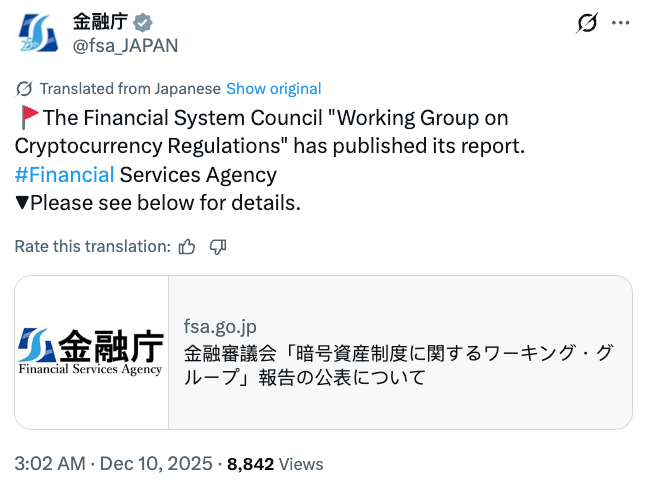
Source: FSA Japan

Among the requirements for IEOs, the proposal mandates that exchanges provide pre-sale disclosures, including detailed information about the core entities behind the offering. It also requires code audits by independent third-party experts and encourages consideration of feedback from self-regulatory organizations.

In addition to exchanges, it places responsibilities on issuers, requiring them to disclose their identities, regardless of whether the project is decentralized, and how tokens are issued and distributed.

Related: Crypto payments coming to PlayStation as Sony plans stablecoin launch in 2026

The proposed framework would also give regulators stronger tools to crack down on unregistered platforms, particularly those operating from overseas or tied to decentralized exchanges. It also includes explicit prohibitions on insider trading, echoing provisions of the European Union’s Markets in Crypto-Assets (MiCA) framework and South Korea’s regulations.

The news came amid the Japanese government’s consideration of plans to reduce the maximum tax rate on crypto profits by imposing a flat rate of 20% on all gains from crypto trading.

On Tuesday, FSA also signaled a cautious stance on permitting derivatives for foreign crypto asset exchange-traded funds, reportedly describing the underlying assets as “not desirable.”

Magazine: When privacy and AML laws conflict: Crypto projects’ impossible choice

Related Reads

Kraken Changed Its Vote at the Last Minute, Solana's Inflation Policy Narrowsly Passes by 0.33 Percent

Kraken’s last-minute vote reversal secured the passage of SGP-0002, a pivotal Solana governance proposal to accelerate the network’s annual inflation reduction from 15% to 30%. The final vote tally was 67.001%, narrowly exceeding the required 66.667% supermajority by just 0.334 percentage points. This change will bring Solana’s terminal inflation rate of 1.5% forward to around 2029, reducing future SOL issuance over six years by approximately 18.9 million tokens (about 2.6% of current supply). The vote, the first major test of Solana’s new on-chain governance system, saw intense drama. The Kraken 2 validator, controlling about 8.9 million staked SOL, switched from support to opposition hours before the deadline, pushing the "yes" vote below the passing threshold. A flurry of lobbying, including direct outreach by Helius CEO Mert Mumtaz, ensued. Kraken ultimately flipped back to supporting the proposal, and JitoSOL holders used the "staker override" mechanism to bypass opposing validators and vote directly with their stake. While SGP-0002 passed, a companion proposal (SGP-0003) to restructure transaction fees failed, indicating community willingness to adjust token supply but hesitance to change fee economics. The approved proposal now moves to a technical implementation phase, requiring client teams to code and activate the change. The event highlighted both the power of large validators and the resilience of Solana’s governance mechanisms, marking a significant, albeit messy, step in decentralized monetary policy management.

marsbit14m ago

Kraken Changed Its Vote at the Last Minute, Solana's Inflation Policy Narrowsly Passes by 0.33 Percent

marsbit14m ago

Trading Volume Surges 10 Times in a Month, Who's Driving UNI's Soaring Price?

The article discusses the recent surge in the price of UNI, the governance token of Uniswap, which reached a high above $5.4 on August 31, marking a three-month increase of over 100%. The resurgence is attributed primarily to two key developments. First, Uniswap was designated as the primary Automated Market Maker (AMM) on the newly launched Robinhood Chain. Data shows Uniswap generated $4.29 million in fees in 24 hours on this chain and facilitated a tenfold increase in stock token trading volume over a month, reaching approximately $130 million daily. Second, a fundamental change in UNI's tokenomics, approved in December 2025, activated a "fee switch" mechanism. A portion of protocol fees is now directed to a "TokenJar" contract. Arbitrage bots can destroy an equivalent value of UNI tokens to claim these fees, creating a perpetual buy-and-burn pressure. This mechanism has led to the burning of over 110 million UNI tokens (worth $630 million), with recent daily burns exceeding $400,000 in value, nearly half contributed by activity on Robinhood Chain. The symbiotic relationship is highlighted: Uniswap gains a substantial new source of on-chain revenue to fuel its token deflation, while Robinhood Chain leverages Uniswap's deep liquidity and decentralized infrastructure for its stock token offerings. This integration represents a deeper convergence of traditional and decentralized finance.

marsbit28m ago

Trading Volume Surges 10 Times in a Month, Who's Driving UNI's Soaring Price?

marsbit28m ago

Marvell: Can't Compare to NVIDIA, Can't Meet Expectations, Overvaluation Gets Squeezed First?

Marvell Technology (MRVL.O) reported its Q2 FY2027 earnings (ending July 2026) after market close on August 27. Key points include: The company raised its full-year revenue outlook for FY2027 to $12 billion (from $11.5B) and for FY2028 to $18 billion (from $16.5B). However, these upward revisions were only slightly above market expectations and significantly trailed NVIDIA's recent explosive guidance. The Data Center segment, accounting for 79% of revenue, grew 19% quarter-over-quarter to $2.17 billion, primarily driven by connectivity products. For FY2028, management forecasts over 60% growth for this segment, again below NVIDIA's >70% outlook. A major disappointment for investors was the lack of an upward revision to the Custom ASIC business guidance, despite Marvell's recent partnership agreement with Google. The market had anticipated potential gains from Google's TPU orders, but the maintained guidance for "over 100% growth" in FY2028 (with no specific target for FY2027) led to concerns that the Google deal may be a less favorable "framework agreement" where Marvell holds a weaker negotiating position. Adjusted gross margin was flat at 58.3%. Q3 revenue guidance is $3.15 billion, slightly above consensus. Overall, the report was largely in line with expectations, but the subsequent stock decline is attributed to growth forecasts that failed to meet heightened market expectations (particularly versus NVIDIA) and lingering uncertainty around the tangible benefits of the Google ASIC partnership. High valuation faces near-term pressure, but expectations for >50% growth in the coming years and long-term ASIC opportunity may provide support.

marsbit1h ago

Marvell: Can't Compare to NVIDIA, Can't Meet Expectations, Overvaluation Gets Squeezed First?

marsbit1h ago

US Stock Market Trend (August 31st): Kashkari's Hawkish Remarks Weigh on Chip Stocks, US-Iran Weekend Strikes Boost Oil Prices

U.S. stock markets ended lower on Friday following hawkish remarks from Federal Reserve Chair Wash at the Jackson Hole symposium, which sharply increased the probability of a September rate hike from 35% to nearly 60%. Major indexes fell: the S&P 500 dropped 0.25%, the Nasdaq declined 0.52%, and the Dow was essentially flat. This shift in interest rate expectations pressured rate-sensitive assets, leading to significant declines in chip stocks. The Philadelphia Semiconductor Index fell 3.47%, with Nvidia dropping 4.57%, erasing about half its post-earnings gains. Geopolitical tensions also escalated over the weekend as the U.S. and Iran exchanged military strikes, raising concerns over the security of oil transit through the Strait of Hormuz. This pushed oil prices up over 2% in early Asian trading on Monday, reintroducing a geopolitical risk premium. In other energy news, former President Trump announced a landmark 25-year oil deal with Venezuela, aiming to significantly increase the country's oil production. However, this long-term supply boost was overshadowed in the short term by the Middle East conflict and the dominant market focus on interest rates. The core market narrative for the coming week revolves around the interplay between re-priced hawkish rate expectations and escalating geopolitical risks. Key areas to watch include the trajectory of Treasury yields, the evolution of U.S.-Iran tensions and its impact on oil prices, and whether the sell-off in high-valuation tech and semiconductor stocks stabilizes or continues under the pressure of higher rates.

marsbit1h ago

US Stock Market Trend (August 31st): Kashkari's Hawkish Remarks Weigh on Chip Stocks, US-Iran Weekend Strikes Boost Oil Prices

marsbit1h ago

Trading

Spot
活动图片