Iranian Crypto Outflows Hit $10.3 Million After US‑Israeli Airstrikes, Chainalysis Finds

bitcoinistPublished on 2026-03-04Last updated on 2026-03-04

Abstract

Following joint US-Israeli airstrikes on February 28, Iranian cryptocurrency exchanges experienced significant outflows totaling approximately $10.3 million, according to Chainalysis data. The report highlights crypto's critical role in Iran's sanction-hit economy, serving both ordinary citizens and state-affiliated entities. With traditional banking access severed due to sanctions, Iranians increasingly rely on Bitcoin and stablecoins as hedges against hyperinflation and capital controls. Notably, half of Iran's $7.78 billion in crypto activity is attributed to the Islamic Revolutionary Guard Corps, underscoring digital assets' dual function as both economic lifeline and sanctions-evasion tool. The incident demonstrates crypto's rapid responsiveness to geopolitical shocks and ongoing regulatory challenges.

On‐chain data shows that in the days after joint US‐Israeli airstrikes on February 28, Iranian exchanges saw a sharp spike in withdrawals, with roughly 10.3 million dollars in crypto fleeing.

Iran’s Crypto Use Amidst Economical Collapse

Crypto has become a financial lifeline for both ordinary households and state‐affiliated networks in Iran, according to an article posted on our sister website NewsBTC. Years of US and EU financial and oil sanctions have strained the economy, cutting Iranian banks off from SWIFT and dollar funding, and now even targeting Iran‐linked crypto platforms through recent US Treasury designations. Add to this cocktail a runaway inflation and a collapsing rial, and it becomes clear why many Iranians increasingly look to Bitcoin and stablecoins as an alternative store of value and cross‐border payment rail.

A Lifeline Of Hope For Ordinary Folk?

Chainalysis has estimated that Iran’s crypto activity reached roughly 7.78 billion dollars in 2025, with usage spiking around protests, bombings and other security crises as people rush to move funds off local platforms and into self‐custody.

In its latest report, Chainalysis visualizes this idea with a series of charts that track hourly outflows from major Iranian exchanges before and after the February 28 airstrikes.
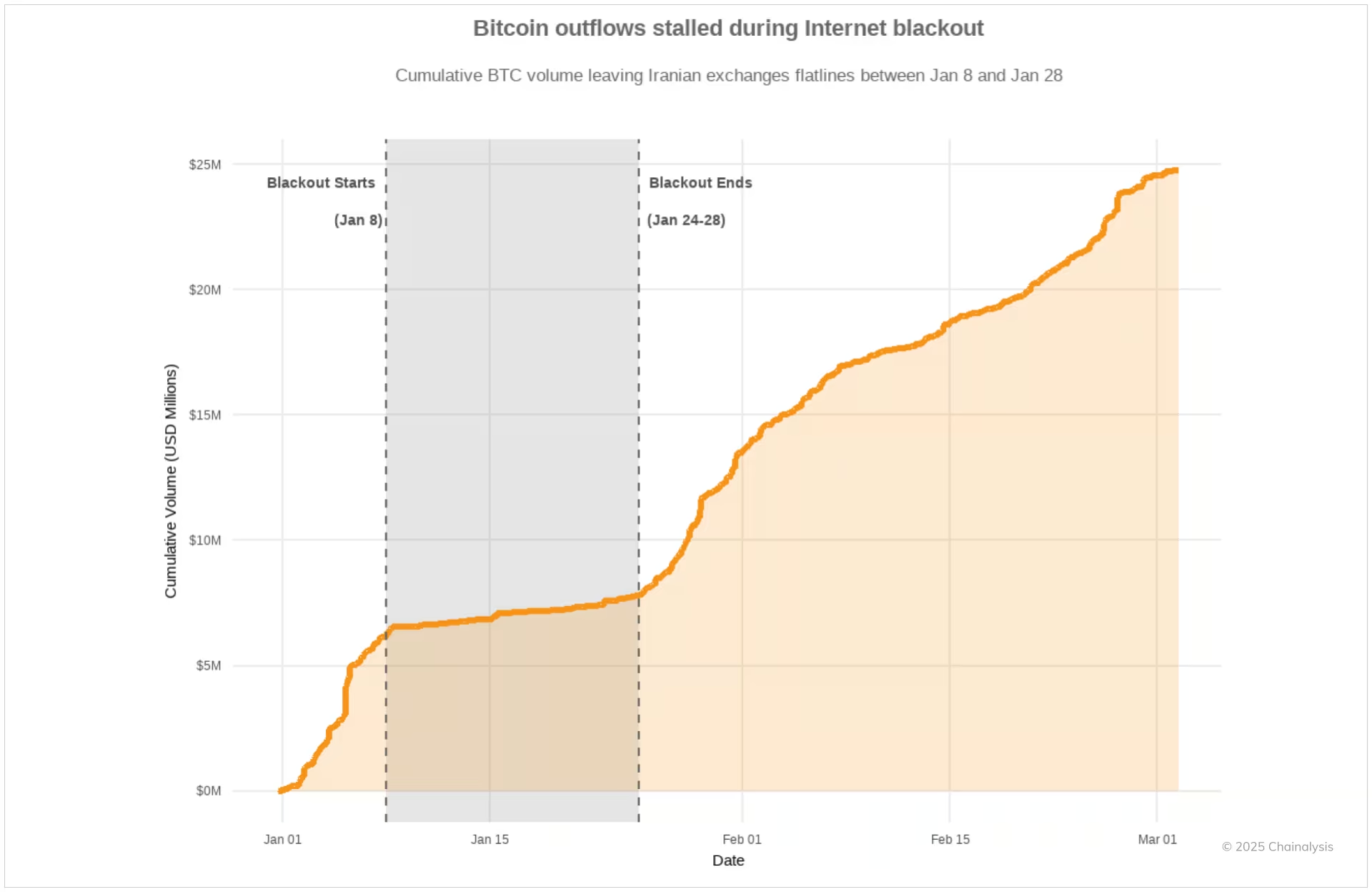
Bitcoin outflows stalled during Internet blackout. Source: Chainalysis

The graphs show relatively modest, choppy activity in the hours leading up to the strikes, followed by a sudden jump where hourly withdrawals approach or exceed roughly 2 million dollars and cumulative outflows climb to about 10.3 million dollars by March 2.
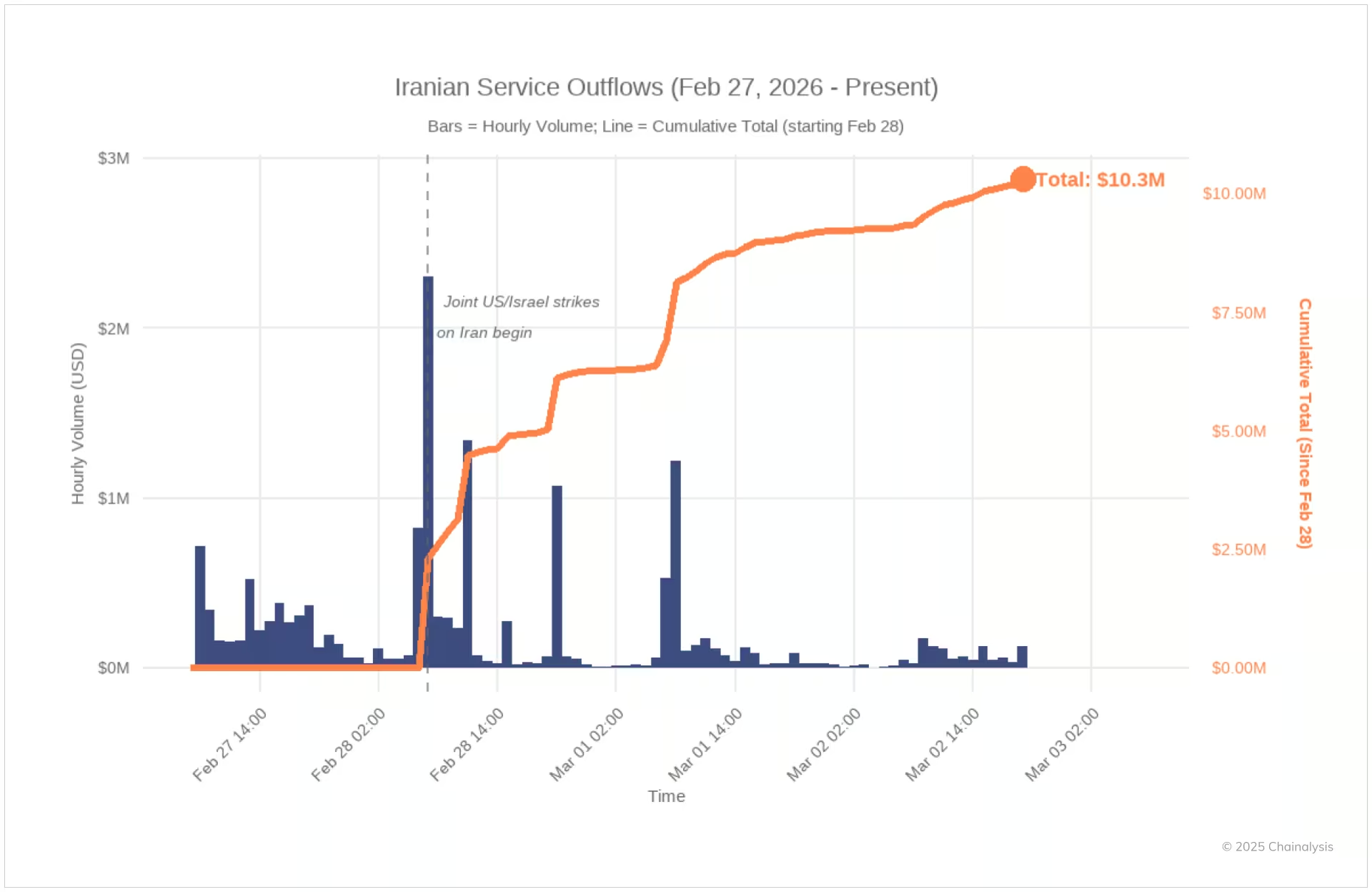
Iranian service outflows (Feb 27, 2026 - Present). Source: Chainalysis

For many ordinary Iranians, Bitcoin and stablecoins now function as a hedge against currency collapse and capital controls, while addresses tied to the Islamic Revolutionary Guard Corps (IRGC) account for roughly half of on‐chain activity, highlighting crypto’s dual role as both a survival tool and a sanctions‐evasion channel.

However, it is worth noting that while some observers praise Chainalysis for helping exchanges and regulators track hacks, scams, and sanctions evasion, civil‐liberties advocates criticize its tools as opaque and potentially overreaching in terms of financial surveillance.

What This Means For The Future Of Iranians

For ordinary users, digital assets may remain a pressure valve against inflation and capital controls, even as regulators tighten the screws on Iran‐linked platforms and wallets. For policymakers, the question now is whether new rounds of enforcement will meaningfully curb sanctions evasion or imply push more of Iran’s crypto activity into harder‐to‐track channels.

What is for sure is that the the latest spike in Iranian exchange outflows comes to show, once more, how quickly crypto reacts to geopolitical shocks and sanctions risk: the market is, after all, in the hands of the people.
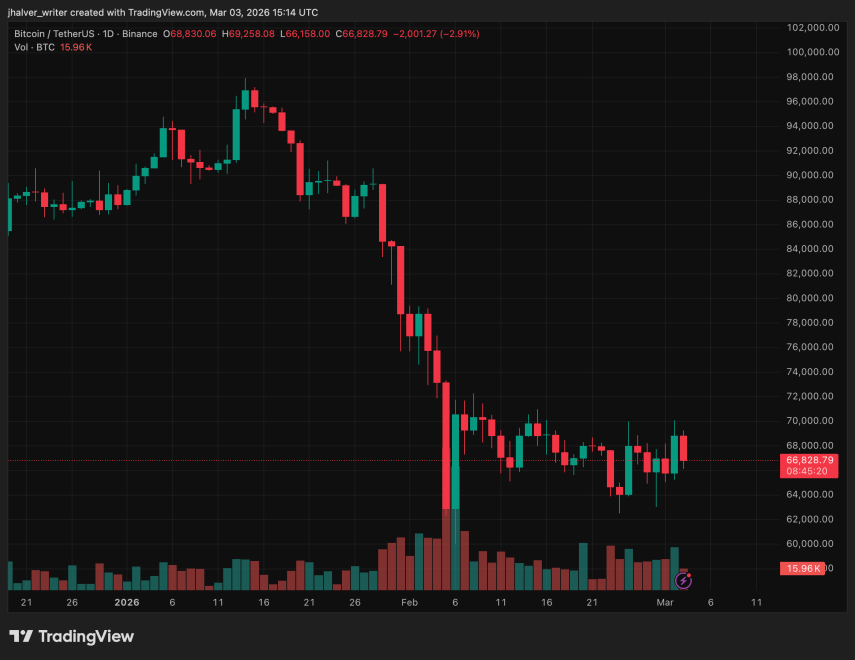
BTC's price trends to the downside on the daily chart. Source: BTCUSDT on Tradingview

Cover image from ChatGPT, BTCUSDT chart from Tradingview

Related Questions

QWhat was the total value of crypto outflows from Iranian exchanges following the US-Israeli airstrikes on February 28, according to Chainalysis?

A$10.3 million

QWhy have many Iranians turned to Bitcoin and stablecoins, according to the article?

AAs a hedge against currency collapse, capital controls, and as an alternative store of value and cross-border payment rail due to economic strain from sanctions, runaway inflation, and a collapsing rial.

QWhat two contrasting roles does cryptocurrency play in Iran, as highlighted in the report?

AIt serves as a survival tool for ordinary households and as a sanctions-evasion channel for state-affiliated networks like the Islamic Revolutionary Guard Corps (IRGC).

QWhat event caused a temporary stall in Bitcoin outflows, as shown in one of the Chainalysis charts?

AAn Internet blackout.

QWhat is the central question for policymakers regarding new enforcement on Iran-linked crypto platforms?

AWhether new enforcement will meaningfully curb sanctions evasion or simply push more activity into harder-to-track channels.

Related Reads

UNI Doubles in Two Months Against the Trend: A 5-Year-Overdue Value Realization

Amidst a generally stagnant crypto market in June and July, UNI, the governance token of Uniswap, saw a significant surge, nearly doubling in price from around $2.3 to $4.6. This rally represents a delayed but significant value reassessment, triggered by the practical implementation of its long-debated "fee switch" mechanism. The key turning point was the on-chain execution of the UNIfication proposal in December 2025. It activated a protocol fee on select pools, directed Unichain sequencer revenue (net of costs) to a communal treasury, executed a one-time burn of 100 million UNI, and established a system where all protocol revenue flows into a "TokenJar" contract. This treasury has a single exit: purchasing and permanently burning UNI via a "Firepit" contract. Initially, the market reacted tepidly as the generated revenue and corresponding burn rate were modest. The narrative shifted dramatically in July 2025 with two major developments. First, the launch of Robinhood Chain, tailored for tokenized stocks, rapidly became a primary source of volume and fees for Uniswap, at one point contributing nearly half of its weekly fees. Second, governance votes successfully expanded the fee mechanism to v4 pools and initiated a temperature check for fees on Robinhood Chain. The activation of v4 fees caused the protocol's daily revenue earmarked for UNI burns to nearly triple. The core of UNI's recent price action is the transition from a pure governance token to a cash-flow asset with a permanent, protocol-funded buyer. Its effectiveness is amplified by UNI's mature and widely distributed supply, with no major impending unlocks to dilute the impact of the buybacks. The sustainability of this rally now hinges on whether the transaction volume, particularly on Robinhood Chain, persists after its initial gas subsidies expire, determining if this is a genuine value realization or a subsidy-fueled spike.

marsbit1h ago

UNI Doubles in Two Months Against the Trend: A 5-Year-Overdue Value Realization

marsbit1h ago

Breaking: Google Earth Urgently Pulls Back Nano Banana 2 Image Generation Feature!

Google Earth's newly launched "Create image" feature, powered by the Nano Banana 2 AI image generation model, was abruptly withdrawn shortly after its release due to being "played" by users. The feature allowed users to generate and overlay AI-created visuals directly onto real-world satellite and 3D maps in Google Earth. The tool enabled creative applications like historical recreations (e.g., visualizing ancient Pompeii), generating informational graphics for landmarks, and envisioning architectural projects or futuristic cityscapes on real terrain. It operated under "geospatial grounding," meaning the AI respected the underlying geography, topography, and perspective of the chosen map view. The model also integrated with Gemini to retrieve relevant factual information. However, upon release, users quickly tested its limits. A prominent example involved reimagining Philadelphia's historic Independence Hall as a post-apocalyptic ruin overrun by "happy" zombies, evil clowns, and giant alien mechs. This highlighted both the feature's playful potential and its risks regarding the generation of inappropriate or misleading content on realistic maps, leading to its swift temporary removal. Google stated it would re-release the feature after implementing "enhanced guardrails." Analysts note this move strategically leverages Google's vast proprietary geospatial data, positioning its AI not just for artistic generation but for spatially accurate world visualization—a unique advantage in the competitive AI image generation landscape.

marsbit2h ago

Breaking: Google Earth Urgently Pulls Back Nano Banana 2 Image Generation Feature!

marsbit2h ago

Altman Admits: Overestimated AI Snatching Jobs! Huang Renxun: The Unemployment Narrative Is Completely Backwards

Sam Altman has revised his earlier predictions about AI rapidly replacing jobs, admitting he overestimated the speed at which AI would eliminate entry-level white-collar roles. Speaking on the "Invest Like the Best" podcast, he stated that people do not truly want an AI CEO, as accountability and human connection remain critical. He found that individuals prefer interacting with people who can be held responsible for decisions. Similarly, NVIDIA's Jensen Huang argued that the narrative of AI destroying jobs is misguided. He distinguishes between tasks and jobs, noting that while AI can automate specific tasks, entire jobs—encompassing communication, judgment, coordination, and accountability—are not eliminated. He cited examples like radiologists and software engineers, where demand for these roles has increased as AI handles repetitive tasks, allowing for business expansion and the creation of more positions. Data from a University of Maryland and LinkUp study supports this, showing that U.S. job postings for new graduates have actually risen, countering the fear of vanishing entry-level roles. However, a significant shift is occurring: the traditional entry-level tasks that help newcomers gain experience are being automated, making initial career access more challenging. The key insight is that as AI takes over standardized tasks, the enduring value of human work shifts toward areas of responsibility, trust-building, and final decision-making—aspects that AI cannot replicate. The real "moat" for professionals lies in these irreplaceable human elements.

marsbit2h ago

Altman Admits: Overestimated AI Snatching Jobs! Huang Renxun: The Unemployment Narrative Is Completely Backwards

marsbit2h ago

Trading

Spot
活动图片





