Introducing: Market Compass

insights.glassnodePublished on 2026-06-18Last updated on 2026-06-18

Abstract

Glassnode introduces Market Compass, a dashboard providing a unified view of Bitcoin market conditions. It consolidates thousands of on-chain and market metrics into seven "lenses." Four forward-looking lenses (Macro, Capital Flows, Investor Behavior, On-Chain Fundamentals) feed a headline composite score from 0 (Risk-Off) to 100 (Risk-On). Three standalone lenses (Cycle Position, Derivatives, Cross-Asset Rotation) describe the current market structure. In the current reading, the headline score is 14/100 (Risk-Off), indicating a defensive regime. The Macro lens is the weakest at 23, constrained by a strong US Dollar (DXY) trading above its 200-day average. While the other forward-looking lenses show moderate improvement from recent lows, the overall picture suggests bottom-fishing within an unturned market cycle. Key observations include stablecoin supply shrinking (reduced buying power), long-term holders absorbing supply, tepid on-chain demand, and a derivatives market coiled for a potential move. The tool is designed as a contextual map, not a direct trading signal, synthesizing complex data into a single coherent read.

The hardest part of using Glassnode has never been finding the right metric. It is knowing which of the thousands to trust on any given morning, and what they add up to. The Glassnode Market Compass fixes that. It takes the indicators our analysts trust most, reads them together, and puts a single coherent read on your screen.

It does this through seven lenses. Each lens is scored from 0 to 100 and mapped to a named regime, so a glance tells you whether macro is Tightening or Expansionary, whether capital is Drained or Flush, whether holders are Distributing or Accumulating. The dashboard refreshes every day. The written read on top of it refreshes every week.

Seven lenses, two jobs

Four of the lenses are forward-looking. Macro, Capital Flows, Investor Behaviour and On-Chain Fundamentals each carry a historical relationship with where Bitcoin trades next, so the Compass averages them into the headline score that runs from Risk-Off to Risk-On. Read this one first. It is a forward-looking index, not a forecast.

The other three are standalone. Cycle Position, Derivatives and Cross-Asset Rotation describe where the market sits today rather than where it heads, so they are kept out of the headline on purpose. A frothy derivatives book tells you positioning is stretched, not which way price breaks.

Forward-looking (these feed the headline):

  • Macro: Tightening to Expansionary
  • Capital Flows & Liquidity: Drained to Flush
  • Investor Behaviour: Distributing to Accumulating
  • On-Chain Fundamentals: Contracting to Hot

Standalone (these describe the current environment):

  • Cycle Position: Capitulation to Euphoria
  • Derivatives: Deleveraged to Frothy
  • Cross-Asset Rotation: BTC Season to Altseason
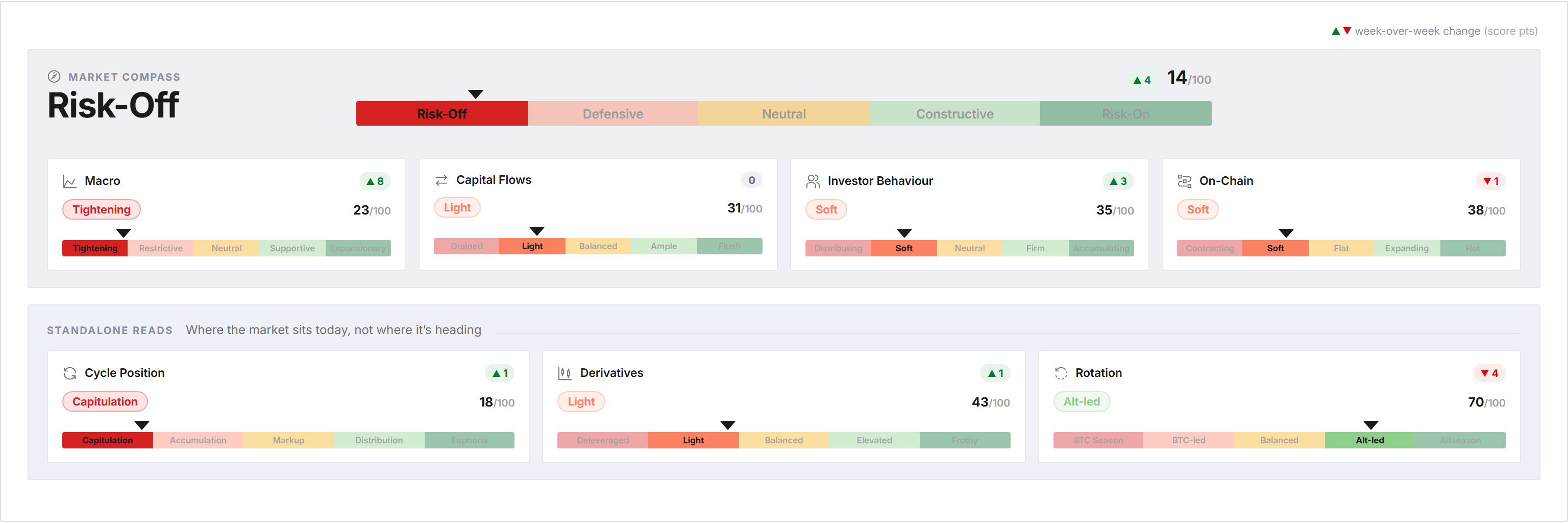
The Market Compass at a glance: the headline composite above the four forward-looking lenses, with the three standalone reads below.

What it is, and what it is not

The Compass is a map. It does not tell you to buy or sell, and it is not the Bitcoin Vector, our systematic product, where strategies like the Moderate Strategy actually move allocation in and out of the market. The Vector acts. The Compass tells you where you are standing, so that a signal, or your own judgement, has context to work from.

The consolidation is the whole point. Glassnode's problem has never been too little data; there are thousands of charts to choose from, each of which answers a sliver of the question. The Compass reads them together and takes a position. Some of what it shows, a handful of the lens-level analyses, is built specifically for this product and is not on the API or in Studio. The Compass is currently still in Beta and we will be updating this with our newest experimental metrics regularly.

How to read a lens

Every lens works the same way. A basket of indicators is distilled into one 0 to 100 reading, ranked against its own multi-year history, so the score answers a precise question: how does today compare to everything this lens has done before? Five named bands turn that number into plain language

A lens score draws on an index that is built from more than just the charts on its page. The additional figures often add important context that is difficult to capture in a single score. We also provide the change, showing each lens carry its 7-day and 30-day move next to the score. This helps the reader intuitively understand how fast scores are changing.

Reading the Compass today

The headline currently reads 14 out of 100, Risk-Off, a level the composite only reaches in genuine bear phases, with Bitcoin near $64,400 and down 16% on the month. Beneath the number, there is additional useful context: four of the forward-looking lenses are climbing off their 30-day lows at once. The regime is defensive but it is quietly repairing from the inside.

Macro

Macro reads the backdrop for risk: the dollar, the yield curve, the front-end policy path. It sits at 23, Tightening, the weakest of the four forward-looking lenses and the binding constraint on the headline. The dollar is the reason for this. DXY is at 100.3, about 1.7% above its 200-day average, the widest premium to trend of the whole downturn. The lens has climbed from 9 a month ago, showing a moderate improvement in macro conditions. It remains to be seen whether that can help BTC heal.
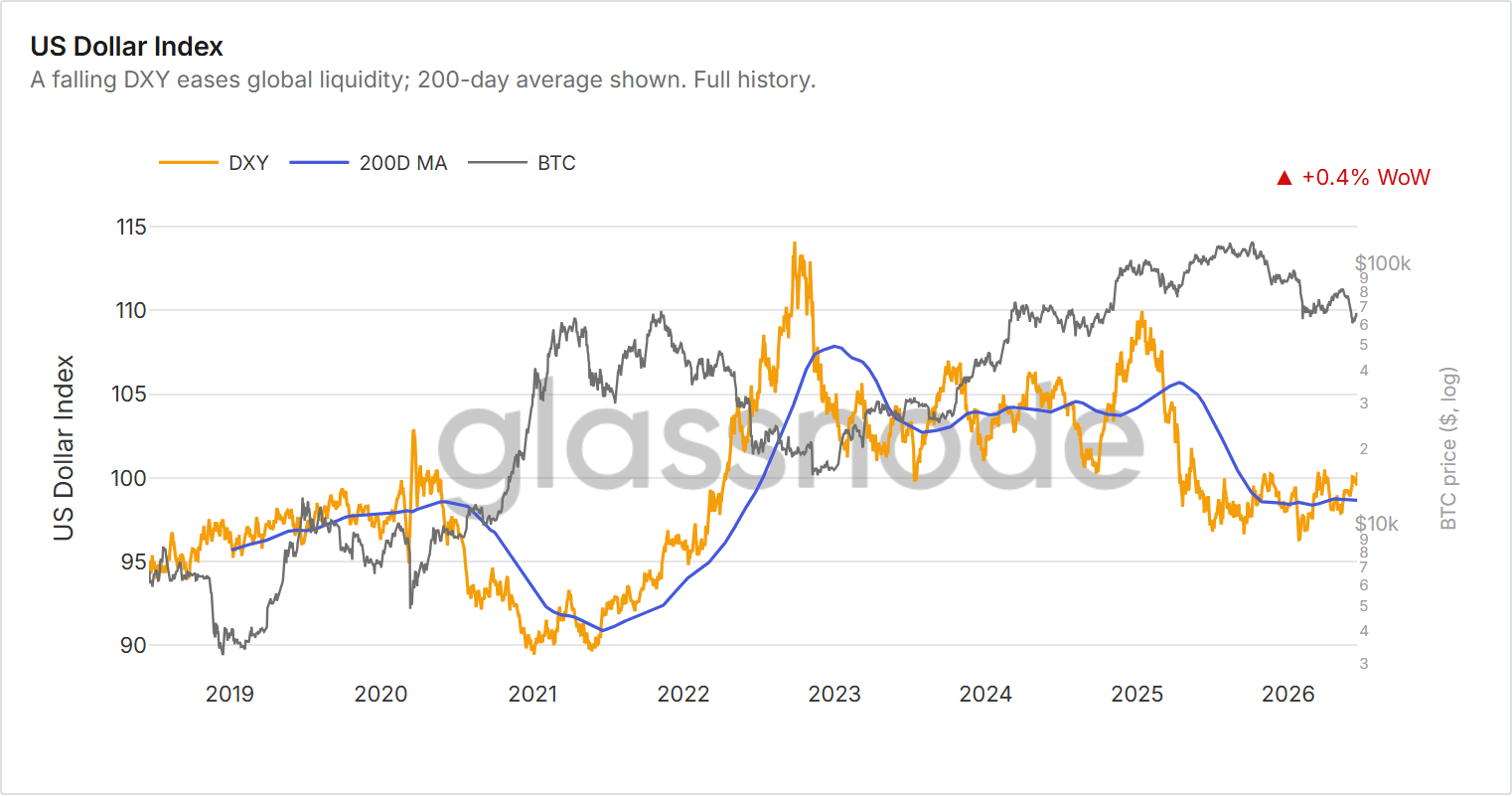
The US Dollar Index against its 200-day average, with BTC overlaid. A dollar bid above trend is a headwind for risk.

A DXY close back below its 200-day average is the single most important threshold in the framework, and it has not happened.

Capital Flows & Liquidity

Capital Flows tracks the money available to bid: stablecoin firepower, coins moving on and off exchanges, the stock held by patient accumulators. It reads 31, Light, down from 49 a month ago and flat on the week. A strong signal we are seeing here is stablecoin supply, the market's dry powder, whose 30-day rate of change has turned negative near minus 2%.
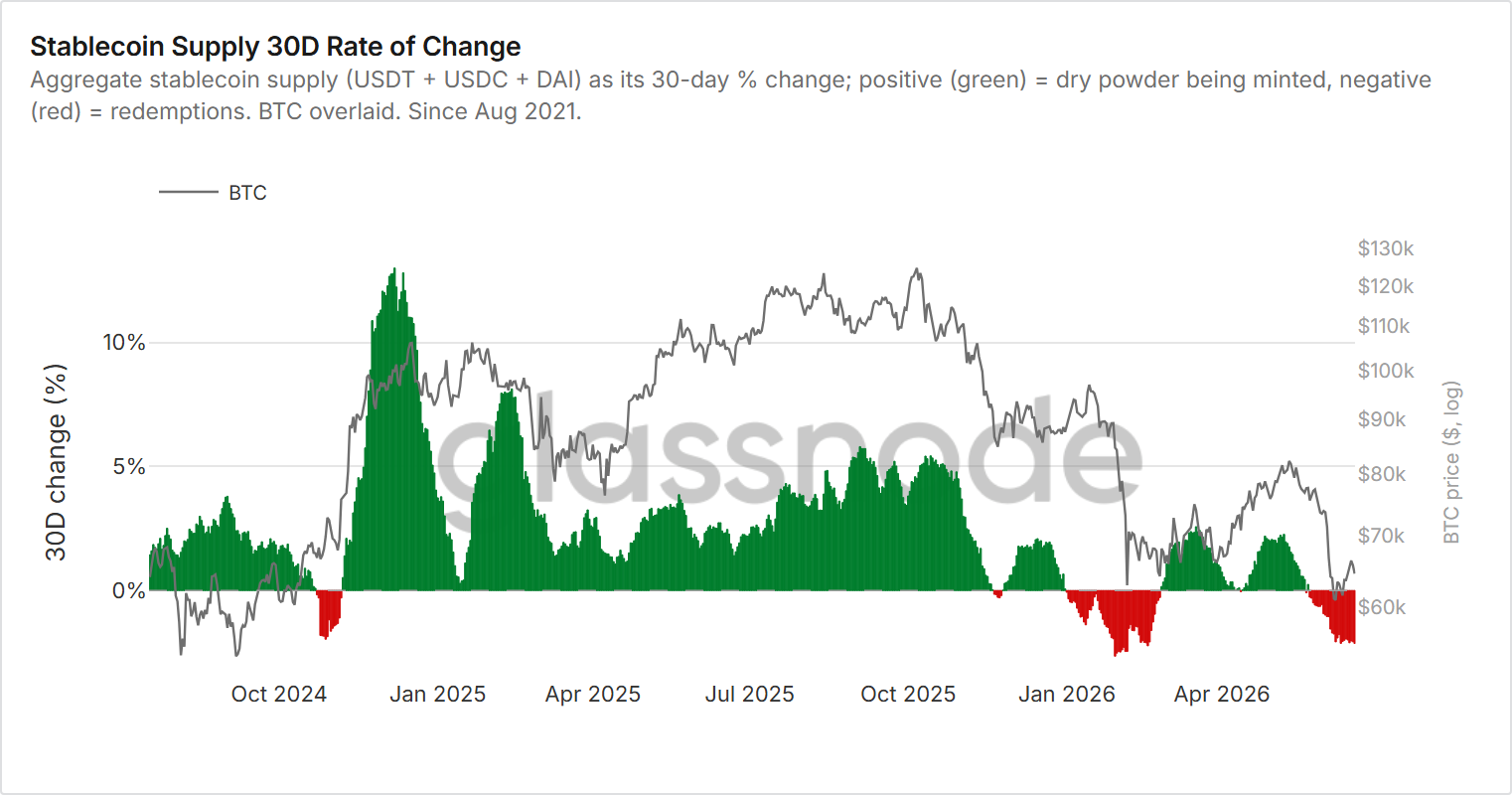
Stablecoin supply as a 30-day rate of change. Green bars are dry powder being minted; red bars are redemptions.

Exchange balances keep draining and spot buying has held net positive for two straight weeks, so the marginal coin is still being absorbed even as firepower leaves. The engine is not leaking hard, but it is not running either, and a minor flip back to positive on US spot ETF flows is the first clean sign it has restarted.

Investor Behaviour

Investor Behaviour reads what holders do with their coins: accumulate or distribute, hold or spend, and at what age. At 35, Soft, it is the most-improved forward-looking lens, up from 15 a month ago, the classic drawdown mechanic of supply migrating into stronger hands. Long-Term Holder supply just set a multi-year high at 88.1% of the float.
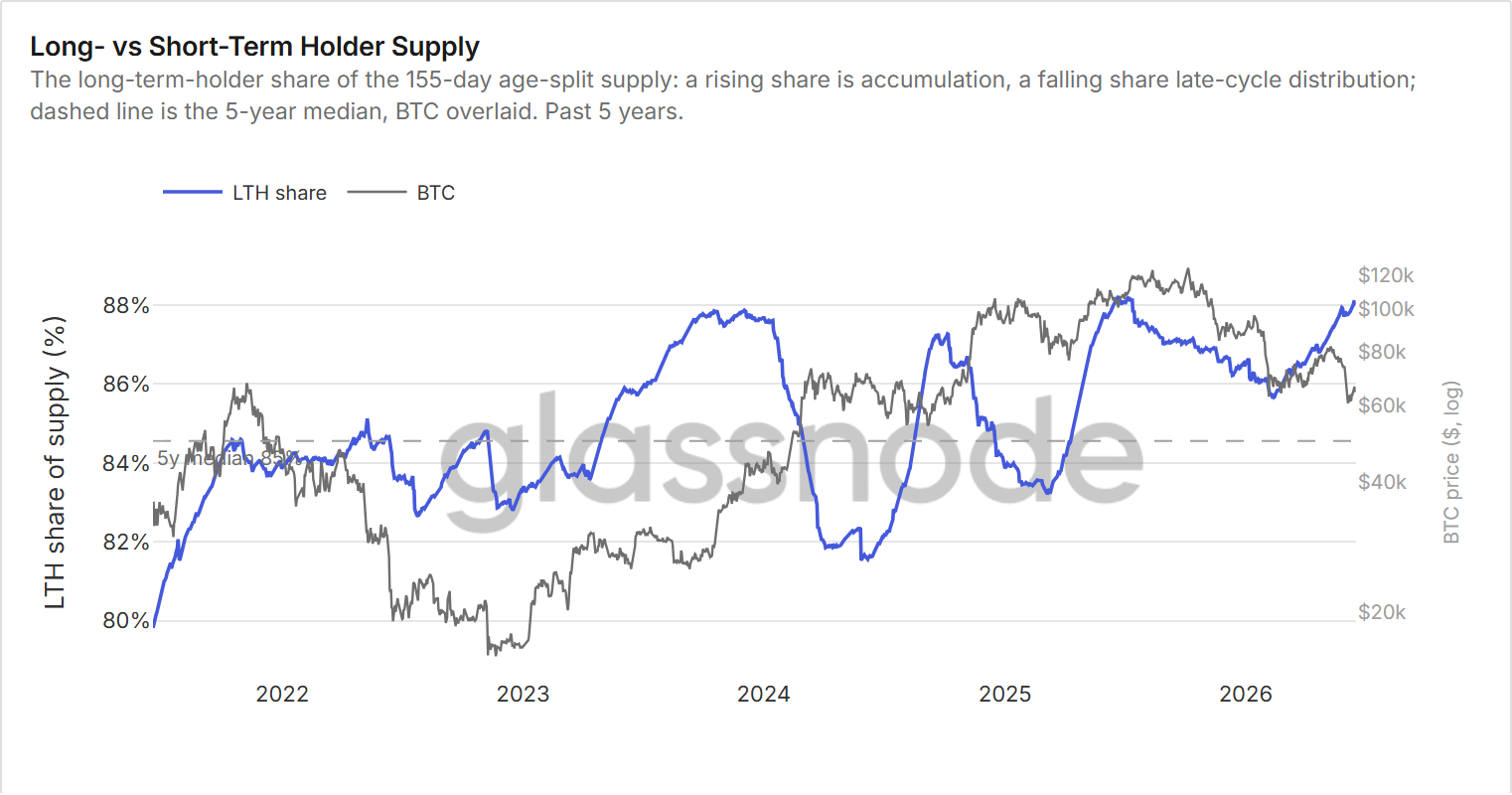
The long-term-holder share of supply against BTC. A rising share is accumulation; a falling share is late-cycle distribution.

The intensity has halved, though. Hodler Net Position is still positive but down more than 60% on the week, and the Accumulation Trend Score has stalled at 0.44. Holders are soaking up the supply that sellers hand them, and the lens only turns firm once the Accumulation Trend Score crosses 0.5.

On-Chain Fundamentals

On-Chain Fundamentals is the synthesis of our demand picture: new users arriving, the network's valuation against the throughput it settles, and blockspace demand in native Bitcoin rather than dollars, which strips out the price leg. It reads 38, Soft, a network still contracting with one corner firming. Fee momentum has climbed to 0.987, near the 1.0 line that marks demand turning up, and small-entity activity runs well above large-entity activity.
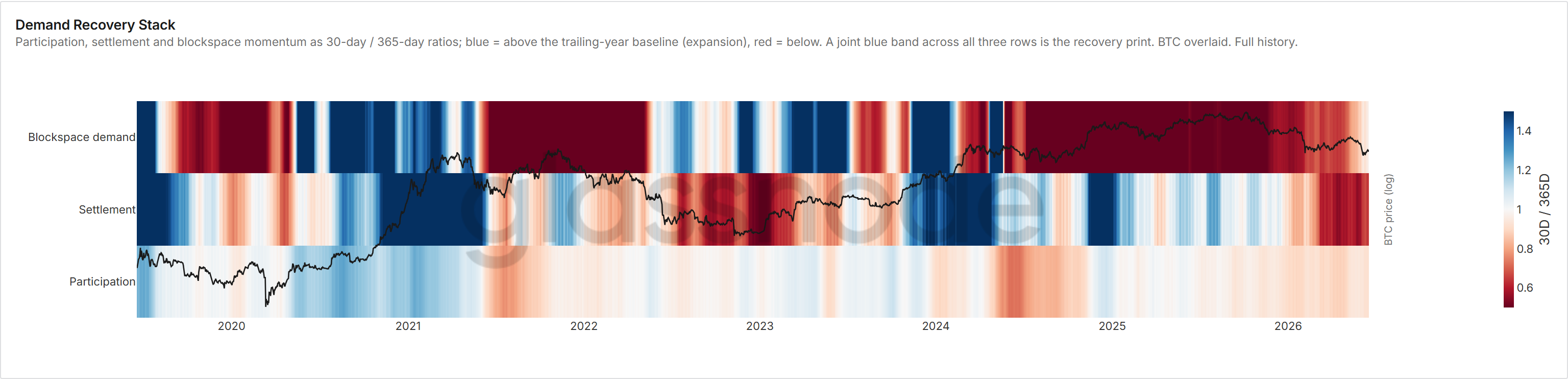
The Demand Recovery Stack: participation, settlement and blockspace momentum. Blue is above the trailing-year baseline, red is below.

A joint blue band across all three rows of the stack is the recovery print; today blockspace is warm but the trend is cooling while participation and valuation lag. Price is being repriced higher faster than the network is recovering, and fee momentum clearing 1.0 is what would confirm the economy is catching up.

Cycle Position

The standalone lenses describe structure rather than feeding the headline. Cycle Position places the market on its clock, from Capitulation to Euphoria, using profitability and holder conviction rather than price alone. It reads 18, Capitulation, down from 36 a month ago.
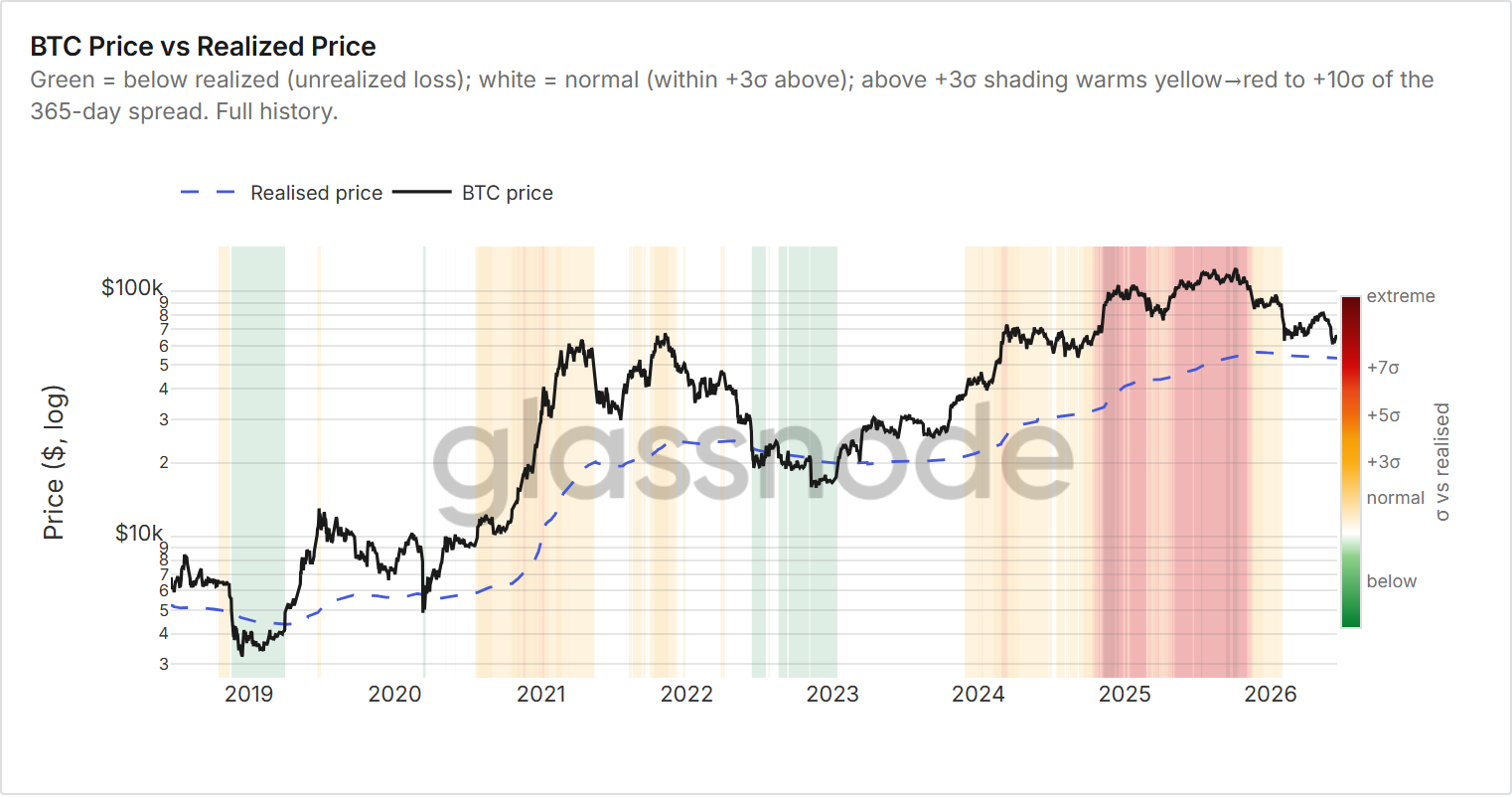
A Realized Profit/Loss Ratio at a fresh cycle low is what dragged the lens into the Capitulation band. Yet spot near $64,400 still trades well above the Realized Price around $53,500, and the chart's shading has cooled from the deep red of late 2025 back toward neutral. The stress shows up in realized-loss flows while spot holds above cost basis, which reads as a liquidity-led bounce rather than a true value bottom.

Derivatives

Derivatives measures leverage and froth: open interest against market size, the cost of carrying a perpetual, and the futures term structure. It reads 43, Light, a coiled and well-hedged book. Funding is negative, so shorts pay to stay short, and BTC implied volatility has compressed below 40, both ingredients of a squeeze.
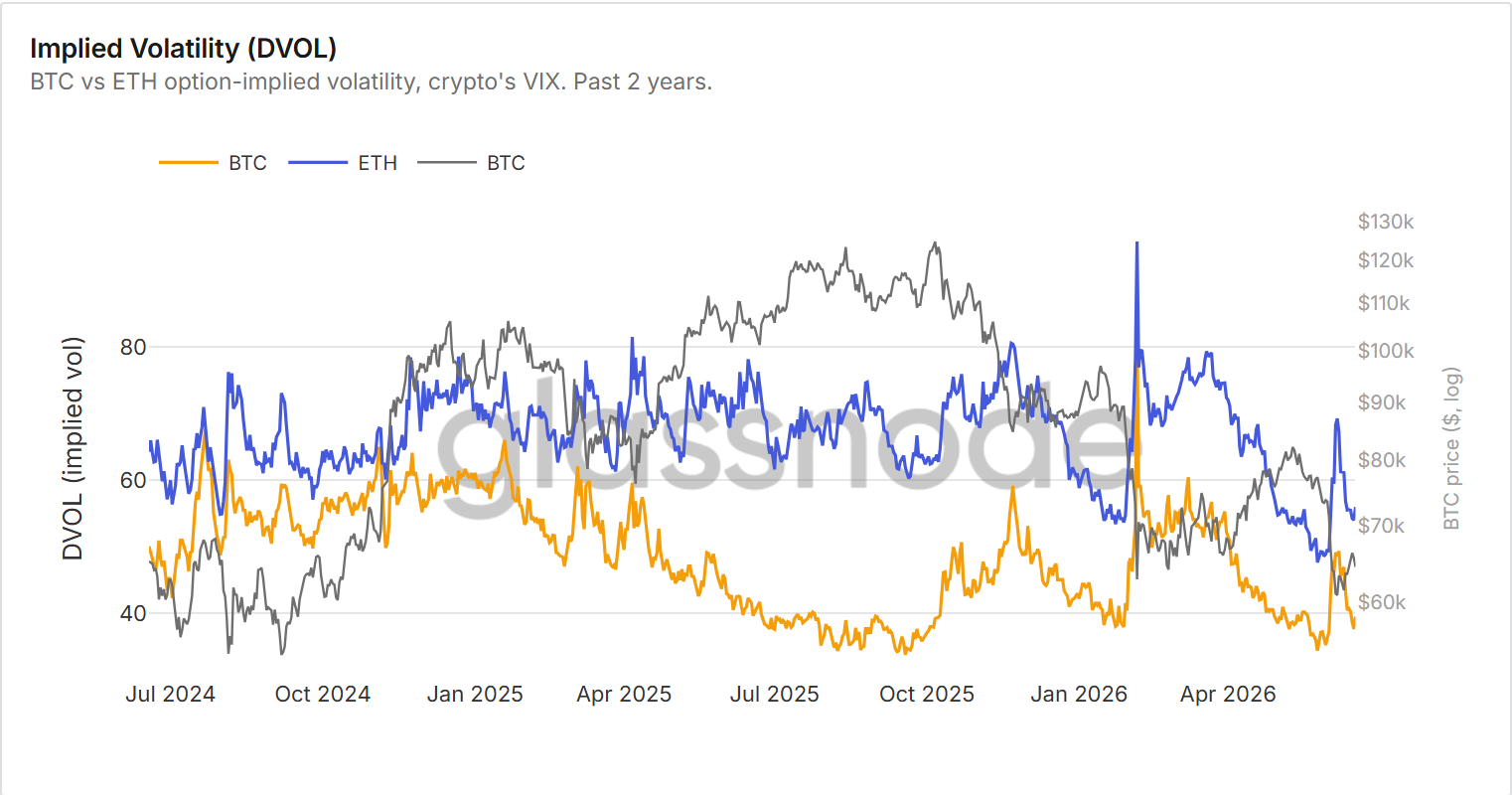
BTC and ETH option-implied volatility, crypto's VIX. BTC DVOL has compressed below 40.

The catch is that 25-delta skew is positive across every tenor, so the same desks are paying for downside protection. Positioning is coiled, not committed, and a DVOL break below 35 or back above 40 will show which way the spring releases.

Cross-Asset Rotation

Rotation reads capital moving between Bitcoin and everything else, from BTC Season to Altseason. It is the loudest reading on the board at 70, Alt-led, with the Altcoin Season Index at 87.5. That sounds like risk appetite.
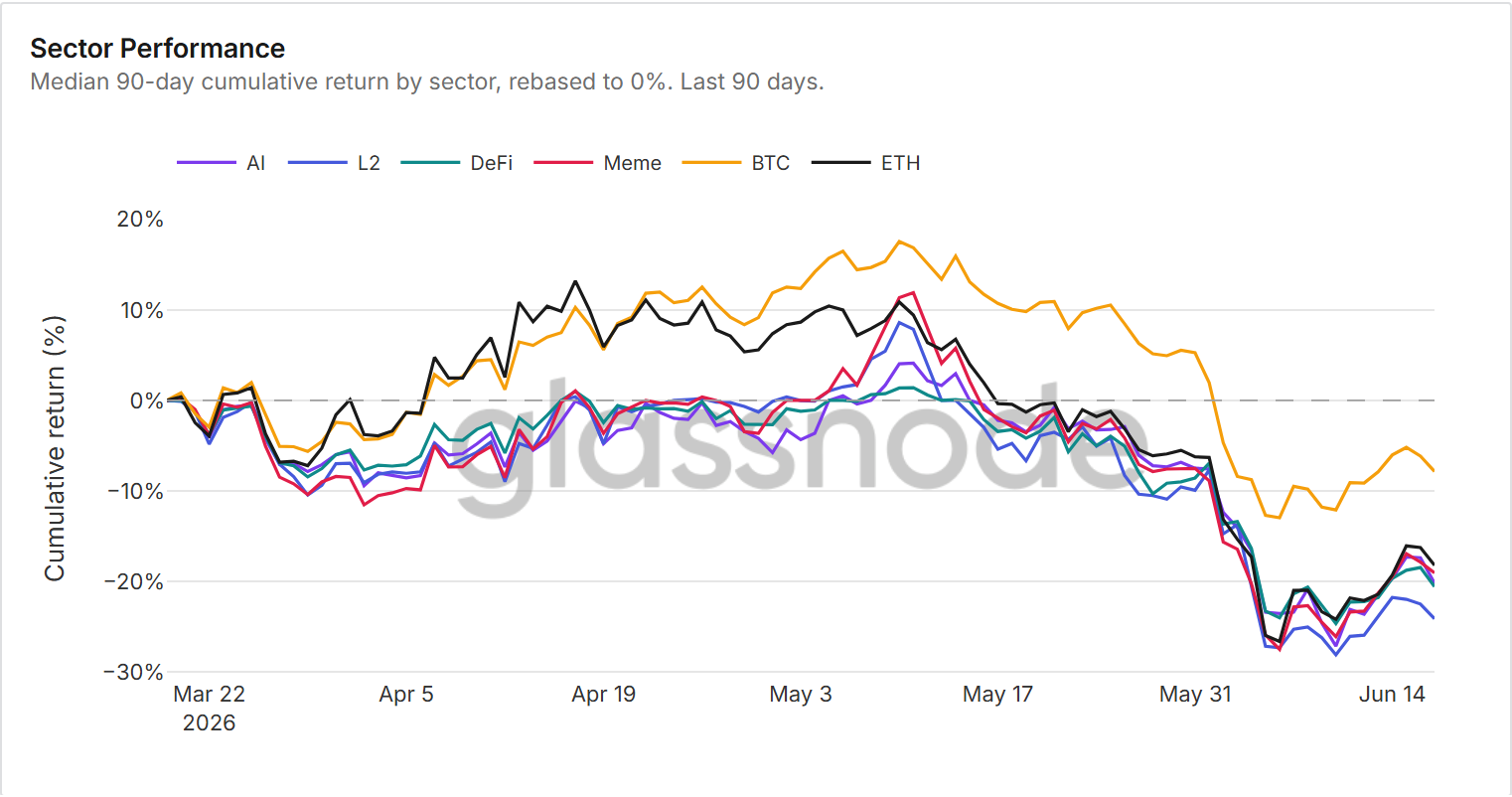
Median 90-day cumulative return by sector, rebased to zero. Every tracked sector is deeply negative.

The sector chart says otherwise: every tracked sector is down 19% to 24% over 90 days. What the index captures is outperformance by falling less, with large-cap alts down 14% on the month against Bitcoin's 16%. It marks dispersion and a relative cushion rather than a fresh bid, and because the index measures relative performance on a rolling 90-day window, the spring alt run aging out of the lookback sets up a mechanical fade even if nothing else changes.

Putting it together

Top to bottom, the Compass tells a story no single metric would. The composite at 14 is held down by Macro, and Macro is held down by a dollar trading above trend. Underneath, the forward-looking lenses are repairing as the drawdown pushes coins into stronger hands. The standalone lenses fill in the texture: a cycle washing out in flows but not valuation, a derivatives book coiled and hedged, and a rotation read that looks bullish until you notice everything is down. The honest read is bottom-fishing inside a regime that has not turned, and the one move that would turn it, a dollar back below its 200-day average, has not come.

That is the case for reading the whole board at once instead of one chart at a time.

Now live for Glassnode Advanced and Professional users, with the data refreshed daily and the written summary refreshed by our analyst team each week.

Explore the Market Compass

  • Follow us on X for timely market updates and analysis
  • Join our Telegram channel
  • For on-chain metrics, dashboards, and alerts, visit Glassnode Studio

Related Questions

QWhat is the primary purpose of the Glassnode Market Compass and what problem does it aim to solve?

AThe primary purpose of the Glassnode Market Compass is to provide a consolidated, coherent market read by synthesizing numerous complex on-chain and market indicators. It solves the problem of information overload and analysis paralysis, as Glassnode's difficulty was never finding the right metric but knowing which of the thousands to trust and what they collectively indicate on any given day.

QWhat are the two distinct groups of lenses in the Market Compass, and how are they used differently?

AThe two groups are forward-looking lenses and standalone lenses. The four forward-looking lenses (Macro, Capital Flows & Liquidity, Investor Behaviour, On-Chain Fundamentals) are averaged into the composite headline score (Risk-Off to Risk-On) as they have a historical relationship with future price direction. The three standalone lenses (Cycle Position, Derivatives, Cross-Asset Rotation) describe the current market structure and environment but are purposely kept out of the headline score as they indicate current positioning rather than future direction.

QAccording to the article's current analysis, what is the single most important threshold needed for the market regime to turn, and has it been met?

AThe single most important threshold for the market regime to turn, according to the framework, is a close of the US Dollar Index (DXY) back below its 200-day average. As of the article's analysis, this has not happened, with DXY trading about 1.7% above its 200-day average.

QHow does the 'Cross-Asset Rotation' lens reaching a score of 70 ('Alt-led') align with the actual performance of altcoin sectors described in the article?

AThere is a contradiction. While the 'Cross-Asset Rotation' lens reads a high 70 ('Alt-led'), indicating altcoin season, the underlying sector chart shows every tracked altcoin sector is down 19% to 24% over 90 days. The high index score reflects relative outperformance (e.g., large-cap alts down 14% vs. Bitcoin's 16% in a month), meaning they are falling less, not that there is fresh buying interest. It signals dispersion and a relative cushion, not a bullish altcoin bid.

QWhat is the 'honest read' or overall conclusion the Compass provides about the current Bitcoin market state as of the article's publication?

AThe honest read is that the market is in a phase of 'bottom-fishing inside a regime that has not turned.' The composite score is a deep Risk-Off 14, held down primarily by a strong US Dollar (Macro lens). While the forward-looking lenses show internal repair (e.g., coins moving to stronger hands), the standalone lenses reveal a cycle washing out in flows but not valuation, coiled derivatives positioning, and misleadingly strong rotation metrics. The overall regime remains defensive, awaiting a key catalyst (DXY dropping below its 200-day average) to signal a turn.

Related Reads

The Hunter Becomes the Hunted: The Most Profitable MEV Bot Gets Hacked

A well-known and highly profitable Ethereum MEV Bot, Jaredfromsubway.eth, suffered a sophisticated on-chain attack this Saturday, losing over $7.5 million. Analysis by Blockaid and others reveals this was not a conventional phishing or smart contract exploit, but a targeted "counter-MEV honeypot attack." The attacker meticulously laid a trap over several weeks, deploying 66 fake token contracts and liquidity pools disguised as major assets like WETH and USDC. These pools created the illusion of arbitrage opportunities. The MEV Bot's automated system detected these signals, executed trades, and in the process, granted approval permissions to attacker-controlled contracts. These approvals were not revoked, creating a persistent vulnerability. The attacker then exploited this in a single transaction, draining the bot's ETH, USDC, and USDT holdings. Jaredfromsubway.eth is notorious as one of Ethereum's most active and profitable MEV Bots, primarily known for executing "sandwich attacks" to profit from transaction slippage. Estimates suggest it has earned tens of millions in MEV revenue. The incident highlights escalating crypto security threats, demonstrating that even top-tier automated "predators" are vulnerable to novel, logic-based attacks designed to exploit their own operational rules. Following the hack, an unverified X account impersonating Jaredfromsubway.eth emerged, falsely offering a bounty for the return of funds, prompting developer warnings for users to stay vigilant.

marsbit1h ago

The Hunter Becomes the Hunted: The Most Profitable MEV Bot Gets Hacked

marsbit1h ago

The Reality of Payments in Latin America Is Not What You Think

The payment landscape in Latin America is undergoing a fundamental shift, driven by on-the-ground realities that challenge common perceptions. Based on over 500 hours of field research across the region, key insights emerge. Firstly, QR code payments, like Brazil's Pix, are becoming the dominant payment method in most emerging markets, overtaking cards. However, these domestic instant payment systems lack international interoperability, creating a significant gap for cross-border users. Secondly, the narrative around crypto cards is often misunderstood; their primary volume comes from high-net-worth professionals using them for salary conversions (e.g., USDT to local currency via Pix), not retail micro-payments. Competition in payments is shifting from customer acquisition to controlling the settlement layer, leading fintechs to acquire banking licenses for efficiency. Thirdly, treating "Latin America" as a single market is a mistake. Countries like Argentina, Brazil, and Mexico have distinct economic realities, user segments, and regulatory approaches. Brazil alone has at least five distinct user segments with different financial flows. Overlooked markets like Guatemala, Honduras, and El Salvador (the "forgotten five") offer high remittance volumes with lower competitive density. Finally, regulation in Latin America is often ahead of the US, with clearer frameworks for digital assets and a pragmatic approach from regulators focused on safety rather than obstruction. The margin on stablecoin forex is rapidly compressing toward zero, meaning future winners will be those building value-added services on top of the infrastructure, not just the cheapest exchange.

marsbit1h ago

The Reality of Payments in Latin America Is Not What You Think

marsbit1h ago

Making Music in a Bear Market: The Survival Experiment of a Bitcoin Band

"Orange Pill Jam: A Bitcoin Band's Survival in the Bear Market" Orange Pill Jam is a musical group exploring themes of financial sovereignty and privacy, born from the Bitcoin community. Formed after singer Mermaid performed her song "Dollar Apocalypse" at a 2022 conference, the band creates music intended for both Bitcoin enthusiasts and general audiences. Their creative process involves Mermaid writing lyrics and melodies, which producer/multi-instrumentalist Michi then shapes with a precise, rhythm-focused approach, often demanding numerous retakes to achieve his unique standard of timing. Their songs, like "Cypherpunks' Manifesto" and "Fire of Freedom," tackle concepts of digital privacy, the pitfalls of "free" services, and personal sovereignty, influenced by experiences in places like El Salvador. Despite operating in a crypto bear market with a Copyleft model (offering music for free sharing/remixing and accepting optional Bitcoin donations), they face practical challenges. Their growth is slow on platforms like YouTube and Spotify, which aren't optimized for their niche content. The band also navigates the rise of AI-generated music. While acknowledging AI's efficiency for certain tasks, they believe human creativity occupies a unique space that algorithms cannot replicate—the ability to create new genres and capture intangible rhythmic feeling. For Orange Pill Jam, the core argument for both Bitcoin in a downturn and human artistry in the AI age lies in this irreplaceable, intentional, and imperfectly human creative process. Their project persists as an anti-algorithm experiment, valuing the unquantifiable impact of music over scalable metrics.

marsbit1h ago

Making Music in a Bear Market: The Survival Experiment of a Bitcoin Band

marsbit1h ago

Trading

Spot
Futures
活动图片