Insurance Veteran Re-Entrepreneurship, Re Opens the Door to Reinsurance with On-Chain Protocols

Foresight NewsPublished on 2026-06-15Last updated on 2026-06-15

Abstract

Insurance veteran Karn Saroya leads Re, a protocol aiming to digitize the global reinsurance market by bridging it on-chain. It tackles high regulatory barriers by using a licensed reinsurer, Cover Re SPC, to handle compliant contracts, separating legal risk from the protocol layer. Users can deposit stablecoins into two tokenized tranches: reUSD (senior, principal-protected with fixed yield) and reUSDe (junior, higher-yield, first-loss). The protocol has secured $409 million in underlying premiums across low-volatility commercial lines like auto and workers' compensation. Re has raised $21 million from investors including Tribe Capital and Electric Capital. Its fixed-supply 1 billion RE governance token, part of an ongoing points program, is planned for a Coinbase listing. Re differentiates itself by offering non-correlated real-world asset yields, a compliant structure, and substantial scaled capital compared to peers like Nexus Mutual or Ensuro.


Author:angelilu,Foresight News


Reinsurance might be the last major financial market that has not yet been digitized. Last year, the global scale of RWA tokenization grew by more than 10 times, and the market value of stablecoins exceeded $320 billion, but the reinsurance sector has seen almost no substantial deployment of on-chain infrastructure.


One reason is the extremely high regulatory barriers. Reinsurance entities need to obtain licenses in jurisdictions, meet solvency requirements, and achieve segregated custody standards—which are difficult for ordinary DeFi teams to bypass.
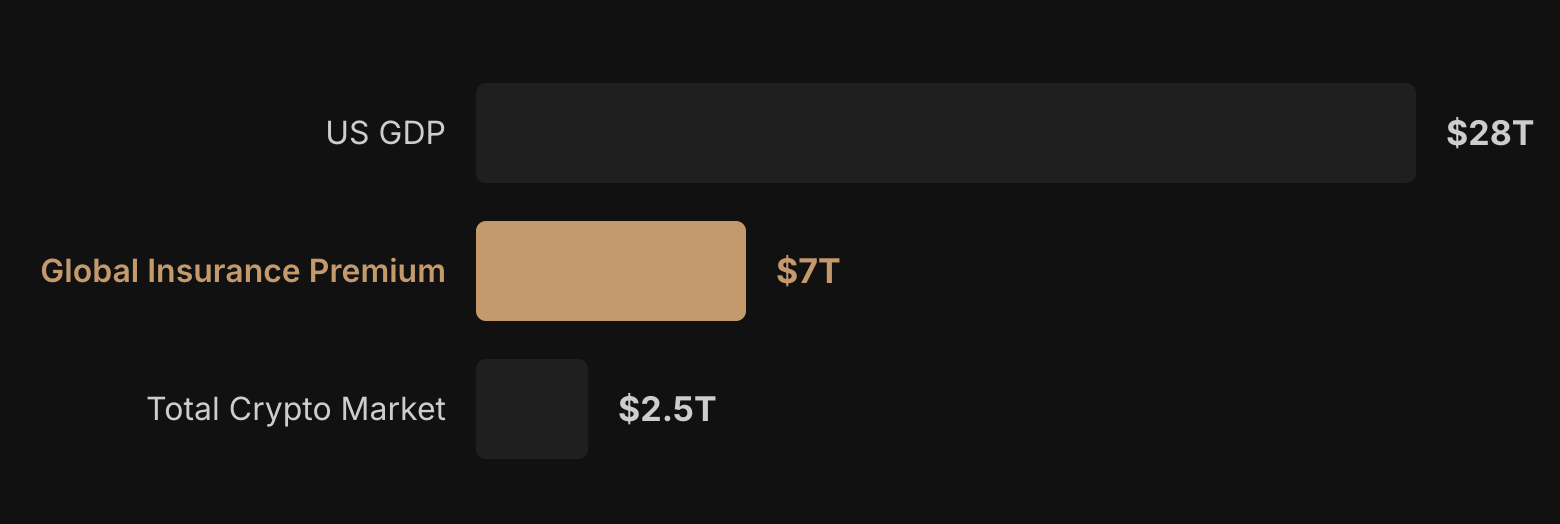


A team composed of insurance technology veterans and on-chain developers is prying open this door to the 'global reinsurance market'.


Moving Reinsurance Companies' Capital Pools On-Chain


The global reinsurance market is dominated by a few giants like Munich Re and Swiss Re, where external capital cannot enter, underwriting conditions are opaque, and solvency cannot be verified. What the Re protocol does is to move reinsurance companies' capital pools on-chain, allowing anyone to deposit money into them and earn premium income.


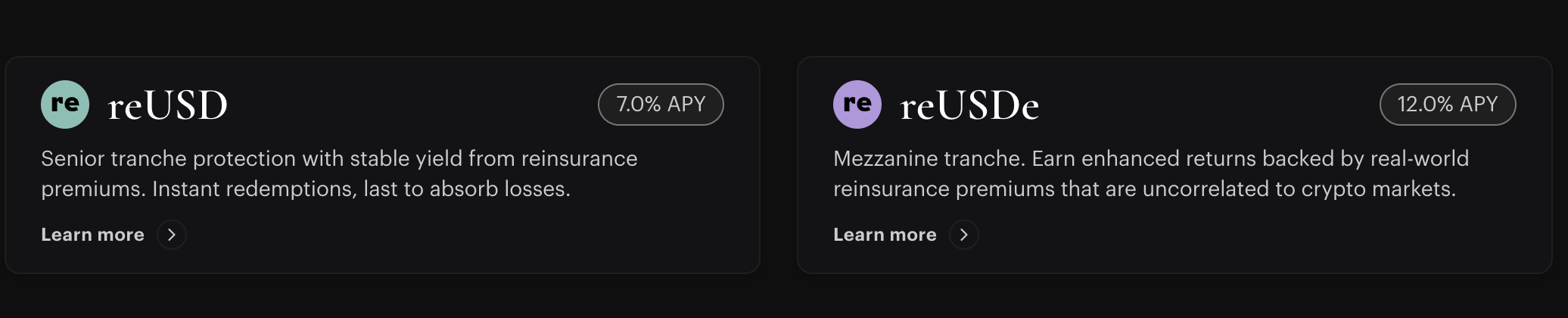
Its core model is not complicated: Insurance companies bundle part of their risks into reinsurance contracts, which are compliantly underwritten by their licensed reinsurance entity Cover Re. Decentralized liquidity providers can then deposit stablecoins into two types of tokenized tranches to earn insurance underwriting income, with the two product forms corresponding to different risk appetites:


reUSD is the senior (stable) tranche, offering principal-protected fixed income (benchmark rate + 250 basis points), with risks absorbed first by the junior tranche; reUSDe is the high-yield tranche, bearing first-loss risk, with a current highest annualized yield of about 23%. The loss absorption order is: first by reUSDe holders and Re Capital, then by reUSD.


To address the regulatory barriers, Re's solution is to separate the operation of the on-chain protocol from the licensed entity: Cover Re SPC (Cayman Islands) acts as an independent reinsurance entity to undertake compliant contracts, while the Resilience Foundation is responsible for issuing the governance token. This achieves legal separation of compliance risk from the technical risk at the protocol layer through an independent licensed entity.


Points and TGE


Re is about to launch its governance token RE. The core role of the token is to enable market participants to formulate protocol rules, but specific revenue, profits, or insurance fund flows are still operated by the licensed entity.


Re's points program aims to reward wallets that provide and store funds within the ecosystem. Its Season 1 points event recently concluded, with 7% of the total RE supply allocated to Season 1 participants. Specific claim windows and vesting mechanisms have not yet been announced. Season 2 started on June 1, 2026, currently with 2,904 active users and a total of 41.2 billion points.


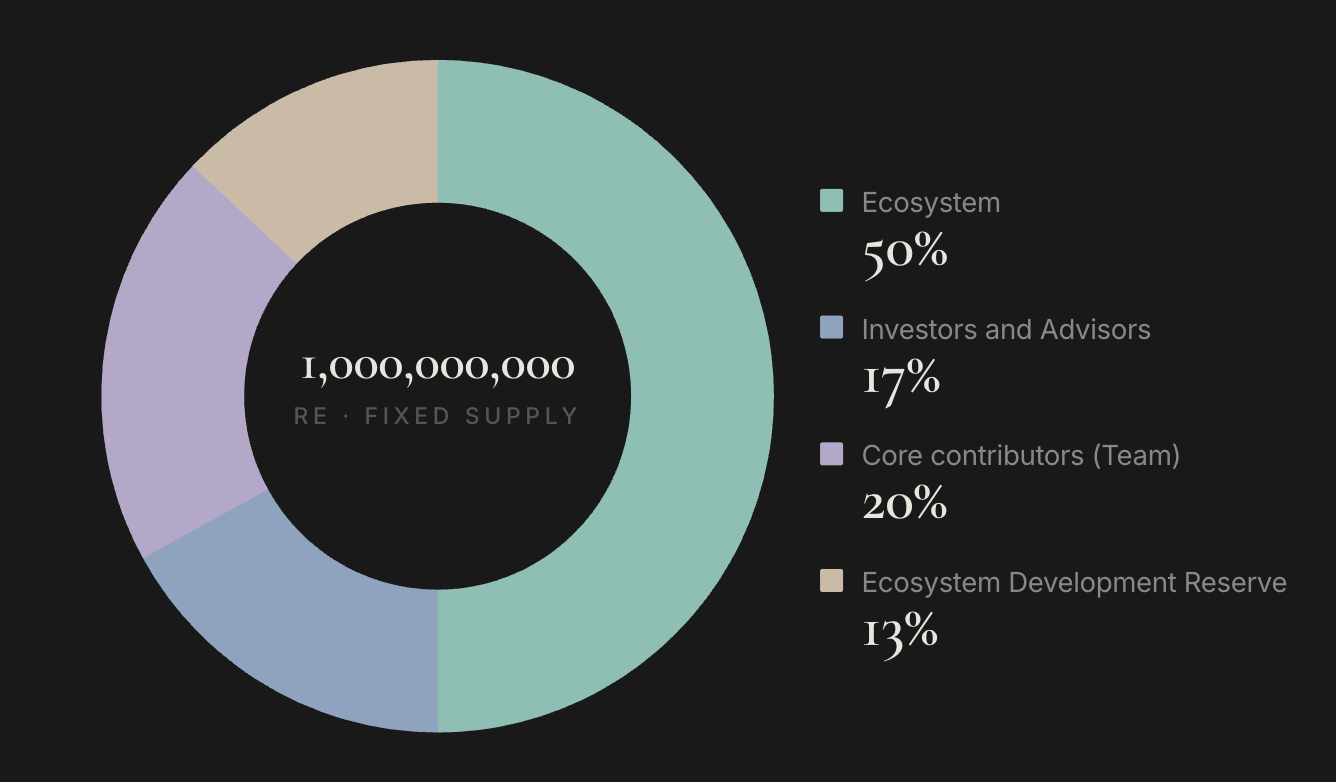
The total supply of RE is fixed at 1 billion tokens, divided into four parts:


  • Ecosystem 50%: 500 million tokens, for community incentives, points program redemptions, and other ecosystem allocations. The 7% supply for Season 1 is allocated from here.
  • Core Contributors / Team 20%: 200 million tokens, team allocation, typically with a vesting period; specific lock-up arrangements have not been announced.
  • Investors and Advisors 17%: 170 million tokens, corresponding to seed round and strategic round investors, also expected to have lock-up periods.
  • Ecosystem Development Reserve 13%: 130 million tokens, for future partnerships, protocol development, etc., managed by the foundation.


RE has been included in Coinbase's listing roadmap, but the specific TGE date has not been announced.


Re Reinsurance Data


Another major feature of Re is the low correlation of its assets. The income source of reinsurance comes from car accident rates, workplace injury occurrence rates, and property damage frequency—these numbers do not fluctuate with BTC price. When the crypto market oscillates repeatedly under geopolitical conflicts and macro policy pressures, the scarcity value of truly non-correlated assets is being repriced.


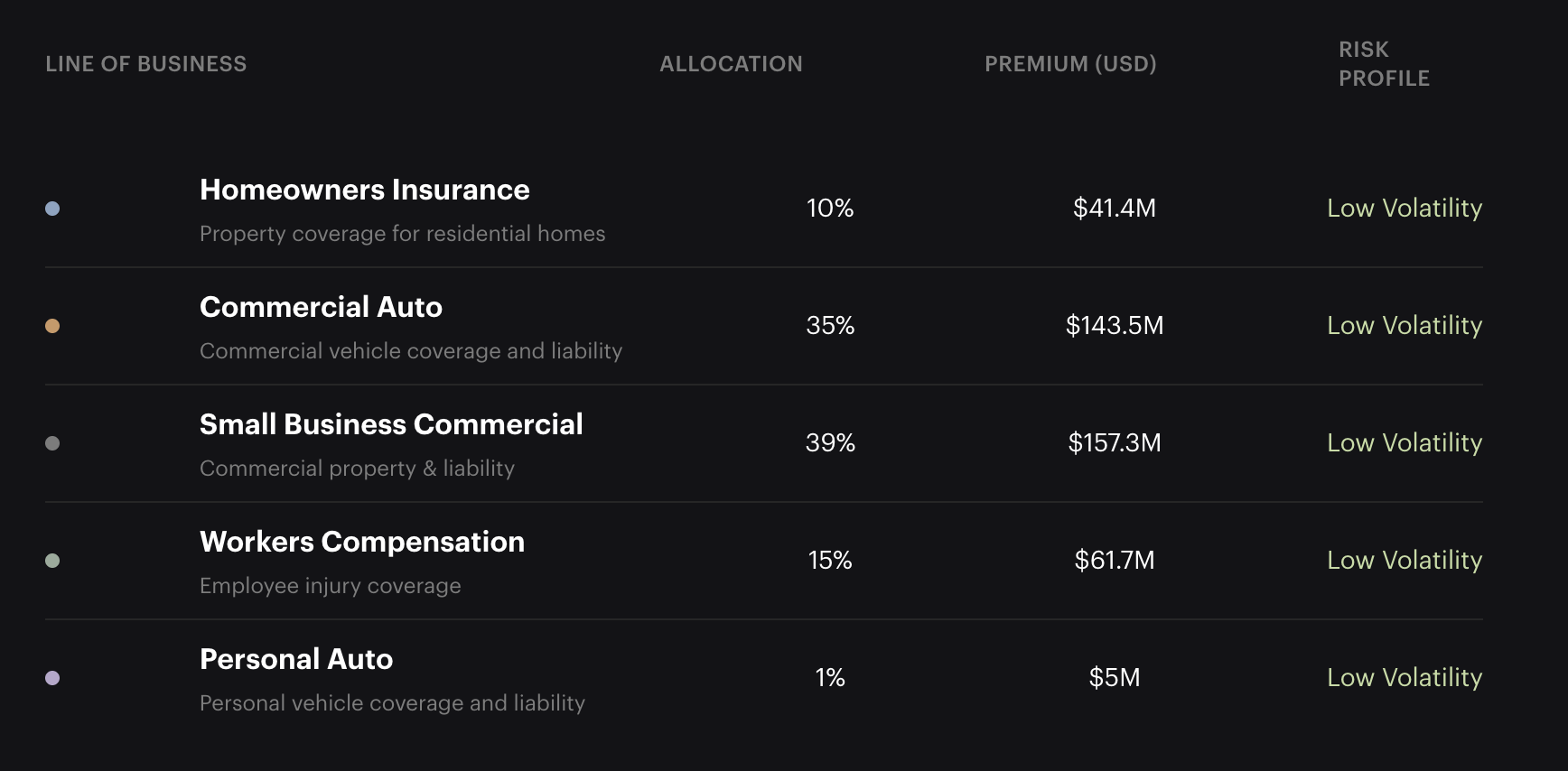
According to its official website data, as of early June 2026, its underlying underwriting portfolio totals $409 million, distributed across commercial auto insurance (35%), small business commercial insurance (39%), workers' compensation (15%), residential insurance (10%), and personal auto insurance (1%). All are in low-volatility daily insurance types, with no high-volatility catastrophic risk exposure. Each reinsurance contract is fully collateralized, with 100% cash or investment-grade assets deposited into segregated Regulation 114 trusts, and solvency can be verified on-chain.


Team and Funding


Re's CEO Karn Saroya has gone through a full round of entrepreneurial experience in the insurtech space. He previously co-founded the insurtech platform Cover, which launched in 2016, raised a total of $27 million from institutions like Exor and Tribe Capital, and later shut down due to business adjustments. Even earlier, he founded the fashion app Stylekick, which was acquired by Shopify.


Other co-founders include Anand Dhillon, Ben Aneesh, Cliff White, and Tribe Capital co-founder Arjun Sethi (the project started under the Tribe Capital crypto incubation system). The specific roles of team members have not been fully disclosed through official channels.


Re completed a $14 million seed round in September 2022, with investors including Tribe Capital, Framework Ventures, Morgan Creek Digital, global reinsurer SiriusPoint, Exor, and Stratos. Post-seed valuation was approximately $100 million. In May 2024, an additional $7 million strategic round was raised, led by Electric Capital, with participation from Nexus Mutual and Avalanche Labs, bringing total funding to about $21 million.


Competitors in the Sector


Comparable projects in the same sector have different directions.


Nexus Mutual is the longest-standing protocol in the on-chain insurance field, but it covers crypto-native risks like DeFi smart contract vulnerabilities and hacker attacks, not involving real-world insurance contracts.


Neptune Mutual focuses on parametric insurance (automatic payouts based on predefined trigger conditions), with a TVL of about $13 million. Its scale is significantly different from Re's, mainly targeting DeFi protocol security scenarios, and has not entered the real-world insurance market.


Ensuro's positioning is closest to Re's—obtaining a regulatory license in Bermuda, partnering with Nexus Mutual to connect on-chain capital with real insurance risks—but publicly disclosed scale data is limited, and it has not yet gained visibility in the mainstream market.


The core differences from the above three are: Re covers insurance types like commercial auto and workers' compensation, which have extremely low correlation with the crypto market; the compliant structure of the licensed reinsurance entity Cover Re allows institutional funds to enter legally; and the $400 million in already underwritten premium volume makes it the only on-chain protocol in this sector that has reached a real commercial scale.


Related Questions

QWhat is the main business model and value proposition of the Re protocol?

AThe Re protocol aims to digitize and open up the traditionally opaque global reinsurance market. Its core model involves transferring a reinsurance company's capital pool onto the blockchain. This allows anyone to deposit stablecoins to earn premium income from underwriting real-world insurance risks. It offers two tokenized positions: reUSD (senior/stable tranche with principal protection and fixed yield) and reUSDe (high-yield/junior tranche that absorbs first losses for higher returns). The protocol uses a licensed reinsurance entity, Cover Re SPC, to handle compliant contracts, separating regulatory risk from the protocol's technical layer.

QHow does Re protocol address the high regulatory barriers in the reinsurance industry?

ARe protocol addresses regulatory barriers by implementing a legal separation between its on-chain protocol and licensed operational entities. A licensed reinsurance entity, Cover Re SPC based in the Cayman Islands, independently underwrites compliant reinsurance contracts. The Resilience Foundation handles governance token issuance. This structure isolates the compliance and regulatory risks associated with the insurance business from the technical and operational risks of the decentralized protocol layer.

QWhat are the key characteristics of RE token's distribution and its planned use?

AThe total fixed supply of the RE governance token is 1 billion. It is distributed across four categories: 50% to the Ecosystem for community incentives and point program rewards; 20% to Core Contributors/Team; 17% to Investors and Advisors; and 13% to an Ecosystem Development Reserve managed by the foundation. Its core function is to allow market participants to govern protocol rules, while the actual insurance cash flows and income are managed by the separate, licensed operating entity. 7% of the total supply is allocated for Season 1 point program participants.

QAccording to the article, what makes the assets underlying Re protocol valuable, especially in the context of the crypto market?

AThe assets underlying Re protocol are valuable due to their low correlation with the crypto market. The protocol's yield is derived from real-world risk events like car accident rates, workplace injury frequency, and property damage—factors that do not fluctuate with Bitcoin's price. As of June 2026, its underwriting portfolio of $409 million is spread across low-volatility, everyday insurance lines like commercial auto, small business commercial, workers' compensation, and residential insurance, with no exposure to high-volatility catastrophe risks. This provides a source of non-correlated yield.

QHow does Re protocol compare to other projects in the on-chain insurance space, such as Nexus Mutual, Neptune Mutual, and Ensuro?

ARe protocol differs from competitors in several key ways: 1) It covers real-world, low-correlation insurance lines (e.g., commercial auto, workers' comp), unlike Nexus Mutual and Neptune Mutual which focus on crypto-native risks like smart contract exploits. 2) It operates through a licensed reinsurance entity (Cover Re SPC), enabling institutional participation. 3) With a $409 million underlying portfolio, it has achieved a significant commercial scale not yet seen by other protocols in this niche. Ensuro has a similar real-world insurance focus and a license, but Re currently has greater market visibility and scale.

Related Reads

SemiAnalysis Dissects Huawei's Kirin 9030: Process Technology Halted, So They Folded the Chip

SemiAnalysis has published a detailed teardown report on the HiSilicon Kirin 9030 Pro chipset found in Huawei's Mate 80 Pro. Fabricated using SMIC's most advanced N+3 node without EUV lithography, the analysis reveals significant technical achievements and strategic shifts. The report indicates SMIC's N+3 has achieved transistor density comparable to TSMC's N6 (113.4 vs 107.7 MTr/mm²), primarily through aggressive use of Self-Aligned Quadruple Patterning (SAQP) for its metal layers. This results in a notably small 32.5nm M0 metal pitch. However, SemiAnalysis notes this achievement comes with significantly higher process complexity, cost, and potential yield challenges compared to competitors using more advanced tools. The Kirin 9030 design maximizes this constrained density. While its GPU performance has improved ~70% and matches Qualcomm's 2022 flagship level, the CPU core's IPC lags behind current top-tier designs from Apple and Qualcomm, a gap attributed to the underlying manufacturing technology rather than design capability. Facing long-term restrictions on advanced tools, Huawei is charting a new path. The report highlights the company's "LogicFolding" roadmap, a 3D stacking technique aimed at shortening signal paths to boost performance and efficiency. The goal is to reach 5GHz frequency and a projected density of 295 MTr/mm² by 2031. SemiAnalysis concludes that export controls have not halted China's chip progress but have fundamentally altered its trajectory, making it more expensive and complex. This has spurred innovation in alternative areas like 3D stacking and domestic EDA tool development, with Huawei's supply chain also beginning to integrate Chinese memory from CXMT.

marsbit32m ago

SemiAnalysis Dissects Huawei's Kirin 9030: Process Technology Halted, So They Folded the Chip

marsbit32m ago

How Will the Price Move Before SpaceX's Next Share Unlock?

TL;DR Investors buying SPCX after SpaceX's IPO are not simply investing in a typical tech stock. It’s a high-valuation asset driven by Musk's narrative, Starlink, and space transport potential, but with a key twist: a very small initial float of ~4% has led to significant post-listing price appreciation. The current price action reflects a timing gap. Before the first lock-up expiration (estimated around August, subject to official confirmation), scarcity and high demand could continue to push prices up. Short-term bulls focus on low float, FOMO, and potential index inclusion. However, bears point to the supply dynamics that will change post-lockup. Existing shareholders still hold over 95% of shares, which will be released in stages starting from the first unlock window. This introduces future selling pressure from low-cost holders. The upcoming Q2 earnings report is a critical catalyst before the unlock. It will test whether the company's fundamentals can justify the current ~$2.1T valuation. Strong results could support the pre-unlock momentum, while weak figures could amplify concerns about future supply. The trading thesis is shifting from immediate scarcity ("can't buy enough") to evaluating future absorption capacity ("who will buy when more supply hits"). The path ahead hinges on the specifics of the unlock schedule, Q2 earnings performance, and whether anticipated passive index buying materializes.

marsbit52m ago

How Will the Price Move Before SpaceX's Next Share Unlock?

marsbit52m ago

Bitcoin Short-Term Bullish Structure Validated, HYPE Low-Entry Window Opens | Guest Analysis

**Market Analysis Summary (Week of June 2026)** **Overall Market Context:** The market environment is exceptionally complex, with the unexpected US-Iran agreement and the reopening of the Strait of Hormuz triggering a global asset repricing and significant volatility. This heightened noise underscores the importance of a structured analytical framework. **Bitcoin (BTC) Analysis & Strategy:** * **Current Status:** The price has climbed above $65,000, currently in a rebound phase (segment 38-39) following a complex 12-segment correction from the May high of $82,850. * **Key Levels:** * **Primary Resistance:** $69,500–$70,500. A successful breakout above $65,000 targets this zone. * **Primary Support:** $65,000 (immediate), followed by $59,000–$60,000 and $55,000. * **Weekly Outlook & Strategy:** The focus is on the confirmation of the $65,000 level. * **Bullish Scenario (Hold $65K):** A move toward the $69.5K–$70.5K resistance zone is anticipated, which is a potential area for initiating medium-term short positions. * **Bearish Scenario (Break below $65K):** A retest of the $60,000–$62,000 support range is likely. * **Medium-Term Strategy:** Currently neutral. Plan to establish short positions (up to 60% allocation) either in the $69.5K–$70.5K resistance zone upon signs of rejection, or on a confirmed breakdown below $65,000 and further below $59K–$60K. * **Short-Term Strategy:** Utilize 30% capital for scalping opportunities based on support/resistance levels, using 30/60-minute charts. **HYPE Analysis & Strategy:** * **Current Status:** The price has stabilized around $52 after a four-segment decline from the June high of $75.87 and is now in a rebound (segment 50-51). * **Key Levels:** * **Primary Resistance:** $62.50–$64.57. Watch for potential rejection here to form a lower high. * **Primary Support:** $52–$55.50, followed by $47–$49. * **Weekly Outlook & Strategy:** Adopt a "buy on dips, avoid chasing rallies" approach. * **Core View:** Monitor the price action and potential formation of a lower high ("endpoint 51") in the $62.50–$64.57 resistance zone. * **Short-Term Strategy:** Consider light long positions (max 30% allocation) if the price finds support and shows reversal signals in the $52–$54.50 or deeper $47–$49 support zones, confirmed by proprietary quantitative bottom signals. **Trade Review:** Last week's HYPE short-term long trade, executed based on proprietary "Price Difference" and "Momentum" model signals, yielded a profit of approximately 11.88%. The entry was near $54.39 and exit near $60.85. **Risk Management Reminder:** Always set an initial stop-loss upon entry. Move stop-loss to breakeven at +1% profit, then trail it upwards to lock in gains as the trade progresses. *Disclaimer: All analysis, models, and strategies are based on personal technical analysis for educational purposes only, not investment advice. The market carries inherent risk.*

Odaily星球日报57m ago

Bitcoin Short-Term Bullish Structure Validated, HYPE Low-Entry Window Opens | Guest Analysis

Odaily星球日报57m ago

Bitcoin Short-Term Bullish Structure Validated, HYPE Accumulation Window Opens | Guest Analysis

**Bitcoin and HYPE Market Analysis: Short-Term Outlook and Trading Strategies** This market analysis examines Bitcoin (BTC) and HYPE amid volatile conditions, providing short-term outlooks and specific trading strategies. **Key Outlooks:** * **Bitcoin (BTC):** Focus is on whether BTC's recent move above $65,000 holds. A successful breakout could lead to a test of the $69,500-$70,500 resistance zone, where medium-term short positions are considered. A failure, breaking below $65,000, may trigger a decline towards the $59,000-$60,000 support area. * **HYPE:** The token completed a four-wave correction and is now rebounding. The key resistance zone is $62.5-$64.57. The trading strategy is "buy on dips," looking for entry opportunities near the $52-$54.5 or deeper $47-$49 support zones, pending confirmation from proprietary models. **BTC Trading Strategy:** * **Medium-term:** Primarily looking to establish short positions (up to 60% allocated capital) if price rallies to the $69,500-$70,500 resistance area and shows signs of reversal. Alternative plans involve initiating shorts on a breakdown below $65,000. * **Short-term:** Allocate up to 30% capital for intraday "spread" trades based on support/resistance levels on 30/60-minute charts. **HYPE Trading Strategy:** * **Short-term:** Adopt a dip-buying approach. Consider light long positions (under 30% capital) when price tests key support levels ($52-$54.5 or $47-$49) and shows stabilization, confirmed by proprietary "Price Spread" and "Momentum Quant" models. **Trade Recap:** The analysis reviews a successful HYPE long trade from the previous week, executed at ~$54.39 and closed at ~$60.85 for an ~11.88% gain, based on signals from the aforementioned models. **Risk Management Emphasis:** The article stresses strict capital allocation (under 30-60%), immediate initial stop-loss placement, and a trailing stop-loss protocol to lock in profits as trades move favorably. ***Disclaimer:** All analysis, models, and strategies are for educational purposes based on technical analysis, not investment advice. Markets are volatile; trade with caution.*

marsbit1h ago

Bitcoin Short-Term Bullish Structure Validated, HYPE Accumulation Window Opens | Guest Analysis

marsbit1h ago

Trading

Spot
Futures
活动图片




