In-Depth Analysis of Coinbase's Transformation into an 'Everything Exchange'

比推Published on 2025-12-19Last updated on 2025-12-19

Abstract

The article "Coinbase's Walled Garden" analyzes the company's strategic pivot from being a simple crypto on-ramp to an "Everything Exchange." Historically, Coinbase derived over 90% of its revenue from transaction fees, but as that business faced pressure from fee compression and volatile trading volumes, it has diversified. Now, less than 55% of revenue comes from trading. Coinbase's new strategy bets on aggregation over specialization, integrating stock trading, prediction markets, and perpetual contracts into its platform. The thesis is that once users complete KYC and link a bank account, they prefer the efficiency of a single platform rather than managing multiple specialized apps. This approach aims to capture more user engagement and revenue streams through various fees, spreads, interest, and subscriptions. A key engagement tool is prediction markets (like those from Kalshi), which provide social, event-driven reasons for users to stay active on the app even during stagnant crypto markets. The long-term differentiator could be Base, Coinbase's Layer 2 blockchain, which might enable true on-chain stock trading and programmable money. Ultimately, Coinbase is prioritizing scale over purity, targeting mainstream users who value convenience over decentralization. The goal is to create a "walled garden" held together by convenience—where the friction of leaving outweighs the benefits of using best-in-class specialists—similar to Amazon’s strategy of being "good enough" a...

Author: Thejaswini M A

Original Title: Coinbase's Walled Garden

Compiled and Edited by: BitpushNews


Across different industries, eras, and every market that has ever existed, there is a recurring pattern. First comes explosive growth: a thousand flowers bloom, with every participant claiming they can do a specific job better than others. Specialists proliferate, niche tools multiply. Consumers are told that 'choice is freedom' and 'customization is power,' and that the future belongs to disruptors who break apart monolithic giants.

Then, quietly, the pendulum inevitably swings back.

This isn't because the specialists were wrong, nor because the giants are so great. It's because fragmentation carries an invisible, compounding cost. Each additional tool means another password to remember, another interface to learn, another potential point of failure in the system you're responsible for maintaining. Sovereignty begins to feel like 'work,' and freedom starts to feel like an 'administrative burden.'

In the consolidation phase, the ultimate winners aren't those who do every single thing perfectly. They are those who do enough things well enough that the friction cost of leaving (and rebuilding the entire system elsewhere) becomes insurmountable. They don't trap you with contracts or lock-in periods. They trap you with convenience. Through countless minor integrations and tiny efficiencies, these drips—none of which are worth leaving over on their own—collectively form a moat.

We've seen this in e-commerce. It happened in cloud computing, and in streaming. Now, we're watching it play out in finance.

Coinbase has just placed its bet on the phase of the cycle we're entering.

Background Context

For most of its existence, Coinbase's positioning was clear. It was the place for Americans to buy Bitcoin without feeling like they were committing some vague crime. It had regulatory licenses, a clean interface, and customer support that, while often criticized, at least theoretically existed. In 2021, the company went public with a $65 billion valuation, its logic being that it was the 'on-ramp to crypto.' For a while, that logic held.

But by 2025, being the 'on-ramp to crypto' started to look like a bad business. Spot trading fees were being compressed. Retail trading volume was intensely cyclical: surging in bull markets, collapsing in bear markets. Bitcoin maximalists were increasingly comfortable with self-custody wallets. Regulators were still suing the company. Meanwhile, Robinhood, which started with stock trading and moved into crypto, suddenly had a market cap of $105 billion, nearly double that of Coinbase.

In 2021, over 90% of Coinbase's revenue came from trading commissions. By Q2 2025, that figure had fallen to under 55%.
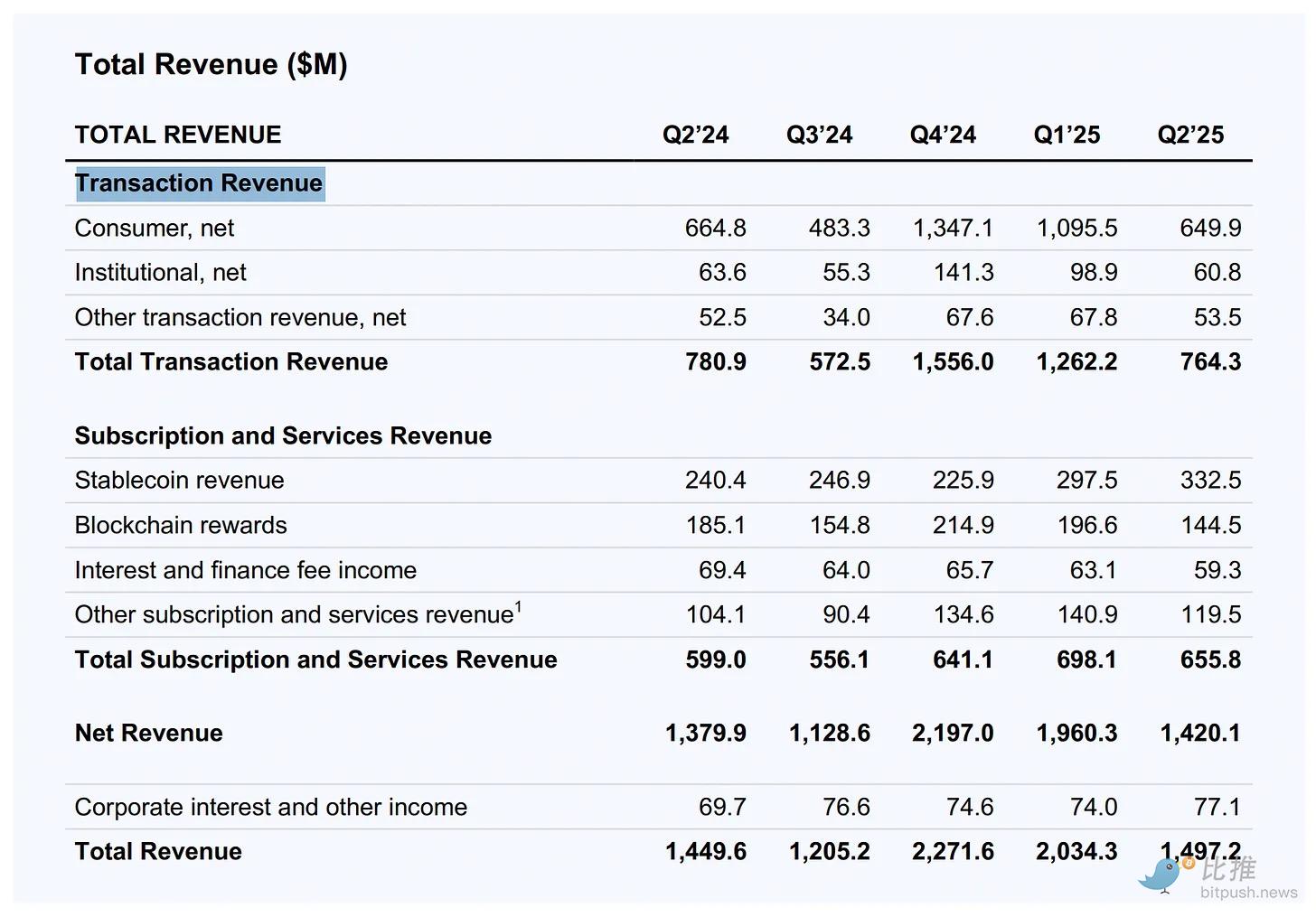
So, Coinbase did what you do when your core product is under pressure: it tried to become 'everything else.'

The "Everything Exchange" Thesis

The so-called 'Everything Exchange' thesis is a bet: aggregation beats specialization.

  • Stock trading means users can now react to Apple's earnings at midnight using USDC, without leaving the app.

  • Prediction markets mean they can check the price of 'Will the Fed cut rates?' over lunch.

  • Perpetual contracts mean they can slap 50x leverage on their Tesla position on a Sunday.

Each new feature module is another reason to open the app, another opportunity to capture spreads, fees, or stablecoin interest on idle balances.

Is the strategy 'Let's become Robinhood,' or 'Let's ensure our users never need Robinhood'?

There's an old view in fintech: users want specialized apps. One for investing, one for banking, one for payments, one for crypto. Coinbase is betting the opposite: once you've done KYC once and linked a bank account once, you don't want to do it nine more times elsewhere.

This is the 'aggregation beats specialization' argument. In a world where the underlying assets are increasingly tokens on a blockchain, it makes a lot of sense. If stocks are tokens, prediction market contracts are tokens, and meme coins are tokens, why shouldn't they all trade in the same venue?

The mechanical logic is: you deposit dollars (or USDC), you trade everything, you withdraw dollars (or USDC). No cross-chain transfers between platforms, no minimum balance requirements across multiple accounts. Just one pool of capital flowing between asset classes.

The Flywheel Effect

The more Coinbase acts like a traditional broker, the more it must compete on traditional broker terms. Robinhood has 27 million funded accounts, while Coinbase has about 9 million monthly transacting users. The competitive differentiation can't just be 'we have stocks too'; it must be in the underlying rails.

The promise is 24/7 liquidity for everything. No market close times, no settlement delays. No waiting for broker approval on your margin request when the market moves against you.

Does this matter to most users? Probably not yet. Most people don't need to trade Apple stock at 3 a.m. on a Saturday. But some do. If you're the venue that lets them do it, you capture their flow. Once you have flow, you have data. With data, you build better products. With better products, you get more flow.

It's a flywheel, provided the flywheel spins.

The Gamble on Prediction Markets

Prediction markets are the most unusual part of this bundle, and perhaps the most important. They aren't 'trading' in the traditional sense but organized betting on binary outcomes: Will Trump win? Will the Fed hike rates? Will the Lakers make the playoffs?

Contracts vanish after settlement, so there's no long-term holder base. Liquidity is event-driven, meaning it's bursty and unpredictable. Yet, platforms like Kalshi and Polymarket saw monthly volume surge past $7 billion in November.
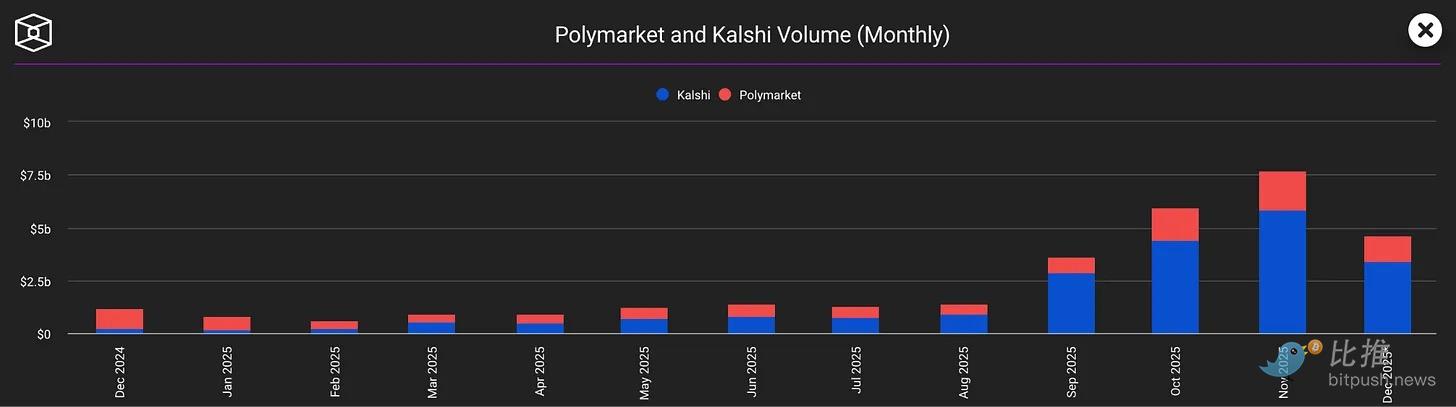
Why? Because prediction markets are social tools. They are a way to express an opinion with chips on the table. They are a reason to check your phone during the fourth quarter of a game or on election night.

For Coinbase, prediction markets solve a specific problem: engagement. Crypto gets boring when prices are flat. Stocks get boring when your portfolio just sits there. But there's always an event happening in the world that people care about. Integrating Kalshi gives users a reason to stay in the app even when Bitcoin isn't moving.

The bet is: users who come for election markets will stay to trade stocks, and vice versa. More feature surface area equals higher user stickiness.

The Business Model's Core: Profit Margins

Strip away the innovative narrative, and what you really see is a company trying to monetize the same user in more ways:

  • Transaction fees from stock trading

  • Spreads from DEX (decentralized exchange) swaps

  • Interest on stablecoin balances

  • Lending fees from crypto-backed loans

  • Subscription revenue from Coinbase One

  • Infrastructure fees from developers using the Base blockchain

This isn't a criticism. This is how exchanges work. The best exchanges aren't the ones with the lowest fees; they're the ones users can't leave—because leaving means rebuilding the entire system elsewhere.

Coinbase is building a walled garden, but the walls are made of convenience, not forced lock-in. You can still withdraw your crypto, you can still transfer your stocks to Fidelity. But you probably won't, because why bother?

Base: The Real Game Changer

Coinbase's advantage was supposed to be its 'on-chain-ness.' It could offer tokenized stocks, instant settlement, and programmable money. For now, its stock trading looks like Robinhood's, just with extended hours; its prediction markets look like Kalshi's, just embedded in a different app.

The real differentiation must come from Base—the Layer 2 blockchain that Coinbase built and controls. If stocks truly flow on-chain, if payments truly use stablecoins, if AI agents truly start trading autonomously using protocols like x402, then Coinbase has built something Robinhood can't easily replicate.

But this is a long-term story. In the short term, the competition is about whose app is the stickiest. And adding more features is not the same as adding stickiness. It can also make the app messy, confusing, and intimidating to new users who just want to buy some Bitcoin.

Scale vs. Purity

A segment of crypto users will hate all of it: the true believers. Those who wanted Coinbase to be the on-ramp to decentralized finance (DeFi), not a centralized 'super app' that happens to bury some DeFi functions in a submenu.

Coinbase has clearly chosen scale over purity. It wants a billion users, not a million purists. It wants to be the default financial venue for the masses, not the favored exchange of those who run their own nodes.

This is probably the correct business decision. The mass market doesn't care about decentralization. The mass market prioritizes convenience, speed, and avoiding financial loss. If Coinbase can deliver that, the underlying philosophy doesn't matter.

But it does create a peculiar tension. Coinbase is both trying to be infrastructure for the on-chain world and a centralized exchange competing with Schwab; it's both trying to be a defender of crypto and a company working to make crypto 'invisible'; it wants to be both rebellious and compliant.

Maybe this is possible. Maybe the future is a regulated, on-chain exchange that feels like using Venmo. Or perhaps, trying to be everything to everyone means you end up being nothing special to anyone.

This is the Amazon strategy. Amazon isn't the best at any single thing: it's not the best bookstore, not the best grocer, not the best streamer. But it's 'good enough' at all of them that most people can't be bothered to go elsewhere.

Yet, many companies have tried to build 'everything apps,' and most have just built a messy app.

If Coinbase can capture the full loop of 'earn, trade, hedge, borrow, pay, recycle,' then it won't matter if individual features are slightly worse than specialized competitors. The switching costs and the hassle of managing multiple accounts will keep users inside the ecosystem.

That's what the Coinbase 'Everything Exchange' is all about.


Twitter:https://twitter.com/BitpushNewsCN

Bitpush TG Discussion Group:https://t.me/BitPushCommunity

Bitpush TG Subscription: https://t.me/bitpush

Original article link:https://www.bitpush.news/articles/7597167

Trending Cryptos

Related Questions

QWhat is the core hypothesis behind Coinbase's 'Everything Exchange' strategy?

AThe core hypothesis is that aggregation will beat specialization. Coinbase is betting that once users complete KYC and link a bank account, they won't want to repeat the process elsewhere. The strategy aims to become a one-stop shop where users can trade a wide variety of assets (crypto, stocks, prediction markets) using a single pool of funds, thereby creating a powerful convenience factor that acts as a moat.

QHow has Coinbase's revenue composition changed from 2021 to 2025 Q2?

AIn 2021, over 90% of Coinbase's revenue came from trading commissions. By the second quarter of 2025, that proportion had fallen to below 55%.

QWhat role do prediction markets play in Coinbase's new strategy?

APrediction markets are a key part of Coinbase's strategy to solve the problem of user engagement. They provide a social, event-driven reason for users to stay in the app even when crypto or stock prices are flat, thereby increasing overall platform stickiness.

QWhat is the significance of Base, Coinbase's Layer 2 blockchain, in its long-term plan?

ABase is considered Coinbase's true killer app and its source of long-term differentiation. If assets like stocks flow on-chain, payments use stablecoins, and autonomous agents trade, Base provides an infrastructure that traditional competitors like Robinhood cannot easily replicate.

QWhat is the primary trade-off Coinbase has made with its 'Everything Exchange' approach?

ACoinbase has chosen scale over purity. It is prioritizing becoming the default financial venue for the mass market (aiming for 1 billion users) by offering convenience, rather than catering to a smaller group of crypto purists (1 million users) who prioritize decentralization and ideological purity.

Related Reads

Weekly Editor's Picks (0725-0731)

Weekly Editor's Picks (0725-0731) provides a curated selection of deep analysis, filtering out market noise. Key themes from this week include: **Macro & Policy:** The Federal Reserve's upcoming meeting is marked by high uncertainty, balancing cooling inflation data against persistent price pressures. Meanwhile, the U.S. crypto regulatory Clarity Act faces critical political hurdles, with its 2026 passage probability seen as low. **Investing & Crypto:** Analysis suggests long-term crypto success depends on conviction through volatile cycles, focusing on assets like Bitcoin and core smart contract platforms. A trend noted is the increasing similarity between global equity markets (especially tech) and crypto, driven by narrative and leverage. Several major crypto protocols show strong revenue growth, but this isn't always translating to token price appreciation due to sell pressure and structural factors. **AI & Semiconductors:** Nvidia's rising credit default swap rates signal market concern over AI infrastructure financing risks. The storage sector experienced volatility as markets began pricing in potential 2027 oversupply. Despite a record profitable quarter, SK Hynix's results were deemed "below expectations," reflecting heightened investor demands for future growth visibility. **Markets & DeFi:** TradeXYZ demonstrated remarkable accuracy in pre-market pricing for a major A股 listing. The token ONDO saw gains, linked to its growing role in the on-chain tokenized stock ecosystem. **Ethereum:** Post-Pectra upgrade, a major structural shift is underway as Lido begins migrating millions of ETH to new validator architectures designed for capital efficiency. **Also Highlighted:** Butian's bullish stock market move; OpenAI's Altman promising major advances; Samsung and SK Hynix securing large AI chip deals; Apple reaching a $5T market cap; and ongoing discussions around exchange security following Poolin's bankruptcy case.

marsbit17m ago

Weekly Editor's Picks (0725-0731)

marsbit17m ago

Low Investment Isn't Apple's Immunity Pass

While Meta and Google face investor scrutiny over ballooning AI capital expenditures, Apple's minimal AI investment has paradoxically become a strength. Its market cap recently reclaimed the global top spot, surpassing $5 trillion. The irony is deep: Apple's own AI efforts have lagged, with "Apple Intelligence" delayed and core talent lost, forcing reliance on partners like Google Gemini and Alibaba's Qianwen. Its Q3 FY2026 (Q2 CY) earnings initially seemed stellar. Revenue hit $109.4B (up 16% YoY), with iPhone and Mac sales, growing 22% and 29% respectively, driving most of the growth. However, the stock fell over 8% post-earnings. The primary concern was a weaker Q4 revenue growth forecast of 9-11%, below expectations, due to looming supply chain constraints. Apple is feeling the indirect cost of the AI boom. Soaring memory and chip prices, fueled by massive data center investments from Microsoft, Amazon, and others, are forcing Apple to raise Mac and iPad prices significantly. The upcoming iPhone launch is also expected to see substantial price hikes. Despite avoiding heavy AI infrastructure spending—its capital expenditures are actually down 28%—Apple cannot escape the industry-wide supply and cost pressures. While Apple's operating cash flow remains robust, its substantial R&D spending (up 32% YoY) has yet to yield major AI breakthroughs. As Tim Cook prepares to step down as CEO, Apple faces a challenging transition: balancing its premium hardware success against the strategic and cost pressures of the AI era it has so far cautiously navigated.

marsbit1h ago

Low Investment Isn't Apple's Immunity Pass

marsbit1h ago

PA Graphics Explanation | One Chart to Understand the Major Web3 Events in August 2026

**PANews Crypto Calendar: Key Web3 Events in August 2026** PANews introduces its revamped crypto calendar, featuring comprehensive coverage, flexible filtering, and easy export options. The market in August will be shaped by multiple key events across macroeconomics, regulation, tokenomics, and project developments: * **Macro & Policy:** Key US economic data releases (July Non-Farm Payrolls, CPI), the Federal Reserve meeting minutes, and the Jackson Hole Economic Symposium will be in focus. On the regulatory front, the US Senate plans to release a new draft of the *CLARITY Act*, while the EU's expanded crypto ban against Belarus comes into effect. * **Token Unlocks:** Significant token unlocks are scheduled for assets including ENA, AVAX, CONX, ZRO, and KAITO, which may influence market volatility. * **Project Updates & Shutdowns:** Several services, including Exchange Art, Ctrl Wallet, Zapper, NFTfi, and Summer.fi, are set to cease operations or undergo major adjustments. Users are advised to manage their assets accordingly. * **Corporate Activity:** Q2 earnings reports from companies like SpaceX, Circle, and Nvidia are due. Unitree Robotics will initiate its IPO subscription on the STAR Market, and Moonshot AI plans to begin a Pre-IPO financing round. * **Industry Events:** Major conferences such as Bitcoin Asia 2026 and the 2026 Digital Expo will take place. The overarching market narrative for August will revolve around macroeconomic expectations, regulatory developments, token unlock schedules, and ongoing industry consolidation.

marsbit1h ago

PA Graphics Explanation | One Chart to Understand the Major Web3 Events in August 2026

marsbit1h ago

Wall Street's Most Famous 'Cassandra' Now Has His Sights Set on Nvidia

Michael Burry, the famed "Big Short" investor, has once again captured Wall Street's attention with a series of short positions against major tech and semiconductor stocks, most notably Nvidia. In late June and July, through his "Cassandra Unchained" newsletter, Burry disclosed short bets against Nvidia, Tesla, Applied Materials, Caterpillar, the SOXX semiconductor ETF, and later, Micron Technology. His core thesis revolves around potential distortions in the AI infrastructure boom, specifically questioning whether extended depreciation schedules (e.g., 6 years vs. a realistic 2-3 years for AI chips) by cloud giants like Microsoft and Google artificially inflate profits. He also raises concerns about possible "off-balance-sheet circular financing," where chip demand might be propped up by vendor-backed funding to clients. Nvidia's stock experienced volatility following these disclosures, briefly dipping but largely holding near Burry's reported entry points, leaving his positions roughly flat or slightly underwater as of late July. This move is part of a pattern for Burry, whose track record since his legendary 2008 bet is mixed. He has faced notable losses, such as on Tesla in 2021, while scoring on broader market turns like the 2020 pandemic crash. His methodology focuses intensely on free cash flow and scrutinizing original financial documents to spot overvaluation and structural risks, but it often struggles with timing the market. The article contrasts Burry's stance with other prominent investors. Steve Eisman, another "Big Short" figure, is not shorting Nvidia, citing strong fundamentals but expressing nervousness about sustainability. Jim Chanos agrees with the broad "accounting mismatch" concern—comparing it to the dot-com bubble—but targets financial leverage in private equity firms rather than the chip stocks themselves. While Nvidia's short interest remains relatively low at 1.3-1.4% of float, the massive stock size means absolute short losses have been significant, exceeding $5 billion earlier this year. The piece concludes that for ordinary investors, the key takeaway is not replicating specific short bets but learning from the critical frameworks these investors use: questioning rosy accounting, identifying structural vulnerabilities, and maintaining skepticism during market euphoria, even if pinpointing the exact catalyst for a downturn remains elusive.

marsbit1h ago

Wall Street's Most Famous 'Cassandra' Now Has His Sights Set on Nvidia

marsbit1h ago

Weekly Selection丨Epic Stock Market Volatility, Changxin Tech's IPO Reshapes Storage Landscape, Saylor Aims to Re-Anchor STRC Around September 8th

PANews Weekly Digest: Market Turmoil, Tech Breakthroughs, and Crypto Developments. The week saw significant volatility across global markets. South Korea's KOSPI index experienced extreme turbulence, including multiple trading halts, largely driven by sharp declines in AI hardware stocks like SK Hynix. In contrast, China's Changxin Xinqiao (CXC) achieved a landmark IPO with a market cap surpassing 4 trillion yuan, marking a major success for the domestic DRAM industry after a decade of losses. In the crypto and Web3 space, several key narratives emerged. AI is driving demand for new infrastructure, with projects like AI agent wallets and programmable payments gaining traction, attracting interest from firms like Coinbase. The Bitcoin mining sector is pivoting, with companies like MARA focusing on energy management as electricity becomes a core AI-era asset. Meanwhile, the RWA (Real World Assets) sector faces a "utilization puzzle," with hundreds of billions in on-chain assets remaining dormant. Notable market movements included a historic single-day surge of over 17% for the KOSPI index and a significant migration of $16.5 billion in staked ETH within the Lido ecosystem. Michael Saylor announced a target to re-peg the STRC stablecoin around September 8th. Other highlights include discussions on Ethereum's ambitious 2030 roadmap for scaling and privacy, analysis showing high protocol revenues not always translating to token price gains, and warnings from Citi about potential extreme commodity price shocks by late 2026.

marsbit1h ago

Weekly Selection丨Epic Stock Market Volatility, Changxin Tech's IPO Reshapes Storage Landscape, Saylor Aims to Re-Anchor STRC Around September 8th

marsbit1h ago

Trading

Spot

Hot Articles

Discussions

Welcome to the HTX Community. Here, you can stay informed about the latest platform developments and gain access to professional market insights. Users' opinions on the price of S (S) are presented below.

活动图片