HTX Research Latest Report | Deciphering the Pre-Market Trading Ecosystem: How a Ten-Billion-Dollar Market is Reshaping the Starting Line of Web3 Assets?

深潮Опубліковано о 2025-12-18Востаннє оновлено о 2025-12-18

Анотація

HTX Research's latest report, "Pre-Market Trading Ecosystem: How a Ten-Billion-Dollar Market is Reshaping the Starting Line for Web3 Assets," analyzes the emergence of a "1.5-level market" bridging primary and secondary crypto markets. Driven by tightened funding and prolonged token generation event (TGE) cycles, this pre-market allows the trading of future token value, points, and convertible rights (like NFTs or whitelist spots) before official listing. Key structures include OTC trades, spot trading, and innovative pre-listing perpetual contracts, exemplified by HTX's launch for WLFI. While growing into a multi-billion-dollar sector, the pre-market faces challenges like thin liquidity and information asymmetry. The report concludes it is a structural shift, not a short-term trend, fundamentally altering project launches, exchange listing strategies, and early user participation.

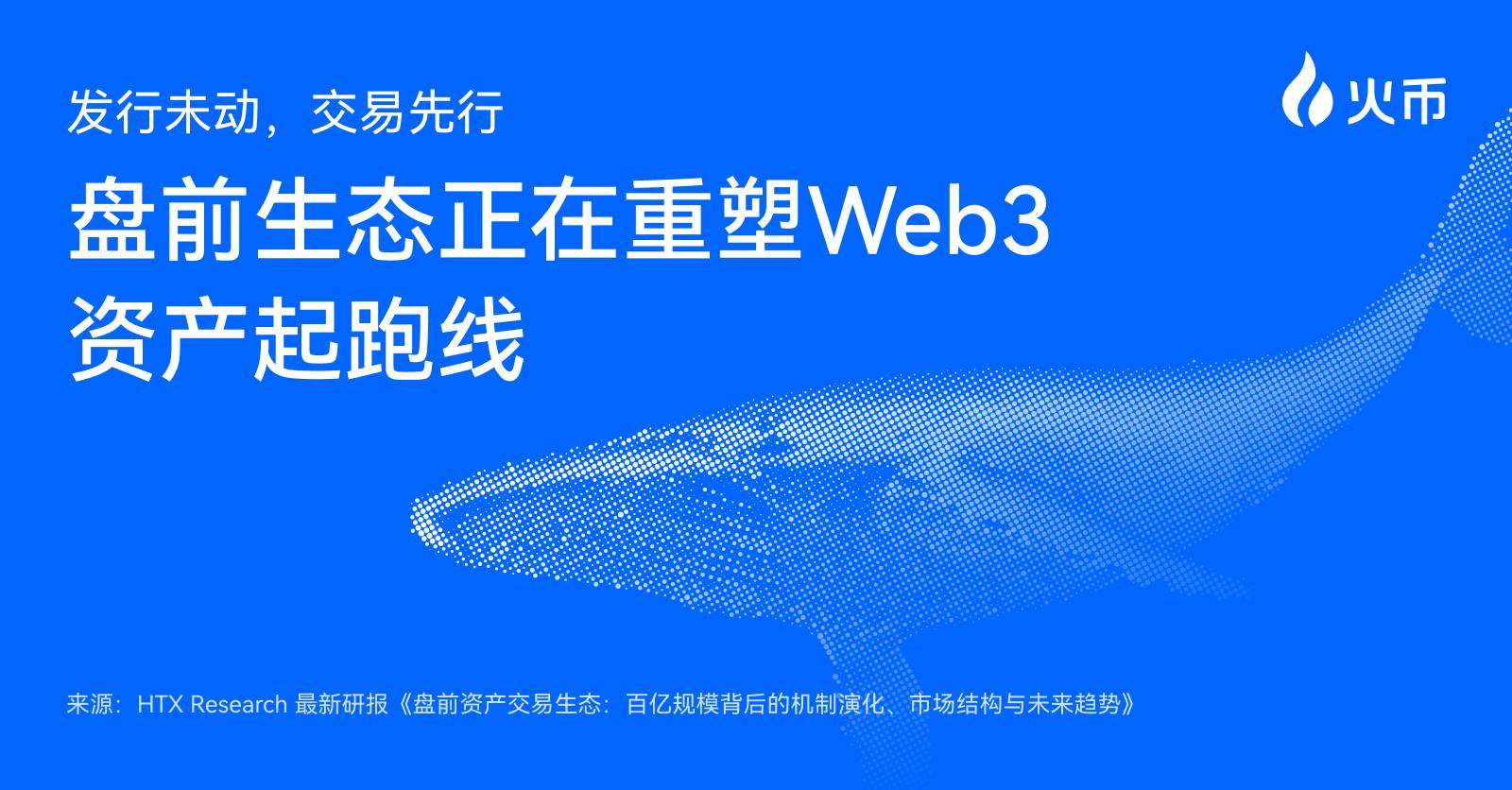
Recently, HTX Research, the exclusive research department under Huobi HTX, released its latest report titled "Pre-Market Asset Trading Ecosystem: Mechanism Evolution, Market Structure, and Future Trends Behind a Ten-Billion Scale." This report systematically studies the formation background, asset structure, typical models, and profound impact on project issuance and exchange systems of the pre-market trading ecosystem in the crypto market.

The report focuses on a rapidly emerging trend: against the backdrop of tightening financing environments and extended token issuance cycles, pre-TGE (Token Generation Event) trading activities are evolving from scattered attempts into a "1.5-level market" connecting primary and secondary markets, gradually becoming an independent market segment that cannot be ignored in the crypto industry.

From the "Pre-Token Vacuum" to the Pre-Market: A New Structure Between Primary and Secondary Markets

HTX Research points out that the rise of the pre-market trading ecosystem is not accidental. As primary fundraising contracts and project issuance cycles are passively extended, project teams are maintaining community activity through points, airdrop expectations, test qualifications, etc., while users continue to invest time and funds before TGE. In this process, previously non-tradable "early contributions" and "future expectations" gradually become assetizable.

At the same time, with lower barriers to token issuance and a surge in the number of projects, attention has become a scarce resource. Mechanisms for pre-market trading around attention, expectations, and future rights have naturally emerged, collectively forming an intermediate market that previously existed only within VCs and exchanges. This is an emerging 1.5-level market (Pre-Market), whose role is no longer just a speculative tool but a key structure reshaping project launch methods and early liquidity.

Three Asset Structures Comprising the Pre-Market Trading Ecosystem

From the perspective of "how future value is anchored," HTX Research categorizes pre-market assets into three structures:

The first category revolves around future token value, with trading models mainly including pre-market OTC, pre-market spot, and pre-market perpetual contracts. These assets are most directly linked to future spot prices and bear the most concentrated price discovery function in the pre-market stage.

The second category centers on points systems, i.e., user behavior points and their financialized derivatives, which have gradually formed a standardized points OTC market. Points, which carry user contribution and incentive expectations in airdrop economics, are incorporated into market pricing in advance through trading and profit-splitting mechanisms.

The third category revolves around future redeemable rights, appearing in forms such as NFTs, qualification certificates, or BuildKeys, converting non-standard rights like whitelists, Early Access, and token allocations into tradable assets.

These three structures collectively cover the complete chain from "user contribution—market expectation—rights confirmation—final settlement," making the pre-market no longer a single-point tool but a multi-layered pre-trading system.

Huobi HTX's Practical Exploration with Pre-Market Perpetual Contracts

As market demand expands and the ecosystem matures, pre-market trading is extending from OTC and spot forms to derivative structures. Pre-market perpetual contracts, as an innovative derivative design, allow users to engage in leveraged speculation around future spot prices before the token is officially listed, further advancing the possibility of price discovery. Currently, pre-market perpetual contracts have become one of the trading modes with the largest volume in pre-market trading.

In this direction, Huobi HTX previously took the lead in launching WLFI (World Liberty Financial) pre-market perpetual contracts before the official listing of the highly anticipated project, providing users with tools for early participation in price speculation and risk management before TGE. This practice also reflects the trend indicated in the report: the role of exchanges is extending from "listing nodes" to the "pre-issuance stage," and pre-market trading is becoming an important part of exchange product systems.

The Scale Potential and Structural Challenges of the Pre-Market

Pre-market trading already has a clear scale foundation. Leading projects often generate trading demand worth hundreds of millions of US dollars in the pre-market stage. The cumulative pre-market trading scale of projects like WLFI and Monad can even exceed one billion US dollars, making pre-market trading a ten-billion-dollar market with potential for further expansion.

However, the pre-market also exposes clear structural risks: liquidity is naturally thin, and prices are easily manipulated by large funds; settlement highly depends on project teams, and information asymmetry persists long-term; different asset forms lack unified standards in rules, performance, and risk allocation. These issues determine that the further expansion of the pre-market depends on whether it can transition from an "opportunistic market" to a more institutionalized and collaboratively governed structure.

Conclusion

HTX Research believes that pre-market trading is not a short-term gimmick but a structural trend driven by changes in the financing environment, the evolution of user participation methods, and the extension of trading platform products. It is reshaping project issuance paths, exchange listing logic, and how users participate in early markets.

In this process, pre-market trading is gradually evolving from a "gray area before issuance" into a key foundational layer connecting primary and secondary markets. Its final form may become a long-term, increasingly institutionalized core market structure in the crypto market.

About HTX Research

HTX Research is the exclusive research department under Huobi HTX, responsible for in-depth analysis of a wide range of areas including cryptocurrency, blockchain technology, and emerging market trends, writing comprehensive reports, and providing professional evaluations. HTX Research is committed to providing data-driven insights and strategic foresight, playing a key role in shaping industry perspectives and supporting informed decision-making in the digital asset field. With rigorous research methods and cutting-edge data analysis, HTX Research is always at the forefront of innovation, leading the development of industry thought, and promoting a deeper understanding of the ever-changing market dynamics. Visit us.

If you wish to communicate, please contact research@htx-inc.com

Трендові криптовалюти

Пов'язані питання

QWhat is the main focus of the latest HTX Research report on the pre-market trading ecosystem?

AThe report systematically studies the formation background, asset structure, typical models, and the profound impact of the pre-market trading ecosystem on project issuance and exchange systems in the crypto market.

QAccording to the report, what are the three main asset structures that constitute the pre-market trading ecosystem?

AThe three structures are: 1) Assets tied to future token value (pre-market OTC, spot, and perpetual contracts), 2) Assets centered around points systems and their financialized derivatives, and 3) Assets representing future exchangeable rights (e.g., NFTs, qualification certificates, BuildKey).

QWhat role did HTX play in the development of pre-market perpetual contracts, as mentioned in the report?

AHTX pioneered the practice by launching pre-market perpetual contracts for the WLFI (World Liberty Financial) project before its TGE, providing users with tools for early price speculation and risk management.

QWhat is the estimated scale of the pre-market trading ecosystem, and what are its main challenges?

AThe pre-market trading ecosystem is a multi-billion dollar market, with top projects generating hundreds of millions to billions of dollars in trading demand. Its main challenges include thin liquidity, price susceptibility to large funds, high dependency on project issuers for settlement, information asymmetry, and a lack of unified standards.

QHow does HTX Research view the long-term significance of pre-market trading?

AHTX Research believes pre-market trading is not a short-term trend but a structural shift driven by changes in financing environments, user participation models, and exchange product evolution. It is reshaping project launch paths, exchange listing logic, and how users engage with early markets, potentially becoming a core, institutionalized market structure in crypto.

Пов'язані матеріали

How to Adapt to Frequent Miraculous Comebacks After the New Patch When Trading in Polymarket's LOL Section?

After recent League of Legends (LoL) game updates, major comebacks and unpredictable outcomes have become more frequent, making trading on Polymarket's LoL prediction markets challenging. This article analyzes the causes and offers adaptation strategies. The author, a longtime LoL fan turned Polymarket trader, notes that post-update, a large early-game gold lead no longer guarantees victory. The current meta reduces the decisive weight of economy, emphasizing instead "advantage conversion, resource trading, team composition strength, and teamfight execution." Key systemic changes aiding comebacks include: Bounty/Kill Gold Compensation, Strategic Objective Bounties, and reduced Baron Nashor rewards. Furthermore, the prevalence of mage picks in the bot lane, instead of traditional marksmen (ADC), can lower sustained damage and teamfight reliability in the late game, contributing to throws. For more successful trading, the article suggests: 1. **Choosing the Right Region:** Prioritize major regions (LPL, LCK, LEC, LCS) where matches matter for World Championship qualification or player contracts, leading to more serious play. Avoid or be extremely cautious with regions like CBLOL (Brazil), TCL (Turkey), and North American Challengers, citing high volatility and potential for unreliable outcomes. 2. **Trading Strategies:** * **Placing Orders:** Use limit orders below market price for strong favorites. In close matchups, consider placing equal low-ball bids (e.g., 25-40 cents) on both sides of a match; if both fill for a total under $1, you secure profit regardless of the winner. Exploit team "power spikes" by buying low before their composition peaks and selling high. * **Timely Selling:** The most crucial lesson is to take profits. If you buy the early-leading team at a low price (e.g., 50-60 cents), sell most of your position (e.g., 75%) at 85-90 cents to lock in gains and avoid a potential comeback zeroing your position. * **Position Sizing:** Practice strict risk management. Do not exceed 5-10% of your capital per match and avoid "tilting" or chasing losses after a few bad trades. In summary, adapting to the new meta requires understanding that early advantages are less stable. Success depends on analyzing team compositions, player form, and regional contexts, combined with disciplined order placement, profit-taking, and capital preservation. The next patch in August is expected to revive traditional ADCs, potentially shifting the dynamics again.

Odaily星球日报Щойно

How to Adapt to Frequent Miraculous Comebacks After the New Patch When Trading in Polymarket's LOL Section?

Odaily星球日报Щойно

Strategy CEO Announces Plan to Resume Bitcoin Purchases This Year, With Buying Volume 25 Times Selling Volume

Strategy CEO Announces Resumption of Bitcoin Purchases This Year, Buy-to-Sell Ratio at 25x In a FOX Business interview, Phong Le, CEO of Strategy (formerly MicroStrategy), stated the company plans to resume its Bitcoin acquisition strategy within the current year. This ends a pause in buying that began in May. Le revealed that since the start of the year, Strategy has purchased approximately 175,000 bitcoins while selling around 7,000, making its buy volume about 25 times its sell volume. The company remains the world's largest corporate holder of Bitcoin, with 840,447 BTC, representing roughly 4% of the circulating supply. Le explained that recent sales were used to fulfill capital obligations under a newly approved framework, including paying preferred stock dividends, funding share buybacks, and bolstering the company's US dollar reserves, which now stand at about $4.7 billion. This move marks a shift from the firm's previous "never sell" mantra, which had contributed to its market premium. The change in strategy and the associated financial pressures led to a significant drop in its stock price (MSTR) and a rating downgrade from JPMorgan. The CEO framed the company's role as the "JPMorgan of the crypto economy," emphasizing its long-term goal of increasing the amount of Bitcoin per MSTR share. The announcement signals the return of a major institutional buyer to the Bitcoin market, which could provide price support. It is also viewed as a micro-indicator of recovering institutional confidence, suggesting the company believes the most acute phase of liquidity pressure has passed.

marsbit22 хв тому

Strategy CEO Announces Plan to Resume Bitcoin Purchases This Year, With Buying Volume 25 Times Selling Volume

marsbit22 хв тому

ArthurHayes新文:押注日元升值,ENA未来几月或涨5至10倍

Arthur Hayes argues that the Japanese Yen is significantly undervalued and posits that its appreciation against the US Dollar is imminent. He outlines three potential mechanisms for this shift, dismissing the first two—the Bank of Japan raising interest rates and domestic institutions selling foreign assets—as politically or economically unfeasible. He identifies the third and preferred method: the Japanese Ministry of Finance (MOF) using its holdings of US Treasuries as collateral in the Fed's FIMA repo facility to borrow US dollars, then selling those dollars to buy Yen in the forex market. Hayes believes US Treasury Secretary Bessant has signaled support for this approach, which requires the Fed's Foreign Currency Subcommittee, led by Chairman Walsh, to remove lending limits on the FIMA tool. Hayes asserts that implementing this "Scheme 3" would lead to a significant expansion of US dollar liquidity. He predicts this surge in liquidity will act as a catalyst, driving up the prices of assets like Bitcoin and physical gold. Within the crypto space, he views Ethereum (ETH) as undervalued and singles out Ethena's ENA token as a speculative play with potential for 5-10x gains in the coming months, contingent on a recovery in Bitcoin basis trades that would boost demand for its USDe stablecoin. He concludes that investors should watch for the Fed's rule change as the key trigger for these market movements.

marsbit34 хв тому

ArthurHayes新文:押注日元升值,ENA未来几月或涨5至10倍

marsbit34 хв тому

Торгівля

Спот

Популярні статті

Що таке AVGO

Контракт на постійний термін AVGOUSDT відстежує ціну акцій Broadcom Inc. (Nasdaq: AVGO). Broadcom Inc. є технологічним лідером, який проектує, розробляє та постачає напівпровідники та програмне забезпечення для інфраструктури, що відповідає складним, критично важливим потребам глобальних організацій.

88 переглядів усьогоОпубліковано 2026.08.08Оновлено 2026.08.08

Що таке AVGO

Як купити AVGO

Ласкаво просимо до HTX.com! Ми зробили покупку Broadcom (AVGO) простою та зручною. Дотримуйтесь нашої покрокової інструкції, щоб розпочати свою криптовалютну подорож.Крок 1: Створіть обліковий запис на HTXВикористовуйте свою електронну пошту або номер телефону, щоб зареєструвати обліковий запис на HTX безплатно. Пройдіть безпроблемну реєстрацію й отримайте доступ до всіх функцій.ЗареєструватисьКрок 2: Перейдіть до розділу Купити крипту і виберіть спосіб оплатиКредитна/дебетова картка: використовуйте вашу картку Visa або Mastercard, щоб миттєво купити Broadcom (AVGO).Баланс: використовуйте кошти з балансу вашого рахунку HTX для безперешкодної торгівлі.Треті особи: ми додали популярні способи оплати, такі як Google Pay та Apple Pay, щоб підвищити зручність.P2P: Торгуйте безпосередньо з іншими користувачами на HTX.Позабіржова торгівля (OTC): ми пропонуємо індивідуальні послуги та конкурентні обмінні курси для трейдерів.Крок 3: Зберігайте свої Broadcom (AVGO)Після придбання Broadcom (AVGO) збережіть його у своєму обліковому записі на HTX. Крім того, ви можете відправити його в інше місце за допомогою блокчейн-переказу або використовувати його для торгівлі іншими криптовалютами.Крок 4: Торгівля Broadcom (AVGO)Легко торгуйте Broadcom (AVGO) на спотовому ринку HTX. Просто увійдіть до свого облікового запису, виберіть торгову пару, укладайте угоди та спостерігайте за ними в режимі реального часу. Ми пропонуємо зручний досвід як для початківців, так і для досвідчених трейдерів.

66 переглядів усьогоОпубліковано 2026.08.08Оновлено 2026.08.08

Як купити AVGO

Як купити SHOP

Ласкаво просимо до HTX.com! Ми зробили покупку Shopify (SHOP) простою та зручною. Дотримуйтесь нашої покрокової інструкції, щоб розпочати свою криптовалютну подорож.Крок 1: Створіть обліковий запис на HTXВикористовуйте свою електронну пошту або номер телефону, щоб зареєструвати обліковий запис на HTX безплатно. Пройдіть безпроблемну реєстрацію й отримайте доступ до всіх функцій.ЗареєструватисьКрок 2: Перейдіть до розділу Купити крипту і виберіть спосіб оплатиКредитна/дебетова картка: використовуйте вашу картку Visa або Mastercard, щоб миттєво купити Shopify (SHOP).Баланс: використовуйте кошти з балансу вашого рахунку HTX для безперешкодної торгівлі.Треті особи: ми додали популярні способи оплати, такі як Google Pay та Apple Pay, щоб підвищити зручність.P2P: Торгуйте безпосередньо з іншими користувачами на HTX.Позабіржова торгівля (OTC): ми пропонуємо індивідуальні послуги та конкурентні обмінні курси для трейдерів.Крок 3: Зберігайте свої Shopify (SHOP)Після придбання Shopify (SHOP) збережіть його у своєму обліковому записі на HTX. Крім того, ви можете відправити його в інше місце за допомогою блокчейн-переказу або використовувати його для торгівлі іншими криптовалютами.Крок 4: Торгівля Shopify (SHOP)Легко торгуйте Shopify (SHOP) на спотовому ринку HTX. Просто увійдіть до свого облікового запису, виберіть торгову пару, укладайте угоди та спостерігайте за ними в режимі реального часу. Ми пропонуємо зручний досвід як для початківців, так і для досвідчених трейдерів.

34 переглядів усьогоОпубліковано 2026.08.10Оновлено 2026.08.10

Як купити SHOP

Обговорення

Ласкаво просимо до спільноти HTX. Тут ви можете бути в курсі останніх подій розвитку платформи та отримати доступ до професійної ринкової інформації. Нижче представлені думки користувачів щодо ціни A (A).

活动图片