Written by: Rita
The greatest value of the space race is returning to Earth. On August 18, HSBC released a report spanning 12 industries, unpacking this transmission chain one by one.
Asteroid mining and orbital data centers are not yet operational. Yet, the space race has already rewritten the competitive logic of communications, semiconductors, power, and robotics. Led by Raj Sinha, Co-Head of Global Equity Research at HSBC, this report covers 12 sectors including telecommunications, semiconductors, power, industrials, agriculture, insurance, and finance.
SpaceX has raised $75 billion. Elon Musk's compensation is tied to the company's $7.5 trillion market capitalization target and Mars colonization. HSBC's conclusion is: the most urgent value of the space economy is its role in driving the upgrading of Earth's industries.
Starlink Has Crossed the Critical Point of Scale
As of June 30, 2026, SpaceX's satellite internet service had 10,200 satellites in orbit and 12 million broadband subscribers, covering 167 markets. An additional 7.4 million monthly active devices are connected via satellite-to-phone (Direct to Cell), covering 30 countries. HSBC telecommunications analysts note that these numbers mean space-based communication has become infrastructure for multiple industries, far beyond an alternative for remote areas.
Maersk has installed Starlink on over 330 container ships, and United Airlines plans to equip 15 Boeing 737-800 aircraft per month. EpicVue has launched a Starlink solution for truck fleets at $99 per month with 250GB of data, covering 99.9% of US and Canadian territory. Satellite connectivity is shifting from an emergency backup to a default configuration.
HSBC assesses that the relationship between Starlink and terrestrial telecom operators is primarily complementary. The performance and cost advantages of fiber and 5G in dense urban areas are unshakeable. In maritime, desert, mountainous, and post-disaster scenarios, satellite connections fill the coverage gaps left by cellular networks. For telecom operators, cooperation is better than confrontation. T-Mobile, KDDI, and Airtel Africa have all signed direct-to-device cooperation agreements with Starlink.
Starship Reduces Launch Cost to $300 Per Kilogram
SpaceX's core advantage lies in cost.
Falcon 9's low-Earth orbit launch cost is $2,940 per kilogram, and Falcon Heavy's is $1,520. Starship aims to reduce this to $100-300, a drop of over 95% compared to the historical average (approximately $18,500/kg from 1970 to 2000).
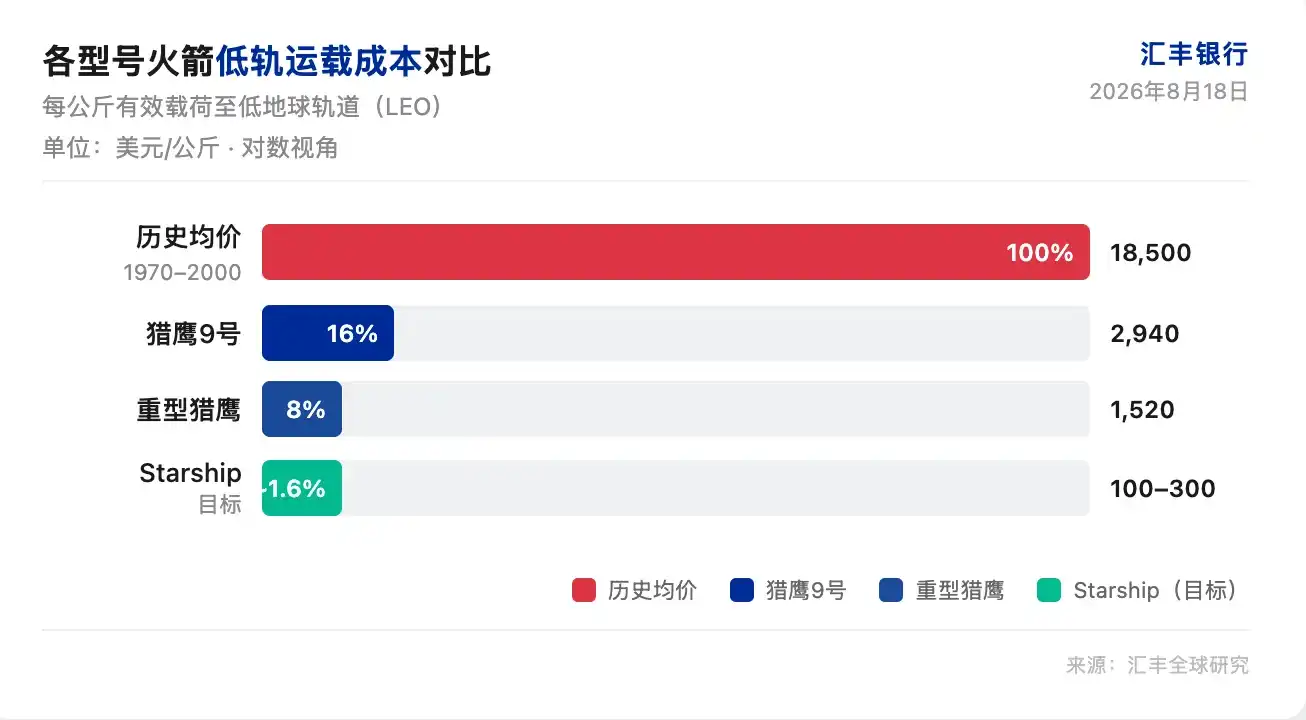
Falling costs are rewriting the fundamental assumptions of the space economy. Material choices for satellite manufacturing, energy solutions for orbital data centers, and feasibility models for asteroid mining all need reassessment. HSBC industrial analysts point out that SpaceX manufactures about 80-85% of its rocket and spacecraft components internally, achieving a high degree of vertical integration. This compresses the space for external suppliers, keeping the benefits of lower launch costs within the company.
A single V2 Starlink satellite costs $1 million, with a launch cost of $2-3 million. One Starship can launch 60 V3 satellites at once, each with a downlink capacity of about 1 Tbps, which is 20 times that of the V2.
Scale and cost are forming a positive feedback loop.
Orbital Data Centers Are a Backup Option for Computing Power
SpaceX plans to deploy 100 GW of orbital AI data center computing power by 2040, with trial launches starting in 2027.
HSBC estimates that the cost of orbital data centers is currently three times that of terrestrial ones and may only converge by 2035-2040. Terrestrial data centers remain the priority choice. Orbital data centers are a strategic reserve. If the US power grid and nuclear power construction cannot keep up with computing demand, space can provide an option bypassing policy, land, and environmental constraints.
The Terafab plan is closer to reality than orbital data centers. A joint venture between SpaceX, Tesla, and xAI plans to build a vertically integrated wafer fab covering the entire chain from design, manufacturing, packaging, to testing. If successful, it could disrupt the horizontal division of labor in the semiconductor industry. The chain of NVIDIA designing chips, TSMC manufacturing, and third-party packaging/testing could be replaced by a one-stop solution.
The cost gap is just a surface-level issue; computing power surplus is the bigger risk. HSBC estimates that the global annual incremental demand for AI data center power by 2030 is below 50 GW, while SpaceX's orbital plan alone targets an annual addition of 100 GW. If terrestrial manufacturers continue expanding at the current pace (HSBC expects annual capital expenditure to exceed $1 trillion from 2027), the market could face a computing power surplus within five years. The asset turnover and return on investment for GPU cloud infrastructure are already under pressure, and SpaceX's entry will intensify this trend.
Another consequence of computing power surplus is the commoditization of LLM models. With computing power no longer scarce, performance gaps between models shrink. Hardware suppliers face pressure, while software and application layers benefit.
The Space Race is Reshaping Three Core Industries
The report covers 12 industries. HSBC analysts judge that the power, semiconductor, and robotics sectors are being directly rewritten by the space race.
The power sector benefits most directly. AI data centers have pushed the US annual electricity demand growth rate from 2-3% to 4-5%. If the computing power race continues, both US and European electricity demand could grow 2.8 times by 2050 (previous expectations were 60% and 80% respectively). HSBC utilities analysts conclude that renewable energy and the power grid are the "clearest winners." Nuclear and natural gas face uncertainty: terrestrial data centers are a boon, but orbital data centers could act as substitutes.
The semiconductor sector faces a dual impact. Orbital inference requires "low-Earth orbit optimized silicon," a new performance tier between consumer-grade chips and radiation-hardened aerospace chips, which will create new demand. If the Terafab model is replicated by other giants, traditional wafer foundries could face order loss.
The logic for robotics and industrials is the most straightforward. Asteroid mining relies on highly autonomous robots, lunar base construction requires engineering machinery, and in-orbit servicing needs robotic arms. Caterpillar has partnered with NASA to develop lunar excavation technology, with its autonomous mining experience on Earth directly transferable to space scenarios. Honeywell provides navigation systems for NASA's Artemis missions; aerospace technology can similarly feed back into aviation and industrial fields.
The other 9 industries also appear in HSBC's framework, including telecommunications, agriculture, chemicals, metals & mining, healthcare, insurance, finance, transportation & logistics, and tech platforms. However, the transmission chains are longer, and the short-term impact is less direct than in the three sectors above.
The takeoff of the space economy doesn't need to wait for asteroid mining or Mars colonization. Starlink's 12 million users, Starship's cost curve, and Terafab's potential impact on the semiconductor landscape are already proof.
The core judgment of the HSBC report is: space is an accelerator for Earth's industries. Computing power continues to expand, electricity demand doubles, and launch costs drop below $300 per kilogram. Three curves are simultaneously approaching historical inflection points. The first to be reshaped is always the link with the shortest transmission chain.
Disclaimer
This article is Tide Research's compilation and interpretation of a third-party brokerage research report (HSBC, August 18, 2026), combined with public market information. The ratings, target prices, earnings forecasts, and related judgments cited herein are the views of the brokerage's analysts, representing only the position of their institution, and do not represent Tide Research's views, nor do they constitute any investment advice.
The market carries risks; decisions must be made independently. This article should not be used as a basis for buying or selling any securities.