HSBC Bank and Anchorpoint Financial win Hong Kong’s first stablecoin licenses – Details

ambcryptoPublished on 2026-04-10Last updated on 2026-04-10

Abstract

Hong Kong has issued its first stablecoin licenses to institutional, bank-backed entities HSBC Bank and Anchorpoint Financial (backed by Standard Chartered, Animoca Brands, and HKT). This marks the formal launch of the city's strict stablecoin regulatory framework, which prioritizes established players with strong compliance, capital reserves, and regulatory respect. The cautious, limited approval process may slow broader market participation and innovation in the near term but is designed to ensure user protection, risk management, and overall trust. The regime, which came into effect in August 2025, includes stringent rules on reserves, governance, and anti-money laundering controls.

Hong Kong has granted its first stablecoin issuer licenses. The initial batch is small and institutional, which sets a cautious tone.

Here’s what you need to know.

Bank-backed issuers dominate first approvals

The first stablecoin licenses went to Anchorpoint Financial and HSBC’s Hong Kong banking arm, both well-known TradFi players. Anchorpoint itself is backed by Standard Chartered, Animoca Brands, and HKT.

The initiative is happening under a new framework, led by the Hong Kong Monetary Authority (HKMA). Both entities are set to begin operations in the coming months.

These approvals are the formal launchpad for the city’s stablecoin regime, which took effect in August 2025.
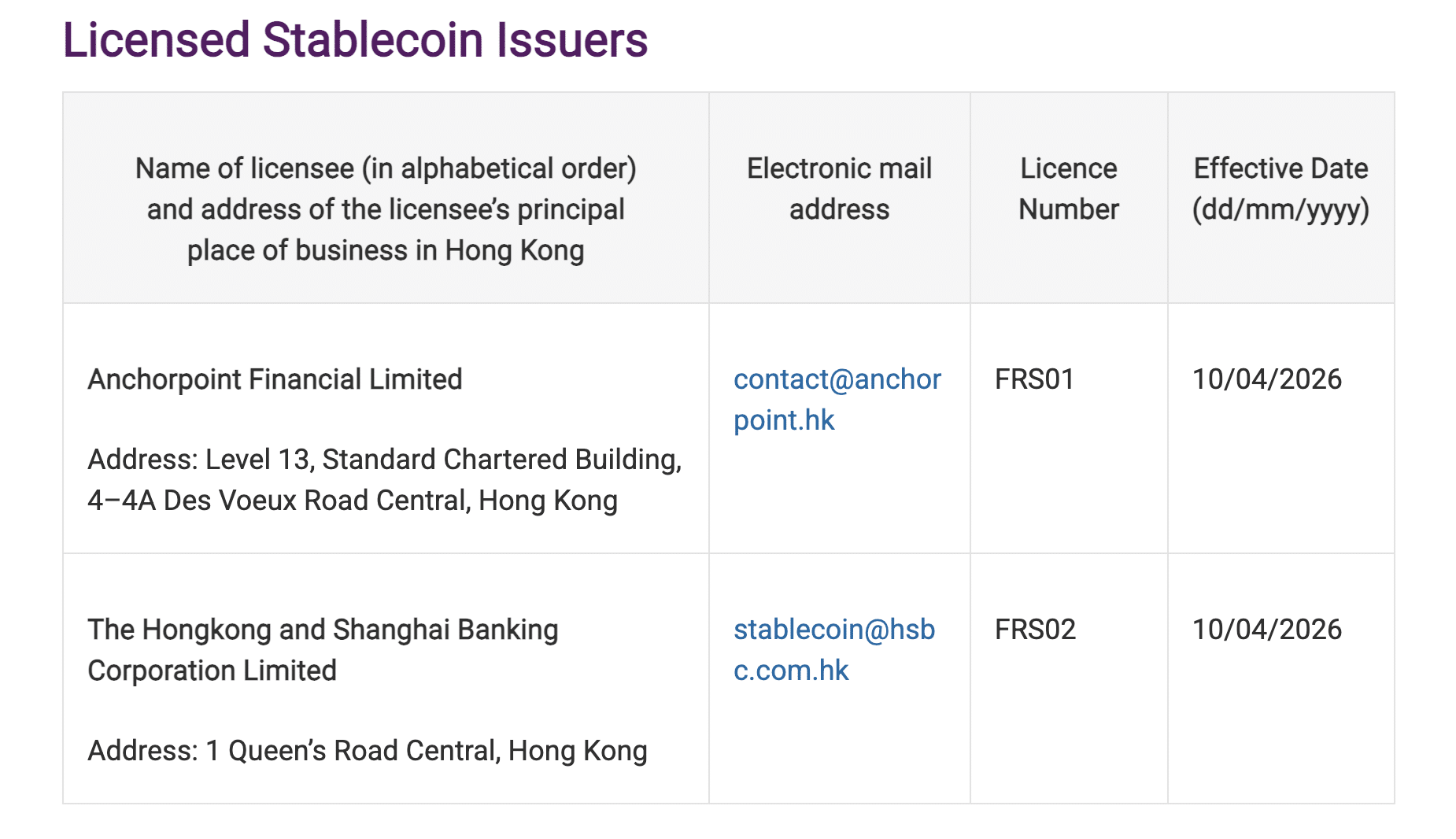
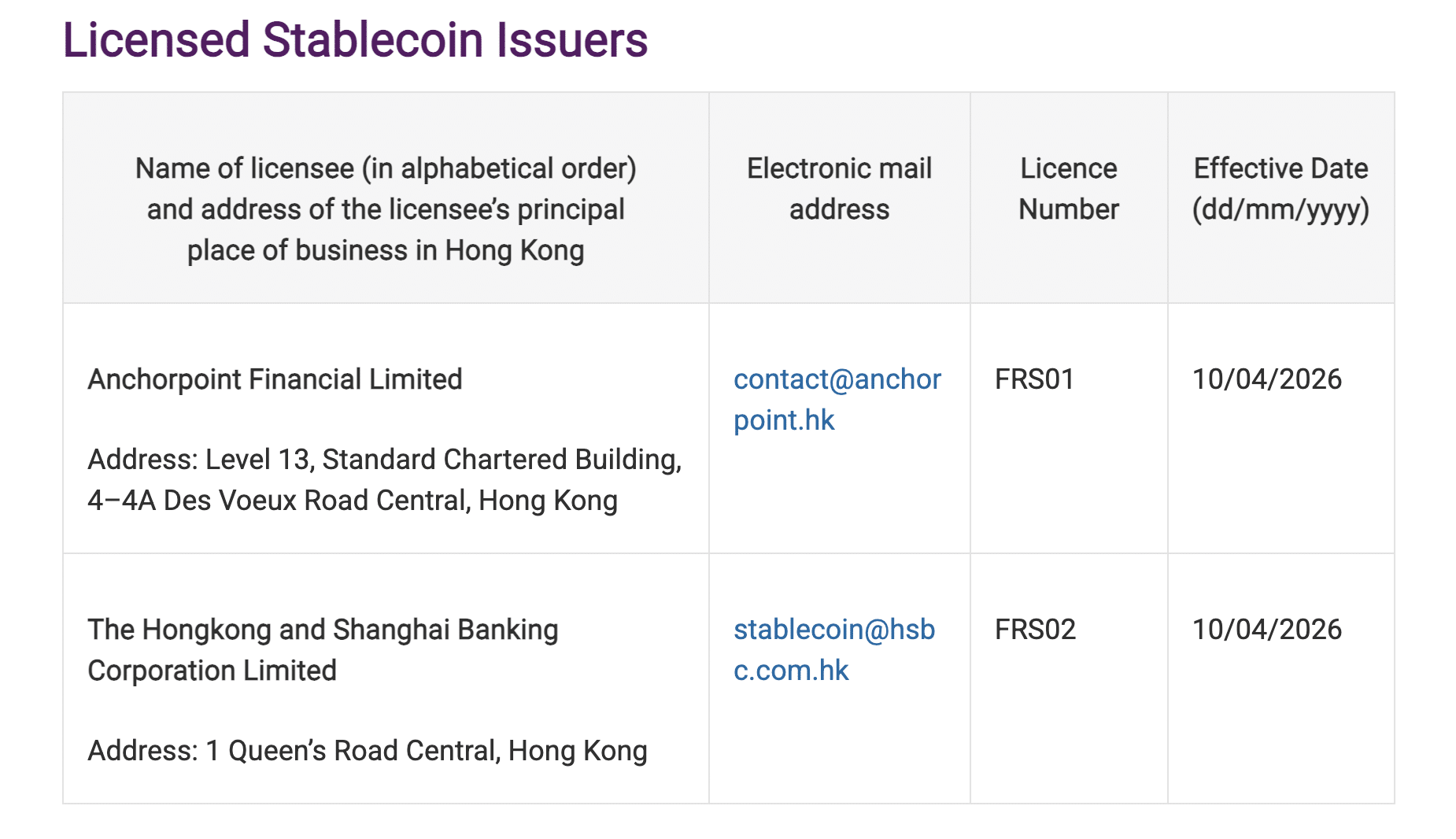
Source: HKMA

They’re prioritizing entities with established compliance systems, capital backing, and regulatory respect.

HKMA Chief Executive Eddie Yue stated that the regime would provide –

An orderly operating environment... while ensuring robust user protection and effective risk management.

AMBCrypto previously reported that Hong Kong expanded its licensing regime to cover crypto dealers and custodians. This brought trading and asset storage under the same regulatory perimeter.

The announcement came after a delayed timeline

The HKMA had earlier stated that initial licenses could be issued as early as March. However, approvals only materialized in April.

This is in line with the regime itself, with its strict requirements on reserve backing, redemption mechanisms, governance, and AML controls. The framework also lays out enforcement powers, including fines and license revocations.

Institutions first, broader access later?

In the near term, Hong Kong’s stablecoin market is likely to remain held by institutional players. Limited licenses and stringent compliance thresholds will slow participation from crypto-native firms.

It will certainly increase trust and stability among the masses, but early innovation impediment is a concern. The key question in time, will be whether the HKMA expands access or maintains a bank-led model.


Final Summary

  • Hong Kong’s first stablecoin licenses go to bank-backed players.
  • Strict rules and limited approvals could slow innovation but increase trust.

Related Questions

QWhich two companies received Hong Kong's first stablecoin licenses?

AHSBC's Hong Kong banking arm and Anchorpoint Financial received the first stablecoin licenses.

QWhich regulatory authority is leading the new stablecoin framework in Hong Kong?

AThe Hong Kong Monetary Authority (HKMA) is leading the new stablecoin framework.

QWhat are some of the key requirements of Hong Kong's stablecoin regime?

AThe regime has strict requirements on reserve backing, redemption mechanisms, governance, and Anti-Money Laundering (AML) controls.

QWhat is a potential concern regarding the new licensing approach according to the article?

AA potential concern is that limited licenses and stringent compliance could slow participation from crypto-native firms and create an early innovation impediment.

QWhen did Hong Kong's stablecoin regulatory regime officially take effect?

AThe stablecoin regulatory regime took effect in August 2025.

Related Reads

Will the Next Crypto Bull Run Start with On-Chain Trading of SpaceX?

This article presents a scenario-based forecast for the crypto industry from 2026 to 2029, arguing that the next major cycle will be driven not by technological narratives but by legal access to real-world assets. The author predicts that by mid-2026, pre-IPO perpetual contracts for top private companies like SpaceX, OpenAI, and Anthropic on platforms like Hyperliquid will become the primary gateway for accessing quality assets, as most crypto-native tokens fail to capture real value. The much-hyped AI x Crypto intersection largely fails except for prediction markets, which thrive on betting on AI model supremacy. By 2027, public blockchain foundations are forced to choose between catering to retail speculation or building compliant infrastructure for institutions, with many opting for the latter. Growth in stablecoins and tokenized private credit/equity hits a "triple ceiling" due to regulatory and political uncertainty rather than market demand. The pivotal shift is forecast for 2028. A major liquidation event in pre-IPO perpetuals exposes the structural flaw of synthetic markets lacking a real underlying asset anchor. In response, regulatory changes finally allow the public solicitation of private securities resales to verified accredited investors. This creates a legitimate secondary market for real company equity, which then becomes the core asset class of the new bull market, relegating synthetic perps to a niche role. By 2029, the industry becomes "boring" but foundational. Tokens without claims on real cash flows or assets cease trading. Stablecoin growth is steady but politically capped. Crypto infrastructure fades from view as it gets absorbed into traditional finance backends. The article's central thesis is that the key bottleneck for crypto's next phase is legal and regulatory channels for real asset ownership, not technology.

marsbit13m ago

Will the Next Crypto Bull Run Start with On-Chain Trading of SpaceX?

marsbit13m ago

The Value Distribution of Stablecoins

**Summary: The Value Distribution of Stablecoins** The article argues that stablecoins are evolving from mere trading tools into broader channels for dollar access. It divides the stablecoin ecosystem into four layers to analyze how value is distributed: 1. **Issuance Layer:** Mints stablecoins, holds reserve assets, and captures the spread between reserve yield and user costs (e.g., Tether, Circle). This layer currently earns the largest profit margin. 2. **Infrastructure Layer:** Connects stablecoins to the traditional financial system, handling fiat on/off-ramps, banking integration, compliance (KYC/AML), and asset management (e.g., Bridge, BVNK). This is the "unglamorous" but critical work, building the essential bridges between crypto and real-world finance. 3. **Acquiring/Distribution Layer:** Integrates stablecoins into merchant systems, manages payment flows, and provides enterprise financial software (e.g., Stripe, Coinbase). They act as the access point for businesses. 4. **Application Layer:** The end-users and businesses that ultimately use stablecoins for payments, settlements, or as a store of value. They benefit from convenience but have little pricing power. The core thesis is that while the issuance layer currently dominates profits, the often-overlooked **infrastructure layer holds significant long-term potential**. The real challenge and barrier to mass adoption is not the on-chain transfer of stablecoins (which is simple), but the complex "last mile" integration into existing business workflows, banking systems, and regulatory frameworks across different countries. Companies in this layer are currently in a "land grab" phase, investing heavily to build networks, secure bank partnerships, and establish compliance pathways. While their position is currently pressured by the profitable issuers above and distribution platforms below, the article suggests that if stablecoins become a default financial rail for businesses, the infrastructure providers who have done the hard work of integration will ultimately gain strong pricing power and become entrenched, essential players.

marsbit6h ago

The Value Distribution of Stablecoins

marsbit6h ago

The Value Distribution of Stablecoins

The Value Distribution of Stablecoins The article argues that stablecoins are evolving from a mere trading tool into a broad "dollar channel." It analyzes the industry's value chain through four layers: 1. **Issuance Layer (e.g., Tether, Circle):** The top layer that mints stablecoins, holds reserve assets, and captures the thickest interest rate spread. 2. **Infrastructure Layer (e.g., Bridge, BVNK):** Connects stablecoins to the traditional financial system, handling critical but complex "dirty work" like fiat on/off-ramps, banking integration, compliance (KYC/AML), and cross-border settlement. 3. **Acquiring/Distribution Layer (e.g., Stripe, Coinbase):** Embeds stablecoins into merchant systems, manages payment flows, and integrates with enterprise software. 4. **Application Layer:** End-users and businesses that ultimately use stablecoins for payments, settlement, or storing value. The author posits that while the issuance layer currently captures the most profit, the most overlooked and potentially critical layer is infrastructure. The core challenge for stablecoin adoption isn't the on-chain transfer (which is simple), but bridging the gap between blockchain and the real-world financial system. This involves solving practical problems for businesses: fiat conversion, reconciliation, tax handling, and user onboarding. Infrastructure companies are currently in a difficult "land-grab" phase—building networks, securing banking relationships, and achieving compliance country-by-country. They face pressure from both the profitable issuance layer above and distribution platforms below. However, the author suggests this layer is building a crucial moat. Once stablecoins become a default business rail, the infrastructure players who have done the hard work of integration may gain significant, durable value and pricing power.

链捕手7h ago

The Value Distribution of Stablecoins

链捕手7h ago

Trading

Spot
Futures

Hot Articles

How to Buy WIN

Welcome to HTX.com! We've made purchasing WINkLink (WIN) simple and convenient. Follow our step-by-step guide to embark on your crypto journey.Step 1: Create Your HTX AccountUse your email or phone number to sign up for a free account on HTX. Experience a hassle-free registration journey and unlock all features.Get My AccountStep 2: Go to Buy Crypto and Choose Your Payment MethodCredit/Debit Card: Use your Visa or Mastercard to buy WINkLink (WIN) instantly.Balance: Use funds from your HTX account balance to trade seamlessly.Third Parties: We've added popular payment methods such as Google Pay and Apple Pay to enhance convenience.P2P: Trade directly with other users on HTX.Over-the-Counter (OTC): We offer tailor-made services and competitive exchange rates for traders.Step 3: Store Your WINkLink (WIN)After purchasing your WINkLink (WIN), store it in your HTX account. Alternatively, you can send it elsewhere via blockchain transfer or use it to trade other cryptocurrencies.Step 4: Trade WINkLink (WIN)Easily trade WINkLink (WIN) on HTX's spot market. Simply access your account, select your trading pair, execute your trades, and monitor in real-time. We offer a user-friendly experience for both beginners and seasoned traders.

5.2k Total ViewsPublished 2024.03.29Updated 2026.06.02

How to Buy WIN

Discussions

Welcome to the HTX Community. Here, you can stay informed about the latest platform developments and gain access to professional market insights. Users' opinions on the price of WIN (WIN) are presented below.

活动图片













