How to Systematically Track High-Winning-Rate Addresses on Polymarket?

Odaily星球日报Published on 2026-03-02Last updated on 2026-03-02

Abstract

How to Systematically Track High-Win-Rate Wallets on Polymarket This article explores methods to identify and track high-performing wallets on Polymarket, a blockchain-based prediction market where all transactions are publicly recorded on-chain. While the platform's data is transparent, the key challenge lies in interpreting this data to find wallets that consistently demonstrate an informational edge. The piece outlines common characteristics of potentially "insider" wallets, which are not necessarily illegal but show patterns of highly informed trading. These include: new addresses making large, concentrated bets; wallets specializing in a single niche topic; sudden, significant increases in position size; and extremely precise timing, repeatedly entering positions hours before major public news breaks. A three-step methodology for systematically identifying these wallets is provided: 1. Analyze Polymarket's leaderboard to filter for addresses with sustained profitability over 30 days, a high win rate (>55%), and significant profits in liquid markets. 2. Drill down into specific event markets to examine the top holders, looking for wallets that consistently hold large positions before the market has fully priced in an outcome. 3. Conduct a detailed analysis of the candidate wallets' on-chain history, focusing on their entry timing (pre-news vs. post-news), position-building strategy (rapid vs. gradual), holding period, and trading focus (specialized vs. generalized)....

Original Title:How To Find 100X Insider Polymarket Wallets To Cop,Author: Aleiah(@AleiahLock)

Compiled | Odaily Planet Daily (@OdailyChina); Translator | Asher (@Asher_ 0210)

An address on Polymarket turned $35,000 into $442,000, achieving a 12.6x return. Notably, the position was established hours before a major market movement, with the trade largely completed and cashed out before the news spread to mainstream channels. This is not an isolated incident; before the news of the "Venezuela raid" political event became public, three addresses had already positioned themselves and collectively profited $630,000 from the same event.

If such trading occurred in traditional financial markets, one might easily think of information asymmetry. But in prediction markets, all fund flows and position changes are recorded on the public blockchain; there are no hidden accounts or private transactions.

Public does not mean without gaps. The key is not whether the trades can be seen, but whether one can discern truly informative signals from the vast amount of data.
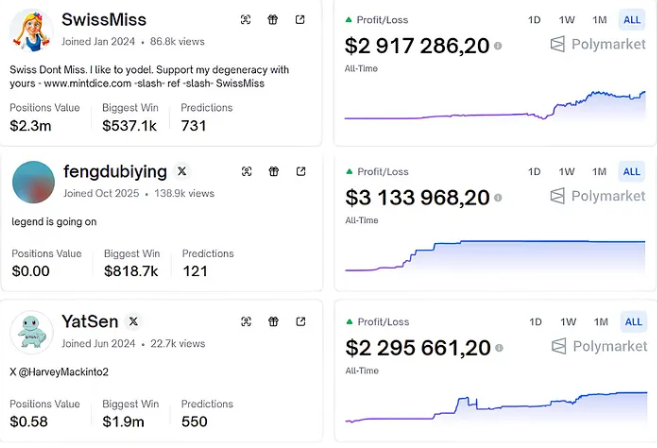
Every Trade on Polymarket is Public Data

Many prediction market participants still view Polymarket as a traditional betting platform: watch the odds, choose a direction, and bet on the outcome. But Polymarket's underlying structure is completely different from DraftKings or ordinary sports betting. All trades occur on-chain; fund flows, position sizes, and entry/exit times are all publicly visible. The operational paths of those with the most accurate judgments and sharpest timing are not post-hoc speculations but real-time on-chain records.
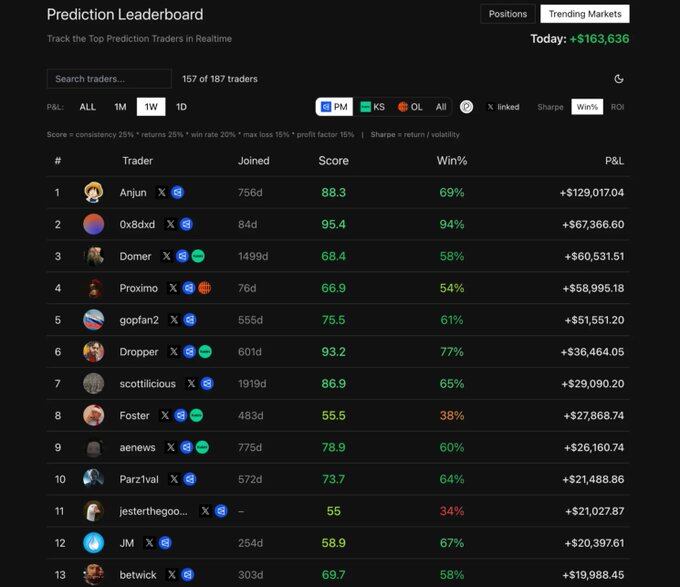
Polymarket's API is also open. Trading records, market data, historical transactions—anyone can directly call it; there is no permission barrier.

Therefore, the gap is not about who can see the data, but who can extract meaning from it. On-chain information is public, but what is valuable are the wallets worth tracking continuously and the ability to recognize behavioral changes before prices fully reflect them.

What Characteristics Do True "Insider Addresses" Typically Have?

It's important to emphasize that not all profitable wallets imply insider information. Some traders have solid research capabilities, while others rely on quantitative models and algorithmic advantages. But when profitability is repeatedly combined with specific behavioral patterns, one can observe structural features that distinguish them from "luck."

First Type: Combination of New Addresses and Unusually Large Bets

A wallet created just days ago, with very few transactions, suddenly invests a large amount of capital in a low-liquidity niche market—this behavior is not common. Especially in the absence of public catalysts, large, concentrated positions often carry stronger informational significance.

Second Type: Highly Vertical Trading Focus

Some addresses do not operate across markets but focus long-term on a specific niche, maintaining a stable and significant win rate in that area. They do not diversify across crypto prices, elections, sports, etc., but concentrate firepower on a single theme, with more decisive position decisions.

Third Type: Abnormal Changes in Position Size

When an address that has been betting with medium-sized positions suddenly significantly increases its stake in a particular market, this behavior often indicates a change in the strength of conviction. Position size itself is an attitude; a sudden change in scale usually reflects an upgrade in information or belief.

Fourth Type: Overly Precise Timing

Occasional early positioning can be attributed to coincidence, but if an address repeatedly completes its position establishment hours before major news is announced, with highly consistent direction, this temporal lead is difficult to explain simply as luck. Once is random; repeated occurrences are more likely to indicate an information advantage.

How to Systematically Screen for Potential "Information-Advantaged Addresses"

Step 1: Analyze Performance on Polymarket Leaderboards

Start with the leaderboards on Polymarket Analytics (link: https://polymarketanalytics.com/traders), sorted by 30-day P&L, using recent stable profitability as the first filter. Focus on wallet addresses with an overall positive return over 30 consecutive days, a win rate above 55%, and total profits significantly higher than total losses. Also, confirm that their trading is concentrated in markets with real liquidity, not low-volume prediction events with little participation.
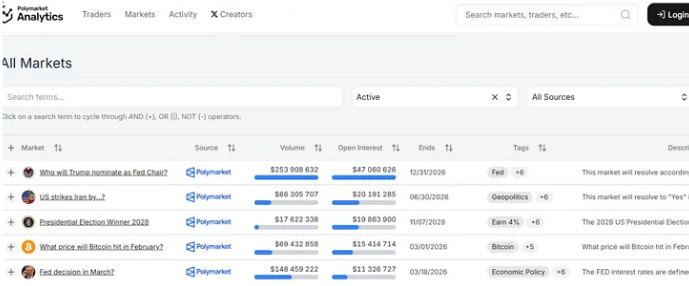
The goal at this stage is not to directly judge whether they have an information advantage, but to establish a watchlist of consistently profitable entities. A stable profit record is the foundation for subsequent behavioral analysis.

Step 2: Analyze Position Structure in Specific Events

After the initial screening, drill down into specific trading events. Enter active prediction markets and check the Top Holders list for that event. Polymarket publicly displays the addresses with the largest current positions; these large positions often represent stronger conviction.
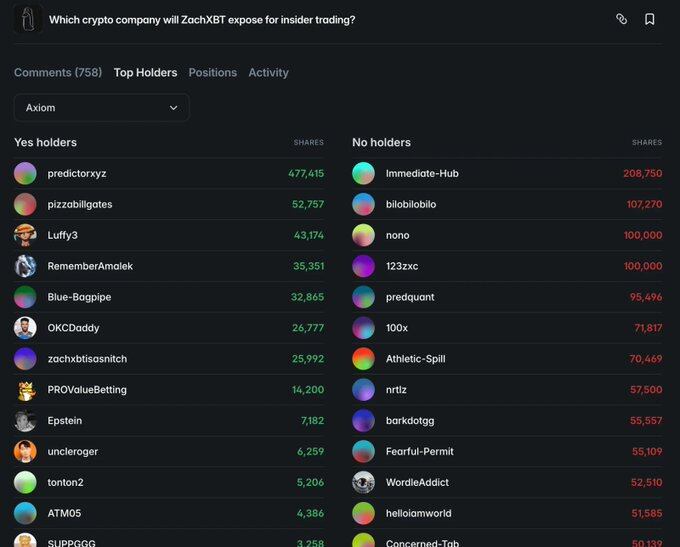
The key is not whether an address hits a single large bet, but whether its behavior is consistent. If a wallet repeatedly appears in the top holder lists for multiple significant events, and these positions are established before the market has fully priced them in, this repetition itself constitutes a signal.

A single successful bet might be chance, but repeatedly establishing large positions early, with consistent direction and verified outcomes, often indicates a judgment system with a stable advantage.

Step 3: Analyze Trading Behavior and Position Timing

After identifying candidate addresses, further analyze their on-chain transaction history, focusing on entry timing, position structure, and holding rhythm.
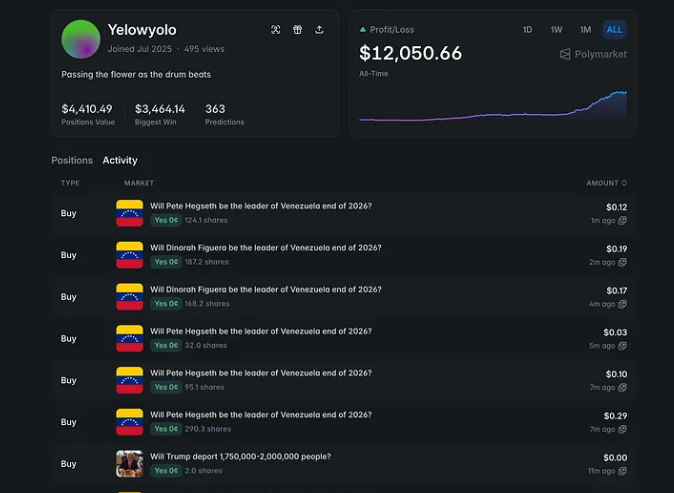
First, observe the entry time. If the purchase occurs hours before official news announcement and repeats multiple times, the timing advantage itself becomes an important variable; entering after media reports is more likely just information following.

Second, analyze the method of position building. Mature traders typically build positions in batches and add gradually, while wallets with strong informational judgment often complete concentrated positioning quickly within a short time window because their opportunity is limited.

Third, pay attention to the holding period. Some high-quality addresses choose to exit during the mid-stage of a trend's development, rather than waiting for the tail end of extreme volatility, indicating their goal is to capture the main trend rather than marginal profits.

Finally, observe their trading scope. Addresses that are highly vertical and long-term focused on a single niche are more likely to develop stable information advantages; addresses that frequently operate across sectors are more likely to rely on market sentiment rather than specific domain judgment.

Advanced Address Tracking Strategies

After mastering the basic screening methods, what truly makes a difference is the further dissection of the details of fund behavior.

First, focus on exit behavior, not just entry timing. Addresses with information advantages often not only position early but also actively reduce positions before potential negative news emerges. When a large address with a long-term stable holding suddenly significantly reduces its position without obvious catalysts, the informational content of this action is often higher than the initial buying behavior. Especially when the reduction reaches a significant proportion, this change is itself a signal.

Second, perform wallet clustering analysis using on-chain data. The relationships between addresses are not completely untraceable. Identical funding sources, similar Gas usage patterns, and transactions occurring consecutively within a very short time may reveal relationships between addresses. Many seemingly "new" accounts can often be traced back to a long-term active old address through 2 or 3 fund transfers. Tracking along the fund flow path helps identify new potential high-quality accounts before the market notices.

Additionally, pay attention to abnormal volume changes in niche markets. If a market with usually small daily trading volume suddenly experiences significant capital inflow without public news, this structural increase in volume often means some participants have acted early. Analyzing the specific addresses driving the volume change can help build a new watchlist.

Finally, cross-verify on-chain behavior with external public information. The so-called "Pizza Index" once inferred potential military action from abnormal order volumes at pizzerias near the Pentagon. Similarly, flight tracking data, social media activity of key figures, adjustments to public schedules, and other information can provide corroboration or counter-evidence for on-chain position behavior. The联动 (linkage) between on-chain fund flows and real-world signals can often strengthen the reliability of judgment.


Related Questions

QWhat are the key characteristics of a potential 'insider address' on Polymarket?

AKey characteristics include: 1) New addresses making unusually large bets; 2) High specialization in a specific trading niche; 3) Abnormal changes in position size; 4) Exceptionally precise timing of trades, repeatedly entering positions hours before major news breaks.

QWhat is the first step in systematically screening for potentially informative addresses?

AThe first step is to analyze the Polymarket Analytics leaderboard, sorting by 30-day P&L to create a watchlist of addresses with consistent profitability, a win rate above 55%, and total profits significantly exceeding losses in liquid markets.

QWhy is analyzing exit behavior of an address as important as its entry timing?

AExit behavior is crucial because addresses with informational advantages often reduce their positions proactively before potential negative news emerges. A significant, unexplained reduction in a large, stable position can be an even stronger signal than the initial entry.

QHow can on-chain data be used for wallet clustering analysis?

AWallet clustering analysis involves tracing connections between addresses through common funding sources, similar gas usage patterns, and transactions occurring in quick succession. This can help identify relationships and trace new 'fresh' accounts back to long-active master addresses.

QWhat is the significance of abnormal volume changes in low-liquidity markets?

AA sudden, large inflow of capital into a typically low-volume market without public news can indicate that some participants are acting on early information. Analyzing the specific addresses driving this volume can help build a new watchlist of potential high-quality traders.

Related Reads

Promised Year of Crypto IPOs? Only One Went Public in Six Months, Down 70%

The much-anticipated wave of crypto IPOs in 2026 has failed to materialize, with market conditions worsening dramatically. While SpaceX prepares for the largest IPO in history, raising $75 billion at a $1.75 trillion valuation, the crypto sector faces a frozen pipeline. The sole crypto IPO success this year, BitGo, serves as a cautionary tale. After launching on the NYSE in January at $18, its stock has plummeted approximately 70%. Other major contenders have stalled or delayed. Kraken, which secretly filed in late 2025, has put its plans on ice, seeing its valuation drop 33% to $13.3 billion. Consensys has postponed its filing until autumn at the earliest, and Bitpanda is poised to miss its self-imposed H1 deadline for a Frankfurt listing. This widespread retreat is driven by a severe liquidity crunch. Bitcoin has fallen below $60,000, with capital being diverted to AI stocks and the massive SpaceX offering. The poor performance of earlier crypto listings like Gemini and the stagnant price of Coinbase further dampen investor appetite. A key underlying pressure is the impending US midterm elections in November, which could alter the currently favorable regulatory landscape. Companies had hoped to go public during this window of policy certainty, but challenging market dynamics have overridden those plans. The transparency that comes with being a public company is now seen as a potential liability rather than a benefit in a down market. The industry's fate now hinges on a few critical watchpoints: whether Kraken restarts its process in H2, if Consensys files in the fall, and if SpaceX's debut can revitalize market liquidity. Otherwise, the promised "crypto IPO year" will likely be pushed beyond the election.

marsbit9m ago

Promised Year of Crypto IPOs? Only One Went Public in Six Months, Down 70%

marsbit9m ago

Behind Musk and Huang Jen-hsun's 'AI Factories', an Unseen Battle for Freshwater Has Begun

Behind the "AI factories" of Elon Musk and Jensen Huang lies a hidden battle for a critical resource: fresh water. As AI models like ChatGPT and Claude process billions of prompts daily, they consume vast amounts of water for cooling. By 2030, global AI infrastructure is projected to use 9.3 trillion liters annually—enough to meet the basic needs of 1.3 billion people. This "water grab" stems from the massive heat generated by high-powered GPUs. Over 70% of data centers use evaporative cooling systems, where water absorbs heat and evaporates into the atmosphere, depleting local groundwater. Training models like GPT-4 can consume over 600 million liters of water. Tech giants like Google and Microsoft report skyrocketing water usage, sparking conflicts with local communities over resources. A flashpoint occurred in Memphis, Tennessee, where Musk's xAI built the Colossus supercomputer. It draws nearly 3.8 million liters of drinking water daily from local aquifers, leading to public outrage and legal action. In response, xAI is building an $80 million water recycling plant to use treated wastewater instead. Facing pressure, companies like Microsoft promote "waterless" closed-loop cooling systems. However, these systems increase electricity consumption by 20-30%, shifting the water burden to power plants, which require immense cooling water themselves—a case of indirect water footprint transfer. For China's AI industry, this crisis offers a strategic warning and opportunity. Instead of replicating the West's resource-intensive model, China can leverage its "East Data, West Computing" policy to locate data centers in cooler, water-rich regions like Guizhou. Furthermore, developing lightweight edge computing for smart homes and embodied AI robots can drastically reduce the need for constant cloud queries, cutting both water and energy consumption at the source. The freshwater war underscores a fundamental question: Will AI be a tool for human advancement or a silicon-based monster competing for our planet's last drops of clean water? The answer is becoming clearer as the water vapor rises.

marsbit56m ago

Behind Musk and Huang Jen-hsun's 'AI Factories', an Unseen Battle for Freshwater Has Begun

marsbit56m ago

AGI is Just One Step Away

The article discusses Anthropic's release of the Fable 5 model, a heavily restricted version of its powerful Mythos model. Initially unveiled in April, Mythos reportedly identified over 10,000 high-risk vulnerabilities for 50 enterprise clients, causing significant concern. Due to its dangerous capabilities in areas like autonomous cyber-attacks and biochemical weapons design guidance (classified as CB-1 level), the unaltered Mythos 5 remains limited to about 200 vetted entities like government agencies. Fable 5, released with a safety classifier, demonstrates extraordinary performance, leading benchmarks in coding (SWE-Bench Pro), software engineering, and research. It exhibits true "long-horizon agency," autonomously planning and executing complex, multi-step tasks like migrating 50 million lines of code in a day, moving beyond simple question-answering. The article positions Fable 5 at OpenAI's Level 3 ("Agent") and progressing toward Level 4 ("Innovator"), suggesting AGI (Artificial General Intelligence) is within reach, potentially 18-24 months away. To mitigate risks, Anthropic implemented a two-layer safety "cage": a silent routing system that redirects dangerous queries to a weaker model, and a mandatory 30-day data retention policy for all Mythos traffic to detect patterns of malicious use. Despite its high cost ($10/$50 per million input/output tokens), the model targets the enterprise market, where its unparalleled productivity and defensive capabilities against AI-powered cyber threats justify the premium. This signals a market maturation where top-tier AI becomes a strategic, high-value tool for businesses, potentially widening the gap with consumer-focused models and accelerating the rise of "one-person companies" while disrupting labor markets.

marsbit1h ago

AGI is Just One Step Away

marsbit1h ago

Trading

Spot
Futures
活动图片