Hormuz Strait Sparks Oil War, Will the Fed Cut Rates in June First?

marsbitPublished on 2026-03-12Last updated on 2026-03-12

Abstract

U.S. February CPI data showed inflation remained at 2.4% year-on-year, with core CPI at 2.5%, indicating persistent price pressures. The report, collected before U.S.-Israel airstrikes on Iran, did not fully reflect potential energy price impacts from recent geopolitical tensions. Morgan Stanley maintains expectations for two 25-basis-point Fed rate cuts in June and September, though rising oil prices could delay this timeline. Market probabilities currently favor a 64% chance of a June cut. Escalating military conflict between the U.S./Israel and Iran has heightened risks of a major oil supply shock. Iran's threat to close the Strait of Hormuz, a critical chokepoint for 20% of global oil shipments, has already driven Brent crude above $100 per barrel. A prolonged closure could push prices to $150 or higher, reminiscent of 1970s-style energy crises, potentially forcing the Fed to maintain higher rates for longer. Bitcoin continues to trade between $54,000 and $78,400, showing relative resilience compared to traditional assets like stocks and bonds. While short-term holders are selling at a loss—a typical bearish signal—crypto market leverage has significantly reduced, decreasing forced selling pressure. The upcoming FOMC meeting remains a key catalyst for both traditional and crypto markets.

On March 11, the U.S. Bureau of Labor Statistics released the February Consumer Price Index (CPI) report, showing a seasonally adjusted CPI increase of 0.3% month-on-month and a year-on-year rise of 2.4%, unchanged from January; core CPI rose 0.2% month-on-month and 2.5% year-on-year.

Also consistent with the previous month. The energy index rose 0.5% month-on-month, with gasoline prices up 0.8% monthly but still down 5.6% annually; the food index rose 0.4% month-on-month, with an annual increase of 3.1%; the housing component rose 3.0% year-on-year, with only a 0.2% monthly increase, indicating that rent and owner's equivalent rent pressures have eased.

This report was largely in line with market expectations, with inflation stagnating at 2.4% and core indicators showing no significant signs of accelerated decline. The February data collection ended in late February, just before the first U.S.-Israel airstrike on Iran, so it did not fully reflect the subsequent impact of energy price fluctuations. Multiple institutions pointed out that if the slight downward bias from data filling methods during the government shutdown is excluded, actual inflation may be close to 2.8%; conversely, if tariff transmission effects are excluded, it may fall to around 2.2%. However, regardless of the adjustment, inflation remains some distance from the Fed's 2% target, especially with sticky components like housing and services remaining at high levels.

Morgan Stanley noted that the Fed may still cut rates as early as June, but the oil price shock triggered by the Iran conflict could delay this process.

The bank's economists maintain their previous forecast, expecting the Fed to cut rates by 25 basis points each in June and September this year—despite rising energy prices potentially exacerbating inflationary pressures. However, they also believe that the Fed may delay the first rate cut to September or even December, both of which could push the next rate cut to 2027.
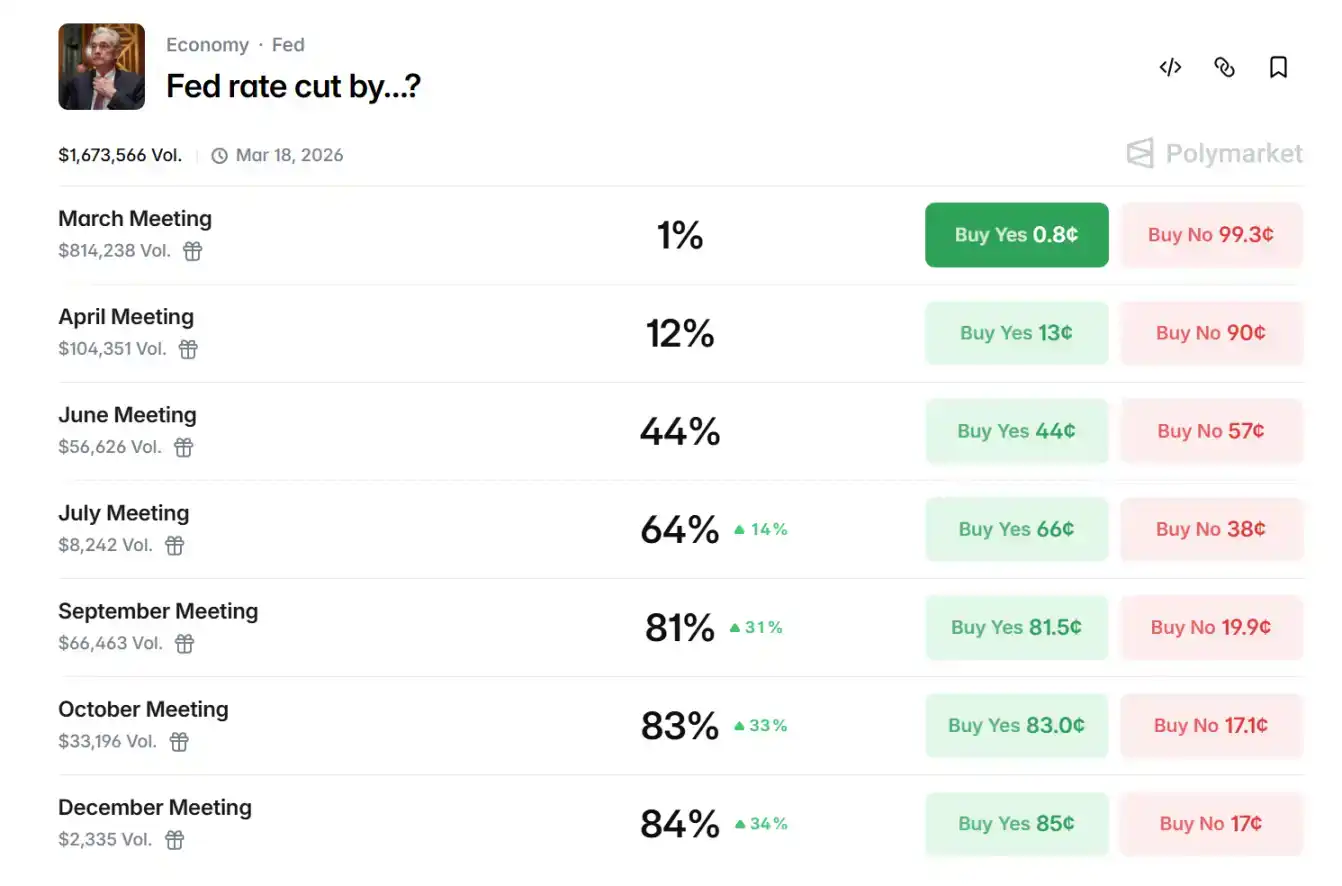
Data from Polymarket shows that the market is currently betting on an 81% probability of a rate cut in September this year, a 64% probability in June, and a 12% probability in April.

Looking ahead to the second half of the year, the Fed's rate cut path remains uncertain. The evolution of the war, inflation trajectory, and employment data will be key variables. If energy prices continue to rise, the Fed may choose to extend the high-interest-rate cycle; conversely, if geopolitical risks ease and core inflation declines, it could open the door for one or two rate cuts. For crypto assets, maintaining high interest rates will continue to suppress risk appetite and valuations, but once a clear signal of rate cuts emerges, market liquidity will recover, providing momentum for Bitcoin's price rise.

Hormuz Strait Becomes Focus, Oil Crisis Imminent

The simultaneous U.S.-Iran military conflict further complicates the policy balance.

On February 28, the U.S. and Israel launched a joint airstrike on Iran. The conflict has lasted nearly two weeks, involving multiple rounds of strikes, energy facility risks, and regional chain reactions. Iran's potential control over the Hormuz Strait has raised global energy supply concerns, with the CPI energy component's month-on-month rebound being an initial reflection.

Iran's Islamic Revolutionary Guard Corps (IRGC) explicitly warned that it would not allow "a single liter of oil" to pass through the Hormuz Strait and claimed that if the blockade continues, oil prices could soar to $200/barrel. The Strait, as a global energy chokepoint, is effectively closed. Satellite data shows most oil tankers are stranded or detouring on both sides of the Strait. Iranian broadcasts warn that any ship attempting to pass will be attacked. The U.S. Navy provides limited escort coverage, leading to a sharp decline in actual traffic.

The Hormuz Strait carries approximately 20 million barrels of crude oil and petroleum products daily, accounting for about 20% of global oil consumption and one-fifth of global seaborne liquefied natural gas (LNG), mainly from exports by Saudi Arabia, Iraq, the UAE, Kuwait, and Iran itself, with destinations primarily in Asia (led by China, India, Japan, and South Korea). Once this bottleneck is cut off, a structural gap in global supply immediately emerges.

From a macroeconomic transmission mechanism perspective, the U.S.-Iran conflict systematically constrains the Fed's rate cut path through the core channel of oil prices. First, the conflict directly impacts global oil supply security. The Hormuz Strait handles about 21% of global seaborne oil trade. Any shipping disruption risk or military threats will immediately push up risk premiums, leading to significant upward pressure on international oil prices. Iran has threatened to maintain the blockade if the conflict persists. Analysts warn that prices could test the $120-150/barrel range in the short term, or even higher; in the long term, if the Strait remains closed for weeks, it could recreate a 1970s-style energy shock,叠加 cost-push inflation.

Historical cases clearly support this logic: During the 1990 Gulf War, soaring oil prices led the Fed to pause its easing cycle; after the 2011 Middle East turmoil and the 2022 Russia-Ukraine conflict, energy price shocks forced the Fed to maintain a tightening stance or delay easing. Although the current U.S.-Iran situation has not yet evolved into a full-blown energy crisis, its persistent disturbance to oil prices is enough to make the FOMC more conservative in assessing financial conditions and inflation prospects, avoiding any easing signals that could amplify risks.

Market data shows that on March 12, Brent crude futures returned above the $100 mark, rising nearly 9% intraday. WTI crude oil is currently at $93.52, up over 8% intraday.

What’s Next for BTC

Since October 2025, Glassnode on-chain data shows that the 7-day exponential moving average for short-term holders has remained below 1, currently at 0.985, confirming that recent buyers are selling at a loss—a typical characteristic of a bear market phase.
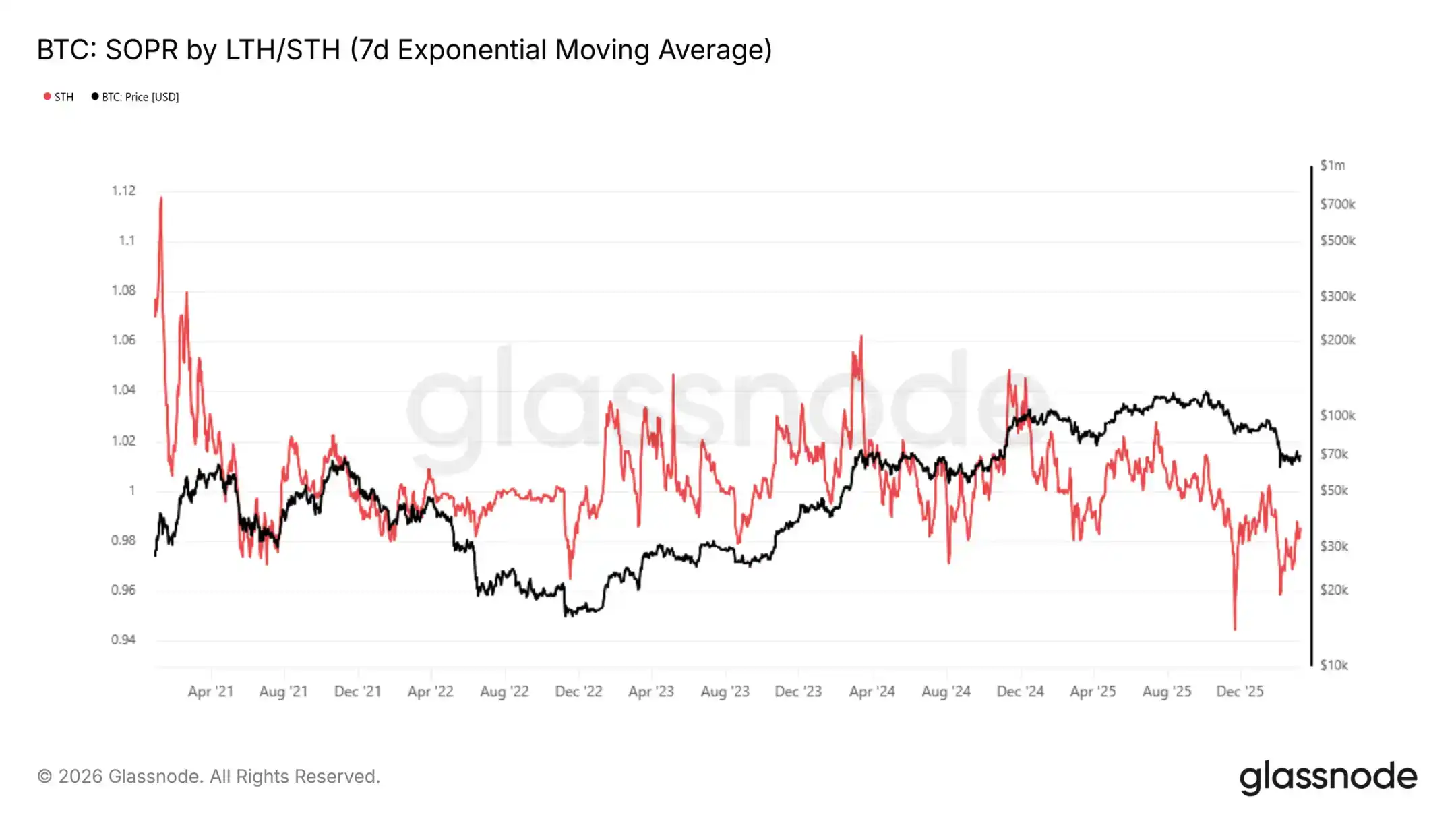
Prices continue to be constrained between the realized price of $54,400 and the true market average price of $78,400. Before decisively stabilizing above $70,000, returns show a明显的 negative skew.

Wintermute stated that macro factors are currently dominating everything, but cryptocurrencies showed resilience last week while stocks, bonds, and even gold fell. The high correlation between cryptocurrencies and stocks in recent quarters is beginning to show cracks. The most likely explanation is that marginal sellers are scarce. The leverage scale in the cryptocurrency market is about $60 billion, roughly half of the peak level. In contrast, speculative positions in gold have accumulated significantly. When all assets fall, cryptocurrencies need to absorb much less forced selling pressure.

From a 12-18 month cycle perspective, the current price level is quite attractive, although the range where BTC buyers are willing to enter extends from the current price down to the low $50,000s. The market still has room to fall further, but most of the deleveraging phase seems to be over. Currently, cryptocurrencies are holding their ground and narrowing the performance gap with other risk assets. Whether this trend can continue once trading volume recovers remains to be seen. Next week's FOMC meeting is a near-term catalyst.

For precious metals, according to Bitget market data, gold is currently oscillating around $5,153, while silver is hovering around $85. The U.S. dollar index (DXY) is currently fluctuating in the 99.35-99.48 range. For U.S. bonds, the 10-year Treasury yield is about 4.21%-4.25%, with a slight intraday increase.
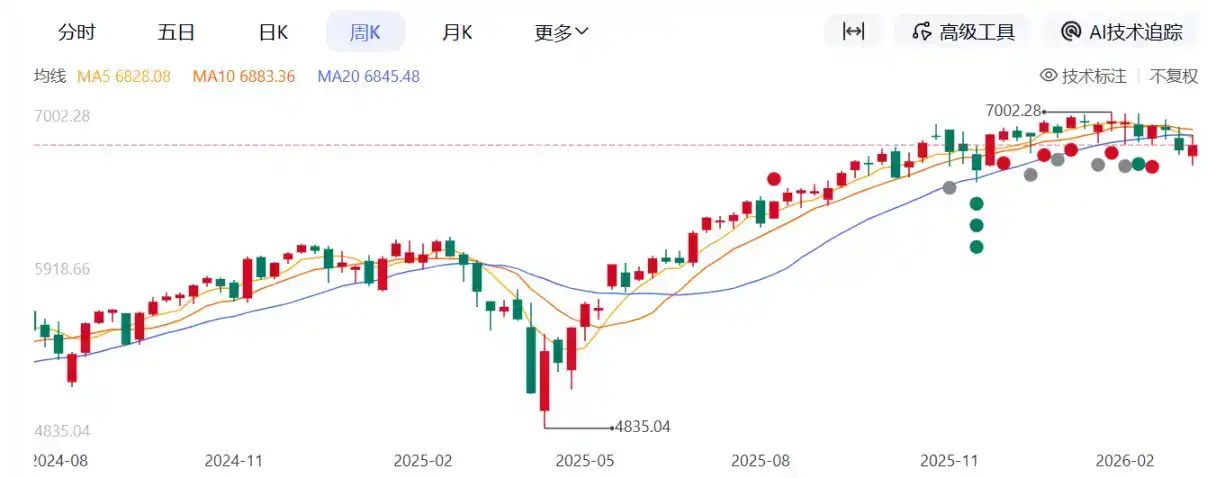
The S&P 500 index is still correcting, currently at 6,775.8. The Nasdaq index is up slightly, currently at 22,716.


Related Questions

QWhat was the year-over-year CPI inflation rate reported for February, and how did it compare to January?

AThe year-over-year CPI inflation rate for February was 2.4%, which was unchanged from January.

QAccording to the article, what is the primary macroeconomic mechanism through which the US-Iran conflict is impacting the Federal Reserve's potential interest rate cuts?

AThe conflict is impacting the Fed's rate cut path through its effect on oil prices. A blockade or threat to the Strait of Hormuz creates a risk premium and pushes international oil prices higher, which can lead to cost-push inflation and force the Fed to maintain a more conservative, higher-for-longer interest rate stance.

QWhat specific warning did the Iranian Islamic Revolutionary Guard Corps (IRGC) issue regarding the Strait of Hormuz?

AThe IRGC warned that it would not allow "a single liter of oil" to pass through the Strait of Hormuz and declared that any ship attempting to pass would be attacked.

QBased on Polymarket data cited in the article, what was the probability the market was assigning to a Federal Reserve rate cut in June at the time of writing?

AAccording to Polymarket data, the probability of a rate cut in June was 64%.

QWhat does the article suggest is a key difference between the current state of the cryptocurrency market and traditional markets like stocks and gold?

AThe article suggests that the cryptocurrency market is showing resilience and a decoupling from traditional assets. It states that while stocks, bonds, and gold were falling, crypto held its ground, partly because its leverage has been reduced to about half its peak, meaning there is less forced selling pressure to absorb compared to gold, which has seen a large buildup of speculative positions.

Related Reads

Three Months, 35 Billion Yuan: Investors Rush to Grab the OpenAI of the Physical World

Investors flock to a physical AI startup as the race for the "OpenAI of the physical world" heats up. Ji Jia Shi Jie (GigaWorld), a company dedicated to developing Artificial General Intelligence (AGI) for the physical world, has raised 3.5 billion RMB (approximately $490 million) in just three months, according to a report from investment media outlet Touzijie. The latest B2 funding round of 1 billion RMB attracted a wide range of top-tier investors, including sovereign wealth funds, industrial capital, and financial institutions. This brings the total funding for the young company, now valued over 10 billion RMB, to 3.5 billion RMB across three recent rounds. The company is led by Huang Guan, a post-90s Tsinghua University PhD with extensive experience in AI, autonomous driving, and entrepreneurship. Its core innovation is a "dual-pyramid" system comprising a five-layer data pyramid (from internet videos to real-world robot data) and a three-layer algorithm pyramid focused on world simulation, action alignment, and reinforcement learning. This system underpins its key models: the "World Action Model" (e.g., GigaBrain series for robot control) and the "World Generation Model" (e.g., GigaWorld series for simulating and understanding the physical world). Its models have reportedly achieved top rankings in global robotics benchmarks. Ji Jia Shi Jie argues that while current digital AGI excels in information processing, the next frontier is physical AGI—systems that can understand and interact with the real world. The company believes the field is approaching its "GPT-3 moment," a key inflection point in capability scaling. To achieve this, the company is pursuing a dual-market strategy. For the consumer (C) market, it launched the "SeeLight" brand and its S1 general-purpose humanoid robot, which has secured initial orders for deployment in real homes. For the business (B) market, it focuses on industrial automation with its Maker series robots, having signed agreements for large-scale deployment in factories, and its DriveDreamer world model for autonomous driving, which is already in use with over 30 automakers and tech companies. The report concludes that by bridging the gap between digital intelligence and physical action, Ji Jia Shi Jie aims to unlock a new wave of productivity, ultimately bringing physical AGI into everyday life.

marsbit21m ago

Three Months, 35 Billion Yuan: Investors Rush to Grab the OpenAI of the Physical World

marsbit21m ago

What's the Connection Between Pinduoduo's Huang Zheng and Blockchain?

This text explores the unexpected connection between Pinduoduo founder Colin Huang and blockchain, as suggested in his article *Turning Capitalism Upside Down*. Huang argues Pinduoduo's core business is about managing "uncertainty." He posits that wealth flows to the rich because they absorb life's uncertainties (e.g., illness, job loss) that devastate the poor, who pay a premium for certainty through insurance or stable prices. Pinduoduo's model attempts a "reverse insurance": by aggregating consumer demand via group-buying and flash sales, it creates a large, predictable order for manufacturers. This certainty allows factories to remove risk premiums, passing savings back as lower prices, thus partially reversing the wealth flow. The key obstacle, Huang notes, is that an individual's buying intent is an unreliable promise. He then asks if blockchain is the natural solution for this "reverse insurance." The text elaborates that blockchain, through smart contracts with binding deposits, could transform casual intent into a costly-to-break, enforceable commitment. This replaces interpersonal trust with coded rules, making promises credible, pricable, and resistant to fraud. Finally, the author draws a parallel to Bitcoin, framing two paths to creating certainty: the "Pinduoduo path" of aggregating decentralized will into scale, and the "Bitcoin path" of locking rules into immutable code. Both sacrifice something—personal freedom or system flexibility—to manufacture trust and predictability.

链捕手1h ago

What's the Connection Between Pinduoduo's Huang Zheng and Blockchain?

链捕手1h ago

The Storage Magnate Who Conquered a Trillion-Dollar Kingdom, Yet Ultimately Could Not Become the Richest

**Summary:** "The Memory Magnate Who Built a Trillion-Dollar Empire, Yet Never Became the Richest" explores the journey of Zhu Yiming, founder of GigaDevice (603986) and co-founder of the soon-to-IPO ChangXin Memory Technologies (CXMT). The article positions GigaDevice, a fabless chip designer now valued at ~¥340 billion, as a prequel to the massive IDM (Integrated Device Manufacturer) venture, CXMT. Starting in 2005 with minimal capital, Zhu strategically "picked up the pieces" by focusing on niche markets like NOR Flash and microcontrollers (MCUs), areas major players were exiting. This allowed GigaDevice to grow into a diversified semiconductor company, maintaining robust profitability even during industry downturns by controlling costs. However, the piece argues that in the highly cyclical and capital-intensive memory chip industry, the fabless model has limits. True resilience and scale require the ability for "counter-cyclical expansion" – investing heavily during downturns – a tactic only possible for IDMs like Samsung or SK Hynix. This insight led Zhu to partner with the Hefei city government in 2016 to establish CXMT, an IDM focused on DRAM. Zhu's symbolic moves, like forfeiting salary and diluting his equity, were crucial in securing the massive state and bank funding needed. CXMT's equipment base is now valued even higher than that of BYD's vast auto manufacturing empire. Despite the potential for CXMT to reach a market cap of ¥1-2 trillion upon its IPO, Zhu's indirect stake in both companies is estimated below 3%, placing his personal wealth far below that of China's top billionaires. The article concludes that his strategic vision built a trillion-yuan memory landscape, but the capital structure necessary to achieve it precluded a personal fortune of similar scale.

marsbit1h ago

The Storage Magnate Who Conquered a Trillion-Dollar Kingdom, Yet Ultimately Could Not Become the Richest

marsbit1h ago

XRP Ledger Daily Fees Drop Below $400 As Network Activity Question Returns

The XRP Ledger is drawing attention as daily network fees have fallen below $400. While low fees align with XRPL's design for affordable transactions and are often seen as a strength, the metric can also serve as an indicator of network demand and paid transaction volume. This data point of around $3,100 in weekly fee burn highlights the stark contrast with higher-fee chains like Ethereum and Bitcoin. The development fuels an ongoing debate. Proponents view low fees as a sign of efficiency and accessibility, while critics may question if the network is generating sufficient high-value activity relative to its market cap and payments-focused narrative. The article cautions against overstating the finding, noting a single low-fee day does not signify network failure. It instead adds context to discussions about XRPL's usage, especially alongside Ripple's broader initiatives in stablecoins (RLUSD), AI payments, and enterprise infrastructure. The report recommends monitoring for a fee rebound, checking transaction counts for a fuller picture, and confirming the trend via native explorers like Bithomp. It frames the story within a larger market shift where on-chain data, protocol updates, and infrastructure developments are becoming crucial alongside price action. The editorial stance is to present the verified data, explain its significance for assessing network activity, and avoid hype, positioning it as part of the daily crypto conversation.

bitcoinist6h ago

XRP Ledger Daily Fees Drop Below $400 As Network Activity Question Returns

bitcoinist6h ago

Trading

Spot
Futures
活动图片




