HIP-3's Watershed Moment: After Trade.XYZ Swallows 90% of the Market, Multiple Players Exit One After Another

marsbitPublished on 2026-06-16Last updated on 2026-06-16

Abstract

HIP-3 on Hyperliquid, enabling permissionless market creation, has fueled rapid growth with over $300 billion in cumulative trading volume. However, the ecosystem is undergoing a sharp consolidation. Trade.XYZ has captured a dominant market share, exceeding 90% of trading volume and 97% of open interest, driven by its first-mover advantage, use of USDC, and rapid asset expansion. This has created a significant liquidity flywheel effect, leaving other projects struggling. Several have recently shut down, including Felix and Ventuals, citing unsustainable competition and the high costs of market deployment. The initial 500,000 HYPE staking requirement (worth ~$35.9M) and subsequent auction costs for new assets present a high barrier to entry. Analysis shows most deployers face low annual yields and multi-year cost recovery periods, unlike Trade.XYZ's estimated 74% yield and 5-month payback. This centralization risks stifling innovation and limiting Hyperliquid's ecosystem diversity beyond perpetual contracts. Proposed solutions include a tiered exchange model with lower entry barriers and adjustments to the fee-sharing model for new markets to improve sustainability for smaller players.

Author: Nancy, PANews

Hyperliquid's battle has "spread to" Wall Street, while the internal dynamics of its ecosystem are also rapidly diverging.

Thanks to the permissionless market deployment capability brought by HIP-3 and the continuous enrichment of tradable asset types, Hyperliquid has rapidly broken through this year, becoming a new battleground for "weekend warriors."

While the HIP-3 market scale is expanding at high speed, its ecosystem is undergoing a brutal reshuffle. Trade.XYZ has almost monopolized the market by leveraging its first-mover advantage, holding over 90% of the market share. In contrast, the survival space for other ecosystem projects is constantly being squeezed. Several projects, including Feilx and Ventuals, have successively announced their closure.

HIP-3 Secures Over $300 Billion in Trading Volume, Trade.XYZ Monopolizes 90% of the Market

The rise of HIP-3 has unlocked a new growth curve for Hyperliquid.

Hyperscreener dashboard data shows that in the past 24 hours, Hyperliquid's full-platform Perp trading volume reached $8.77 billion, with the HIP-3 market contributing about $3.5 billion, accounting for 39.9% of the total trading volume. In other words, for every approximately $10 of perpetual contract trading volume generated on Hyperliquid, nearly $4 comes from HIP-3.

In fact, since its launch last October, HIP-3 has accumulated a trading volume exceeding $319.8 billion in just over half a year, far exceeding market expectations in terms of growth speed. However, what expanded alongside the trading scale was not a blossoming ecosystem but an increasingly obvious head effect, with Trade.XYZ devouring almost the entire market's incremental cake.

Looking at open interest, Hyperscreener data shows that as of June 16, the cumulative open interest in the HIP-3 market was approximately $29.4 billion. Trade.XYZ alone contributed $28.7 billion, accounting for a staggering 97.6% market share. In contrast, other projects like DreamCash, HyENA, Ventuals, and Felix mostly account for less than 1%, almost negligible.
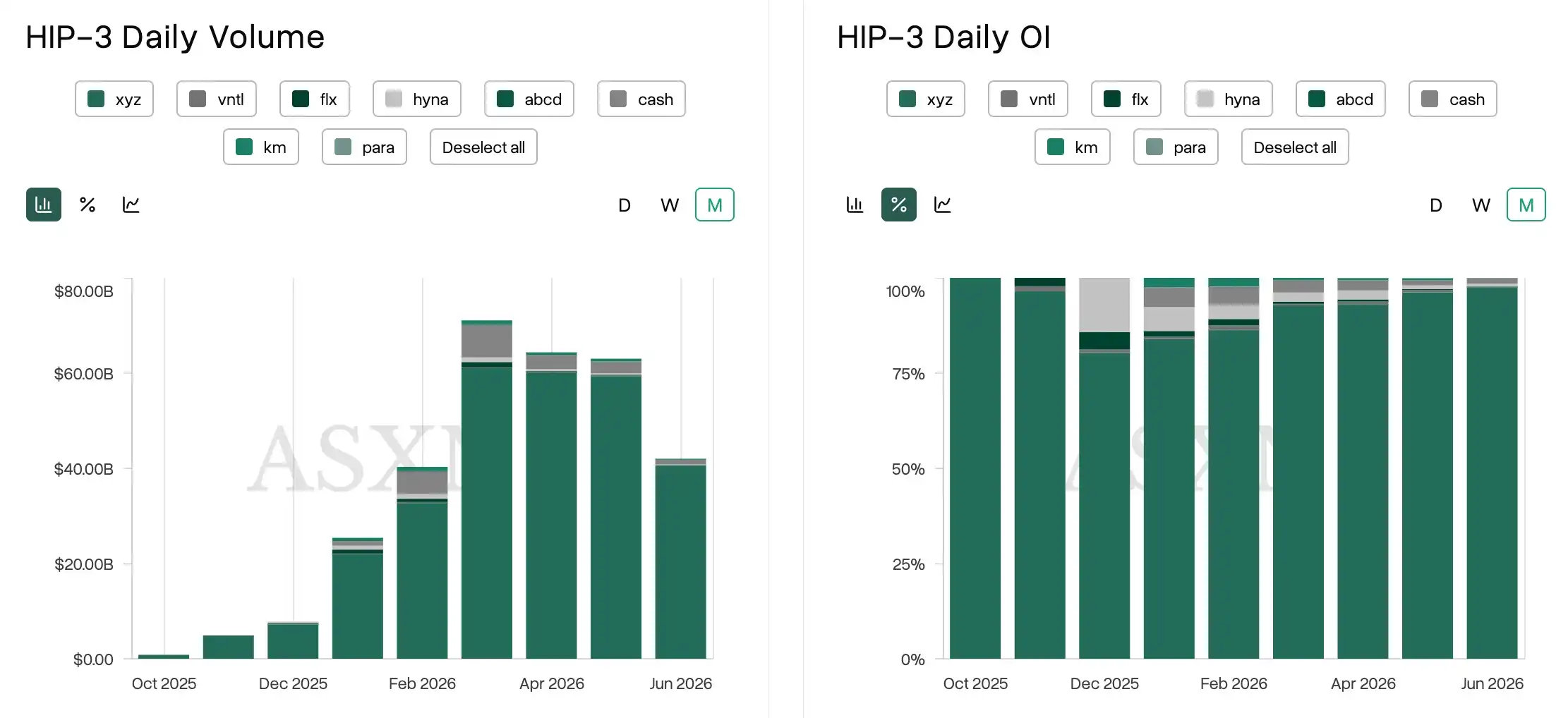
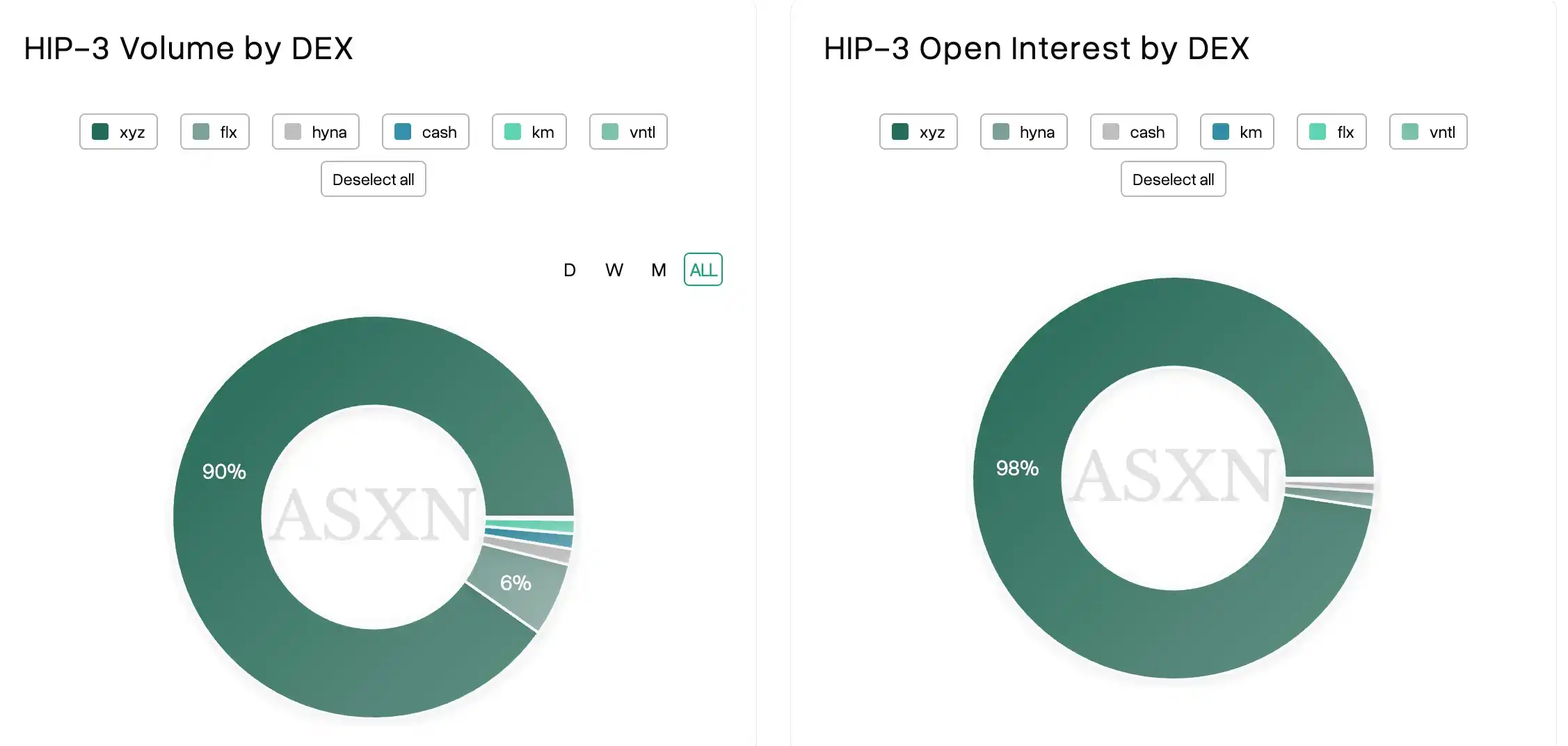
The trading volume dimension confirms this trend. In terms of cumulative historical trading volume, Trade.XYZ firmly holds about 90% market share, with DreamCash second at about 6%. The remaining projects jointly vie for less than 5% of the market space. In June alone, the head effect intensified further, with Trade.XYZ's market share climbing to 96.65%. The other seven markets, including Felix Exchange, Ventuals, and HyENA, collectively accounted for only 3.35%, with some projects even holding less than 0.1%.

Looking further at the trading activity of assets, this gap becomes even more apparent. This month, the cumulative trading volume of all assets on HIP-3 reached $11.21 billion. The core product on Trade.XYZ, XYZ100 (an index tracking the top 100 companies), contributed $10.64 billion alone, meaning a single asset supports most of the trading activity in the entire HIP-3 market.
The divergence in user activity is equally significant. Data shows that this month, Trade.XYZ attracted over 46,000 unique trading addresses to participate in trading, while other markets mostly had only a few hundred unique traders, some even fewer than a hundred. In terms of transaction frequency, Trade.XYZ has accumulated over 22.03 million trades this month, while most other markets had only tens of thousands to over a hundred thousand trades, a stark contrast to the leading platform.

To some extent, the growth story of HIP-3 at this stage can almost be seen as the growth story of Trade.XYZ alone.

HIP-3 Starts an Elimination Race, Ecosystem Projects Exit Successively

As Trade.XYZ continuously siphons market liquidity, HIP-3 is transforming from an open innovation arena into an elimination race dominated by top players, making it increasingly difficult for newcomers to get a piece of the pie.

Recently, several HIP-3 projects have been shutting down. Last week, Charlie, co-founder of the Hyperliquid lending protocol Felix, posted an announcement stating that Felix's HIP-3 DEX and all spot markets would begin shutting down on June 19, with full deactivation completed by June 20. All traders need to close their positions before then. This adjustment will not affect Felix's lending and spot stock businesses. The future focus will be on core products, and they do not rule out returning as a HIP-3 deployer once a new user growth path is found.

In his review, Charlie frankly admitted that although Felix, leveraging its first-mover advantage in markets like crude oil, gold, and silver, had accumulated approximately $3 billion in trading volume and earned substantial fee revenue, its market share was gradually overtaken after Trade.XYZ launched similar markets denominated in USDC.

In his view, Trade.XYZ's ability to quickly establish a moat was key: choosing the more liquid USDC over USDH, seizing the HIP-3 launch window, rapidly expanding the number of markets, and the brand effect and liquidity flywheel created by airdrop expectations. With USDH gradually fading out, continuing to maintain HIP-3 deployment can hardly form a differentiated competitive edge, hence the team's decision to scale back related operations.

Felix is not an isolated case. Shortly after, Ventuals, one of the largest participants offering private company stock trading on Hyperliquid, also announced it would gradually cease operations, with the team joining another building team within the Hyperliquid ecosystem. The platform will successively close markets for OpenAI, Anthropic, commodities, indices, etc. vHYPE holders can redeem HYPE at a 1:1 ratio and claim staking rewards. Ventuals is also terminating its points and referral programs and confirmed it will not issue a token.

Ventuals disclosed that during its operation, the project raised over 500,000 HYPE and achieved over $650 million in trading volume, once becoming one of the most representative innovative applications in the Hyperliquid HIP-3 ecosystem.

Although the team did not publicly explain the reason for the closure, the market generally believes that Trade.XYZ's siphoning of liquidity for popular assets, coupled with the inherent liquidity and pricing challenges of Pre-IPO assets themselves, were significant reasons for the project's eventual exit.

Most Deployers Need Four Years to Break Even, Pressure on HIP-3 Ecosystem Intensifies

Beyond the competitive pressure from the head effect, HIP-3's own deployment mechanism is further squeezing the survival space for latecomers.

According to HIP-3 rules, any team wanting to create a DEX must first stake 500,000 HYPE as a security deposit. Calculated at the current price, this capital outlay amounts to approximately $35.89 million, and must be locked for at least 183 days after deployment. Meanwhile, only the first three assets for each deployer do not require an auction. Any subsequent new assets must acquire deployment rights through a Dutch auction, with a minimum starting bid of 500 HYPE (currently worth about $36,000, though significantly lower than the 1,750 HYPE in January). The HYPE paid for the auction will be directly burned by the protocol.

For new entrants, under the condition of liquidity highly concentrated towards top players, the high upfront investment, continuously increasing expansion costs, and lengthy payback period are becoming increasingly burdensome to bear. It's worth noting that Hyperliquid disclosed in May of this year that it would gradually lower the 500,000 HYPE staking threshold.
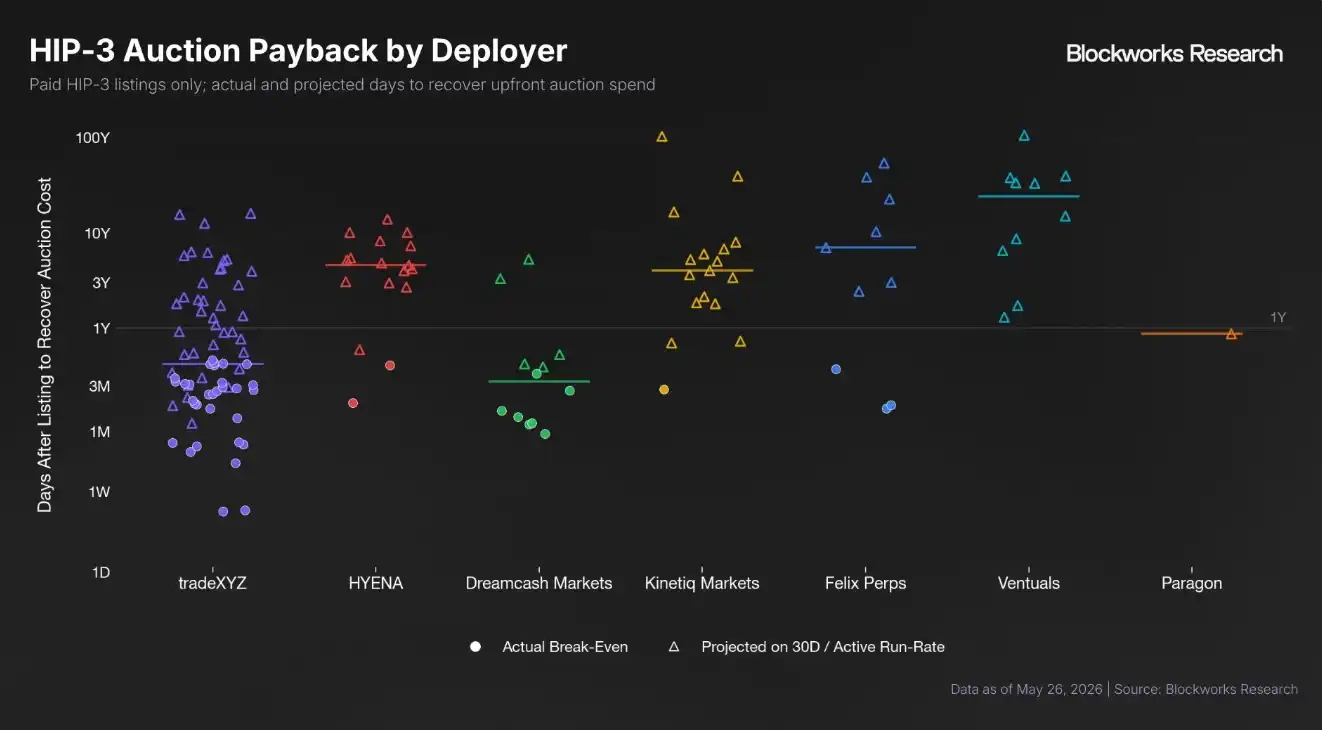
According to Blockworks Research analyst shaunda devens, except for Trade.XYZ, most HIP-3 deployers have an annualized yield based on their staked HYPE close to or even below 1%, with a median recovery period for market auction costs as long as four years. In stark contrast, Trade.XYZ is a clear exception, with an estimated yield on its staked HYPE as high as 74% and a median recovery period for auction costs of only 5 months.
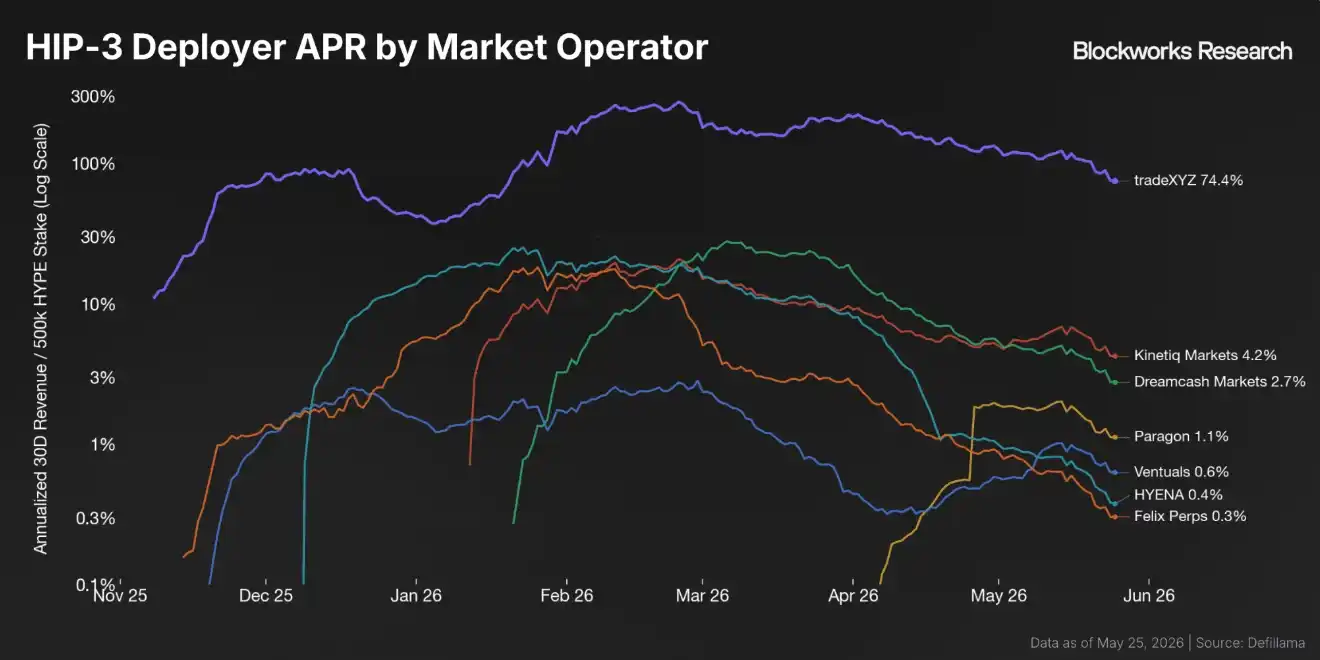
In other words, Trade.XYZ's success stems not only from the product itself but also from a self-reinforcing network effect. More users bring stronger liquidity, stronger liquidity attracts more assets to be listed, and more high-quality assets further consolidate its market position. Meanwhile, marginal deployers lack the incentive to expand further due to low returns, which also dampens demand for new HYPE staking and participation in market auctions.

For Hyperliquid, this situation is not without its concerns.

Undeniably, Trade.XYZ has brought huge incremental space for Hyperliquid, even becoming the most successful showcase case for HIP-3. However, if the listing rights and liquidity for the vast majority of popular assets are concentrated in the hands of a single deployer, then HIP-3 competition will remain top-heavy, struggling to evolve into an open and diverse ecosystem competition.

In the long run, this will not only compress the survival space for innovative projects but may also trap Hyperliquid in the single narrative of perpetual contracts. Especially as competition in the Perp DEX track intensifies, relying solely on perpetual contract trading makes it difficult to build a sufficiently rich on-chain application ecosystem and sustainable network effects. It is noteworthy that Hyperliquid has already ventured into the currently hot prediction market via HIP-4, attempting to further diversify its business portfolio.

Addressing the current dilemma, shaunda devens proposes two mechanism optimization suggestions to enhance the sustainability of market creation and strengthen HYPE's value capture capability.

First, introduce a tiered exchange mechanism. Allow new deployers to launch a HIP-3 DEX with a threshold lower than the current 500,000 HYPE, but with correspondingly restricted permissions, such as lower open interest caps, lower leverage multiples, and stricter risk control rules. As the deployer increases their HYPE stake size, gradually unlock higher-level functionalities.

Second, adjust the HIP-3 market auction economic model. Before a new market recovers its auction costs, allow the deployer to receive up to 100% of trading fee revenue; or, before the cumulative revenue of the entire DEX covers auction costs, prioritize returning transaction fees to the deployer, and revert to the standard 50:50 split between protocol and deployer only after reaching breakeven.

For Hyperliquid, HIP-3 has proven that decentralized market creation is a viable path. Trade.XYZ's success has not only validated product demand but has also become Hyperliquid's significant growth engine at this stage.

However, compared to relying on a single super-app to continuously siphon liquidity, a more resilient, healthier, and open ecosystem perhaps needs to ensure that innovators of different stages and types can all find a space to survive, allowing new assets, new play styles, and new business models to continuously emerge.


Related Questions

QWhat is the main reason behind the dominance of Trade.XYZ in the Hyperliquid HIP-3 market?

AThe main reasons for Trade.XYZ's dominance include its first-mover advantage in the HIP-3 launch window, its use of USDC (which has stronger liquidity) instead of USDH for settlements, rapid expansion of the number of markets it offers, and the brand effect and liquidity flywheel created by airdrop expectations.

QWhy are other HIP-3 projects like Felix and Ventuals shutting down?

AProjects like Felix and Ventuals are shutting down primarily due to intense competitive pressure from Trade.XYZ, which has siphoned away market liquidity. Felix acknowledged that after Trade.XYZ launched competing markets settled in USDC, its market share eroded. For Ventuals, the reasons are believed to be a combination of Trade.XYZ's liquidity absorption and the inherent challenges of liquidity and pricing for its pre-IPO asset market.

QWhat are the significant economic challenges for new HIP-3 deployers, according to the article?

ANew HIP-3 deployers face significant economic challenges: a high upfront requirement to stake 500,000 HYPE as a security deposit (worth ~$35.89 million), the need to win Dutch auctions to list new assets after the first three, and a very long return on investment period. Analysis shows most deployers have an annualized return of less than 1% on staked HYPE, with a median cost recovery period of 4 years.

QWhat potential long-term risk for Hyperliquid's HIP-3 ecosystem does the article identify?

AThe article identifies a potential long-term risk where the overwhelming dominance of a single deployer like Trade.XYZ could stifle competition and innovation within the HIP-3 ecosystem. If most popular assets and liquidity are concentrated with one player, HIP-3 risks becoming a top-heavy competition rather than a truly open and diverse ecosystem. This could also trap Hyperliquid in a single narrative centered on perpetual contracts, hindering the development of a richer on-chain application ecosystem.

QWhat are the two mechanism optimization suggestions proposed in the article to improve the HIP-3 ecosystem?

AThe two suggested optimizations are: 1) Introduce a tiered DEX mechanism allowing new deployers to start with a lower HYPE stake but with limited permissions (e.g., lower open interest caps, leverage), which increase as they stake more. 2) Adjust the market auction economic model so that deployers can receive up to 100% of trading fees until a new market's auction costs are recovered, or until the entire DEX's cumulative income covers its total auction costs, before reverting to the standard 50/50 split with the protocol.

Related Reads

Sharplink CEO: One Million Ethereum Developers, Who Can Compete?

Etherean Ecosystem: One Million Developers and a Formidable Moat The Ethereum network has surpassed a significant milestone: over one million unique lifetime developers, with approximately 232,000 active in the past year. This vast and growing talent pool is Ethereum's core advantage, far more critical than transient metrics like speed or transaction fees. The central question is not which blockchain is fastest, but where the best builders choose to build long-term. Ethereum's answer lies in a decade-long accumulation of infrastructure, standards, tools, liquidity, and collaborative culture that is exceptionally difficult to replicate. It has become the default operating system for programmable finance. This massive developer base is actively working on complex, high-risk challenges that deepen Ethereum's strategic moat: * **Glamsterdam Upgrade (2026):** Focused on core protocol scalability (ePBS, parallel execution) while preserving core values like credible neutrality. * **Synchronous Composability:** Aims to make numerous Rollups interoperate like a single chain, directly addressing fragmentation concerns. * **Quantum Resistance:** Ethereum leads mainstream ecosystems in coordinated preparation for post-quantum cryptography, with a targeted migration plan around 2029. This developer advantage is self-reinforcing, fueled by: * **Deep Composability:** Applications interact like interoperable financial Lego bricks via shared standards (e.g., EVM, Solidity). * **Credible Neutrality:** Secured by over 900,000 validators, making it trusted by major institutions. * **Modularity:** Rollups (Base, Arbitrium, etc.) expand, rather than fracture, the ecosystem into a tightly connected modular internet economy. * **Culture:** Attracts top-tier researchers and standard-setters who guide the entire industry. In essence, while other chains generate activity, Ethereum is consolidating as the trusted, long-term coordination layer for internet-native finance. Its future is being built now by the architects of the next-generation financial infrastructure.

Odaily星球日报29m ago

Sharplink CEO: One Million Ethereum Developers, Who Can Compete?

Odaily星球日报29m ago

Ethereum Reaches the Milestone of One Million Developers, Sharplink CEO Delves Deep into Ethereum's Future Possibilities

Ethereum Surpasses One Million Developers Milestone: A Look at Its Unshakeable Dominance and Future Joseph Chalom, CEO of Sharplink, reflects on his recent Asia trip where he engaged deeply with Ethereum developers and ecosystem leaders. The most striking takeaway was not just the industry's vibrancy, but the rigorous, long-term vision of local builders. This context brings to life a pivotal statistic: Ethereum has now surpassed one million cumulative developers (1,012,824), with approximately 232,000 remaining active in the past year—a talent pool unmatched by any other crypto ecosystem. The critical question isn't which blockchain is fastest, but where top developers choose to build long-term. Ethereum's answer is unequivocal. Its decade-long lead stems from a unique convergence of technology, institutional culture, economic systems, and composability, cementing its role as the foundational operating system for programmable finance. This massive developer base is tackling the industry's hardest problems, continuously strengthening Ethereum's moat. Key initiatives include: * **The Glamsterdam Upgrade (planned 2026):** Introducing ePBS and Block-level Access Lists for parallel execution and higher throughput while preserving core values like credible neutrality and fair MEV distribution. * **Synchronous Composability:** Projects are working to enable atomic transactions across dozens of Rollups, making them function as one unified chain and eliminating ecosystem fragmentation. * **Post-Quantum Security:** Ethereum is far ahead in preparing for quantum computing threats, with a dedicated foundation working group and testnets targeting a full migration by ~2029—a crucial factor for institutional adoption. Beyond developers, Ethereum's core network effects are its unparalleled composability and unified standards (like EVM and Solidity), which create a powerful flywheel: more developers → better tools → greater liquidity → more institutional participation. Its other decisive advantages include credible neutrality (over 900k validators), a secure modular architecture with interconnected Rollups, and a deeply entrenched culture shaped by top-tier researchers. Ultimately, there's a vast difference between generating short-term activity and becoming the trusted, long-term coordination layer for global native finance. Major institutions prioritize security, trust, and liquidity—areas where Ethereum holds dominant mindshare. The industry's trajectory shows resources consolidating around unified standards, deep liquidity, and developer consensus. After meeting the builders in Seoul and Hong Kong, Chalom is more convinced than ever: Ethereum's unshakeable future is being built right now.

Foresight News41m ago

Ethereum Reaches the Milestone of One Million Developers, Sharplink CEO Delves Deep into Ethereum's Future Possibilities

Foresight News41m ago

Saylor's Latest Long Read: Bitcoin is Not Money, It's Digital Capital, and Money is Built Upon It

Michael Saylor presents his "Digital Asset Stack" theory, positioning Bitcoin as the foundational layer of digital capital. He argues Bitcoin itself should remain unchanged—no staking, inflation, or protocol alterations. Instead, a five-layer financial architecture should be built atop it: Digital Capital (BTC), Digital Credit (e.g., yield instruments like STRC), Digital Currency (stable, yield-bearing instruments pegged to fiat), Digital Yield (leveraged/structured products), and Digital Equity (e.g., MSTR stock, absorbing residual volatility). Saylor asserts this stack transforms Bitcoin's high-volatility, high-energy capital into tailored products: stable currencies for payments/savings, yield instruments for income seekers, and equity for growth investors. This approach meets diverse needs—corporate treasuries, banks, retirees, emerging market users—without compromising Bitcoin's core properties (scarcity, decentralization). The "killer use case" is rebuilding global money, credit, and capital markets on Bitcoin, bridging the fiat world with a superior digital asset foundation. The system leverages traditional finance principles (risk layering, structured products) while using Bitcoin as the ultimate collateral. This expands Bitcoin's utility, drives adoption, and offers a better monetary experience: digital, yield-bearing, stable-value tools for everyday use.

marsbit53m ago

Saylor's Latest Long Read: Bitcoin is Not Money, It's Digital Capital, and Money is Built Upon It

marsbit53m ago

Can SK Hynix's Stock Double Again in This Rally?

The article discusses the highly optimistic price target of approximately $3,500 for SK Hynix stock, set by Aletheia Capital. This target is significantly above the consensus range of $2,000-$2,520 from major brokerages. The core debate is whether SK Hynix deserves a fundamental re-rating beyond its traditional cyclical discount, based on the long-term impact of AI-driven demand. The $3,500 target hinges on three key assumptions holding simultaneously until at least 2027: 1) Continued shortage and high pricing for HBM (High Bandwidth Memory), a critical component for AI chips; 2) Sustained high prices for standard DRAM, as HBM production consumes capacity and constrains general supply; and 3) Strong AI server demand generating substantial, above-expectation free cash flow. SK Hynix's leading ~58% market share in HBM and its early certification with key clients like Nvidia provide a competitive advantage, allowing it to capture significant supply chain premiums. The HBM shortage is seen not just as a niche growth driver but as a catalyst that amplifies profitability across the entire memory business by tightening overall DRAM supply. However, the article cautions that this target represents an optimistic "tail scenario." Key risks include potential supply increases from competitors (Samsung, Micron) by 2027, a possible slowdown in HBM price growth, and high capital expenditures that could erode the projected free cash flow. The divergence in analyst targets reflects the market's uncertainty over whether the current AI-driven boom will temporarily elevate earnings or permanently raise the memory industry's profit baseline.

marsbit56m ago

Can SK Hynix's Stock Double Again in This Rally?

marsbit56m ago

Has the Cryptocurrency Market Hit Bottom? Here's What Institutions Think

"Has the crypto market bottomed out? Major institutions are divided on the outlook, according to a recent analysis by Matt Hougan, Chief Investment Officer of Bitwise. Three prominent research firms published in-depth reports on the topic with differing conclusions. Galaxy Digital argues Bitcoin has not yet found its bottom, pointing to only 4 out of 13 historical bottoming indicators being met. Their analysis suggests a potential bottom range of $30,000 to $54,000. NYDIG adopts a more cautious stance, noting that while metrics are close to historical bear market lows, a classic panic-selling capitulation event is missing. They acknowledge the possibility of a bottom but consider it unlikely, citing structural changes from institutional adoption. In contrast, Standard Chartered Bank asserts the bottom is already in at around $59,000. Their revised bullish view, predicting a year-end target of $100,000, hinges on anticipated reductions in ETF selling pressure linked to events like a potential SpaceX IPO. Despite the surface-level disagreement on the exact price floor, the reports share significant common ground crucial for long-term investors. All three institutions agree that a market bottom will likely form within the current year, that current prices are closer to the bottom than to previous cycle highs, and that Bitcoin is poised for another major bull cycle in the future. The core takeaway is that while the precise bottom level remains debated, the long-term value proposition for Bitcoin remains strong and may even be strengthening. Key supportive trends include rising global debt, persistent inflation, declining trust in traditional institutions, accelerating digitization, and improving market infrastructure. Therefore, for investors with a long-term horizon, the focus should shift from pinpointing the exact bottom to recognizing that the cycle's peak is likely still ahead, making current levels an attractive entry point for substantial potential upside."

Foresight News1h ago

Has the Cryptocurrency Market Hit Bottom? Here's What Institutions Think

Foresight News1h ago

Trading

Spot
Futures

Hot Articles

Discussions

Welcome to the HTX Community. Here, you can stay informed about the latest platform developments and gain access to professional market insights. Users' opinions on the price of S (S) are presented below.

活动图片