Here’s why TAO’s 60% March price hike is NOT the real story!

ambcryptoPublished on 2026-03-24Last updated on 2026-03-24

Abstract

Bittensor (TAO) has surged over 60% in March, briefly nearing $300, but the real story goes beyond the price rally. While the token shows a strong uptrend with higher highs and lows, derivatives data reveals caution: open interest hasn’t aggressively followed the rally, and funding rates remain slightly negative, indicating a bias toward short positions. The rally appears driven by spot demand rather than leverage, suggesting a healthier near-term move. Key changes, such as emissions flowing into subnet liquidity pools and reduced reward exploitation, have eased sell pressure. Additionally, subnets are beginning to generate real value across AI inference, decentralized training, and computer vision, with early revenue signs emerging.

Bittensor [TAO] is back in focus! However, while the rally of this month might look familiar on the surface, there may be bigger things at play this time.

TAO marches ahead

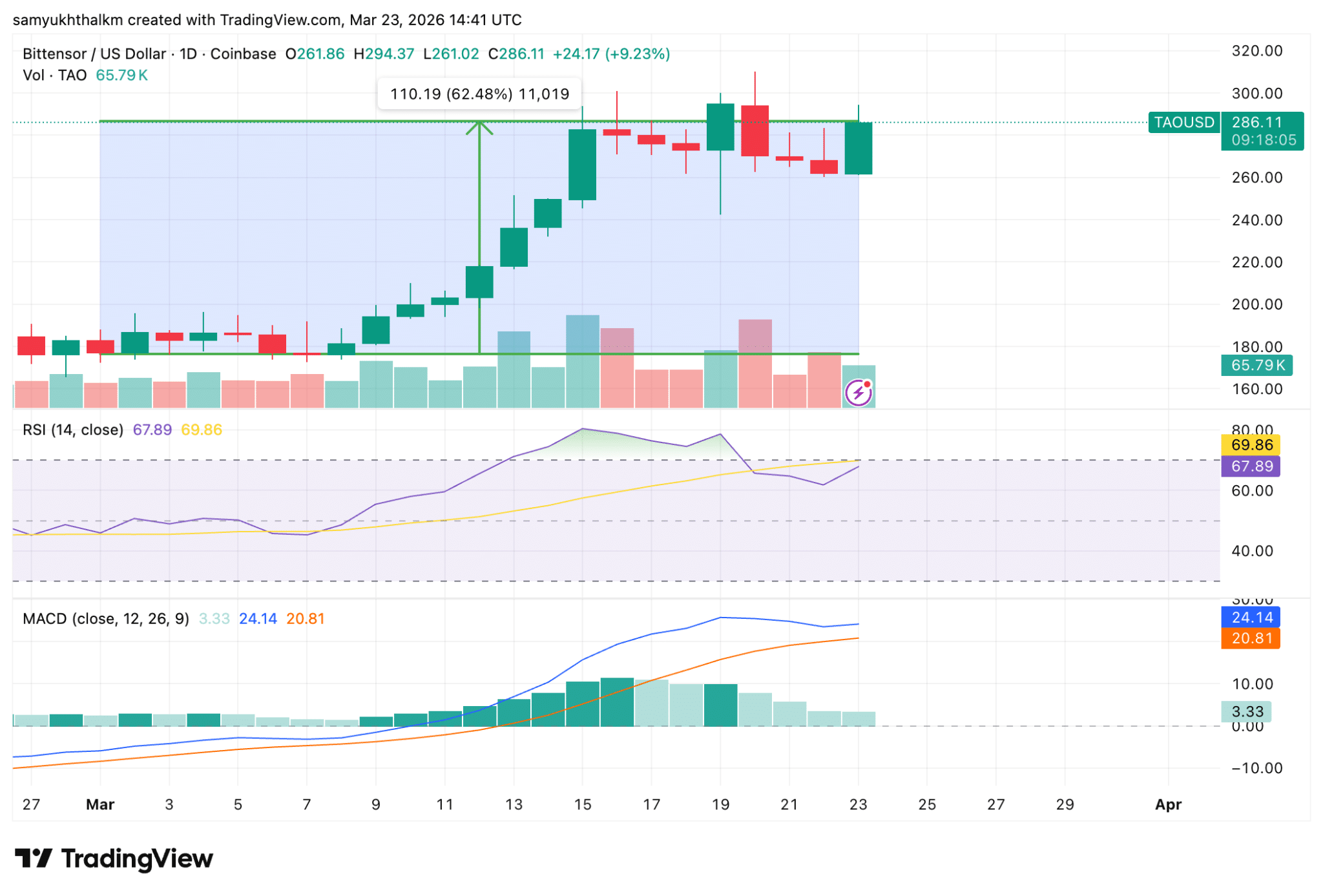
The token climbed up over 60% from its local lows, and briefly pushed towards the $300-mark. The uptrend remained intact, with higher highs and higher lows forming on the daily chart. This, despite the RSI starting to slow down from a near-overbought range.

Source: TradingView

Derivatives numbers looked a lot more cautious though.

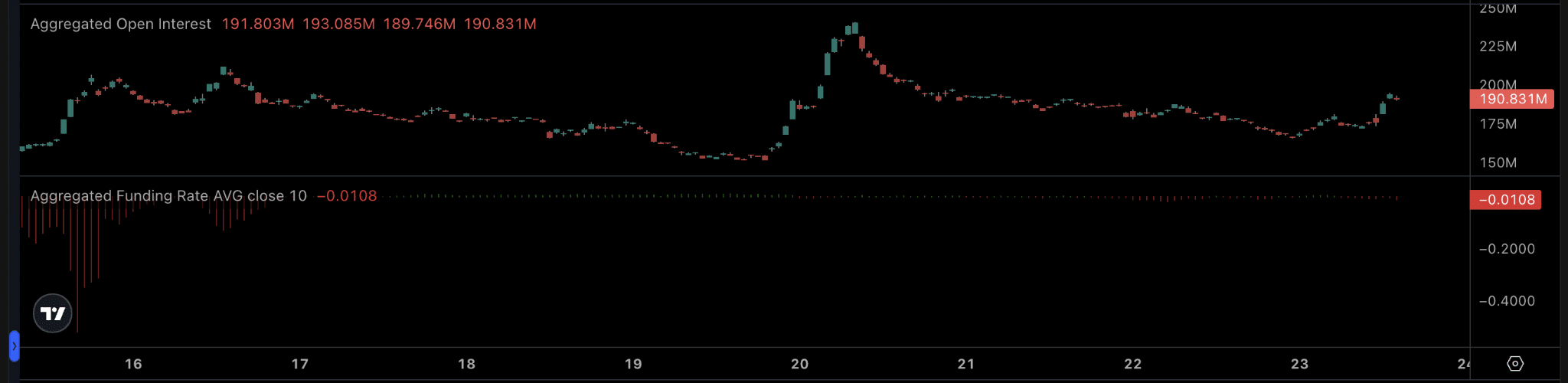
The Aggregated Open Interest (OI), for instance, indicated that fresh leveraged positions have not been aggressively chasing the rally. Meanwhile, Funding Rates have been in slightly negative territory, with a bias towards short positioning despite the price strength.

Source: Coinalyze

TAO’s rally has been caused more by spot demand than leverage, and that’s often a sign of a healthy move... at least in the near term.

Supporting this trend are some key changes. With emissions now flowing into subnet liquidity pools and incentive mechanisms reducing reward exploitation, sell pressure has calmed. With more controlled emissions, these changes might be creating a solid foundation for TAO’s ongoing rally.

Beyond the price

Subnets are beginning to generate tangible value across multiple sectors, from AI inference and decentralized training to enterprise-grade computer vision. In fact, early revenue signs are starting to emerge as well.

Related Questions

QWhat is the main reason behind TAO's recent price rally according to the article?

AThe rally was primarily driven by spot demand rather than leveraged positions, indicating a healthy near-term move. Additionally, reduced sell pressure from controlled emissions and subnet liquidity incentives provided a solid foundation.

QHow much did TAO's price increase from its local lows in March?

ATAO's price climbed over 60% from its local lows in March, briefly pushing towards the $300 mark.

QWhat did the derivatives market data (OI and Funding Rates) suggest about TAO's rally?

AAggregated Open Interest showed no aggressive chasing of the rally with fresh leveraged positions, while Funding Rates were slightly negative with a bias towards short positioning despite price strength.

QWhat key changes in TAO's ecosystem helped support the price rally?

AEmissions flowing into subnet liquidity pools and incentive mechanisms reducing reward exploitation calmed sell pressure, while more controlled emissions created a foundation for the rally.

QBeyond price, what tangible value are Bittensor subnets generating according to the article?

ASubnets are generating tangible value across AI inference, decentralized training, and enterprise-grade computer vision, with early revenue signs beginning to emerge.

Related Reads

I Built Myself an Investment Workbench Using AI

For the past two weeks, I've been immersed in Vibe Coding—using AI to write code from natural language descriptions. This process has enabled me to quickly build functional tools that address long-standing personal ideas. Previously, I had many concepts but found execution too cumbersome. Key ideas included a unified dashboard for assets across US stocks, Crypto, HK stocks, and A-shares; a real-time alert system for price movements; an investment map visualizing sector relationships; and a tool to correlate prediction market bets with news and market data. Traditional development hurdles meant these often remained unrealized. Using AI (Codex, Claude Code, and DeepSeek API), I built four initial tools: 1. A **Cross-Market Asset Dashboard** showing total assets, daily P&L, and holdings by market, with added features for alerts and sector mapping. It's deployed locally for privacy. 2. A **Prediction Market (PM) Monitor** tracking bets on events (e.g., company valuations) and correlating probability shifts with news and market movements. I categorize bets by conviction to filter noise. 3. A **Simple Operations Backend** for managing my writing workflow (topics, progress, publishing). It's cloud-deployed for mobile access. 4. A **One-Click Formatting Tool** that automates converting drafts into various platform-specific formats, saving manual effort. While these tools are basic, they represent a significant shift: AI lowers the barrier to creating personalized systems. I believe individual investors can now feasibly build core systems for: * **Asset Observation** (tracking holdings and changes) * **Signal Monitoring** (watching for key market shifts) * **Sector Mapping** (understanding network relationships within a sector) * **Performance Review** (documenting rationale and outcomes) The power of Vibe Coding is its fast feedback loop. Ideas can be implemented, tested, and iterated on rapidly, turning "want-to-do" into "done." This marks the start of my new phase, where I'll share investment thoughts, tool tests, on-chain operations, and educational Web3 content.

marsbit9m ago

I Built Myself an Investment Workbench Using AI

marsbit9m ago

After Tokenization of Assets, How to Exit?

Title: How to Exit After Asset Tokenization? Author: Symbiotic Compiled by: Hu Tao, ChainCatcher Summary: Tokenization addresses how assets go on-chain but largely leaves the redemption question unresolved. While tokenized assets can settle instantly, the underlying redemption for assets like treasuries, private credit, or real estate can take from T+1 to 180 days. This gap hinders DeFi adoption of Real World Assets (RWAs). Three emerging models aim to provide instant exit liquidity, differing primarily in their capital structure and efficiency: 1. **Balance Sheet Model (e.g., Grove Basin):** A single entity (like Sky) provides immediate liquidity from its balance sheet, acting as a bridge during the settlement period. It offers simplicity and deep initial liquidity but is constrained by a single entity's capacity and risk appetite. 2. **Asset-Specific Vault Model (e.g., Upshift Clear):** Independent liquidity providers fund dedicated vaults for each supported asset, earning fees. It decentralizes capital sources but isolates liquidity and capital per asset, leading to potential fragmentation. 3. **Shared Liquidity Layer Model (e.g., Symbiotic Liquid Lane):** A shared capital pool supports multiple RWA types simultaneously. Funds remain productive between redemptions (e.g., earning yield in lending markets). Exits are settled via a competitive RFQ market. This model aims for higher capital efficiency, scalability across assets, and serves longer-duration assets like private credit. Key differentiators are: 1) Source of capital and risk bearer, 2) Redemption pricing mechanism, 3) Capital efficiency, 4) Scalability to new asset types, and 5) Composability. The shared liquidity layer model represents a move from piecemeal solutions toward scalable infrastructure, enabling T+0 exits by pooling capital, maintaining yield, and using competitive pricing, thus enhancing RWA utility in DeFi.

marsbit22m ago

After Tokenization of Assets, How to Exit?

marsbit22m ago

After Tokenizing Assets, How to Exit?

After tokenization, a key unresolved issue is providing holders with a reliable exit mechanism, as underlying asset settlement (taking days to months) lags far behind on-chain token settlement. Three primary models for instant liquidity have emerged, differing in their capital structure and efficiency: 1. **Balance Sheet Model (e.g., Grove Basin):** A single, well-capitalized entity (like Sky) provides immediate liquidity from its own reserves. This offers simplicity and deep initial liquidity but is constrained by that single balance sheet's capacity and risk appetite, limiting scalability. 2. **Dedicated Vault Model (e.g., Upshift Clear):** Independent liquidity providers (LPs) fund separate vaults for each supported asset. This decentralizes capital sources but isolates liquidity and capital, which becomes inefficient as the number of tokenized assets grows. 3. **Shared Liquidity Layer Model (Symbiotic Liquid Lane):** Independent capital providers fund shared vaults that can support multiple tokenized assets simultaneously. Capital remains productive between redemptions (e.g., earning yield in DeFi markets). Exits are settled via a competitive RFQ market where market makers bid. The article argues that the shared layer model offers superior capital efficiency and scalability. It transforms exit liquidity from an asset-specific patch into shared market infrastructure, allowing liquidity capacity to grow with overall market participation rather than being fragmented per asset. This is particularly valuable for longer-duration assets like private credit, where reliable T+0 exits can significantly enhance their utility in DeFi.

链捕手35m ago

After Tokenizing Assets, How to Exit?

链捕手35m ago

Anthropic's Triple Moment: Code Leak, Government Confrontation, and Weaponization

This article analyzes Anthropic's recent conflicts and strategic moves following the U.S. government's emergency halt of its new Fable model, citing national security concerns over potential "jailbreaks." The author argues this incident reveals deeper tensions between AI labs, governments, and the software industry. While critics view Anthropic's safety-focused rhetoric as marketing fear, the author suggests it serves as a commercial moat masking the company's core economic imperative: moving closer to end-users and their valuable data to avoid being commoditized. The piece outlines a coming clash between frontier AI labs like Anthropic and established software companies. Labs need real-world usage data for model improvement via reinforcement learning, creating a cycle where better products attract more users and more data. This threatens software firms who, as Microsoft's Satya Nadella warns, risk having their value captured by a few dominant models. Anthropic's controversial policy changes—initially secretly degrading Fable's performance for LLM development and expanding data retention—are framed as assertions of control, justified by its safety narrative. The company's foundational belief that it alone is sufficiently concerned about superintelligent AI dangers legitimizes its actions, from resisting government demands to shaping usage policies. The author concludes that this alignment of mission, talent, and business strategy is powerful but concerning, as it concentrates immense potential power in the hands of those convinced of their own righteous understanding.

marsbit45m ago

Anthropic's Triple Moment: Code Leak, Government Confrontation, and Weaponization

marsbit45m ago

Trading

Spot
Futures

Hot Articles

Discussions

Welcome to the HTX Community. Here, you can stay informed about the latest platform developments and gain access to professional market insights. Users' opinions on the price of S (S) are presented below.

活动图片