Helius CEO Says Crypto’s ‘Straw Houses’ Face Collapse As AI Raises The Stakes

bitcoinistPublished on 2026-06-11Last updated on 2026-06-11

Abstract

Helius Labs CEO Mert Mumtaz warns that cryptocurrency is entering a critical security phase, demanding spaceflight-level rigor. He argues crypto's promise of irreversible execution can no longer tolerate the "sloppy" software standards of traditional web apps, where bugs can be patched. Instead, immutable financial code must be provably correct, akin to launching a spaceship. Mumtaz connects this to the historical "software crisis" and the need for formal verification. He criticizes the industry's "facade of decentralization"—reliance on admin keys and emergency interventions—which masks underlying fragility. AI is a dual catalyst: while it empowers attackers to find exploits faster, it also makes rigorous practices like formal verification, audits, and invariant checking more accessible at scale. This will trigger a "trial by fire" and "aggressive natural selection," separating robust "serious infrastructure teams" from fragile "straw house" protocols that may collapse. The ultimate goal is a crypto industry where demonstrable correctness and security are paramount, making it safer and more robust than centralized finance. Mumtaz's warning comes as AI models like Claude advance, compressing the time for both offensive and defensive security research in DeFi.

Helius Labs CEO Mert Mumtaz has warned that crypto is entering a new security era in which AI, formal verification and higher software standards could separate serious infrastructure teams from fragile protocols. In a widely viewed post on X, he argued that crypto is “about to enter the space age,” with immutable financial code increasingly demanding the rigor of aerospace, chip manufacturing and other failure-intolerant industries.

Mumtaz’s central argument is that most software has historically tolerated a level of sloppiness that crypto can no longer afford. In conventional internet businesses, a bug may cause downtime, lost revenue or an embarrassing outage, but centralized operators can usually intervene, patch the system, roll back changes or compensate users. Crypto, he wrote, is structurally different because its core promise depends on irreversible execution in adversarial environments.

“Immutable financial code is akin to a spaceship leaving Earth that you have no further control over. It must work, or there will be catastrophe,” Mumtaz said. “This crisis has come up before. In the late 1960s, a NATO conference declared a ‘software crisis,’ as the software industry was getting increasingly sloppy and no one could really reason about these systems at scale.”

Crypto Must Reach Spaceflight-Level Security

He connected that earlier software crisis to the intellectual roots of formal verification, citing Edsger Dijkstra and the long-standing argument that testing can show the presence of bugs, but not their absence. For systems where correctness matters, Mumtaz said, software has to be treated less like an iterative consumer product and more like a mathematical object that can be reasoned about and proven.

That framing is especially relevant to crypto because blockchain systems handle billions of dollars in assets through code that is public, immutable and constantly probed by attackers. Mumtaz argued that the industry has often adopted the risk profile of aviation or spaceflight while retaining the development culture of web applications. In his words, crypto falls into the category of low-margin-of-error software industries, yet “most of the industry has been built using the sloppy standards of the former, human-intervenable systems.”

The Helius Labs CEO also took aim at what he described as the “facade of decentralization” that has softened the perceived urgency of the problem. Admin keys, controlled validator sets, social coordination and emergency interventions, he argued, have created a short-term sense of comfort. But those mechanisms also blur the distinction between genuinely autonomous systems and systems that can still be rescued by human operators when something breaks.

Mumtaz expects that distinction to become harder to ignore as AI improves. Rather than viewing AI only as a threat vector, he framed it as a force that will make rigorous software practices more accessible. Specification writing, proof assistance, symbolic reasoning, fuzzing, audits, invariant checking and formal verification workflows, he said, could become dramatically easier to use at scale.

“The silver lining is that AI will greatly streamline the process of formal verification and making programs more rigorous. What was once extremely manual and expensive will now become tractable at scale: specification writing, proof assistance, symbolic reasoning, fuzzing, audits, invariant checking, and formal verification workflows will all get dramatically more accessible,” he wrote. “This set of circumstances will lead to crypto reaching its ultimate potential, but I suspect only through trial by fire.”

That “trial by fire” is the crux of his warning. Mumtaz said an “aggressive natural selection mechanism” has already begun and may continue for several years. Strong teams, in his view, will emerge with more resilient systems, while weaker architectures will fail under higher security expectations and increasingly capable adversarial tooling.

He was careful not to frame those failures purely as malicious or negligent. “The serious teams will emerge stronger than ever, while straw houses will collapse,” Mumtaz wrote, adding that the latter should not necessarily be read as an insult because these systems are genuinely hard to build.

The broader implication is that crypto’s next competitive cycle may not be defined only by throughput, liquidity incentives or distribution, but by demonstrable correctness. Mumtaz’s end state is an industry where security, rigor and privacy become first-class concerns again, allowing crypto to become “demonstrably safer, more robust, and more Lindy than any centralized financial system.” His closing line was blunt: “I am long math and I am long crypto.”

The timing of Mert’s post is notable because it came just after Anthropic’s June 9 release of Claude Fable 5 and Claude Mythos 5, a rollout that underscored how quickly AI is moving into offensive and defensive security research. Anthropic said Fable 5 is its most capable generally available model, but added safeguards around cybersecurity queries because the same capabilities could be misused; Mythos 5, the less-restricted version, is being limited at first to selected cyberdefenders and infrastructure providers through Project Glasswing in collaboration with the US government.

For DeFi, that is the uncomfortable part of the story. If models can increasingly reason through large codebases, identify subtle logic flaws and help turn vulnerabilities into working exploits, then public smart contracts become a natural target for AI-assisted bug hunting. Mumtaz’ “straw houses” warning is therefore not abstract: AI may sharply compress the time it takes both auditors and attackers to find the next broken invariant, unsafe assumption or exploitable edge case in crypto’s financial code.

At press time, the total crypto market cap stood at $2.12 trillion.
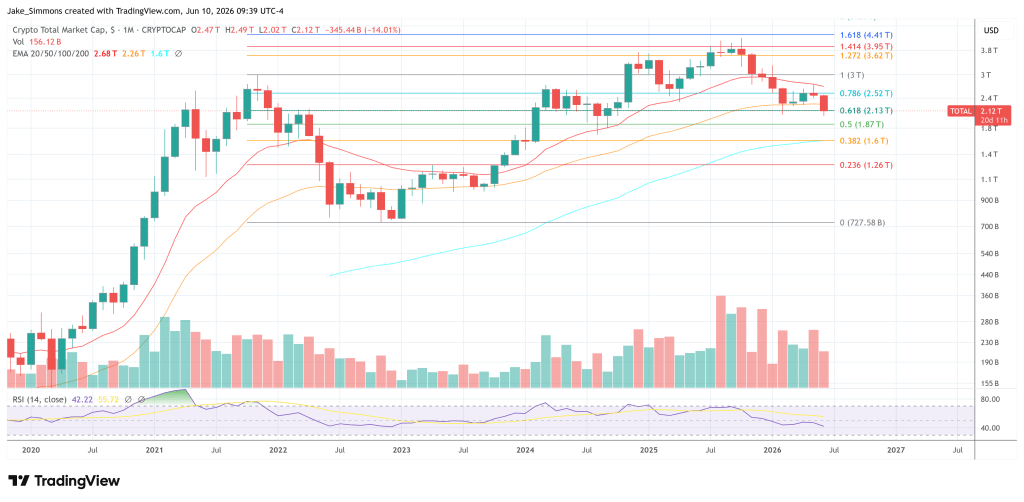
Total crypto market cap must stay above the 0.618 Fib, 1-month chart | Source: TOTAL on TradingView.com

Trending Cryptos

Related Questions

QWhat is the main warning issued by Helius Labs CEO Mert Mumtaz regarding the future of crypto?

AMert Mumtaz warns that crypto is entering a new security era where AI, formal verification, and higher software standards will separate robust infrastructure from fragile 'straw house' protocols. He argues that crypto's immutable financial code demands aerospace-level rigor, and systems that cannot meet these heightened security expectations will collapse under pressure from more capable adversarial tools, including AI.

QAccording to the article, why does crypto software require a higher standard of correctness than conventional internet businesses?

ACrypto software requires a higher standard of correctness because its core promise depends on irreversible execution in adversarial environments. Unlike conventional businesses where centralized operators can intervene, patch systems, or roll back changes, crypto's immutable code, like a spaceship leaving Earth, has no further control. A failure can lead to catastrophic, irreversible financial loss.

QHow does Mert Mumtaz view the role of AI in the future of crypto security?

AMumtaz views AI as a dual-purpose force. While it is a threat vector that can help attackers find vulnerabilities faster, it is also a tool that will make rigorous software practices like formal verification, specification writing, proof assistance, and audits dramatically more accessible and scalable, ultimately helping strong teams build more resilient systems.

QWhat does the article suggest is the 'uncomfortable part of the story' for DeFi regarding AI advancements?

AThe uncomfortable part for DeFi is that AI models are becoming increasingly capable of reasoning through large codebases, identifying subtle logic flaws, and helping turn vulnerabilities into working exploits. This makes public smart contracts a natural target for AI-assisted bug hunting, sharply compressing the time for both auditors and attackers to find the next critical flaw.

QWhat broader shift does Mumtaz predict will define crypto's next competitive cycle?

AMumtaz predicts that crypto's next competitive cycle will be defined not just by throughput, liquidity incentives, or distribution, but by demonstrable correctness. He envisions an industry where security, rigor, and privacy become first-class concerns, allowing crypto to become demonstrably safer and more robust than any centralized financial system.

Related Reads

Supporters of Bitcoin BIP-110 Update Have Prepared a 'Last Resort' Plan If the Proposal Is Not Adopted: It Could Radically Change BTC's Value

Supporters of the BIP-110 update for Bitcoin have prepared a contingency plan in case the proposal is not adopted, a move that could radically alter BTC's value. Developer Chris Guida has adapted a proof-of-work code originally created by Luke Dashjr in 2017 for the current version of Bitcoin Knots. This adaptation is described as a last-resort measure to be activated if miners do not signal readiness for BIP-110. The proposal itself is a soft fork aimed at temporarily limiting the storage of arbitrary data in Bitcoin transactions. It introduces stricter limits on new transaction outputs, OP_RETURN fields, and witness data, with rules designed to expire after approximately one year. Guida stated this option needs to remain open if miners were to "conspire to betray Bitcoin." Should the contingency code be used, it could change Bitcoin's current mining algorithm. This change would likely prevent existing ASIC miners from generating blocks on the new chain, leading to a large-scale reorganization of the Bitcoin mining network. Luke Dashjr, another Bitcoin Knots developer, contributed to the code and expressed hope it would not be needed, but sees its existence as useful for a potential crisis. A supporter known as Mechanic argued that the mere possibility of a proof-of-work change could act as a deterrent, emphasizing that Bitcoin's rules should be set by participants and node operators, not miners. While miner signals are tracked for BIP-110 activation, data from the proposal's official tracking page indicates support remains limited.

cryptonews.ru3h ago

Supporters of Bitcoin BIP-110 Update Have Prepared a 'Last Resort' Plan If the Proposal Is Not Adopted: It Could Radically Change BTC's Value

cryptonews.ru3h ago

Why Did Bitcoin's Price Remain Stable and Not Fall Despite the Recent Major Hack? Here's the Secret

The article discusses why Bitcoin's price remained stable despite a recent $100 million hack targeting individual cold wallets, citing insights from experts on "The Wolf of All Streets" channel. Analysts attribute this resilience to significant institutional shifts in the crypto market. Key points include: 1. **Market Maturation:** The crypto market has transitioned from being dominated by individual retail holders to institutional investors. Most new capital now enters via regulated channels like spot ETFs and custodial services (e.g., Coinbase, Anchorage), making vulnerabilities in individual cold wallets less impactful. 2. **Institutional Dominance:** Control over price dynamics has shifted from miners and crypto exchanges to Wall Street and institutional capital. These large players operate with long-term strategies, viewing price corrections as buying opportunities rather than reasons for panic. 3. **Increased Resilience:** Institutional involvement has reduced market sensitivity to negative news. Sellers are largely exhausted, and remaining holders are steadfast. Major financial institutions (e.g., Morgan Stanley, Wells Fargo) are incorporating crypto assets into portfolios, with research teams recommending allocations of 1–6% to Bitcoin. 4. **Risk Perception:** Bitcoin's integration into traditional financial indices has lowered perceived risk among professionals and institutions, further stabilizing its price against isolated security breaches.

cryptonews.ru4h ago

Why Did Bitcoin's Price Remain Stable and Not Fall Despite the Recent Major Hack? Here's the Secret

cryptonews.ru4h ago

Trading

Spot

Hot Articles

Discussions

Welcome to the HTX Community. Here, you can stay informed about the latest platform developments and gain access to professional market insights. Users' opinions on the price of S (S) are presented below.

活动图片