GSR Research Says Ethereum’s Identity Crisis Is Deepening

bitcoinistPublished on 2026-05-26Last updated on 2026-05-26

Abstract

GSR Research highlights Ethereum's deepening strategic and identity crisis, driven by high-profile departures from the Ethereum Foundation (EF), weak ETH performance, and internal debate over the EF's role. Analysts argue the EF's new "CROPS" framework (censorship resistance, open source, privacy, security) is seen as deprioritizing growth amid pressure from rivals like Solana. Vitalik Buterin responded by advocating for a smaller EF focused narrowly on CROPS and credible neutrality, not growth, betting on technical pillars like AI-assisted formal verification and "available chain consensus." However, the report concludes that while credible neutrality is a key differentiator, Ethereum's window to execute its vision is not unlimited as competitors advance on user experience and throughput.

Ethereum is facing one of its most uncomfortable periods in recent memory, with GSR Research’s Carlos Guzman arguing that leadership turnover, weak ETH performance and a sharpening debate over the Ethereum Foundation’s (EF) role have exposed a deeper strategic crisis for the network.

GSR Research Flags Ethereum’s Identity Crisis

In a note titled “Ethereum’s Identity Crisis,” Guzman framed the issue as more than a temporary morale problem. At least nine senior EF contributors have departed in 2026, according to the note, including five in May alone. The list includes protocol cluster leads Tim Beiko and Barnabé Monnot, veteran researchers Carl Beekhuizen and Julian Ma, and former co-executive director Tomasz Stańczak.

Several of the exits followed an internal mandate centered on CROPS, shorthand for censorship resistance, open source, privacy and security. The framework was intended to clarify the foundation’s priorities, but Guzman wrote that many in the community perceived it as deprioritizing growth and adoption at a moment when Ethereum is already under pressure from faster-moving rivals.

The personnel churn has amplified a broader debate over whether the EF should remain a narrow research and protocol institution or take a more active role in defending Ethereum’s market position. Dankrad Feist, formerly at the foundation, publicly called for a new $1 billion-plus organization economically aligned with Ethereum to fill what he sees as an institutional void. Bankless co-host and long-time ETH bull David Hoffman also said he had sold all of his ETH, citing frustration with leadership he views as insufficiently focused on growth.

The market backdrop has made the internal debate harder to dismiss. Guzman noted that ETH is down roughly 30% year to date, while the ETH/BTC ratio fell to 0.027 in May, its lowest level since mid-2025. Network revenue has also weakened as Ethereum cedes ground to chains such as Solana, Tron and Hyperliquid. Revenue is not a complete measure of network health, particularly as blockchains deliberately reduce fees to attract users, but the trend has fed the perception that Ethereum’s economic gravity is weakening.

Vitalik Buterin responded with a lengthy post on X that sought to redefine the foundation’s role rather than expand it. Buterin described the EF as “a smaller ship” that should sell less ETH and focus narrowly on CROPS. He also argued that the foundation should be viewed as “one node, with a defined purpose,” not the center of Ethereum itself.

That framing is central to the tension Guzman identifies. Buterin’s argument is that moving talented people into roles outside the foundation may be necessary if the ecosystem is to attract outside capital and develop independent leadership. The foundation, in this view, should not become ETH’s growth department. It should preserve the properties that make Ethereum credible in the first place.

Buterin’s technical vision rests on three pillars that he said could make Ethereum “deeply impressive” in ways competitors cannot easily replicate. The first is provably bug-free software through AI-assisted formal verification, an approach that appeared unrealistic until recently but may now be moving closer to feasibility.

The second is what he called “available chain consensus,” a property Guzman described as unique among proof-of-stake chains because it combines traditional BFT-style safety under network asynchrony with Bitcoin-like safety under synchrony against attackers up to 49%. The third is intermediary minimization, reducing Ethereum’s reliance on centralized relayers and third-party infrastructure for transaction inclusion and privacy through proposals such as FOCIL and EIP-8141.

The core bet is credible neutrality. Guzman argued that this remains a more compelling advantage than Ethereum’s critics often acknowledge. The view that “blockspace is a commodity” misses an important point: users have repeatedly shown a willingness to pay more to transact on one chain rather than another when that chain offers superior assets, applications, liquidity and network effects.

But the note also underscored the limits of that argument. Credible neutrality may attract builders and institutions, but users still need affordable transactions, fast execution, privacy and a workable experience. On several of those fronts, Ethereum remains vulnerable to competitors that are optimizing for throughput, fees and user experience today while promising stronger neutrality tomorrow.

Guzman’s conclusion is not that Buterin’s vision is wrong. It is that Ethereum’s window to execute on it is not unlimited. The question now is whether a smaller, more narrowly focused EF can preserve Ethereum’s deepest differentiator while the rest of the ecosystem builds the growth machinery around it.

At press time, ETH traded at $2,097.
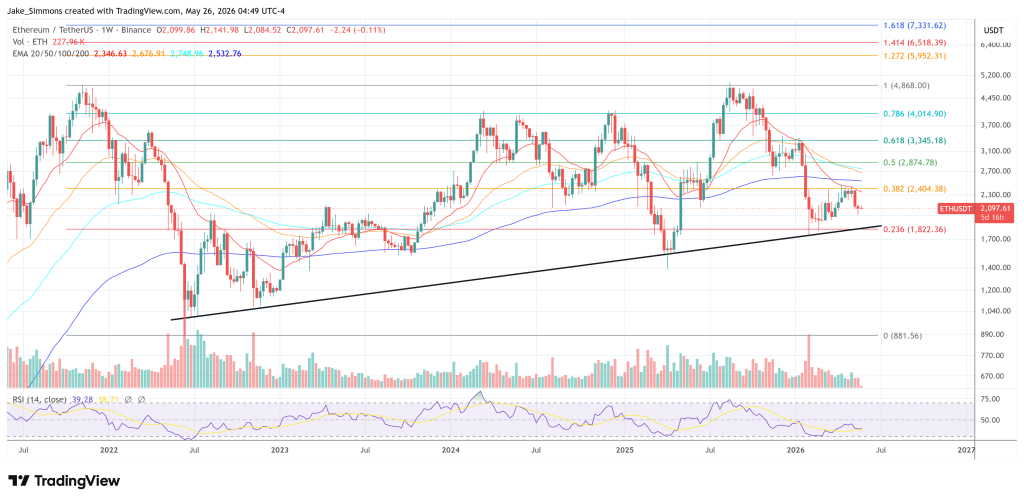
ETH uptrend remains intact, 1-week chart | Source: ETHUSDT on TradingView.com

Related Questions

QAccording to GSR Research's note, what are the key factors contributing to Ethereum's perceived identity crisis?

AThe key factors include significant leadership turnover at the Ethereum Foundation (with at least nine senior contributors departing in 2026), weak ETH price performance, a debate over the EF's strategic role, and internal disagreements over the CROPS (censorship resistance, open source, privacy, security) mandate which some perceive as deprioritizing growth.

QWhat is the core of the tension identified by GSR regarding the Ethereum Foundation's role?

AThe tension revolves around whether the Ethereum Foundation should remain a narrow research and protocol-focused institution, as advocated by Vitalik Buterin, or take a more active role in defending Ethereum's market position and driving growth, as suggested by some community members and former contributors.

QWhat are the three technical pillars of Vitalik Buterin's vision for Ethereum's future, as mentioned in the article?

AThe three pillars are: 1) Provably bug-free software through AI-assisted formal verification. 2) 'Available chain consensus,' a unique property combining BFT-style safety under asynchrony with Bitcoin-like safety under synchrony. 3) Intermediary minimization, reducing reliance on centralized relayers and third-party infrastructure.

QWhat is the 'CROPS' framework mentioned in the context of the Ethereum Foundation's internal mandate?

ACROPS is a framework intended to clarify the Ethereum Foundation's priorities. It is an acronym standing for Censorship resistance, Open source, Privacy, and Security.

QWhat is GSR Research's main conclusion regarding Ethereum's current situation and future?

AGSR Research's conclusion is not that Vitalik Buterin's vision for a credibly neutral, technically robust Ethereum is wrong, but that Ethereum's window to execute on this vision is not unlimited. The key question is whether a smaller, more focused EF can preserve Ethereum's core differentiators while the broader ecosystem builds the necessary growth machinery around it.

Related Reads

From Mining Pool to Mars: Why Is Wang Chun in the SpaceX Cockpit?

Title: From Mining Pool to Mars: Why Wang Chun is in the SpaceX Cockpit? When SpaceX announced that Wang Chun, co-founder of F2Pool, would command the first commercial crewed interplanetary mission, many were shocked. Why would a Bitcoin mining pool founder be on a Mars mission roster? However, understanding Wang Chun's journey over the past decade and the deepening ties between the crypto industry and SpaceX reveals this is not accidental, but an inevitable result of a new era taking shape. Today's Mars plan is no longer just a space engineering project; it is evolving into a civilization-upgrading experiment driven by global tech capital, AI, computing power, energy, and the crypto economy. Wang Chun stands precisely at the intersection of these forces. Part 1: From F2Pool to SpaceX – Wang Chun's Leap F2Pool, founded when Bitcoin was still niche, is one of the earliest large-scale mining pools and once held a significant share of global Bitcoin hash rate. Wang Chun belongs to the first generation of Chinese Bitcoin advocates and infrastructure builders—idealists and engineers who believed in a new value network independent of traditional finance. Miners like him built the hardware, energy, and computing power foundational to decentralized networks. This aligns with the long-term, high-engineering, future-oriented vision required for space civilization. Elon Musk’s space endeavors value such long-term builders over mere capital players, which explains Wang Chun's entry into the SpaceX ecosystem. Part 2: Why Crypto and SpaceX Are Growing Closer The core of global tech competition is shifting from internet applications to next-generation infrastructure. Both crypto and SpaceX are part of this. SpaceX's goal is to drastically reduce space access costs. If successful, it could enable orbital servers, space-based energy, global satellite internet, and Martian bases. These new frontiers will require new payment systems, value networks, and global financial architectures. Cryptocurrencies, inherently global and trustless, are poised to become key to off-planet economies. Moreover, crypto and SpaceX share a high-risk, long-termist ethos—believing in ambitious, world-changing goals despite early skepticism. Part 3: Human Spaceflight Enters the Commercial Era Space exploration, long dominated by state actors, is now being transformed by commercial entities like SpaceX. Wang Chun's involvement signifies that future deep-space participants may include not just career astronauts, but also entrepreneurs, engineers, and AI researchers. This mirrors the Age of Exploration, where commercial capital eventually drove global expansion. Wang Chun has emphasized that Mars colonization must not be delayed for future generations, countering a potential over-focus on nearer-term, commercial lunar projects. His presence symbolizes how new capital, technical communities, and idealists from the crypto world are now entering the interstellar age. In summary, the true significance is not an individual's journey to Mars, but the shift in the driving force of human civilization expansion from state machinery to tech companies, AI systems, and global technology capital. Wang Chun's path—from mining pool to Mars, from the Bitcoin network to starships—may be a preview of technological civilization's evolution in the coming decades.

marsbit8h ago

From Mining Pool to Mars: Why Is Wang Chun in the SpaceX Cockpit?

marsbit8h ago

Trading

Spot
Futures

Hot Articles

Discussions

Welcome to the HTX Community. Here, you can stay informed about the latest platform developments and gain access to professional market insights. Users' opinions on the price of S (S) are presented below.

活动图片