Goldman Sachs Predicts 11% Return: How Far Can the Optimistic Cycle of Global Stock Markets Go?

比推Published on 2026-01-14Last updated on 2026-01-14

Abstract

Goldman Sachs Research forecasts an 11% total return (including dividends, in USD terms) for global equities over the next 12 months, anticipating a continued but more moderate bull market into 2026. While valuations are at historical highs following last year's strong performance, the rally is expected to be driven by corporate earnings growth and sustained economic expansion rather than further multiple expansion. A key theme is the importance of diversification. Investors benefited in 2025 from geographic diversification, a trend expected to continue and broaden to include factors (growth vs. value) and sectors. The analysis suggests the market is in an "optimism" phase of the cycle, which typically carries upside risk to valuations. The report highlights that while AI enthusiasm remains high, it does not constitute a bubble. The tech sector's dominance is supported by superior earnings growth, and the valuation gap between the largest tech stocks and the rest of the market is far smaller than during previous bubbles. Investors are advised to seek alpha opportunities through stock selection as correlations decrease and to consider non-tech companies that may benefit from AI-driven capital expenditure.

Author: Goldman Sachs

Compiled by: Shenchao TechFlow

Original title: Goldman Sachs Predicts: Global Stock Markets Expected to Achieve 11% Return in the Next 12 Months


  • Following last year's strong growth, Goldman Sachs Research predicts that global stock markets are expected to continue climbing in 2026, with an anticipated return of 11% over the next 12 months (including dividends, in USD terms).

  • Although last year's stock market rally has left valuations at historically high levels, corporate earnings and economic growth globally are expected to continue supporting the markets.

  • Last year, investors benefited significantly from cross-regional diversification, a trend that is likely to continue. Additionally, diversification across investment styles and sectors is expected to further enhance returns.

According to Goldman Sachs Research, the global bull market is likely to continue this year, driven by growth in corporate earnings and sustained economic expansion. However, the gains in the stock market are expected to be lower than the significant rally seen in 2025. In 2026, the global economy is expected to maintain expansion across regions, and the US Federal Reserve is anticipated to continue with moderate easing policies.

"In the current macroeconomic context, even with high valuations, a significant stock market correction or bear market without an economic recession would be unusual," wrote Peter Oppenheimer, Chief Global Equity Strategist at Goldman Sachs Research, in his report titled "Global Equity Strategy 2026 Outlook: Tech Tonic—a Broadening Bull Market."
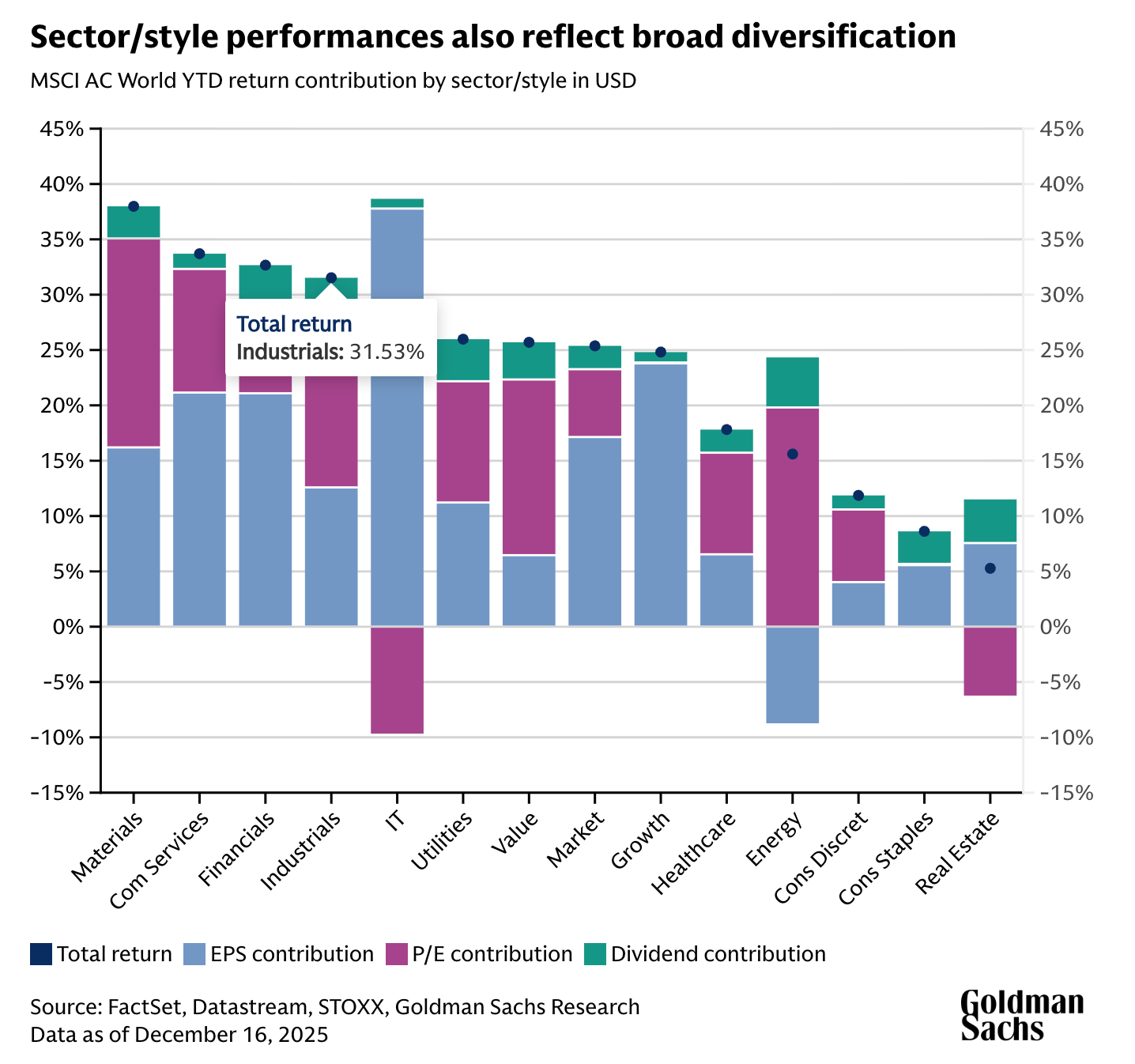
Diversification was a core theme emphasized by Goldman Sachs Research last year. In 2025, for the first time in many years, investors who diversified across regions were rewarded. Goldman Sachs analysts expect this trend to continue in 2026 and expand to include diversification across investment factors such as growth and value, as well as across various sectors. (Investment factors refer to asset characteristics such as size, value, or momentum that typically influence risk and return.)

What Is the Outlook for Global Stock Markets in 2026?

Despite the strong performance of stock markets in 2025, outperforming commodities and bonds, the rally was not smooth. At the beginning of the year, stocks underperformed, with the S&P 500 experiencing a nearly 20% correction from mid-February to April before rebounding.

Peter Oppenheimer, Chief Global Equity Strategist at Goldman Sachs Research, noted that the strong rally in global stock markets has left valuations at historically high levels across all regions, including the US, Japan, Europe, and emerging markets.
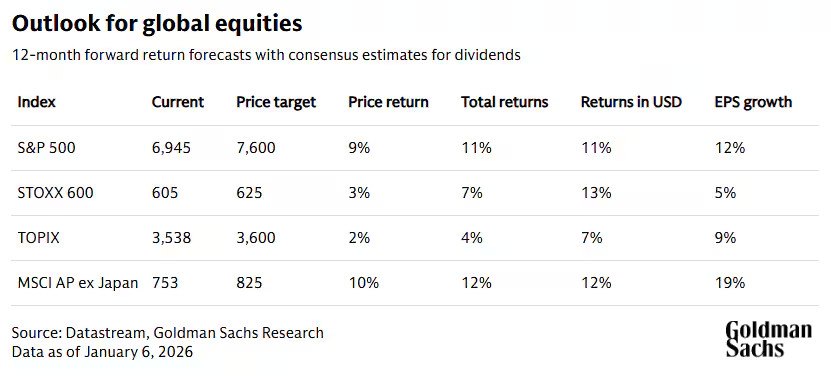
"Therefore, we believe that returns in 2026 are more likely to be driven by fundamental earnings growth rather than further valuation expansion," Oppenheimer said. According to Goldman Sachs analysts' forecasts as of January 6, 2026, global stock prices (weighted by regional market capitalization) are expected to rise by 9% over the next 12 months, achieving an 11% return in USD terms (including dividends). He added, "Most of the return will come from earnings-driven growth."

Additionally, according to another Goldman Sachs forecast, commodity indices are also expected to rise this year, with gains in precious metals once again offsetting declines in energy prices, a trend similar to 2025.

Oppenheimer's team also studied the typical evolution of market cycles: the despair phase during bear markets when stocks fall; the brief hope phase during market rebounds; the longer growth phase where returns are driven by earnings growth; and finally, the optimistic phase where investor confidence strengthens and even becomes complacent.

Their analysis suggests that stocks are currently in the optimistic phase of a cycle that began with the bear market during the COVID-19 pandemic in 2020. "This late-cycle optimistic phase is often accompanied by rising valuations, indicating that there may be some upside risk to our core forecast," Oppenheimer's team wrote.

Should Investors Diversify Their Stock Portfolios in 2026?

In 2025, geographical diversification provided significant benefits to investors, which is uncommon. US stock markets underperformed other major markets for the first time in nearly 15 years. Due to the depreciation of the US dollar, the returns from European, Chinese, and Asian stock markets were almost double the total return of the S&P 500.

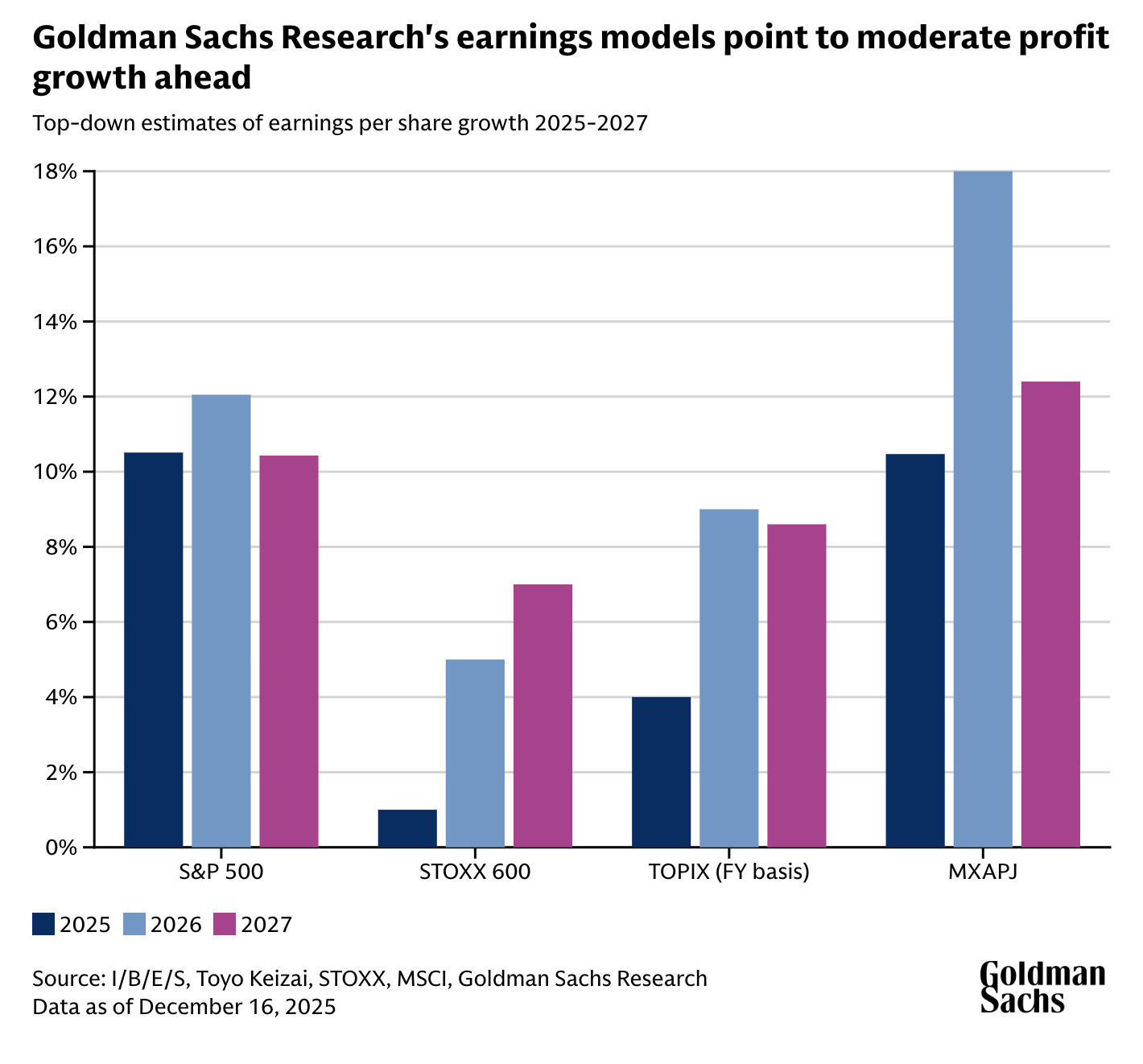
Returns in US stock markets were primarily driven by earnings growth, especially from large technology companies. However, outside the US, the balance between earnings improvement and valuation expansion was more even. Last year, the growth-adjusted valuation gap between US and global markets narrowed.

"Even though absolute valuations in the US remain high, we expect these growth-adjusted valuation ratios to continue converging in 2026," Oppenheimer's team wrote.

Oppenheimer noted that diversification is still expected to provide better risk-adjusted returns in 2026. He advises investors to explore broad geographical investment opportunities, including increased focus on emerging markets. At the same time, investors should balance between growth and value stocks and pay attention to different sectors. Additionally, they can look for opportunities where correlations between stocks decrease, providing room for stock picking.
"As stock correlations decline and may remain low, we are also paying more attention to enhancing alpha," wrote Peter Oppenheimer, Chief Global Equity Strategist at Goldman Sachs Research. Alpha measures an asset's performance relative to a broader market index.

Oppenheimer added that non-technology sectors may perform strongly this year, and investors could profit from stocks benefiting from technology companies' capital expenditures. Furthermore, as new capabilities of artificial intelligence (AI) are gradually realized, market attention may increasingly focus on companies outside the technology sector that benefit from AI development.

Are AI Stocks in a Bubble?

Overall, market focus on artificial intelligence "remains intense," Goldman Sachs analysts noted. However, this does not mean there is a bubble in the AI sector. "The dominance of the technology sector in the market was not triggered by the rise of AI," Oppenheimer wrote. "This trend began after the financial crisis and has been supported by its exceptional earnings growth."

Despite the surge in stock prices of large technology companies, current valuation levels have not reached the extremes seen in previous bubble periods. For example, comparing the valuation gap between the five largest companies by market capitalization in the S&P 500 and the other 495 stocks shows that this gap is much smaller than in previous cycles, such as the peak of the tech bubble in 2000.


Twitter: https://twitter.com/BitpushNewsCN

BitPush TG Discussion Group: https://t.me/BitPushCommunity

BitPush TG Subscription: https://t.me/bitpush

Original link: https://www.bitpush.news/articles/7602780

Related Questions

QWhat is Goldman Sachs' predicted 12-month return for global equities, and what factors are expected to drive this return?

AGoldman Sachs predicts an 11% return for global equities over the next 12 months (including dividends, in USD terms). This return is expected to be primarily driven by fundamental earnings growth rather than further valuation expansion, supported by corporate profit growth and continued economic expansion across regions.

QAccording to the report, what stage of the market cycle are global equities currently in, and what characterizes this phase?

AGlobal equities are currently in the 'optimism' phase of the market cycle, which began with the bear market during the COVID-19 pandemic in 2020. This phase is characterized by rising valuations and increased investor confidence, sometimes bordering on complacency.

QHow did geographic diversification benefit investors in 2025, and is this trend expected to continue in 2026?

AIn 2025, geographic diversification provided significant benefits as U.S. equities underperformed other major markets for the first time in nearly 15 years. European, Chinese, and Asian markets delivered nearly double the total return of the S&P 500. This trend is expected to continue in 2026, with further convergence in growth-adjusted valuations and better risk-adjusted returns from diversification.

QDoes Goldman Sachs report suggest that AI stocks are in a bubble, and what evidence supports this view?

ANo, the report does not suggest that AI stocks are in a bubble. While market enthusiasm for AI remains high, the dominance of the tech sector is not solely triggered by AI but began after the financial crisis and is supported by superior earnings growth. The valuation gap between the top five companies in the S&P 500 and the rest is far smaller than during previous bubbles, such as the 2000 tech bubble peak.

QWhat investment strategies does Peter Oppenheimer recommend for 2026 to enhance returns and manage risk?

APeter Oppenheimer recommends diversifying across geographies, including increased exposure to emerging markets, balancing growth and value investment styles, and diversifying across sectors. He also suggests focusing on stock picking opportunities as correlations between stocks decrease, and looking for non-tech sectors that may perform well, including companies benefiting from tech capital expenditure and AI adoption.

Related Reads

As Consensus Accelerates, What Are Young Investors Betting On?

Title: As Consensus Forms Faster, What Are Young Investors Betting On? In the rapid evolution of tech investment, a new generation of young investors is navigating a landscape where AI, robotics, commercial aerospace, and quantum computing are advancing simultaneously. Traditional investment logic based on financial models is giving way to a need for deep technical understanding and the ability to act before industry consensus forms. An analysis of trends from the "WAIC FUTURE TECH" list of young investment leaders reveals key shifts in focus. The first major trend is the movement of AI from the digital screen into the physical world. Investment is shifting from large language models and chatbots towards embodied AI, robotics, AI hardware, and edge computing. While demonstrations generate excitement, the real challenge lies in achieving scalable, reliable, and cost-effective delivery in complex real-world environments like factories and logistics. Success depends not just on algorithms but on the integration of sensors, actuators, and control systems. Second, the competitive focus for large models is moving beyond raw capability toward building an "intelligence flywheel." The goal is to create self-reinforcing systems where user interaction generates data, improving the model, which in turn enhances the user experience and attracts more engagement. Companies that successfully embed AI into workflows to create these closed-loop systems can build lasting value that isn't easily erased by the next model upgrade. Third, facing a potential bottleneck in high-quality human-generated data, investors are looking at new underlying technologies. Reinforcement learning and self-play, as demonstrated by AlphaGo Zero, offer paths for AI to generate its own experience. Scientific foundation models, which aim to build general AI capabilities for fields like life sciences and materials discovery, represent a non-consensus direction that could unlock new frontiers of knowledge and data. Finally, in deep-tech areas like quantum computing, commercial aerospace, and space-based infrastructure, patient capital is essential. These fields have long, uncertain development and validation cycles involving complex engineering, supply chains, and regulations. Investment here requires a long-term view, focusing on foundational team capabilities and the eventual emergence of market demand, even if commercial returns are distant. Collectively, these trends illustrate how young investors are adapting to a new era. They are learning to make earlier, technically-informed judgments, balance hype with real-world viability, and provide the patient capital needed to build the deep-tech foundations of the future.

marsbit22m ago

As Consensus Accelerates, What Are Young Investors Betting On?

marsbit22m ago

Can Japan Buy Growth with AI? Will the Bond Market Believe It?

Japan's cabinet has introduced the 2026 Basic Policy on Economic and Fiscal Management and Reform, shifting its primary fiscal target. The new framework moves away from the traditional annual primary balance goal and instead prioritizes a stable reduction of the debt-to-GDP ratio. This change is tied to a strategy of increased "responsible proactive fiscal" spending, aiming to boost long-term growth through investments in strategic sectors like AI, semiconductors, energy, and robotics. The government estimates total public and private investment in 62 key technologies could exceed 370 trillion yen by 2040. The market reaction has been mixed and cautious. While equity markets may respond to policy signals, bond markets are focused on fiscal credibility. Concerns center on whether the weakening of the clear primary balance anchor could lead to looser fiscal discipline. If investors doubt that these strategic investments will generate sufficient productivity gains, tax revenue, and nominal growth to outpace rising interest costs, they may demand higher yields on Japanese Government Bonds (JGBs). Recent volatility in the yen and JGB yields, with the 10-year yield briefly reaching 2.9%, reflects this skepticism. The success of this new framework hinges on two factors: whether Japan can achieve a nominal growth rate consistently higher than its long-term interest rates, and whether future budgets demonstrate disciplined control over bond issuance. The government's narrative is that strategic investment is essential to break Japan's cycle of low growth, aging, and labor shortages. However, the bond market will continuously assess the credibility of this plan, pricing the risk that it may represent fiscal expansion rather than a viable growth strategy.

marsbit59m ago

Can Japan Buy Growth with AI? Will the Bond Market Believe It?

marsbit59m ago

Misjudged A-Shares: Resilience, Expectations, and Confidence

China's A-share market recently faced selling pressure, especially in tech sectors, initially triggered by a global tech sell-off that began in South Korea. However, the article argues this is a case of "mistaken injury" and highlights the market's underlying resilience. This resilience stems from three main pillars: **1) Tech Sector Fundamentals:** Unlike Korea's market dominated by a few memory chip stocks, China's tech sector is diversified across computing, communications, electronics, and semiconductors, supported by dual narratives of global AI supply chains and domestic substitution. Core areas like optical modules and fiber optics continue to show strong earnings growth. **2) "National Team" Support:** State-backed institutions and large corporations have made significant market purchases and announced buybacks, providing liquidity and signaling confidence. This is seen as a stabilizing policy signal, often associated with market bottoms. **3) Broader Market Pillars:** Other major sectors are showing endogenous recovery momentum. Consumer stocks benefit from stabilizing CPI and signs of sector recovery (e.g., liquor price hikes). Cyclical sectors like aluminum have high earnings, potential price increases due to tight supply, and low valuations. The financial sector offers stable dividends and low valuations. The conclusion is that the sell-off was driven by external contagion, not a collapse in fundamentals. With strong policy support and recovering momentum across key sectors, the A-share market possesses the toughness to regain stability.

marsbit1h ago

Misjudged A-Shares: Resilience, Expectations, and Confidence

marsbit1h ago

Trading

Spot
活动图片





