Gate Enters Strategic Partnership with Bank Frick to Launch Multi-Currency Fiat On-Ramp and Off-Ramp Services

marsbitPublished on 2026-03-11Last updated on 2026-03-11

Abstract

Gate, a leading global digital asset trading platform, has entered a strategic partnership with Bank Frick, a Liechtenstein-based bank, to offer multi-currency fiat deposit and withdrawal services for institutional clients. This collaboration enables users to access major fiat currencies through Bank Frick’s xPULSE payment infrastructure, which supports near-instant transactions 24/7, beyond traditional banking hours. The service reduces reliance on regional currency pre-conversion and allows direct trading with major fiat currencies, enhancing accessibility and settlement efficiency for global institutional traders. All services operate under applicable regulatory and compliance standards. Gate’s Dr. Han emphasized the partnership’s client demand for compliant and convenient multi-currency access, while Bank Frick’s Mirko Pfiffner highlighted the role of xPULSE in providing secure and regulated fiat gateways for the crypto ecosystem. The partnership strengthens Gate’s institutional service capabilities and reinforces its role as a bridge between traditional finance and digital assets.

Gate, a leading global digital asset trading platform, has entered into a strategic partnership with Liechtenstein-based Bank Frick to offer fiat on-ramp and off-ramp services for institutional clients across multiple jurisdictions. This collaboration aims to provide institutional clients with convenient access to mainstream fiat currencies. The initial phase supports multiple major fiat currencies, with plans for further service expansions to be announced soon.

Bank Frick boasts over 25 years of development and is renowned in the fields of regulated blockchain banking services, tokenization solutions, and innovative payment infrastructure. As a pioneer in the European blockchain sector, the bank has built a robust ecosystem encompassing crypto exchanges, market makers, and professional financial institutions, dedicated to bridging the traditional financial system and the digital asset space. Its self-developed xPULSE payment service operates 24/7, breaking through the limitations of traditional banking hours, enabling near-instant fiat transactions even outside regular cut-off times.

Through this partnership, Gate clients will utilize Bank Frick's xPULSE payment infrastructure to deposit and withdraw multi-currency fiat funds, supporting fiat trading of mainstream crypto assets on the Gate platform. This service reduces reliance on pre-conversion of regional currencies, allowing clients to trade directly with major fiat currencies and experience seamless settlement, which is particularly important for global institutional traders operating across time zones. All related services are executed in accordance with applicable regulatory and compliance standards, operating under a governance framework to ensure a secure and compliant trading environment.

"Mainstream fiat currencies remain the core foundation of global digital asset trading, and our clients have long awaited a compliant and convenient multi-currency access solution," said Dr. Han, Founder and CEO of Gate. "By partnering with Bank Frick, which possesses professional expertise in connecting the traditional banking system and the crypto space, we are meeting this demand while upholding our commitment to compliant operations. This partnership further strengthens Gate's service capabilities, enabling hedge funds, asset management firms, family offices, and other eligible users to more easily participate in the mainstream crypto asset market through reliable fiat channels."

Mirko Pfiffner, Senior Solutions Manager at Bank Frick, added: "We are delighted to establish this partnership with Gate, further expanding regulated fiat and crypto asset on-ramp and off-ramp channels for global clients. Our xPULSE infrastructure is tailor-made for the digital asset industry, featuring 24/7 operation capabilities, efficient settlement mechanisms, and a strong emphasis on compliance. This collaboration reinforces our mission to provide secure and robust fiat on-ramp and off-ramp channels for the global crypto ecosystem."

This partnership marks a significant step for Gate in continuously strengthening its fiat infrastructure and institutional service capabilities. By deepening cooperation with regulated banking partners, Gate continues to optimize access experience, settlement efficiency, and compliance capabilities, further solidifying its position as a vital gateway connecting traditional finance and the digital asset economy.

About Bank Frick

Bank Frick is one of the pioneers of regulated blockchain banking services in Europe, becoming the first European bank to offer such services in 2018. In addition to traditional banking services, Bank Frick focuses on asset tokenization, innovative fund solutions, capital market trading, and credit card acquiring services. It is the only bank in Liechtenstein holding acquiring licenses from both Visa and Mastercard. The bank has been family-owned since 1998, is headquartered in Balzers with approximately 300 employees, and has branches in London and Dubai. Bank Frick is ISO 27001 certified and is committed to being a bridge between traditional finance and digital business models.

About Gate

Founded in 2013 by Dr. Han, its Founder and CEO, Gate is one of the world's leading cryptocurrency trading platforms. The platform serves over 50 million users and supports trading for over 4,500 crypto assets. As an industry benchmark, Gate was among the first to achieve 100% Proof of Reserves. Its ecosystem encompasses diverse services including Gate Wallet and Gate Ventures.

To learn more, please visit: Website | X | Telegram | LinkedIn | Instagram | YouTube

Disclaimer:

This content does not constitute any offer, solicitation, or recommendation. You should always seek independent professional advice before making any investment decision. Please note that Gate may restrict or prohibit all or part of its services from restricted regions. Please read the User Agreement for more information at: https://www.gate.com/zh/user-agreement.


Trending Cryptos

Related Questions

QWhat is the main purpose of the strategic partnership between Gate and Bank Frick?

AThe partnership aims to provide institutional clients with convenient access to mainstream fiat currency deposit and withdrawal services, supporting multiple major currencies and enabling direct trading of mainstream crypto assets with fiat currencies.

QWhich Bank Frick payment infrastructure is being utilized in this collaboration to handle fiat transactions?

AThe collaboration utilizes Bank Frick's xPULSE payment infrastructure, which supports 24/7 operation and enables near-instant fiat transactions even outside conventional banking hours.

QWhat specific advantages does the xPULSE system offer to global institutional traders according to the announcement?

AxPULSE offers 24/7 operation capabilities, efficient settlement mechanisms, and reduces dependence on regional currency pre-conversion, allowing direct trading with major fiat currencies and providing a seamless settlement experience crucial for global institutional traders operating across time zones.

QHow does Bank Frick describe its role in connecting traditional finance with digital assets?

ABank Frick describes itself as a pioneer in regulated blockchain banking services in Europe, focusing on asset tokenization, innovative fund solutions, capital market transactions, and serving as a bridge connecting traditional financial systems with digital business models.

QWhat significant milestone did Gate achieve in the industry according to the article?

AGate became the industry benchmark by being the first to achieve 100% Proof of Reserves, demonstrating full transparency and security for user assets on its platform.

Related Reads

Wall Street's Most Famous 'Cassandra' Now Has His Sights Set on Nvidia

Michael Burry, the famed "Big Short" investor, has once again captured Wall Street's attention with a series of short positions against major tech and semiconductor stocks, most notably Nvidia. In late June and July, through his "Cassandra Unchained" newsletter, Burry disclosed short bets against Nvidia, Tesla, Applied Materials, Caterpillar, the SOXX semiconductor ETF, and later, Micron Technology. His core thesis revolves around potential distortions in the AI infrastructure boom, specifically questioning whether extended depreciation schedules (e.g., 6 years vs. a realistic 2-3 years for AI chips) by cloud giants like Microsoft and Google artificially inflate profits. He also raises concerns about possible "off-balance-sheet circular financing," where chip demand might be propped up by vendor-backed funding to clients. Nvidia's stock experienced volatility following these disclosures, briefly dipping but largely holding near Burry's reported entry points, leaving his positions roughly flat or slightly underwater as of late July. This move is part of a pattern for Burry, whose track record since his legendary 2008 bet is mixed. He has faced notable losses, such as on Tesla in 2021, while scoring on broader market turns like the 2020 pandemic crash. His methodology focuses intensely on free cash flow and scrutinizing original financial documents to spot overvaluation and structural risks, but it often struggles with timing the market. The article contrasts Burry's stance with other prominent investors. Steve Eisman, another "Big Short" figure, is not shorting Nvidia, citing strong fundamentals but expressing nervousness about sustainability. Jim Chanos agrees with the broad "accounting mismatch" concern—comparing it to the dot-com bubble—but targets financial leverage in private equity firms rather than the chip stocks themselves. While Nvidia's short interest remains relatively low at 1.3-1.4% of float, the massive stock size means absolute short losses have been significant, exceeding $5 billion earlier this year. The piece concludes that for ordinary investors, the key takeaway is not replicating specific short bets but learning from the critical frameworks these investors use: questioning rosy accounting, identifying structural vulnerabilities, and maintaining skepticism during market euphoria, even if pinpointing the exact catalyst for a downturn remains elusive.

marsbit21m ago

Wall Street's Most Famous 'Cassandra' Now Has His Sights Set on Nvidia

marsbit21m ago

Weekly Selection丨Epic Stock Market Volatility, Changxin Tech's IPO Reshapes Storage Landscape, Saylor Aims to Re-Anchor STRC Around September 8th

PANews Weekly Digest: Market Turmoil, Tech Breakthroughs, and Crypto Developments. The week saw significant volatility across global markets. South Korea's KOSPI index experienced extreme turbulence, including multiple trading halts, largely driven by sharp declines in AI hardware stocks like SK Hynix. In contrast, China's Changxin Xinqiao (CXC) achieved a landmark IPO with a market cap surpassing 4 trillion yuan, marking a major success for the domestic DRAM industry after a decade of losses. In the crypto and Web3 space, several key narratives emerged. AI is driving demand for new infrastructure, with projects like AI agent wallets and programmable payments gaining traction, attracting interest from firms like Coinbase. The Bitcoin mining sector is pivoting, with companies like MARA focusing on energy management as electricity becomes a core AI-era asset. Meanwhile, the RWA (Real World Assets) sector faces a "utilization puzzle," with hundreds of billions in on-chain assets remaining dormant. Notable market movements included a historic single-day surge of over 17% for the KOSPI index and a significant migration of $16.5 billion in staked ETH within the Lido ecosystem. Michael Saylor announced a target to re-peg the STRC stablecoin around September 8th. Other highlights include discussions on Ethereum's ambitious 2030 roadmap for scaling and privacy, analysis showing high protocol revenues not always translating to token price gains, and warnings from Citi about potential extreme commodity price shocks by late 2026.

marsbit27m ago

Weekly Selection丨Epic Stock Market Volatility, Changxin Tech's IPO Reshapes Storage Landscape, Saylor Aims to Re-Anchor STRC Around September 8th

marsbit27m ago

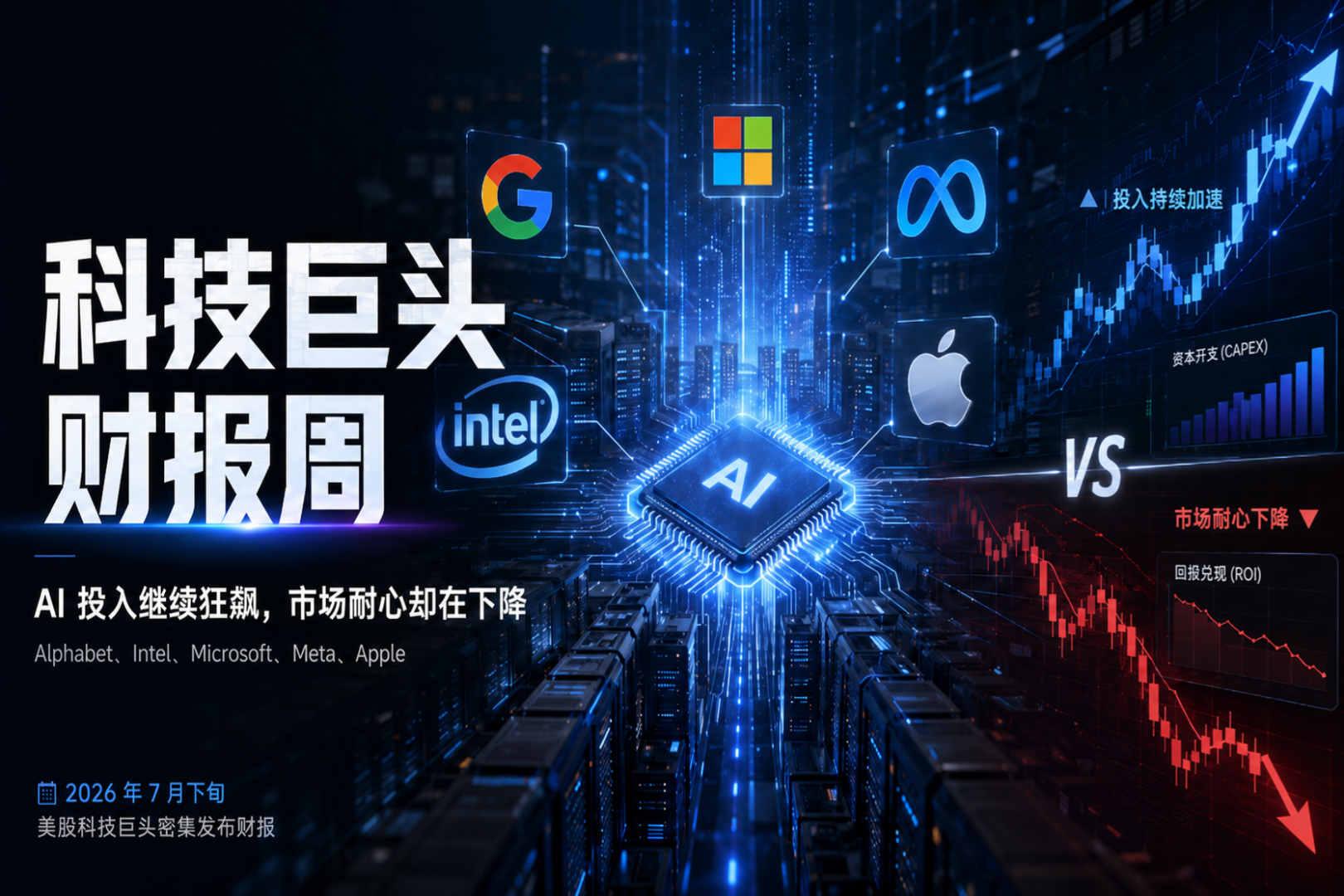
When the Market Begins to Question AI Capex: A Full Analysis of Q2 Earnings Reports from Five Tech Giants

In late July 2026, five major US tech giants—Alphabet, Intel, Microsoft, Meta, and Apple—released their Q2 earnings reports. While all companies exceeded revenue and profit expectations, driven by strong AI-related business growth, investor reactions diverged sharply due to concerns over escalating AI capital expenditures (capex) and their impact on free cash flow. Alphabet reported strong revenue growth and a surging cloud business, but its stock fell after announcing a doubled year-on-year capex and negative quarterly free cash flow for the first time. Intel posted its strongest revenue growth in over 15 years, but its stock experienced volatile trading after significantly raising its full-year capex guidance. Microsoft saw its stock surge after beating estimates and, crucially, lowering its capex forecast while projecting positive free cash flow. Meta faced the most severe sell-off as its profits declined despite revenue beats, with free cash flow plunging over 90% and its capex guidance raised. Apple reported record June-quarter results, but its stock plummeted after providing Q4 revenue guidance that fell short of expectations, citing supply chain constraints and forex headwinds. The overall takeaway is that the market's focus has shifted from validating AI demand to scrutinizing the timeline for returns on massive AI investments. Companies demonstrating a clearer path to managing capex and preserving free cash flow, like Microsoft, were rewarded, while those signaling continued aggressive spending faced investor skepticism.

Odaily星球日报36m ago

When the Market Begins to Question AI Capex: A Full Analysis of Q2 Earnings Reports from Five Tech Giants

Odaily星球日报36m ago

a16z: From Companies to DAOs, DUNA May Become the Next Generation Organizational Form

This article, "From Companies to DAOs: How DUNA Could Become the Next Organizational Form," traces the 500-year evolution of business collaboration. It begins with medieval structures like the *commenda* and Florentine *compagnia*, which exposed partners to personal risk. The modern corporation, exemplified by the Dutch East India Company (VOC), was a revolutionary leap, enabling large-scale, capital-intensive ventures by offering limited liability and reducing coordination costs. However, corporations introduced new challenges like principal-agent problems and bureaucratic overhead. The piece argues that software and internet-native protocols are now reducing these traditional overheads. Decentralized Autonomous Organizations (DAOs) emerged as a new model for coordination without centralized management. Yet, DAOs face a significant legal vacuum: they lack legal recognition, leaving members exposed to unlimited personal liability, and their tokens are vulnerable to being classified as securities under unclear regulations (e.g., the Howey Test). This has forced projects into suboptimal workarounds like offshore foundations. The article identifies the Decentralized Unincorporated Nonprofit Association (DUNA) as a potential solution. Recently legalized in states like Wyoming, the DUNA provides a legal wrapper for decentralized networks. It grants key protections—legal personality, limited liability, and perpetual existence—to a group without imposing a traditional hierarchical management structure. This allows token-holder communities to govern, hold assets, and contract as a single legal entity, aligning with their decentralized nature. While DUNA doesn't solve all governance challenges or magically resolve securities law questions, it represents a crucial step. It fills the legal recognition gap, offering a native legal form for internet-scale, decentralized collaboration and extending the separation of personal risk from organizational venture into a new domain.

marsbit1h ago

a16z: From Companies to DAOs, DUNA May Become the Next Generation Organizational Form

marsbit1h ago

2026 Mid-Year Report On-Chain RWA: Tokenized Stock Market Cap Doubles in a Year, But 90% of Rights Are Hollow Shells

The 2026 Mid-Year Report on On-Chain RWA highlights a significant growth in tokenized stock market capitalization, which nearly doubled from $951 million in March to $1.89 billion by July. However, the report reveals a fundamental contradiction in this "layer 2.5" ecosystem: products with the strongest legal foundation (like regulated U.S. infrastructure) lack liquidity and distribution, while freely tradable offshored wrapper products often lack substantive ownership rights. The increase is driven largely by a few products (SECZ, FGRS, STRCx) and platforms (Ondo, xStocks, Securitize collectively hold over 85% share). While distributed value across networks like Ethereum, Solana, and BNB Chain has grown, the market remains fragmented. Products referencing the same underlying asset (e.g., Apple stock) are distinct legal liabilities with different intermediaries and jurisdictional rules, offering varying degrees of legal claim. The report cautions that headline numbers are misleading, as they reflect changes in distributed token value—driven by issuance, conversions, and price movements—not pure investor inflows. True "canonical shares" with legal ownership, wide wallet distribution, institutional liquidity, and independent on-chain price discovery do not yet exist at scale. Tokenized treasuries show stronger product-market fit, and ETFs may be easier to scale than single stocks. The core takeaway is a trade-off: legal certainty versus liquidity and composability.

marsbit2h ago

2026 Mid-Year Report On-Chain RWA: Tokenized Stock Market Cap Doubles in a Year, But 90% of Rights Are Hollow Shells

marsbit2h ago

Trading

Spot

Hot Articles

What is $BANK

Bank AI: A Revolutionary Step in the Future of Banking Introduction In an era marked by rapid advancements in technology, Bank AI stands at the intersection of artificial intelligence (AI) and banking services. This innovative project seeks to redefine the financial landscape, enhancing operational efficiency, security measures, and customer experiences through the power of AI. As we embark on this exploration of Bank AI, we will delve into what the project entails, its operational dynamics, its historical context, and significant milestones. What is Bank AI? At its core, Bank AI represents a transformative initiative aimed at integrating artificial intelligence into various banking operations. This project harnesses the capabilities of AI to automate processes, improve risk management protocols, and enhance customer interaction through personalized services. The primary objectives of Bank AI include: Automation of Banking Functions: By leveraging AI technologies, Bank AI aims to automate routine tasks, reducing the burden on human resources and enhancing efficiency. Enhanced Risk Management: The project utilises AI algorithms to predict and identify risks, thereby fortifying security measures against fraud and other threats. Personalization of Banking Services: Bank AI focuses on offering tailored financial products and services by analysing customer data and behaviours. Improving Customer Experience: The implementation of AI-driven solutions, such as chatbots and virtual assistants, aims to provide users with more human-like interactions, revolutionising the way customers engage with banks. With these goals, Bank AI positions itself as a crucial player in rendering banking more efficient, secure, and user-centric. Who is the Creator of Bank AI? Details regarding the creator of Bank AI remain unknown. As such, no specific individual or organisation has been identified in the available information. The anonymity surrounding the project's inception raises questions but does not detract from its ambitious vision and objectives. Who are the Investors of Bank AI? Similar to the project's creator, specific information regarding the investors or supporting organisations of Bank AI has not been disclosed. Without this information, it is challenging to outline the financial backing and institutional support that might be propelling the project forward. Nevertheless, the importance of having a robust investment foundation is pivotal for sustaining development in such an innovative field. How Does Bank AI Work? Bank AI operates on several innovative fronts, focusing on unique factors that differentiate it from traditional banking frameworks. Below are key operational features: Automation: By applying machine learning algorithms, Bank AI automates various manual processes within banks. This results in reduced operational costs and allows human workers to redirect their efforts towards more strategic activities. Advanced Risk Management: The integration of AI into risk management practices equips banks with tools to accurately predict potential threats such as fraud, ensuring that customer information and assets remain secure. Tailored Financial Recommendations: Through continuous learning from customer interactions, the AI systems develop a nuanced understanding of user needs, enabling them to offer tailored advice on financial decisions. Enhanced Customer Interactions: Utilizing chatbots and virtual assistants powered by AI, Bank AI enables a more engaging customer experience, allowing users to have their queries resolved quickly, thus reducing wait times and improving satisfaction levels. Together, these operational features position Bank AI as a pioneer in the banking sector, establishing new benchmarks for service delivery and operational excellence. Timeline of Bank AI Understanding the trajectory of Bank AI requires a look at its historical context. Below is a timeline highlighting important milestones and developments: Early 2010s: The conceptualization of AI integration into banking services began to gain attention as banking institutions recognised the potential benefits. 2018: A marked increase in the implementation of AI technologies occurred when banks started using AI tools like chatbots for basic customer service and risk management systems for improved security handling. 2023: The sophistication of AI continued to advance, with generative AI being introduced for more complex tasks such as document processing and real-time investment analysis. This year marked a significant leap in the capabilities afforded to banks by AI technology. 2024-Current Status: As of this year, Bank AI is on an upward trajectory, with ongoing research and developments poised to further enhance capabilities in banking operations. Continued exploration of AI applications hints at exciting developments yet to come. Key Points About Bank AI Integration of AI in Banking: Bank AI focuses on adopting artificial intelligence to streamline banking processes and improve user experiences. Automation and Risk Management Focus: The project strongly emphasizes these areas, aiming to shift the burden of routine tasks while enhancing security frameworks through predictive analytics. Personalized Banking Solutions: By harnessing customer data, Bank AI enables tailored banking services that cater to individual user needs. Commitment to Development: Bank AI remains committed to ongoing research and development efforts, ensuring its adaptability and ongoing relevance as technology continues to evolve. Conclusion In summary, Bank AI exemplifies a crucial step forward in the banking industry, leveraging artificial intelligence to reshape operational paradigms, enhance security, and promote customer satisfaction. Despite gaps in information surrounding the creator and investors, the clear objectives and functional mechanisms of Bank AI provide a strong foundation for its ongoing evolution. As AI technology continues to advance and merge with the banking sector, Bank AI is well-positioned to significantly impact the future of financial services, enhancing the way we understand and interact with banking.

1.5k Total ViewsPublished 2024.04.05Updated 2024.12.03

What is $BANK

How to Buy BANK

Welcome to HTX.com! We've made purchasing Lorenzo Protocol (BANK) simple and convenient. Follow our step-by-step guide to embark on your crypto journey.Step 1: Create Your HTX AccountUse your email or phone number to sign up for a free account on HTX. Experience a hassle-free registration journey and unlock all features.Get My AccountStep 2: Go to Buy Crypto and Choose Your Payment MethodCredit/Debit Card: Use your Visa or Mastercard to buy Lorenzo Protocol (BANK) instantly.Balance: Use funds from your HTX account balance to trade seamlessly.Third Parties: We've added popular payment methods such as Google Pay and Apple Pay to enhance convenience.P2P: Trade directly with other users on HTX.Over-the-Counter (OTC): We offer tailor-made services and competitive exchange rates for traders.Step 3: Store Your Lorenzo Protocol (BANK)After purchasing your Lorenzo Protocol (BANK), store it in your HTX account. Alternatively, you can send it elsewhere via blockchain transfer or use it to trade other cryptocurrencies.Step 4: Trade Lorenzo Protocol (BANK)Easily trade Lorenzo Protocol (BANK) on HTX's spot market. Simply access your account, select your trading pair, execute your trades, and monitor in real-time. We offer a user-friendly experience for both beginners and seasoned traders.

6.0k Total ViewsPublished 2025.05.09Updated 2026.06.02

How to Buy BANK

Discussions

Welcome to the HTX Community. Here, you can stay informed about the latest platform developments and gain access to professional market insights. Users' opinions on the price of BANK (BANK) are presented below.

活动图片